Ripple Global Footprint Expands, Quietly Building A Banking Empire – Here’s Why February 26 Is Important

bitcoinistPublicado a 2026-02-23Actualizado a 2026-02-23

Resumen

Ripple, a leading US payment company, is expanding its global footprint and building a modern digital banking empire through strategic alliances, regulatory approvals, and infrastructure development. Key acquisitions like Metaco and Hidden Road have bolstered its institutional custody, prime brokerage, and treasury infrastructure. A crucial date is February 26, when the SEC is set to announce a decision on a proposed crypto ETF, potentially providing clearer pathways for traditional investors. Meanwhile, investor interest in XRP is surging, with data showing a rapid increase in long positions, indicating growing optimism for a price rebound.

In a significant development that could shape the finance sector, Ripple, a leading American-based payment company, has disclosed its financial ambitions, which signal a growing banking powerhouse. With this move, the firm is extending its global reach in the crypto and financial landscape, reinforcing its modern-day banking infrastructure.

A Bid From Ripple To Reshape Global Banking

Ripple is taking the spotlight after an update about the firm’s latest move that underscores its financial ambitions. The company is progressively growing its global presence and establishing the foundation for what is beginning to seem like a modern digital banking empire.

By forming strategic alliances, gaining regulatory approval, and building infrastructure in important financial areas, the business is putting itself in a position to lead institutional blockchain adoption and cross-border payments. Pumpius, a crypto expert and investor, stated that Ripple is bringing together the full institutional stack in a similar pattern to how banks do it, one regulated component at a time.

The expert has also underlined the firm’s acquisitions in recent years, which tells a story. This is evidenced by the firm’s acquisition of Metaco and Hidden Road. While Metaco gave the firm institutional custody rails, Hidden Road has added prime brokerage-grade execution, financing, and access to real market plumbing. As a result of this, Ripple’s rail plugs into high-volume payment distribution.

While several prices are displayed to the public, some of them are not. However, the trajectory is clear, which is indicated by custody payments, prime brokerage, and treasury infrastructure under one roof. With the inclusion of the OCC Trust bank angle, Ripple is already moving through the United States banking pathway, generating conditional approvals observed among firms in that field.

This is considered the cheat code. Getting involved with the regulated perimeter leads to a barrier to permission, and a company becomes the system that institutions are allowed to use.

As the payment builds a banking stack, February 26 stands as a crucial date in its journey. On the day, the US Securities and Exchange Commission (SEC) is scheduled to announce its decision in a Federal Register proceeding linked to a proposed T Rowe Price crypto Exchange-Traded Fund (ETF). “That is the calendar of when traditional allocators get clearer lanes,” Pumpius added.

Long Positions In XRP Are Heating Up Once Again

With excitement surrounding several updates of Ripple, investors appear to be doubling down on XRP again. Interest in the altcoin has improved over the past few days, as long positions in the leading altcoin are reemerging at a fast rate.

Using data from Binance, the cryptocurrency exchange leader, CW has disclosed a rapid increase in XRP positions from top traders. When investors start to open longs again, it may suggest that they are positioning ahead of a potential bounce.
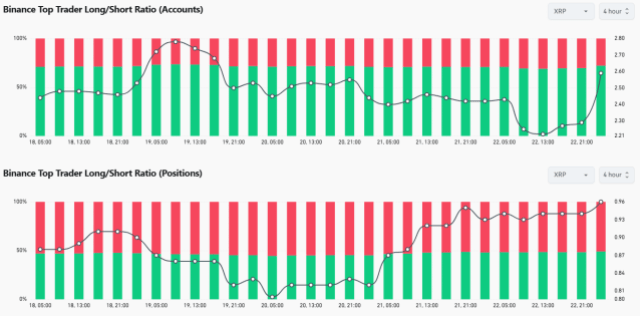
Source: Chart from CW on X

CW noted that these traders were previously positioned heavily on the short side, but the chart shows that they are now becoming neutral. As a result of the renewed conviction, the expert believes that XRP will soon regain the upper hand.

XRP trading at $1.36 on the 1D chart | Source: XRPUSDT on Tradingview.com

Preguntas relacionadas

QWhat is the significance of February 26th for Ripple, according to the article?

AFebruary 26th is the date the US Securities and Exchange Commission (SEC) is scheduled to announce its decision in a Federal Register proceeding linked to a proposed T Rowe Price crypto Exchange-Traded Fund (ETF), which is seen as a crucial moment for traditional allocators to get clearer regulatory lanes.

QWhich two key companies has Ripple acquired to build its institutional infrastructure?

ARipple has acquired Metaco, which provided institutional custody rails, and Hidden Road, which added prime brokerage-grade execution, financing, and access to real market plumbing.

QHow are top traders on Binance positioning themselves regarding XRP, as reported in the article?

AData from Binance shows a rapid increase in long positions for XRP from top traders, indicating they are positioning ahead of a potential price bounce after previously being heavily positioned on the short side.

QWhat strategy is Ripple using to build a modern digital banking empire, as described by the expert Pumpius?

ARipple is building its empire by forming strategic alliances, gaining regulatory approvals, and building infrastructure in key financial areas, bringing together the full institutional stack one regulated component at a time, similar to how traditional banks operate.

QWhat specific advantage does the article say Ripple gains by operating within the regulated perimeter?

AOperating within the regulated perimeter creates a barrier to permission and allows the company to become the system that institutions are officially allowed to use, which is described as 'the cheat code' for success.

Lecturas Relacionadas

Polymarket's "2028 Presidential Election" Volume King Is... LeBron James???

An article from Odaily Planet Daily, authored by Azuma, discusses a peculiar phenomenon observed on the prediction market platform Polymarket regarding the "2028 US Presidential Election" event. Despite having a real-time probability of less than 1%, unlikely candidates such as NBA star LeBron James (with $48.41 million in trading volume), celebrity Kim Kardashian ($33.84 million), and even ineligible figures like Elon Musk ($23.14 million) and New York City Mayor Zohran Mamdani ($18.39 million) account for approximately 70% of the total trading volume. In contrast, high-probability candidates like Vice President JD Vance ($10.58 million), California Governor Gavin Newsom ($15.71 million), and Secretary of State Marco Rubio ($9.32 million) have significantly lower trading activity. The article explains that this counterintuitive trend is not driven by irrational speculation but by rational strategies. Polymarket offers a 4% annualized holding reward for certain markets, including the 2028 election, to maintain long-term pricing accuracy. This yield exceeds the current 5-year US Treasury rate (3.98%), attracting large investors ("whales") to hold "NO" shares on low-probability candidates for risk-free returns. Additionally, some users utilize a platform feature that allows converting a set of "NO" shares into corresponding "YES" shares for better liquidity or pricing efficiency, rather than directly buying "YES" shares for their preferred candidates. Thus, the seemingly absurd trading activity is strategically motivated.

marsbitHace 47 min(s)

Polymarket's "2028 Presidential Election" Volume King Is... LeBron James???

marsbitHace 47 min(s)

Dialogue with ViaBTC CEO Yang Haipo: Is the Essence of Blockchain a Libertarian Experiment?

"ViaBTC CEO Yang Haipo: Blockchain as a Hardcore Libertarian Experiment" In a deep-dive interview, ViaBTC CEO Yang Haipo reframes the essence of blockchain, arguing it is not merely a new technology or infrastructure but a hardcore libertarian experiment. This experiment, born from the 2008 financial crisis and decades of cypherpunk ideology, tests a fundamental question: to what extent can freedom and self-organization exist without centralized trust? The discussion highlights the experiment's verified outcomes. On one hand, it has proven its core value of censorship resistance, providing critical financial lifelines for entities like WikiLeaks and individuals in hyperinflationary or sanctioned countries via tools like stablecoins. However, Yang points out a key paradox: the most successful product, USDT, is itself a centralized compromise, showing users prioritize a less-controlled pipeline over pure decentralization. On the other hand, the experiment has exposed the severe costs of this freedom—a "dark forest" without safeguards. Events like the collapses of LUNA, Celsius, and FTX, resulting in massive wealth destruction and prison sentences for founders, underscore the system's fragility and the inherent risks of an unregulated environment. Yang observes that despite decentralized protocols, human nature inevitably recreates centralized power structures, speculative frenzies, and narrative-driven cycles (from ICOs to Meme coins), where emotion and belonging often trump technological substance. Looking forward, he believes blockchain's future is significant but niche. Its real value lies in serving specific, real-world needs for financial sovereignty and bypassing traditional controls, not as a universal infrastructure replacing all centralized systems. For the average participant, Yang's crucial advice is to cultivate independent judgment. True freedom is not holding a crypto wallet, but possessing a mind resilient to groupthink and narrative hype in a high-risk, often irrational market.

marsbitHace 1 hora(s)

Dialogue with ViaBTC CEO Yang Haipo: Is the Essence of Blockchain a Libertarian Experiment?

marsbitHace 1 hora(s)

Trading

Spot
Futuros
活动图片