Ripple Gains UK Regulatory Approval Ahead Of FCA’s New Crypto Licensing Regime

bitcoinistPublicado a 2026-01-10Actualizado a 2026-01-10

Resumen

Ripple has secured a regulatory approval from the UK’s Financial Conduct Authority (FCA) through its subsidiary Ripple Markets UK Ltd. The company obtained an Electronic Money Institution (EMI) license under the Money Laundering Regulations (MLR), allowing it to provide payment services and issue electronic money. However, the approval comes with restrictions: Ripple cannot operate crypto-fiat automated exchange machines, offer services to retail clients, or issue e-money to consumers without prior written consent from the FCA. This approval aligns with the UK’s broader effort to integrate crypto into its financial framework. The FCA will introduce a new crypto licensing regime under the Financial Services and Markets Act starting September 2026. Ripple and other crypto firms must reapply for authorization under the new rules by October 2027 to continue regulated activities.

In a significant development, Ripple has expanded its footprint in regulated markets after gaining regulatory approval from the UK’s financial authorities to provide payment services.

Ripple Obtains FCA Approval

On Friday, Ripple secured a major regulatory victory in the UK by officially obtaining its registration approval with the Financial Conduct Authority (FCA) through its subsidiary Ripple Markets UK Ltd.

According to the FCA’s official records, the company obtained an Electronic Money Institution (EMI) license under the country’s Money Laundering Regulations (MLR). Therefore, it will be able to conduct certain crypto-related activities in the UK.

The EMI registration will allow Ripple to provide payment services and issue electronic money, according to the FCA website. However, it will remain subject to key restrictions without the financial authority’s approval.

First, “Ripple Markets UK Ltd will not, without the prior written consent of the Authority, provide the following services: 1. The firm will not operate a machine which utilises any automated processes to exchange cryptoassets for money or money for cryptoassets 2. Offer or commence any services to retail clients,” the records read.

In addition, the company cannot appoint any agents or distributors, and “will not issue electronic money, or provide payment services, to a consumer, micro-enterprise or charity.”

Ripple’s regulatory approval comes amid the authorities’ efforts to develop a comprehensive financial services regulation that integrates crypto assets into the existing framework, positioning the UK as a global crypto hub.

As reported by Bitcoinist, the UK Treasury is set to extend existing laws to cover crypto firms, moving exchanges, wallet providers, and other crypto service companies from the current anti-money-laundering registration to the regulatory regime of banks and brokers.

FCA To Start New Registration Regime In September

Ahead of the new rules’ implementation, set to take effect in October 2027, the FCA recently unveiled a timeline for crypto firms to comply with the new registration regime, which could affect Ripple’s recent victory.

On January 8, the financial regulator published a notice informing that it expects to open the application period for crypto firms requesting authorization in September 2026.

Notably, firms seeking to undertake any of the new crypto asset regulated activities will need new approvals to undertake those activities authorized by the FCA under the Financial Services and Markets Act 2000 (FSMA).

Therefore, crypto companies operating in the UK must secure approval or a variation of the existing permission. The FCA emphasized that “firms that are registered with us under the MLRs should note that there will be no automatic conversion and that they will need to secure authorisation by us under FSMA prior to the commencement of the new regime.”

Based on this, Ripple’s UK subsidiary will need to reapply in September to continue conducting regulated crypto activities under the new regime. Firms that apply during the established window are expected to receive a decision before the rules take effect. Nonetheless, companies that have not received approval by October 2027 will be allowed to continue operating until a decision is made.

Meanwhile, companies that miss the application period or are not authorized before the new rules are enacted will enter a “transitional provision.” This will allow them to continue fulfilling existing contracts, but they won’t be able to conduct new regulated crypto activities in the UK until they are authorized.
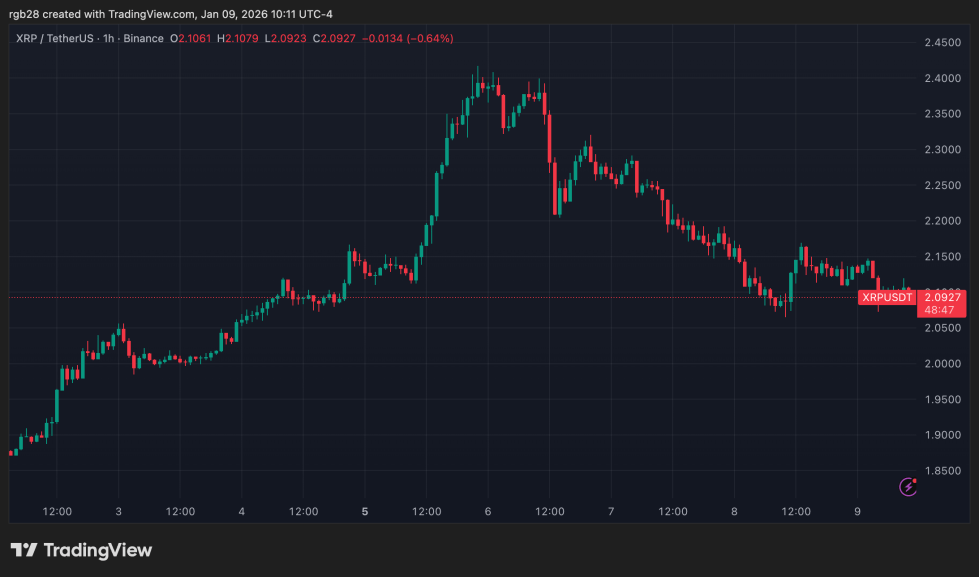
XRP trades at $2.09 in the one-week chart. Source: XRPUSDT on TradingView


Preguntas relacionadas

QWhat type of regulatory approval did Ripple obtain from the UK's Financial Conduct Authority (FCA)?

ARipple obtained an Electronic Money Institution (EMI) license under the UK's Money Laundering Regulations (MLR) through its subsidiary Ripple Markets UK Ltd.

QWhat are the key restrictions placed on Ripple Markets UK Ltd despite the FCA approval?

AThe company cannot operate automated crypto-to-fiat exchange machines, offer services to retail clients, appoint agents or distributors, or issue electronic money or provide payment services to consumers, micro-enterprises, or charities without prior written consent from the FCA.

QWhen will the FCA open the application period for crypto firms seeking authorization under the new regime?

AThe FCA expects to open the application period for crypto firms requesting authorization in September 2026.

QWhat must Ripple's UK subsidiary do to continue conducting regulated crypto activities under the new regime starting October 2027?

ARipple's UK subsidiary will need to reapply for authorization under the Financial Services and Markets Act 2000 (FSMA) in September 2026, as there is no automatic conversion from the current MLR registration.

QWhat happens to crypto companies that are not authorized by the FCA before the new rules take effect in October 2027?

ACompanies not authorized by October 2027 will enter a 'transitional provision' allowing them to fulfill existing contracts but not conduct new regulated crypto activities until they receive authorization.

Lecturas Relacionadas

Understanding Hash in One Article: The "Browser Miner" on Ethereum

Hash is an Ethereum-based ERC-20 token described as a "browser-minable post-quantum token." Its key features include enabling browser-based GPU mining without specialized hardware, a fixed supply cap of 21 million tokens, immutable and permissionless smart contracts with no team allocation or pre-mining, and an emphasis on post-quantum security using Keccak256 hashing. The mining mechanism is a simplified on-chain proof-of-work where miners solve unique challenges tied to their wallet address. Key design elements prevent answer theft, with epochs resetting every 100 blocks (~20 minutes) and a per-block minting limit. Emission follows a Bitcoin-like halving schedule every 100,000 mints, starting at 100 tokens per mint. Projections suggest all tokens could be mined within approximately 294 days if a target rate of one mint per minute is sustained. Hash emphasizes "post-quantum" security by leveraging hash-based primitives like Keccak256, which are considered more resistant to quantum attacks compared to elliptic-curve cryptography. While not a fully post-quantum asset, it aligns with Ethereum's broader post-quantum research narrative. The project completed its Genesis sale at $0.03 and began trading on Uniswap, with its price reaching around $0.19. The initial circulating supply is small, with 5% sold in Genesis and 5% allocated to liquidity. The majority (47.6% of total supply) is allocated to early-stage mining, leading to a front-loaded emission schedule. This structure, combined with low initial liquidity, makes Hash a high-volatility, high-risk project dependent on sustained miner participation and market demand to absorb new supply.

marsbitHace 10 min(s)

Understanding Hash in One Article: The "Browser Miner" on Ethereum

marsbitHace 10 min(s)

OpenAI's Largest Internal Wealth Creation: 600 People Cash Out a Total of $6.6 Billion, 75 Take Home the Maximum $30 Million Each

A Wall Street Journal report reveals OpenAI's unprecedented pre-IPO wealth creation. In a single employee stock sale last October, over 600 current and former employees sold shares, collectively cashing out approximately $6.6 billion. Due to high investor demand, the company tripled the individual sale cap to $30 million, with about 75 employees selling the maximum amount. This event represents the largest such transaction in tech industry history for a private company. OpenAI's valuation was $500 billion for this tender offer. Employees with over two years of tenure were eligible, allowing many post-ChatGPT hires their first liquidity event. The company's stock has reportedly grown over 100-fold in seven years. Following a restructuring, employees collectively hold about 26% of OpenAI. The scale of executive wealth is also staggering. In court testimony related to Elon Musk's lawsuit, President and co-founder Greg Brockman confirmed his OpenAI stake is worth around $30 billion. Analysis indicates about 165 current and former employees hold a combined ~$164.9 billion in equity, averaging nearly $1 billion per person in paper wealth. OpenAI's per-employee stock-based compensation is estimated to be 34 times the average of major tech firms before their IPOs. OpenAI continues its rapid ascent, closing a $122 billion funding round at an $852 billion valuation in March. With monthly revenue hitting $2 billion, over 900 million weekly ChatGPT users, and plans for a potential trillion-dollar IPO in late 2026, this wealth-creation engine shows no signs of stopping.

链捕手Hace 33 min(s)

OpenAI's Largest Internal Wealth Creation: 600 People Cash Out a Total of $6.6 Billion, 75 Take Home the Maximum $30 Million Each

链捕手Hace 33 min(s)

Trading

Spot
Futuros
活动图片




