Ripple CEO Says Epstein File Release Shows ‘They Were Afraid Of Us’

bitcoinistPublicado a 2026-03-09Actualizado a 2026-03-09

Resumen

Ripple CEO Brad Garlinghouse, citing newly released Epstein documents, claims that early industry players were "afraid" of Ripple due to its advanced technology. He referenced a 2014 email from Blockstream co-founder Austin Hill, which criticized investor support for Ripple and Stellar, urging recipients to withdraw allocations. Garlinghouse interprets this as validation of co-founder Chris Larsen's long-held concerns about coordinated opposition. The documents do not show direct Epstein involvement against Ripple but highlight early power struggles in crypto. They also renew scrutiny of Epstein's ties to crypto investors and institutions. Garlinghouse argues this reveals influential figures sought to suppress Ripple, though the files do not prove regulatory coordination. XRP traded at $1.34 at press time.

A resurfaced clip from Ripple CEO Brad Garlinghouse’s appearance at XRP Australia Sydney 2026 is drawing fresh attention after he linked Ripple’s early battles to material in the latest Epstein document release. The comment matters because it reframes Ripple’s long-running grievance in Washington and in crypto itself as something deeper than routine rivalry: a sign, Garlinghouse suggested, that parts of the industry saw Ripple as a real threat.

Speaking on stage in Sydney on Feb. 27, Garlinghouse said Ripple co-founder Chris Larsen had long sounded “a little conspiratorial” about the forces lining up against the company. Then he added:

“Now that we have seen the public Epstein files, you’re like, holy shit, he’s kind of right. And what’s interesting about it, they were afraid of us. They were afraid of us because the technology was ahead of its time and it was a threat. And they were trying to do things to put pressure on it. And again, I don’t think I totally appreciated in the earliest days how prescient some of Chris’s concerns were about that stuff. But in retrospect, it was.”

The Connection Between Ripple And Epstein

The video is only now circulating widely in XRP circles, but the backdrop is the Justice Department’s Jan. 30 release of more than 3 million additional pages under the Epstein Files Transparency Act.

Expert Claims Ripple Is Next to Secure Fed Master Account After Kraken Win— Here’s Why

What, exactly, is the Ripple connection? Not a disclosed business partnership with Epstein, and not evidence that Epstein directed action against Ripple. The link comes from a 2014 email that surfaced in the file dump. Austin Hill, then a Blockstream co-founder, emailed Jeffrey Epstein and Joichi Ito, with Reid Hoffman copied, to complain about investor support for Ripple and Stellar. The email framed those rival projects as harmful to the Bitcoin-focused ecosystem Blockstream was trying to build and pushed recipients to reconsider their allocations.

That distinction is crucial. Ripple appears in the documents because it was part of an early power struggle over which crypto networks and companies would win capital, talent and legitimacy. In one quoted passage from the 2014 correspondence, Hill wrote: “Ripple, and Jed’s new Stellar are bad for the ecosystem we are building, and it does our company damage to have investors who are backing two horses in the same race.” He then reportedly urged investors to “reduce or take your allocation away,” effectively forcing a choice.

The context around Epstein’s presence on that chain is also more mundane, if no less uncomfortable for the industry. Fortune reported that emails in the DOJ release show Epstein had exposure to Blockstream through a fund associated with former MIT Media Lab director Joi Ito, while the broader file dump has renewed scrutiny of Epstein’s ties to early crypto investors, Bitcoin development circles and MIT-linked networks.

That helps explain Garlinghouse’s argument. His point was not that Epstein personally ran an anti-Ripple operation. It was that the newly public records seem to validate a long-held suspicion inside Ripple: that influential figures in the early Bitcoin orbit treated Ripple as something to be boxed out, not merely debated. Still, the released documentation stops well short of proving coordination with regulators or a hidden hand behind the SEC’s later case against Ripple.

At press time, XRP traded at $1.34.
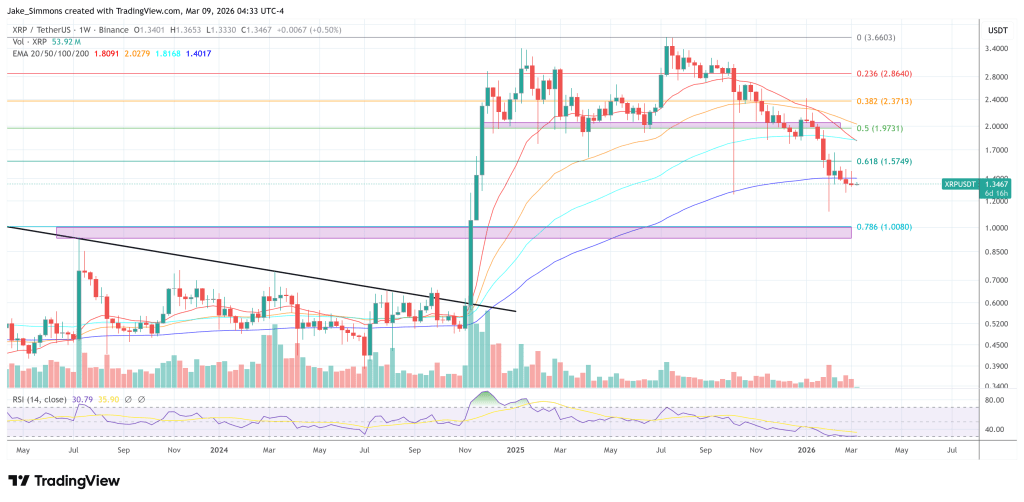
XRP remains below the 200-week EMA, 1-week chart | Source: XRPUSDT on TradingView.com

Criptos en tendencia

Preguntas relacionadas

QWhat did Ripple CEO Brad Garlinghouse claim about the Epstein files in relation to Ripple?

ABrad Garlinghouse claimed that the released Epstein files validated Ripple's long-held suspicion that influential figures in the industry saw Ripple's technology as a threat and were actively trying to suppress it, making co-founder Chris Larsen's earlier concerns appear prescient.

QHow is Ripple connected to the Epstein documents according to the article?

AThe connection comes from a 2014 email in the documents where Blockstream co-founder Austin Hill complained to Jeffrey Epstein and others about investor support for Ripple and Stellar, urging them to withdraw investments as he viewed these projects as harmful to Bitcoin's ecosystem.

QWhat specific action did Austin Hill propose regarding Ripple and Stellar in the revealed email?

AAustin Hill urged investors to 'reduce or take your allocation away' from Ripple and Stellar, effectively forcing them to choose between supporting these projects or the Bitcoin-focused ecosystem Blockstream was building.

QDoes the article suggest Jeffrey Epstein directly targeted Ripple?

ANo, the article clarifies there is no evidence of a direct business partnership with Epstein or that he directed action against Ripple. The connection is through email correspondence showing industry figures discussing Ripple as a competitive threat.

QWhat was the price of XRP at the time the article was published?

AAt press time, XRP traded at $1.34.

Lecturas Relacionadas

Who Decides the Rules of Bitcoin? BIP-110 Ignites Governance Debate

Bitcoin's governance is once again at the center of a heated debate, this time ignited by BIP-110, the "Reduced Data Temporary Softfork." This proposal aims to curb non-monetary data (like inscriptions and Runes) by introducing seven new consensus-layer restrictions over a year, such as limiting new output scripts to 34 bytes and restoring the OP_RETURN cap to 83 bytes. The controversy stems from BIP-110's fundamental shift: it moves the battle against "spam" from node relay and miner policies to the consensus layer, rendering currently valid transactions invalid. Supporters, arguing that default policy governance has failed (highlighted by Bitcoin Core v30's relaxation of OP_RETURN limits), see this as necessary to protect node resources and Bitcoin's monetary focus. Opponents, led by figures like Michael Saylor and Adam Back, warn it dangerously centralizes governance. Saylor listed 110 reasons against it, criticizing its low 55% miner activation threshold and potential for chain splits. Back emphasized Bitcoin's "permissionless" ethos, arguing no single group should impose value judgments via consensus rules. Further complicating matters, technical critiques suggest BIP-110 may be technically circumventable, and a "BlockSlop" vulnerability in its upgrade path poses a consensus risk. The debate has drawn in diverse stakeholders: miners (with pools like Ocean signaling support and Foundry polling clients), node operators (like Bitcoin Knots), and new players like corporate treasury holder MicroStrategy (Saylor), whose market influence adds a novel dimension. Ultimately, BIP-110 acts as a governance stress test, exposing the unresolved question: who decides Bitcoin's rules? It pits the authority of miners, node operators, developers, and capital holders against each other, with each side claiming to defend Bitcoin's core principles of neutrality and security.

marsbitHace 12 min(s)

Who Decides the Rules of Bitcoin? BIP-110 Ignites Governance Debate

marsbitHace 12 min(s)

Who Decides Bitcoin's Rules? BIP-110 Ignites Governance Debate

Title: Who Decides Bitcoin's Rules? BIP-110 Ignites Governance Debate A new technical proposal, BIP-110 (Reduced Data Temporary Softfork), has sparked a fundamental governance debate within the Bitcoin community. It aims to impose new consensus rules for one year to limit non-financial data (like inscriptions and Runes) on-chain, moving beyond simple node and miner policy filters to invalidate currently valid transactions. Supporters argue that default policies have failed due to workarounds, necessitating consensus-layer changes to protect Bitcoin's core monetary function from data spam. Critics, including Michael Saylor and Adam Back, contend this dangerously centralizes judgment, undermines permissionlessness, and sets a risky governance precedent. They advocate for market-based solutions like fees or Layer 2s instead. The debate exposes deeper tensions: miners are divided on activation; node operators assert their sovereignty; Bitcoin Core developers influence defaults without direct accountability; and large corporate holders like MicroStrategy now wield narrative influence. Technically, BIP-110 may not fully block data and carries a disclosed consensus bug risk. Ultimately, BIP-110 acts as a stress test, forcing the community to confront the unresolved question: who legitimately decides what Bitcoin is and how it evolves, amidst competing claims from miners, nodes, developers, and capital holders.

链捕手Hace 24 min(s)

Who Decides Bitcoin's Rules? BIP-110 Ignites Governance Debate

链捕手Hace 24 min(s)

Zcash's New Node Zakura Goes Live: Privacy Payments Can Reach 50,000 TPS, Aiming to Rival Visa and Mastercard

Zcash, a privacy-focused cryptocurrency, has launched a new full node software called Zakura version 1.0.0. Developed by Zcash co-founder Sean Bowe and Dev Ojha, with private ZEC donations, its goal is to enable Zcash to process over 50,000 transactions per second (TPS)—matching the scale of Visa and Mastercard—while maintaining full transaction privacy and verifiability. This addresses a key bottleneck, as Zcash currently handles only about 1 private transaction per second. Zakura is a fork of the Zcash Foundation's Zebra node. It features chain pruning and snapshots, reducing disk usage and allowing new nodes to sync in under two minutes. It also offers compatibility with the legacy `zcashd` client interface. The scalability challenge stems from the large data size of privacy proofs. Bowe's Tachyon project aims to use recursive proofs to reduce consensus-layer data needs from ~500 MB/s to ~100 MB/s. For wallet scalability, Valar Group is researching Private Information Retrieval (PIR) tech to allow wallets to fetch their data privately. Zakura supports fast block propagation and the upcoming "Ironwood" network upgrade (NU6.3), scheduled for activation around July 28th. Ironwood was created to contain a critical inflation bug discovered in the Orchard shielded pool in May 2024. The fix uses "turnstiles" to trap any counterfeit ZEC created during the vulnerability period within the shielded pool, preventing it from entering circulation and restoring supply integrity.

marsbitHace 39 min(s)

Zcash's New Node Zakura Goes Live: Privacy Payments Can Reach 50,000 TPS, Aiming to Rival Visa and Mastercard

marsbitHace 39 min(s)

Replicating the "DeepSeek Moment"? Wall Street Unanimously Says: Kimi K3 Instead Strengthens Computing Power Demand

Title: Wall Street Sees Kimi K3 as a Catalyst for Compute Demand, Not a "DeepSeek Moment 2.0" Summary: Following the release of Moonshot AI's powerful open-source model Kimi K3, initial market reaction mirrored the "DeepSeek moment" that sparked a sell-off in compute stocks earlier in 2025, fearing reduced demand for AI infrastructure. However, major Wall Street banks including UBS, Nomura, BofA, and Citi argue the opposite: K3 will accelerate, not weaken, demand for compute, memory, storage, and networking. Their analysis centers on K3's specifications—2.8 trillion parameters, 1M token context, and MoE architecture—which represent a "scale" story rather than a pure "efficiency" one like DeepSeek R1. These features increase pressure on inference, memory (especially KV cache), and storage. Analysts invoke Jevons Paradox: as high-quality models become more affordable (K3 is cheaper than top closed models but not the cheapest), usage and token volumes expand, ultimately increasing total compute consumption. The reports highlight that competition will force leading US AI labs (OpenAI, Anthropic, Google) to invest more in training and iteration to maintain their edge. Furthermore, the rise of capable open-source models like K3 is expanding the global AI developer ecosystem, with Chinese models now accounting for over 45% of developer traffic. Key beneficiaries identified across the AI infrastructure chain include memory/storage players (e.g., Micron, Samsung), compute leaders (Nvidia, TSMC), networking suppliers (due to "super-node" cluster needs for deploying K3), and cloud platforms (e.g., Alibaba) that host diverse model ecosystems. The consensus is that stronger open-source models are an entry point for the next wave of infrastructure demand diffusion, provided workload growth outpaces efficiency gains.

链捕手Hace 42 min(s)

Replicating the "DeepSeek Moment"? Wall Street Unanimously Says: Kimi K3 Instead Strengthens Computing Power Demand

链捕手Hace 42 min(s)

Trading

Spot

Artículos destacados

Qué es XRP 2.0

XRP 2.0: Una Nueva Frontera en el Panorama de las Criptomonedas Introducción a XRP 2.0 En el siempre cambiante ámbito de las criptomonedas, nuevos proyectos surgen continuamente, compitiendo por atención y adopción. Una de estas iniciativas prometedoras es XRP 2.0, un nuevo proyecto de criptomoneda diseñado para aprovechar la tecnología blockchain avanzada y metodologías de encriptación robustas. Aunque el nombre establece paralelismos con el XRP de Ripple, es crucial señalar que XRP 2.0 opera de manera independiente, enfocándose en mejorar la seguridad de las transacciones, la privacidad y la escalabilidad. A medida que el panorama financiero digital abraza cada vez más soluciones descentralizadas, XRP 2.0 busca contribuir de manera significativa a web3 y a la expansión general de los proyectos de criptomonedas. ¿Qué es XRP 2.0? En esencia, XRP 2.0 es un proyecto de criptomoneda que busca crear un ecosistema de moneda digital seguro y descentralizado. Su tecnología fundamental integra principios avanzados de blockchain con técnicas de encriptación de vanguardia. El objetivo principal de XRP 2.0 es establecerse como una plataforma confiable y eficiente que permita la ejecución rápida de transacciones mientras prioriza la protección de la privacidad de sus usuarios. El proyecto se promociona como una solución a muchas limitaciones enfrentadas por las criptomonedas existentes, proponiendo un sistema que puede manejar un mayor volumen de transacciones con mejor velocidad y privacidad. Esta versatilidad posiciona a XRP 2.0 como un competidor significativo en un mercado plagado de diversas monedas digitales. ¿Quién es el Creador de XRP 2.0? La identidad del creador detrás de XRP 2.0 ha sido señalada como 'Wilbur.' Sin embargo, los detalles completos sobre Wilbur o su entidad asociada siguen siendo elusivos. La anonimidad de muchos creadores de criptomonedas no es un fenómeno poco común en la industria, a menudo diseñado para mantener un grado de privacidad y seguridad. ¿Quiénes son los Inversores de XRP 2.0? Hasta ahora, la información específica relacionada con las fundaciones o organizaciones de inversión que apoyan a XRP 2.0 no está disponible públicamente. En el sector de las criptomonedas, el respaldo de inversores respetables puede influir significativamente en la credibilidad y el éxito de un proyecto, sin embargo, la transparencia sobre los patrocinadores financieros de XRP 2.0 no se ha establecido. ¿Cómo Funciona XRP 2.0? XRP 2.0 se destaca al emplear una combinación de tecnología blockchain y algoritmos de encriptación avanzados que aseguran transacciones seguras y descentralizadas. Su estructura innovadora incluye características únicas diseñadas para fomentar el compromiso del usuario y ampliar las funcionalidades más allá de las transacciones convencionales de criptomonedas. Entre estas características, XRP 2.0 incorpora capacidades impulsadas por IA, como funcionalidades de texto a imagen y de texto a voz. Estas adiciones están diseñadas para mejorar la experiencia interactiva de los usuarios, promoviendo una mayor aplicabilidad en diversos sectores. Al unir avances tecnológicos con un diseño centrado en el usuario, XRP 2.0 busca captar la atención de una amplia gama de individuos y empresas que buscan integrar soluciones de criptomonedas en sus marcos operativos. Cronología de XRP 2.0 Entender XRP 2.0 requiere examinar los hitos que han definido su viaje hasta ahora: 23 de julio de 2023: Se presenta XRP 2.0 como un nuevo proyecto de criptomonedas, con el objetivo de revolucionar las capacidades de transacciones seguras y descentralizadas en el ámbito de blockchain. 8 de septiembre de 2023: Se lanza otro proyecto, XRP20, marcando la aparición de un token ERC-20 en la blockchain de Ethereum que no guarda relación con XRP 2.0. 13 de noviembre de 2023: El Libro Mayor de XRP experimenta una actualización significativa con el lanzamiento de la versión 2.0.0 del software del servidor rippled. Es esencial señalar que este desarrollo está desconectado del proyecto de criptomonedas XRP 2.0. Puntos Clave sobre XRP 2.0 Para destilar la esencia de XRP 2.0, surgen varios factores críticos: Características Únicas: La inclusión de características como texto a imagen y texto a voz impulsadas por IA diversifica aún más las aplicaciones potenciales de XRP 2.0. Tecnología Blockchain: El marco utiliza mecanismos avanzados de blockchain y protocolos de encriptación, asegurando un entorno seguro y descentralizado para las transacciones. Escalabilidad y Privacidad: XRP 2.0 prioriza la protección mejorada de la privacidad en los procesos de transacción y la escalabilidad necesaria para acomodar una base de usuarios creciente. No Afiliación con Ripple: Es importante destacar que, a pesar de su nombre, XRP 2.0 no tiene ninguna lealtad ni colaboración con el XRP de Ripple, diferenciando su marco operativo y objetivos dentro del ecosistema de criptomonedas. Conclusión XRP 2.0 representa una ambiciosa aventura en la esfera de las criptomonedas, buscando ofrecer una combinación de seguridad, privacidad y eficiencia en las transacciones digitales. Al integrar tecnologías sofisticadas y características amigables para el usuario, el proyecto se propone ampliar los horizontes de lo que la criptomoneda puede lograr en la economía digital de hoy. Si bien la anonimidad de su creador y la falta de inversores revelados pueden generar cuestionamientos para algunos, el enfoque de XRP 2.0 en funcionalidades avanzadas y descentralización realza su atractivo en un mercado de criptomonedas cada vez más abarrotado. A medida que el paisaje de las criptomonedas sigue evolucionando, XRP 2.0 podría emerger como un jugador crucial en la expansión de soluciones blockchain seguras y escalables.

223 Vistas totalesPublicado en 2024.04.05Actualizado en 2024.12.03

Qué es XRP 2.0

Cómo comprar XRP

¡Bienvenido a HTX.com! Hemos hecho que comprar XRP (XRP) sea simple y conveniente. Sigue nuestra guía paso a paso para iniciar tu viaje de criptos.Paso 1: crea tu cuenta HTXUtiliza tu correo electrónico o número de teléfono para registrarte y obtener una cuenta gratuita en HTX. Experimenta un proceso de registro sin complicaciones y desbloquea todas las funciones.Obtener mi cuentaPaso 2: ve a Comprar cripto y elige tu método de pagoTarjeta de crédito/débito: usa tu Visa o Mastercard para comprar XRP (XRP) al instante.Saldo: utiliza fondos del saldo de tu cuenta HTX para tradear sin problemas.Terceros: hemos agregado métodos de pago populares como Google Pay y Apple Pay para mejorar la comodidad.P2P: tradear directamente con otros usuarios en HTX.Over-the-Counter (OTC): ofrecemos servicios personalizados y tipos de cambio competitivos para los traders.Paso 3: guarda tu XRP (XRP)Después de comprar tu XRP (XRP), guárdalo en tu cuenta HTX. Alternativamente, puedes enviarlo a otro lugar mediante transferencia blockchain o utilizarlo para tradear otras criptomonedas.Paso 4: tradear XRP (XRP)Tradear fácilmente con XRP (XRP) en HTX's mercado spot. Simplemente accede a tu cuenta, selecciona tu par de trading, ejecuta tus trades y monitorea en tiempo real. Ofrecemos una experiencia fácil de usar tanto para principiantes como para traders experimentados.

1.5k Vistas totalesPublicado en 2024.12.10Actualizado en 2026.06.02

Cómo comprar XRP

Discusiones

Bienvenido a la comunidad de HTX. Aquí puedes mantenerte informado sobre los últimos desarrollos de la plataforma y acceder a análisis profesionales del mercado. A continuación se presentan las opiniones de los usuarios sobre el precio de XRP (XRP).

活动图片