Ripple Advances Zero-Knowledge Proofs For The XRP Ledger

bitcoinistPublicado a 2026-01-20Actualizado a 2026-01-20

Resumen

RippleX, the development arm of Ripple, is actively prototyping zero-knowledge proof (ZKP) capabilities for the XRP Ledger (XRPL). According to Aanchal Malhotra, Head of Research at RippleX, this initiative aims to introduce "programmable privacy," trust-minimized interoperability, and a scaling model that offloads heavy computation to layer-2 systems while XRPL remains the settlement layer. Malhotra emphasized that integrating ZKPs into XRPL is complex and requires custom development rather than using off-the-shelf solutions. The approach involves a hybrid implementation—some components native for performance, others in a programmability layer for developer choice. Key benefits include selective disclosure for compliance (e.g., proving age without revealing exact data), reducing reliance on trusted intermediaries in cross-chain bridges, and scaling via succinct proof verification on-chain. The goal is to enhance XRPL’s competitiveness without compromising on flexibility or security.

RippleX, the developer arm of Ripple, is prototyping zero-knowledge proof (ZKP) capabilities for the XRP Ledger (XRPL), positioning the technology as a route to “programmable privacy,” trust-minimized interoperability, and a scaling model that pushes heavy computation to layer-2 systems while keeping XRPL as the settlement layer.

In Episode 9 of Ripple’s “Onchain Economy” video series, Aanchal Malhotra, Ph.D., Head of Research at RippleX, framed ZK enablement as a near-term research priority and a long-horizon bet on XRPL’s competitiveness. “I would really like to see an XRP ledger with zero knowledge proof technology enabled. There are so many use cases. There are so many innovative applications that we can build using this technology. So my number one priority right now is to work on enabling zero knowledge proofs on XRP ledger,” Malhotra said.

What Ripple Is Planning With ZK-Proofs

Malhotra also stressed that integrating modern ZK systems into XRPL is not a simple plug-in exercise. “We are getting past the exploration phase of zero knowledge technologies. When the XRP ledger was built, these technologies were not even around. So it takes a while. We cannot just use any off-the-shelf solution. It takes a while for us to figure out the specifics of ZK technology to integrate with XRP ledger,” she said, describing the work as moving from exploratory research into prototyping.

That prototyping effort, according to RippleX’s Head of Research, is taking a hybrid form. Some components of ZK proofs would be implemented “natively for better performance,” while another portion would sit in a “programmability layer” to let developers choose proving systems and build applications tuned to their requirements.

The goal, she indicated, is a design that balances throughput and developer flexibility rather than forcing a single ZK stack across all use cases. “We are at the stage of prototyping zero knowledge proof,” Malhotra said, adding that the approach is intended to support “different applications [and] different proving systems.”

Much of Malhotra’s framing centered on privacy, specifically, a version that can satisfy compliance and business constraints without collapsing into blanket opacity. “In my opinion, zero knowledge proofs is a very very powerful tool. When we talk about privacy, people think about 100% privacy where everything is hidden [...] and those things could be used in nefarious ways,” she said.

“However, what blockchains enable is something called programmable privacy [...] you can do selective disclosure meaning disclose the relevant information to third parties for example auditors for compliance purposes.” In her example, a user could prove they are above a threshold, such as being over 18, without revealing the underlying data like an exact age.

Malhotra also pointed to interoperability as a domain where ZK techniques could reduce reliance on trusted intermediaries. She characterized bridges as “fraught with technical challenges,” with trust being the biggest: today’s designs often depend on third parties, federators, or other centralized structures. “What zero knowledge proofs provide is trustlessness. It provides verifiability. So you do not have to trust a third party. Instead what you trust in is cryptography,” she said.

On scaling, Malhotra described a model where ZK proofs help compress or externalize execution: layer-2 systems perform computation, then submit succinct proofs that can be verified on XRPL. That, in her telling, lets the base layer focus on settlement and proof verification rather than running every workload directly. The practical implication is an architecture where XRPL could support more complex applications without forcing all computation onto the L1.

At press time, XRP traded at $1.976.
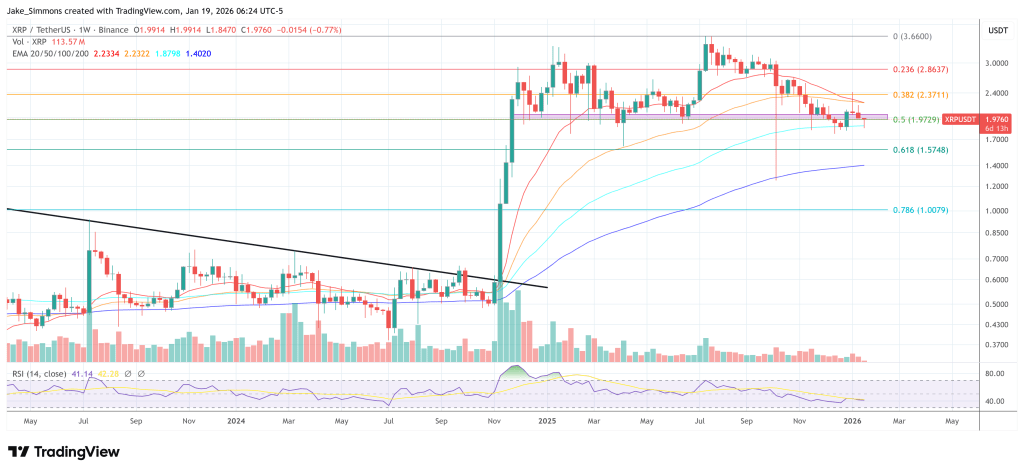
XRP falls into the red support zone, 1-week chart | Source: XRPUSDT on TradingView.com

Preguntas relacionadas

QWhat is RippleX's main research priority according to Aanchal Malhotra?

AAanchal Malhotra stated that her number one priority is enabling zero-knowledge proof technology on the XRP Ledger to support innovative applications and use cases.

QHow does Ripple plan to implement zero-knowledge proofs on the XRP Ledger?

ARipple is taking a hybrid approach: some ZKP components will be implemented natively for performance, while others will reside in a programmability layer to allow developers to choose proving systems and build customized applications.

QWhat is 'programmable privacy' as described by Malhotra?

AProgrammable privacy refers to selective disclosure capabilities where users can prove specific information (e.g., being over 18) without revealing underlying data (e.g., exact age), enabling compliance with auditors while maintaining privacy.

QHow can zero-knowledge proofs improve interoperability according to the article?

AZK proofs can reduce reliance on trusted intermediaries in bridges by providing verifiability through cryptography instead of third parties, federators, or centralized structures.

QWhat scaling model does Ripple envision using ZK proofs for the XRP Ledger?

ARipple envisions a model where layer-2 systems perform heavy computations and submit succinct proofs for verification on the XRPL base layer, allowing XRPL to focus on settlement and proof verification rather than executing all workloads directly.

Lecturas Relacionadas

The Macroeconomic Underpinnings of Africa's Payment Market Landscape

The African payments market, characterized by the world's highest mobile money penetration and fastest-growing cryptocurrency adoption, is not a coincidence but a macroeconomic necessity driven by deep structural factors. Two key drivers create this landscape: (1) Africa's heavy reliance on commodity exports, trade, and remittances, generating massive cross-border settlement and remittance demand; and (2) chronically underdeveloped financial infrastructure, exacerbated by international bank de-risking, foreign exchange mismanagement, and persistent inflation. This vacuum has allowed mobile money and crypto to thrive. Mobile money platforms replace banks for domestic payments, while cryptocurrencies serve as a store of value against local currency depreciation and a low-cost medium for cross-border exchange. A crucial division lies along the Sahara Desert. North Africa is integrated into the oil-anchored MENA framework, while Sub-Saharan Africa (SSA), plagued by dollar shortages and fragmented currencies, has become a natural, massive market for mobile money and crypto. Nigeria, Kenya, and South Africa are global leaders in adoption. The SSA economy is deeply dollarized due to currency instability, yet suffers from a severe "dollar shortage" caused by trade deficits and limited export capacity. This creates parallel forex markets and high remittance costs. Cryptocurrencies, particularly stablecoins, fill this gap by providing access to dollar liquidity, cheaper cross-border transfers, and an inflation-resistant store of value, primarily driven by retail users for small-value transactions. While regional initiatives like PAPSS aim to reduce dollar dependence, the fundamental constraints of commodity reliance, trade imbalances, and shallow financial markets persist. Therefore, mobile money and cryptocurrencies are not niche trends but essential financial infrastructure filling a structural void, and they are likely to remain central to Africa's economic landscape for the foreseeable future.

链捕手Hace 9 min(s)

The Macroeconomic Underpinnings of Africa's Payment Market Landscape

链捕手Hace 9 min(s)

Is the Sharp Decline Over? Let the Data Speak

**Has the Sharp Decline Ended? Let Data Speak** Bitcoin's recent significant drop has placed short sellers in a precarious position. Three concurrent pressures—sustained outflows from ETFs, miners offloading coins to exchanges, and short-term holders capitulating—pushed the price near $63k. The asset fell 13% this week and 21% this month, roughly halving from its all-time high. A critical data point is the extremely crowded short positioning, with a short-to-long ratio reaching 8:1, representing nearly $100 billion in short interest overhead. This creates conditions for a potential short squeeze if selling pressure merely pauses, similar to the event in November 2022 which triggered a 24% rally. The selling pressures are real: spot Bitcoin ETFs have seen a record $5.4 billion outflow over 20 days. Short-term holders moved 53k loss-held BTC to exchanges in a day, and miners sent 24k BTC to Binance, a six-month high. Capital is also rotating towards AI and tech stocks like SpaceX, with $400 billion invested in AI infrastructure recently. However, on-chain data shows accumulation by long-term holders, who added 200k BTC in a month, and institutions/miners have absorbed 1.24 million BTC since 2023. This indicates strong buying beneath the surface. Key levels to watch are the $67k-$70k zone (2021 high & 2024 breakout point). A swift recovery above it suggests a leverage washout; failure could test $60k-$55k. The direction also hinges on ETF flow reversal. Currently, the S&P 500 hits new highs driven by AI, while Bitcoin and DeFi (TVL down from $173b to $73.9b) lag. The most probable path is a grinding basing process between $60k-$58k with continued ETF outflows. A less likely but explosive scenario involves a sudden flow reversal, a surge above $70k triggering a short squeeze, and a rally back above $76k. The immediate trigger depends on when the relentless selling pauses. A final cautionary note questions Bitcoin's correlation: if the high-flying U.S. stock market corrects, will Bitcoin once again miss the rally but not the decline?

foresightnews_apiHace 24 min(s)

Is the Sharp Decline Over? Let the Data Speak

foresightnews_apiHace 24 min(s)

Single-Day Plunge of 30%, Arthur Hayes Suddenly Liquidates: Why Did ZEC Get Exploded by Security Issues?

On June 5th, Zcash founder Zooko Wilcox disclosed a critical soundness vulnerability in the project's latest Orchard privacy pool. This flaw, found in the elliptic curve multiplication constraints, could allow an attacker to create unlimited counterfeit ZEC within the shielded pool, with transactions appearing valid. The vulnerability was discovered in late May by security researcher Taylor Hornby, who utilized Anthropic's new Opus 4.8 AI model for a targeted audit. The Zcash ecosystem had already performed an emergency network upgrade to patch the issue. However, the detailed disclosure triggered severe market panic, causing ZEC's price to plummet over 30% in a single day. Notably, prominent investor Arthur Hayes announced he had sold his entire ZEC position following the news. The incident starkly challenges the "technological trust" narrative central to privacy coins. Despite years of top-tier cryptographic audits, the bug persisted until uncovered with advanced AI-assisted research. This highlights the growing gap between theoretical perfection and practical implementation in privacy technology. The event serves as a industry-wide warning: in an AI-driven security landscape, the assumption that "undiscovered equals safe" is obsolete. It underscores the urgent need for continuous, proactive security practices combining AI audits, formal verification, and rapid response mechanisms.

foresightnews_apiHace 1 hora(s)

Single-Day Plunge of 30%, Arthur Hayes Suddenly Liquidates: Why Did ZEC Get Exploded by Security Issues?

foresightnews_apiHace 1 hora(s)

Trading

Spot
Futuros

Artículos destacados

Qué es XRP 2.0

XRP 2.0: Una Nueva Frontera en el Panorama de las Criptomonedas Introducción a XRP 2.0 En el siempre cambiante ámbito de las criptomonedas, nuevos proyectos surgen continuamente, compitiendo por atención y adopción. Una de estas iniciativas prometedoras es XRP 2.0, un nuevo proyecto de criptomoneda diseñado para aprovechar la tecnología blockchain avanzada y metodologías de encriptación robustas. Aunque el nombre establece paralelismos con el XRP de Ripple, es crucial señalar que XRP 2.0 opera de manera independiente, enfocándose en mejorar la seguridad de las transacciones, la privacidad y la escalabilidad. A medida que el panorama financiero digital abraza cada vez más soluciones descentralizadas, XRP 2.0 busca contribuir de manera significativa a web3 y a la expansión general de los proyectos de criptomonedas. ¿Qué es XRP 2.0? En esencia, XRP 2.0 es un proyecto de criptomoneda que busca crear un ecosistema de moneda digital seguro y descentralizado. Su tecnología fundamental integra principios avanzados de blockchain con técnicas de encriptación de vanguardia. El objetivo principal de XRP 2.0 es establecerse como una plataforma confiable y eficiente que permita la ejecución rápida de transacciones mientras prioriza la protección de la privacidad de sus usuarios. El proyecto se promociona como una solución a muchas limitaciones enfrentadas por las criptomonedas existentes, proponiendo un sistema que puede manejar un mayor volumen de transacciones con mejor velocidad y privacidad. Esta versatilidad posiciona a XRP 2.0 como un competidor significativo en un mercado plagado de diversas monedas digitales. ¿Quién es el Creador de XRP 2.0? La identidad del creador detrás de XRP 2.0 ha sido señalada como 'Wilbur.' Sin embargo, los detalles completos sobre Wilbur o su entidad asociada siguen siendo elusivos. La anonimidad de muchos creadores de criptomonedas no es un fenómeno poco común en la industria, a menudo diseñado para mantener un grado de privacidad y seguridad. ¿Quiénes son los Inversores de XRP 2.0? Hasta ahora, la información específica relacionada con las fundaciones o organizaciones de inversión que apoyan a XRP 2.0 no está disponible públicamente. En el sector de las criptomonedas, el respaldo de inversores respetables puede influir significativamente en la credibilidad y el éxito de un proyecto, sin embargo, la transparencia sobre los patrocinadores financieros de XRP 2.0 no se ha establecido. ¿Cómo Funciona XRP 2.0? XRP 2.0 se destaca al emplear una combinación de tecnología blockchain y algoritmos de encriptación avanzados que aseguran transacciones seguras y descentralizadas. Su estructura innovadora incluye características únicas diseñadas para fomentar el compromiso del usuario y ampliar las funcionalidades más allá de las transacciones convencionales de criptomonedas. Entre estas características, XRP 2.0 incorpora capacidades impulsadas por IA, como funcionalidades de texto a imagen y de texto a voz. Estas adiciones están diseñadas para mejorar la experiencia interactiva de los usuarios, promoviendo una mayor aplicabilidad en diversos sectores. Al unir avances tecnológicos con un diseño centrado en el usuario, XRP 2.0 busca captar la atención de una amplia gama de individuos y empresas que buscan integrar soluciones de criptomonedas en sus marcos operativos. Cronología de XRP 2.0 Entender XRP 2.0 requiere examinar los hitos que han definido su viaje hasta ahora: 23 de julio de 2023: Se presenta XRP 2.0 como un nuevo proyecto de criptomonedas, con el objetivo de revolucionar las capacidades de transacciones seguras y descentralizadas en el ámbito de blockchain. 8 de septiembre de 2023: Se lanza otro proyecto, XRP20, marcando la aparición de un token ERC-20 en la blockchain de Ethereum que no guarda relación con XRP 2.0. 13 de noviembre de 2023: El Libro Mayor de XRP experimenta una actualización significativa con el lanzamiento de la versión 2.0.0 del software del servidor rippled. Es esencial señalar que este desarrollo está desconectado del proyecto de criptomonedas XRP 2.0. Puntos Clave sobre XRP 2.0 Para destilar la esencia de XRP 2.0, surgen varios factores críticos: Características Únicas: La inclusión de características como texto a imagen y texto a voz impulsadas por IA diversifica aún más las aplicaciones potenciales de XRP 2.0. Tecnología Blockchain: El marco utiliza mecanismos avanzados de blockchain y protocolos de encriptación, asegurando un entorno seguro y descentralizado para las transacciones. Escalabilidad y Privacidad: XRP 2.0 prioriza la protección mejorada de la privacidad en los procesos de transacción y la escalabilidad necesaria para acomodar una base de usuarios creciente. No Afiliación con Ripple: Es importante destacar que, a pesar de su nombre, XRP 2.0 no tiene ninguna lealtad ni colaboración con el XRP de Ripple, diferenciando su marco operativo y objetivos dentro del ecosistema de criptomonedas. Conclusión XRP 2.0 representa una ambiciosa aventura en la esfera de las criptomonedas, buscando ofrecer una combinación de seguridad, privacidad y eficiencia en las transacciones digitales. Al integrar tecnologías sofisticadas y características amigables para el usuario, el proyecto se propone ampliar los horizontes de lo que la criptomoneda puede lograr en la economía digital de hoy. Si bien la anonimidad de su creador y la falta de inversores revelados pueden generar cuestionamientos para algunos, el enfoque de XRP 2.0 en funcionalidades avanzadas y descentralización realza su atractivo en un mercado de criptomonedas cada vez más abarrotado. A medida que el paisaje de las criptomonedas sigue evolucionando, XRP 2.0 podría emerger como un jugador crucial en la expansión de soluciones blockchain seguras y escalables.

174 Vistas totalesPublicado en 2024.04.05Actualizado en 2024.12.03

Qué es XRP 2.0

Cómo comprar XRP

¡Bienvenido a HTX.com! Hemos hecho que comprar XRP (XRP) sea simple y conveniente. Sigue nuestra guía paso a paso para iniciar tu viaje de criptos.Paso 1: crea tu cuenta HTXUtiliza tu correo electrónico o número de teléfono para registrarte y obtener una cuenta gratuita en HTX. Experimenta un proceso de registro sin complicaciones y desbloquea todas las funciones.Obtener mi cuentaPaso 2: ve a Comprar cripto y elige tu método de pagoTarjeta de crédito/débito: usa tu Visa o Mastercard para comprar XRP (XRP) al instante.Saldo: utiliza fondos del saldo de tu cuenta HTX para tradear sin problemas.Terceros: hemos agregado métodos de pago populares como Google Pay y Apple Pay para mejorar la comodidad.P2P: tradear directamente con otros usuarios en HTX.Over-the-Counter (OTC): ofrecemos servicios personalizados y tipos de cambio competitivos para los traders.Paso 3: guarda tu XRP (XRP)Después de comprar tu XRP (XRP), guárdalo en tu cuenta HTX. Alternativamente, puedes enviarlo a otro lugar mediante transferencia blockchain o utilizarlo para tradear otras criptomonedas.Paso 4: tradear XRP (XRP)Tradear fácilmente con XRP (XRP) en HTX's mercado spot. Simplemente accede a tu cuenta, selecciona tu par de trading, ejecuta tus trades y monitorea en tiempo real. Ofrecemos una experiencia fácil de usar tanto para principiantes como para traders experimentados.

1.4k Vistas totalesPublicado en 2024.12.10Actualizado en 2026.06.02

Cómo comprar XRP

Discusiones

Bienvenido a la comunidad de HTX. Aquí puedes mantenerte informado sobre los últimos desarrollos de la plataforma y acceder a análisis profesionales del mercado. A continuación se presentan las opiniones de los usuarios sobre el precio de XRP (XRP).

活动图片