Rhythm Interview with OpenMind: From x402 Payments to Building the 'Android for Robots'

marsbitPublicado a 2026-01-22Actualizado a 2026-01-22

Resumen

In a 2025 interview, OpenMind founder and Stanford professor Jan Liphardt discusses his vision for building the "brain" for humanoid robots, positioning it as a potential "Android for robots." Following a $20 million funding round, OpenMind has accelerated its product roadmap, launching a suite of offerings from an underlying operating system to a payment protocol. A core of OpenMind’s strategy is enabling the emerging "Machine Economy," where robots act as independent economic agents. A key development is its partnership with Circle and the implementation of the x402 protocol, allowing robots to autonomously conduct transactions using USDC stablecoins—exemplified by robots independently paying for charging at stations in San Francisco. Beyond payments, OpenMind is creating a modular operating system (OM1) and a dedicated app store where users can download skills and applications for their robots. The company aims to address critical challenges in robotics, including value exchange, identity authentication, data privacy, and collaborative governance through its FABRIC protocol and blockchain technology, envisioning a future of seamless human-robot collaboration.

In 2025, humanoid robots are transitioning from science fiction to reality. From Tesla's Optimus to Figure AI's Figure 01, the capabilities of general-purpose humanoid robots are rapidly expanding with the support of large language models. According to Goldman Sachs predictions, the humanoid robot market could reach $154 billion by 2035. A trillion-dollar market is attracting the world's top tech companies and brightest minds to dive in.

However, as robots' "limbs" become increasingly advanced, a more core question arises: how to build an intelligent, open, and secure enough "brain"? When thousands of robots enter homes, hospitals, and cities, how will they collaborate, exchange value, and seamlessly integrate with human society?

Stanford professor and OpenMind founder Jan Liphardt provides his answer. After securing $20 million in funding led by Pantera Capital in August 2025, OpenMind hit the fast-forward button, releasing a series of products from the underlying operating system to upper-layer payment protocols, gradually outlining the complete blueprint for its "robot brain."
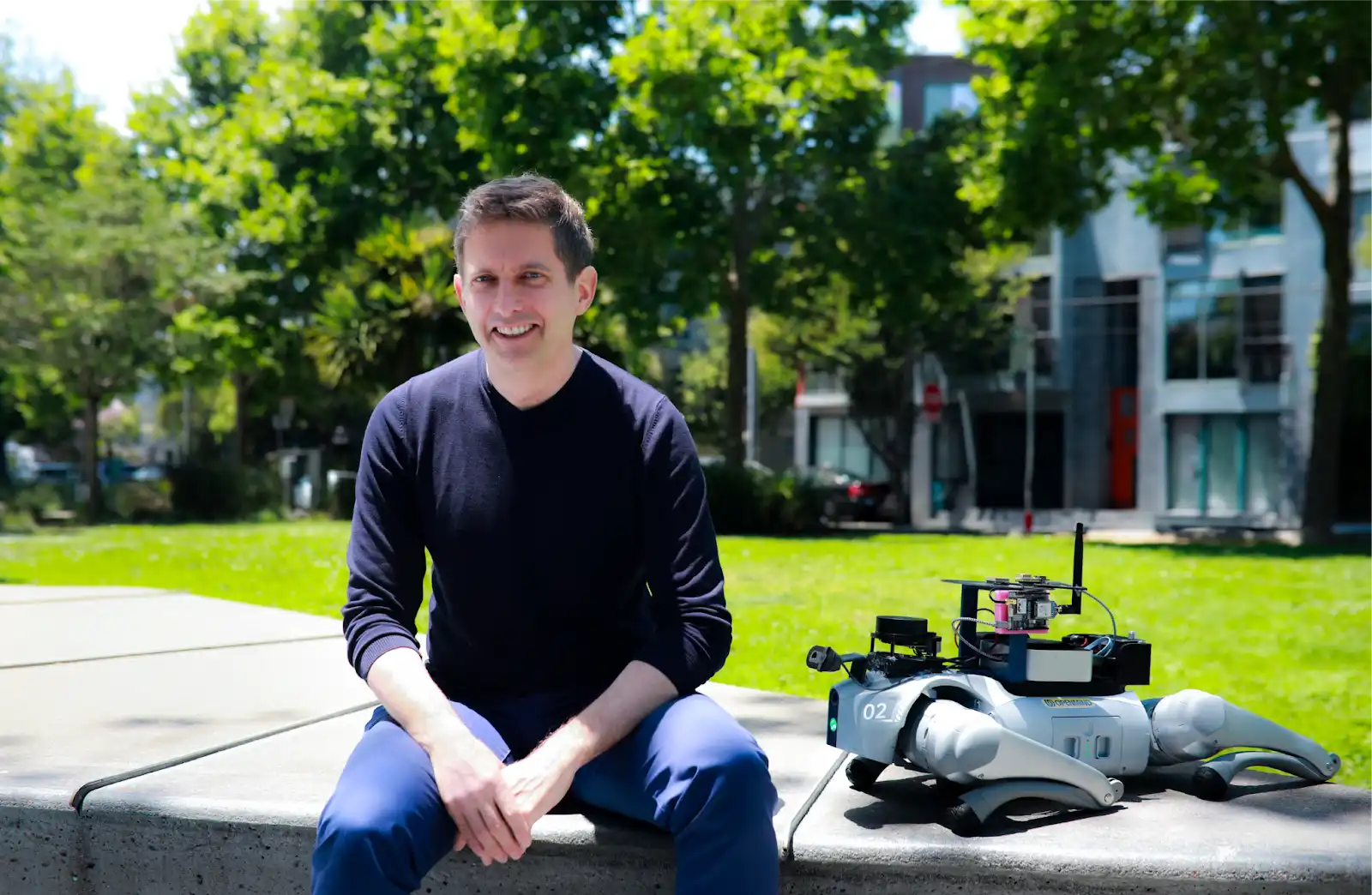
OpenMind's core business is providing SaaS-based cloud cognitive services to enterprises. But they keenly observed that as robots become independent economic participants, blockchain will play a crucial role in payment systems, identity authentication, data privacy, and collaborative governance.

Recently, OpenMind's collaboration with stablecoin issuer Circle and the deployment of robot charging stations on the streets of San Francisco are initial implementations of this vision. Robots can independently complete charging payments using USDC, which may mark the dawn of the "Machine Economy" era.

Simultaneously, OpenMind is building a dedicated app store for robots, allowing users to download applications and skills to their robots in one place, much like customizing phone apps on the Apple App Store or Google Play Store. The app was launched last week on the OpenMind App Store.

In this exclusive interview, we delved into the philosophy behind building the robot "brain," the design理念 of the modular operating system OM1, and how the FABRIC protocol and blockchain technology can构建 a future where machines and humans collaborate efficiently. He shared OpenMind's technical roadmap and offered profound insights on key issues such as developer ecosystems, remote operation, and data privacy.

Below is the interview content:

Establishing a "Bank Account" for Robots

In December 2025, OpenMind and stablecoin issuer Circle jointly announced the launch of a robot autonomous payment system based on the x402 protocol. As robots' capabilities improve, they will no longer be mere tools for executing tasks but will start to act as autonomous economic entities. They will need to purchase computing power, data, skills, and even hire other robots or humans to complete complex tasks.

To achieve this, a financial system designed specifically for machines, requiring no human intervention, becomes indispensable. The traditional banking system is clearly not prepared for this, and cryptocurrency and blockchain technology, with their native digital and decentralized characteristics, have become the most natural choice.


Preguntas relacionadas

QWhat is the core business of OpenMind as mentioned in the article?

AOpenMind's core business is providing SaaS-based cloud cognitive services for enterprises.

QWhich company led the $20 million funding round for OpenMind in August 2025?

APantera Capital led the $20 million funding round for OpenMind in August 2025.

QWhat specific payment protocol did OpenMind collaborate with Circle to implement for robots?

AOpenMind collaborated with Circle to implement a robot autonomous payment system based on the x402 protocol.

QWhat is the name of the modular operating system that OpenMind is developing for robots?

AOpenMind is developing a modular operating system called OM1 for robots.

QWhat recent development did OpenMind announce for customizing robot capabilities, similar to smartphone app stores?

AOpenMind announced a dedicated app store for robots, allowing users to download applications and skills to their robots, similar to smartphone app stores.

Lecturas Relacionadas

"Water Scarcity": The Hidden Fatal Flaw of AI Infrastructure

“Water Scarcity: The Hidden Vulnerability of AI Infrastructure” In June 2026, SpaceX revised its IPO prospectus to highlight a core resource constraint alongside power and processors: water. This move signals a pivotal shift where water scarcity has transformed from an operational cost to a major, uncontrollable investment risk, directly threatening AI data center expansion. The scale of the problem is immense. U.S. data centers consumed an estimated 17 billion gallons of water for direct cooling in 2023, with indirect water use for power generation exceeding 211 billion gallons. Giants like Google alone use billions of gallons annually, with single sites consuming volumes equivalent to a medium-sized city. This water is largely “consumptive,” evaporated into the atmosphere and lost. This massive demand is colliding with scarcity. Tech companies are building “water tigers” in arid regions, sparking community protests in places like Mexico and Arizona, where data centers can legally use millions of gallons daily—enough for tens of thousands of residents. These conflicts are not about illegality, but about a mismatch between historic water allocation frameworks and new, colossal demand. The consequences are real. Community opposition, largely centered on water, has reportedly stalled or canceled $64 billion in U.S. data center projects over two years. Simultaneously, investors are pressuring companies for greater water footprint transparency, viewing it as a financial risk, not just an ESG metric. Technological solutions like air or liquid cooling involve trade-offs between water and electricity use, with final choices dictated by local constraints. The irony is stark: while industry leaders envision AI as a utility “like water,” its physical infrastructure is straining real-world water supplies. The race for AI supremacy may ultimately be governed not by the fastest chip, but by the slowest water meter.

marsbitHace 27 min(s)

"Water Scarcity": The Hidden Fatal Flaw of AI Infrastructure

marsbitHace 27 min(s)

Global Card Issuance Enters a Compliance-Driven Era: WasabiCard is Building the Next-Generation Payment Infrastructure

Global card issuance is entering a compliance-driven era, with WasabiCard building next-generation payment infrastructure. The platform asserts that as stablecoins increasingly enter cross-border payments, corporate settlements, and global commerce, the industry is shifting focus from "availability" and "growth-driven" models to long-term, compliant operation under global frameworks. Competition will center on sustainable compliance and global infrastructure capabilities. Stablecoins are evolving from on-chain assets into key payment tools in global business, with card issuance acting as critical infrastructure connecting digital assets to traditional payment networks like Visa and Mastercard. This expansion has revealed structural issues, including cross-regional issuance, BIN resource management, and insufficient AML and risk controls. In response, the industry is moving away from reliance on "grey efficiency" towards prioritizing compliance, risk management, and long-term operational stability. WasabiCard outlines its strategy: collaborating with licensed principals and local partners for localized operations, building robust KYC/AML systems, strictly separating commercial and consumer BIN usage, and enhancing global issuance, payment, and cross-border fund flow infrastructure. The goal is to build stable, scalable payment infrastructure amid evolving global regulations, shifting industry competition from scale to infrastructure capability. As stablecoins integrate further with global commerce, payment infrastructure will become a fundamental, embedded component of internet business. WasabiCard will continue to develop capabilities in global card issuance, stablecoin payments, cross-border fund flows, and API-driven financial workflows.

marsbitHace 37 min(s)

Global Card Issuance Enters a Compliance-Driven Era: WasabiCard is Building the Next-Generation Payment Infrastructure

marsbitHace 37 min(s)

Zhou Hang: How Much Is SpaceX Really Worth?

**Zhou Hang: How Much is SpaceX Really Worth?** SpaceX, arguably one of the greatest industrial companies of the past 50 years, is reportedly targeting a staggering $1.75 trillion valuation in its potential IPO. However, the author argues this figure is inflated by approximately $1.25 trillion when assessed through standard financial metrics. The analysis begins by acknowledging SpaceX's undeniable success: drastically reducing launch costs, achieving near-monopoly in commercial launches, and building the strategic Starlink network. Its achievement surpasses even Tesla's, given it disrupted a state-monopolized industry. Despite this greatness, a $1.75 trillion valuation places SpaceX above the combined market cap of Boeing, Lockheed Martin, Northrop Grumman, RTX, and General Dynamics. Projecting optimistic 2030 revenues of $50-80 billion and applying generous tech-sector multiples yields a "reasonable" valuation range of $500 billion to $1.2 trillion. The $1.25 trillion gap is attributed to three non-financial premiums: 1. **Long-term vision premium** for future Starship-enabled markets (e.g., space-based computing). 2. **Sovereign asset/strategic premium**, as SpaceX is deeply integrated into U.S. national security. 3. **Retail narrative/Musk cult premium**, driven by a heroic story and personal following. Post-IPO, three scenarios are outlined: valuation solidifying (25% probability), sideways volatility as narrative outpaces reality (50%), or a re-rating down to $800B-$1.2T if execution falters or Musk-related risks emerge (25%). The probability-weighted expected value is $1.3-1.5 trillion, suggesting negative expected returns for those buying at the IPO price. The conclusion advises investors to separate the company's excellence from its stock price. Buying at the IPO likely prices in excessive optimism. A more prudent strategy would be to wait for key milestones (e.g., Starship V3 stability) or a significant price correction before investing, or to treat an early purchase as a long-term, high-conviction hold with limited position size, not a short-term bet.

链捕手Hace 42 min(s)

Zhou Hang: How Much Is SpaceX Really Worth?

链捕手Hace 42 min(s)

Trading

Spot
Futuros
活动图片




