Retail Investors Frantically Buy In, Institutions Raise Expectations: Where is SPCX Headed Next?

Odaily星球日报Publicado a 2026-06-16Actualizado a 2026-06-16

Resumen

SpaceX's stock (SPCX) saw a highly volatile debut week. While its IPO closed at a $2.1 trillion valuation, missing some lofty pre-market expectations and earning a "sell" rating from CFRA, it surged nearly 20% the following Monday to $192.5, pushing its market cap to ~$2.52 trillion. Strong retail investor demand was a key driver, with data showing SPCX captured approximately 73% of all U.S. retail net inflows on one day. Macro factors like a U.S.-Iran detente easing oil prices also provided a bullish tailwind for equities. Analysts are divided on the path forward. Oppenheimer initiated coverage with an "Outperform" rating and a $190 target, citing SpaceX as a fully integrated AI company. Influential figures like Peter H. Diamandis and Brad Gerstner framed it as a foundational, long-term bet on multi-planetary expansion and AI compute infrastructure. Conversely, commentary from zerohedge highlighted risks of a potential "Gamma Squeeze," where intense retail options buying could force market makers to bid up the thinly-traded stock, creating extreme volatility akin to the 2021 GameStop event. The overall narrative pits immense retail enthusiasm and long-term transformative potential against concerns over valuation, supply/demand dynamics, and near-term price sustainability.

Original | Odaily Planet Daily (@OdailyChina)

Author | Golem (@web3_golem)

Last Friday, SpaceX closed its first trading day at $160.95, with a market capitalization fixed at $2.1 trillion. Although SpaceX still created the largest IPO in U.S. stock market history, compared to the pre-IPO market sentiment, this result did not meet all expectations. Some research institutions, like CFRA, even directly rated SPCX as a "Sell." Musk's "Mars story" was well-received but not commercially successful.(Related reading:Reflections After SpaceX's Debut: A $2.1 Trillion Market Cap, Is It Still Worth Chasing?)

Facing these market concerns, SPCX shocked everyone with its gains at the U.S. market open on Monday. According to Gate's U.S. stock data, SPCX surged after opening, ultimately closing at $192.5, a gain of 19.6%. The closing price was the day's high, pushing the market cap to $2.519 trillion, making SpaceX the 8th largest company globally by market capitalization. However, market sentiment is far from subsiding. According to Hyperliquid data, SPCX's pre-market price has already risen above $214. Therefore, after the U.S. market opens on Tuesday, SPCX is highly likely to continue Monday's upward trend, potentially surpassing Amazon, which ranks 7th, in market value.

U.S.-Iran Understanding Agreement Signed, Retail Investor Enthusiasm for SpaceX Remains Undiminished

From a macro perspective, the understanding agreement reached between the U.S. and Iran this week brought significant positive news to the U.S. stock market. The market widely expects a new round of gains in global stock markets amid stabilizing geopolitical tensions, with SpaceX being one of the beneficiaries.

On June 15th, Trump announced an agreement had been reached with Iran, and the Strait of Hormuz would be opened. Unlike many previous instances of unilateral rhetoric, this agreement was also acknowledged by Iran. Iranian Deputy Foreign Minister Jalibabadi stated on the same day that the text of the U.S.-Iran Memorandum of Understanding had been finalized and would be formally signed in Switzerland this Friday (June 19th).

The agreement's conclusion received secondary confirmation from the Iranian President. Additionally, U.S. Vice President Vance stated that the agreement reached with Iran was signed electronically over the weekend, indicating the terms are effective, making it unlikely for either side to renounce it. After the news spread, U.S. stocks opened broadly higher, with the Dow Jones up 0.92%, the S&P 500 up 1.65%, and the Nasdaq up 3.07%.

Morgan Stanley believes that the long-term agreement between the U.S. and Iran, along with falling oil prices easing inflationary pressures, is shifting the U.S. stock market from a "single-headed rally" to a healthier broad-based advance. The upward momentum in U.S. stocks may no longer be confined to the tech sector but is gradually spreading to broader cyclical industries.

From a market sentiment perspective, SpaceX remains the stock most favored by retail capital. According to Vanda Track data, on June 16th (U.S. local time), it received approximately $93.8 million in net retail buying, accounting for about 73% of the total net retail inflow into individual U.S. stocks that day. This means that for nearly every $4 of incremental retail capital flowing into the U.S. stock market, about $3 flowed into SpaceX.

Given such strong demand for SPCX, SpaceX's underwriters exercised the over-allotment option (Greenshoe) in the IPO, purchasing an additional 83.33 million shares, bringing the total IPO share offering to 638,888,888 Class A ordinary shares. This increased the total financing size of the offering to $85.7 billion, a scale that surpasses the over-allotment arrangements of almost all tech company IPOs on record.

Yet, despite this, reports indicate that during SpaceX's IPO subscription, most qualified retail investors in the U.S. were allocated only about one share. Therefore, under conditions of extreme supply shortage caused by the low float, concentrated buying from retail investors can significantly drive up the stock price.

What's Next for SPCX?

Zerohedge: With Options Launch, Stock Price Could Be Pushed to $400

On June 16th, the influential U.S. financial media outlet Zerohedge published an article stating that once SPCX options begin trading, its stock price could rise to $400 due to a Gamma Squeeze effect, surpassing Nvidia.
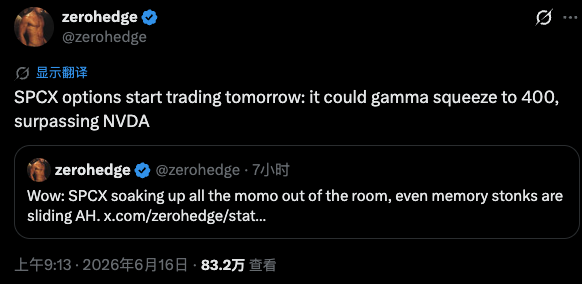
A Gamma Squeeze is essentially an upward spiral triggered by market makers being forced to buy stock to hedge their positions. SpaceX has an extremely low float (4.2%) and exceptionally high retail buying interest. Retail investors who haven't bought SPCX stock might turn to purchasing relatively cheaper call options. If massive funds frantically buy call options, market makers would be forced to continuously buy SPCX shares to hedge their risk, thereby pushing the stock price higher and forming a positive feedback loop.

The surge of GameStop (GME) in 2021 is one of the most classic cases of this effect.

Oppenheimer: SPCX Will Continue to Outperform the Market

On June 15th, before the U.S. market opened, investment bank Oppenheimer's analyst Timothy Horan initiated coverage on SpaceX, giving it an "Outperform" rating with a near-term price target of $190. After the U.S. market opened this Monday, SPCX closed at $192.5, essentially matching Oppenheimer's target.

Timothy Horan is a 4.70-star-rated analyst at Oppenheimer, primarily focusing on the tech, communications, and telecom sectors. According to Tipranks data, his prediction success rate is 58.82%. He views SpaceX as "the only fully vertically integrated AI company," controlling capital, data, large models, hardware, manufacturing, and engineering talent, and should not be viewed merely as a traditional aerospace company.

Peter H. Diamandis: Idle Funds Used to Buy Bitcoin, Now Buying SpaceX

On June 14th, renowned entrepreneur, XPRIZE founder, and early SpaceX investor Peter H. Diamandis posted that SpaceX is the "railroad in orbit" that will open up a multi-planetary civilization for humanity, creating immense wealth just as the 19th-century railroads opened the American West. He also predicted that within a year, SpaceX and Tesla would merge to become the first $100 trillion company.

He also stated that over the past decade, whenever he freed up funds from other trades, he would invest them in Bitcoin. But now, whenever he has idle funds, he invests in SpaceX. While he expects the stock price to decline when locked-up shareholders can sell their shares and some cash out, he emphasized that his investment in SpaceX isn't for seeking quarterly stock price gains but for advancing the off-world economy.

Brad Gerstner: SpaceX is a Must-Buy, Must-Hold Asset for Institutional Investors

On June 16th, prominent Silicon Valley investor Brad Gerstner described SpaceX as a must-buy, must-hold asset for institutional investors in the latest episode of his BG2 podcast. His reasoning is that the company stands at the intersection of two major trends: the space economy and the expansion of AI computing power.

Gerstner said those bearish on SpaceX focus on the company's revenue from last year and investment banks' forecasts for significant revenue growth over the next three years, questioning how few companies can achieve several-fold expansion in three to four years. However, he believes if investors believe in the direction of AGI development, they must accept the premise that the scale of global computing power needed will far exceed current market expectations. Combining this judgment with SpaceX's core business, it's hard to find another company or entrepreneur offering a more direct bet on the future.


Preguntas relacionadas

QWhat is the ticker symbol for SpaceX after its IPO?

AThe ticker symbol for SpaceX is SPCX.

QAccording to the article, what rating did CFRA initially give SPCX, and what was Oppenheimer's rating and price target?

AAccording to the article, research firm CFRA initially gave SPCX a 'Sell' rating. In contrast, the investment bank Oppenheimer gave it an 'Outperform' rating with a short-term price target of $190.

QWhat financial mechanism does the article mention as a potential catalyst that could push SPCX's stock price to $400?

AThe article mentions that a 'Gamma Squeeze' could be a potential catalyst to push SPCX's stock price to $400.

QBased on Vanda Track data cited in the article, what percentage of retail investor net inflows on June 16th went into SPCX?

ABased on Vanda Track data, approximately 73% of the net inflow from retail investors into U.S. stocks on June 16th went into SPCX.

QWhy does investor Brad Gerstner, as mentioned in the article, consider SPCX a 'must-own, must-hold asset' for institutional investors?

ABrad Gerstner considers SPCX a 'must-own, must-hold asset' because the company is positioned at the intersection of two major trends: the space economy and the expansion of AI computing power, offering a direct bet on the future.

Lecturas Relacionadas

Former CFTC Chairman, Circle President Tarbert: Preaching Long-Termism While Cashing Out $30 Million Himself

Former CFTC Chairman and Circle President Heath Tarbert has consistently advocated for a long-term vision in public, urging patience from investors as Circle’s stock price has fallen significantly from its peak. However, it has been revealed that since Circle’s IPO, Tarbert has continuously sold his CRCL shares through pre-arranged trading plans, cashing out approximately $30 million, without making any public market purchases. This contrast between his public messaging and personal actions has drawn criticism. Tarbert joined Circle in July 2023 as Chief Legal Officer, leveraging his regulatory experience to help guide the company through its IPO and expansion. Despite promoting stablecoins as long-term infrastructure, he established a 10b5-1 trading plan just before Circle went public, leading to substantial stock sales over the following year. In March 2026, he initiated another plan to sell more shares. His career trajectory highlights a pattern of moving between high-level regulatory roles and influential positions in the financial sector. After resigning as CFTC Chairman in early 2021, he joined Citadel Securities as Chief Legal Officer just 27 days later, during a period of intense regulatory scrutiny for the firm. He later joined Circle, aiding its efforts to navigate regulatory challenges for its public listing. While Tarbert's expertise in policy and compliance is valuable to companies like Circle, his actions—advocating long-term confidence while personally divesting—raise questions about the alignment between his public statements and his private financial decisions, leaving investors who followed his advice to bear the market risks.

marsbitHace 15 min(s)

Former CFTC Chairman, Circle President Tarbert: Preaching Long-Termism While Cashing Out $30 Million Himself

marsbitHace 15 min(s)

Gate Research Institute: The 'Wall Street-ization' Wave of Crypto Financial Products – Competition or Integration?

The article titled "Gate Research Institute: Are Crypto Financial Products Sparking a 'Wall Street' Wave—Competition or Convergence?" explores the evolving relationship between the crypto ecosystem and traditional finance (TradFi). The piece begins by reflecting on Bitcoin's original 2009 vision of decentralization, disintermediation, and moving away from banks. It then contrasts this with the 2024 landscape, where key crypto assets like Bitcoin are increasingly held through Wall Street products like ETFs issued by giants like BlackRock. The article questions whether this signifies that TradFi is systematically taking over the rights to issue, price, custody, and distribute crypto financial assets. The core argument is that this is not a zero-sum takeover but rather a bidirectional convergence where each side addresses the other's weaknesses. Crypto offers 24/7 global markets, programmable settlement, and open access but lacks compliant channels, institutional-grade custody, deep fiat liquidity, and mainstream distribution. TradFi possesses these but is constrained by legacy systems, limited operating hours, and slow settlement. Two primary convergence paths are highlighted: * **Path A (CEX to TradFi):** Exemplified by Gate, which has progressed from offering tokenized stocks and CFDs to providing direct, real stock trading (US, Hong Kong, South Korea) within its platform, using USDT. * **Path B (TradFi to Crypto):** Exemplified by Robinhood, which has integrated crypto trading, acquired exchanges like Bitstamp, and is moving traditional assets like stocks onto the blockchain via tokenization and its own Layer 2. Both paths are ultimately competing to become the next-generation, unified financial account—a "super account" where users can seamlessly trade cryptocurrencies, stocks, ETFs, RWA (Real World Assets), and tokenized treasury products in one interface. The growth of RWA and tokenized treasuries (e.g., BlackRock's BUIDL) is presented as the asset-layer fusion, providing stable, yield-bearing assets on-chain and acting as a bridge between the two worlds. In conclusion, the "Wall Street-ization" of crypto is framed as a mutual transformation. Decentralized ideals persist in the protocol layer, while at the application layer, a more efficient, global, and accessible unified capital market is emerging from this convergence. The future competition lies not between crypto exchanges and stockbrokers, but between platforms vying to offer the most comprehensive asset coverage, liquidity, and user experience within a single account.

marsbitHace 19 min(s)

Gate Research Institute: The 'Wall Street-ization' Wave of Crypto Financial Products – Competition or Integration?

marsbitHace 19 min(s)

Claude's Major New Feature: Screen Recording + Voice, Distilling Your Skills into AI Tasks in One Click

Claude has introduced a major new feature called "Record a Skill," available for Pro, Max, and Team users. This function, found in the Claude desktop app's CoWork menu, allows users to create reusable AI skills simply by recording their screen and providing voice narration while performing a task. Claude then automatically analyzes the recording and generates a functional Skill. A hands-on test confirmed the feature works seamlessly. Users start recording via the Skills manager, perform their workflow while verbally explaining the steps and logic, and avoid including sensitive information. After recording, Claude processes the content and creates the Skill, which can be saved and later invoked with a slash command (/). This eliminates the need for manual adjustments or writing complex instruction files. The innovation goes beyond mere efficiency. Previously, creating a Skill required writing a detailed SKILL.md file in Markdown—a significant barrier for non-technical users. "Record a Skill" bypasses this by directly capturing both actions and the implicit reasoning shared in the narration. This lowers the barrier to knowledge transfer and automation, addressing a core challenge in corporate knowledge management: the difficulty of getting experts to write and maintain documentation. However, the feature also highlights a shift in the nature of work. A case study from March 2026 showed a freelancer whose five-year client relationship was effectively replaced by a hand-coded Claude Skill automating their content workflow. With the even lower barrier of screen recording, the ability to distill personal expertise into automatable skills accelerates this trend. The "moat" for work is moving from simply knowing how to do a task to mastering tasks that are difficult or impossible to automate.

marsbitHace 24 min(s)

Claude's Major New Feature: Screen Recording + Voice, Distilling Your Skills into AI Tasks in One Click

marsbitHace 24 min(s)

Feeding AI "Noise" Can Also Boost Scores, This Work Enables Positive Transfer with Noise

Feeding "Noise" to AI Can Improve Performance: A Method Enables Positive Transfer from Noise This work, Semi-Supervised Noise Adaptation (SSNA), introduces a Noise Adaptation Framework (NAF) that challenges traditional transfer learning. Instead of requiring a labeled source domain of real data (e.g., images, text), NAF uses randomly generated Gaussian noise as the source. For a target task with C classes, it constructs C noise clusters by sampling from Gaussian distributions. Although this synthetic noise contains no semantic meaning, NAF trains it to form a discriminative class structure in a shared representation space—clustering same-class noise and separating different classes. The key is aligning this learned structure from the noise domain to the real, sparsely labeled target domain. A small number of target labels are still essential to establish the correspondence between noise clusters and actual classes. The training objective combines: 1) supervised loss on the few labeled target samples, 2) classification loss for the noise to build its structure, and 3) a distribution alignment loss (using Negative Domain Similarity) to minimize the gap between the noise and target domains in the shared space. Experiments show significant gains in few-label settings. With just 4 labels per class, NAF with a ResNet-18 backbone improves accuracy over a standard supervised baseline (ERM) by +12.35% on CIFAR-10, +7.61% on CIFAR-100, +4.38% on DTD-47, and +2.74% on Caltech-101. It also benefits fine-grained datasets and scales to ImageNet-1K (with 100 labels/class) and text classification (AG News). NAF can be integrated into existing semi-supervised methods like FixMatch for further gains. Ablation studies confirm the transferred benefit comes from the discriminative structure of the noise, not randomness itself. Collapsing all noise into a single point causes negative transfer, while increasing separation between noise cluster centers improves performance. The amount of noise per class is less critical once a basic structure forms. In conclusion, this work demonstrates that for positive transfer, the semantic content of source data may not be necessary. What can be effectively transferred is the *organizational structure* of categories within a representation space. This offers a promising alternative for scenarios where real source data is unavailable due to privacy, copyright, or procurement constraints.

marsbitHace 25 min(s)

Feeding AI "Noise" Can Also Boost Scores, This Work Enables Positive Transfer with Noise

marsbitHace 25 min(s)

Trading

Spot
活动图片