Crypto Market Performance
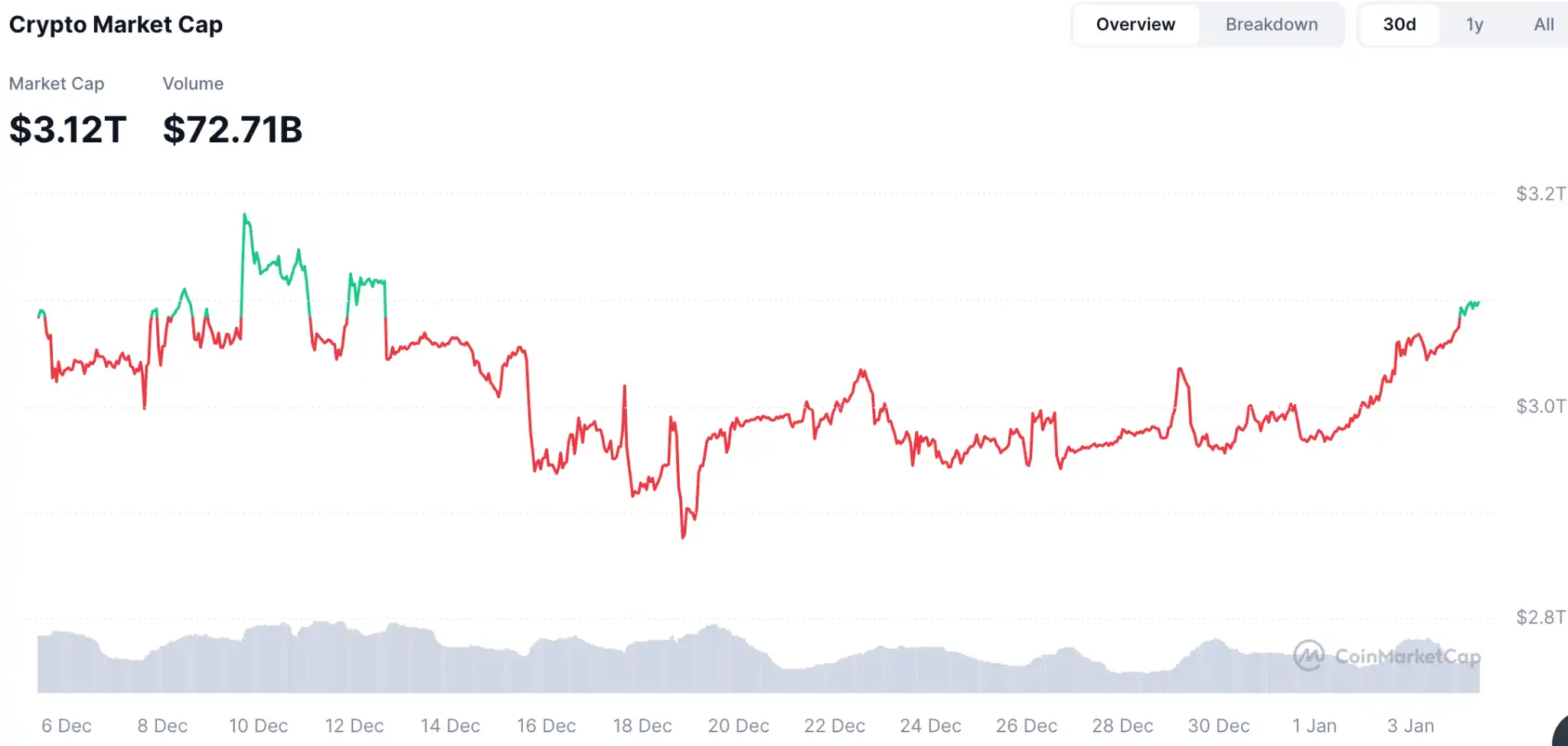
Currently, the total cryptocurrency market capitalization is $3.11 trillion, with BTC accounting for 58.56%, at $1.82 trillion. The stablecoin market cap is $307.5 billion, decreasing by 0.25% in the last 7 days. Stablecoins have seen negative weekly growth for two consecutive weeks, with USDT accounting for 60.8%.
Among the top 200 projects on CoinMarketCap, most have risen while a few have fallen. Specifically: BTC gained 4.2% in 7 days, ETH gained 6.92%, SOL gained 7.93%, MYX gained 84.42%, and PEPE gained 54.1%.
This week, the net inflow for U.S. Bitcoin spot ETFs was $458.7 million; the net inflow for U.S. Ethereum spot ETFs was $1.613 million.
Market Forecast (January 5 - January 9):
The current RSI index is 60.59 (neutral zone), the Fear & Greed Index is 26 (higher than last week, generally in the fear zone), and the Altcoin Season Index is 39 (neutral, higher than last week).
BTC Core Range: $87,000-93,000
ETH Core Range: $3,000-3,500
SOL Core Range: $129-150
This week marks the first week of 2026. The net inflow into U.S. spot ETFs directly boosted the crypto market cap. After gold and silver hit new highs, their prices have corrected. With capital spilling over, crypto has absorbed some liquidity. It is expected that next week's market will fluctuate within a range with an upward trend. Short-term traders can consider "buying low and selling high." Recently, small-cap altcoins have seen significant gains. Given the uncertain market outlook for 2026, it is not advisable to chase highs.
Understanding the Present
Review of the Week's Major Events
- On December 29, Lu Lei, Deputy Governor of the People's Bank of China, stated that the PBOC will issue the "Action Plan on Further Strengthening the Digital Yuan Management Service System and Related Financial Infrastructure." A new generation of digital yuan measurement framework, management system, operational mechanism, and ecosystem will be officially launched and implemented on January 1, 2026;
- On December 29, Indian police in Hyderabad arrested a former Coinbase customer service employee suspected of involvement in the insider data breach disclosed by Coinbase in May this year. This is the first known arrest in the case, as confirmed by Coinbase CEO Brian Armstrong;
- According to a report by LatePost, Meta acquired Butterfly Effect, the company developing the AI application Manus, for billions of dollars. This is Meta's third-largest acquisition to date,仅次于 WhatsApp and ScaleAI. It is reported that before Meta's acquisition, Manus was raising a new round of funding at a $2 billion valuation. "It happened so fast that I even doubted if it was a fake offer," said Liu Yuan, a partner at ZhenFund and an angel investor in Butterfly Effect. The acquisition negotiation was completed in an extremely short time, taking only about ten days;
- On December 30, Trust Wallet announced it would proactively compensate affected users. The total stolen assets amounted to approximately $8.5 million;
- On December 31, boosted by the Fed's interest rate cuts and a significant surge in AI investment enthusiasm, global stock markets are poised for their largest annual gain in six years in 2025. With only one trading day left in 2025, the MSCI World Stock Index has risen 21% this year;
- On January 4, Tom Lee expressed support for BitMine's increase in authorized share capital. BMNR closed up 14.88%;
- On January 3, after 14:00 Beijing time, loud explosions were heard in Caracas, the capital of Venezuela, air raid sirens sounded, and power outages occurred in the southern part of the city near a large military base. The crypto market experienced a certain degree of decline, possibly influenced by this event.
Macro Economy
- On December 31, U.S. initial jobless claims for the week ending December 27 were 199,000, the lowest since the week of November 29, below the expected 220,000. The previous week's figure was revised from 214,000 to 215,000.
- On January 4, according to CME's "FedWatch Tool," the probability of a 25 basis point rate cut by the Fed in January is 16.6%, while the probability of maintaining the current rate is 83.4%.
ETFs
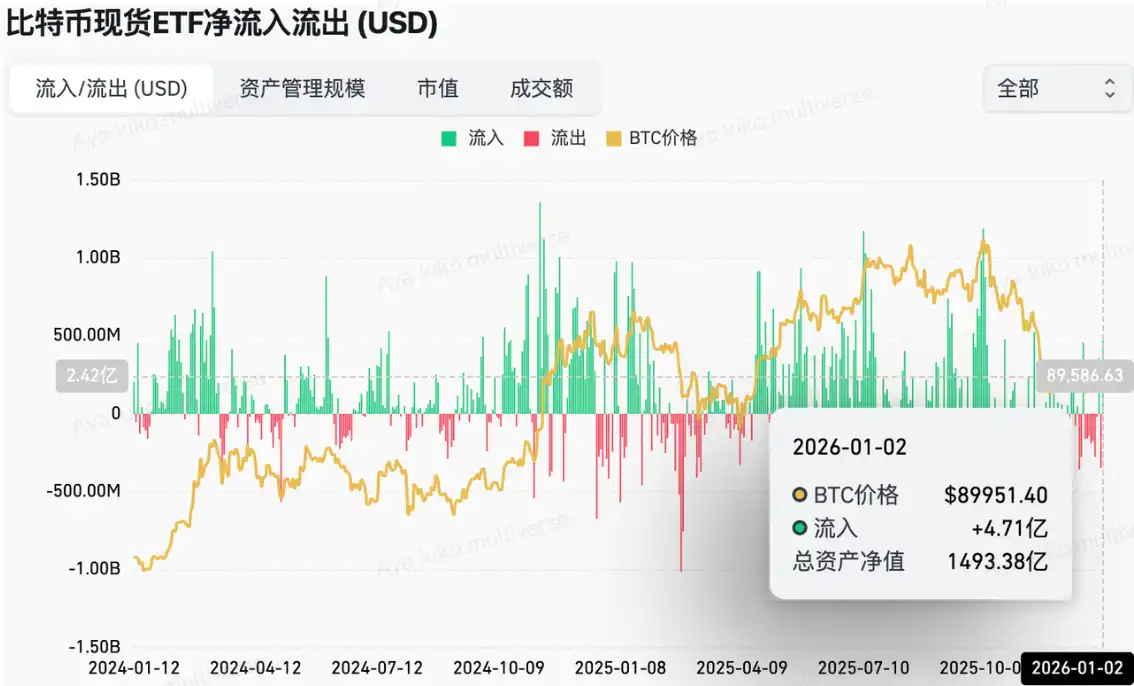
According to statistics, during the period from December 29 to January 2, the net inflow for U.S. Bitcoin spot ETFs was $458.7 million. As of January 2, GBTC (Grayscale) has seen a total outflow of $25.193 billion and currently holds $14.793 billion. IBIT (BlackRock) currently holds $69.313 billion. The total market capitalization of U.S. Bitcoin spot ETFs is $119.546 billion.
The net inflow for U.S. Ethereum spot ETFs was $1.613 million.
Foreseeing the Future
Project Developments
- The Daily Gwei, a video program focused on Ethereum, will resume weekly updates on January 5, 2026;
- The claim period for the social app Based's Christmas commemorative "Soulbound" NFT ends on January 7, 2026;
- Web3 robotics company XMAQUINA will collaborate with Virtuals Protocol for a DEUS community sale on January 8. The auction starts at 20:00 on January 8, with an FDV of $60 million (DEUS price: $0.06). At TGE, 33% will be liquid, and 67% will vest linearly over 12 months. The public sale is open to all non-U.S. contributors. Eligible wallets can receive a 20% DEUS reward, including a Genesis OG reward for those who participated in any previous genesis auction. Contributing 10,000 USDC from the same wallet will yield a 20% DEUS reward.
Important Events
- January 7, 21:15: The U.S. will release the December ADP Employment Change (in thousands);
- January 8, 21:30: The U.S. will release the Initial Jobless Claims for the week ending January 3 (in thousands);
- January 9, 21:30: The U.S. will release the December Unemployment Rate.
Token Unlocks
- 1.2 million team-allocated tokens for Hyperliquid will unlock on January 6. Subsequent unlocks will occur on the 6th of each month;
- Jito (JTO) will unlock 11.31 million tokens on January 7, worth approximately $5.4 million, accounting for 1.14% of the circulating supply;
- Movement (MOVE) will unlock 161 million tokens on January 9, worth approximately $6 million, accounting for 1.62% of the circulating supply;
- Linea (LINEA) will unlock 1.44 billion tokens on January 10, worth approximately $10.18 million, accounting for 2% of the circulating supply.
About Us
Hotcoin Research, as the core research arm of Hotcoin Exchange, is dedicated to transforming professional analysis into your practical tool. We analyze market trends through "Weekly Insights" and "In-Depth Research Reports"; with our exclusive column "Hotcoin Selection" (dual screening by AI and experts), we help you identify potential assets and reduce trial costs. Every week, our researchers also engage with you face-to-face through live streams, interpreting hot topics and predicting trends. We believe that warm companionship and professional guidance can help more investors navigate cycles and seize the value opportunities in Web3.
Risk Disclaimer
The cryptocurrency market is highly volatile, and investing carries inherent risks. We strongly advise investors to fully understand these risks and invest within a strict risk management framework to ensure capital safety.
Website:https://lite.hotcoingex.cc/r/Hotcoinresearch
X: x.com/Hotcoin_Academy
Mail:[email protected]




