Regulatory Clarity for Tokenized Securities: Which Hot Projects Won't Pass the SEC's Scrutiny?

Odaily星球日报Publicado a 2026-01-30Actualizado a 2026-01-30

Resumen

The U.S. SEC has issued new guidance clarifying the regulatory treatment of tokenized securities, emphasizing that the use of blockchain does not change the fundamental nature of securities obligations. The guidance distinguishes between two main types of tokenized securities: those led by the issuer (where blockchain is used as a technical upgrade to record ownership registry, without altering rights or regulatory requirements) and those created by third parties (which may not confer direct ownership rights and introduce additional risks such as custody or counterparty risk). The SEC stresses that regardless of the technology used, any asset that meets the definition of a security or derivative remains subject to existing federal securities laws. This move aims to address market confusion, particularly around unauthorized “tokenized stocks” that mimic equity without issuer involvement—such as certain products offered by platforms like Robinhood in Europe or third-party claims of tokenized equity in companies like OpenAI. In contrast, compliant initiatives—such as those by Kraken, NYSE, or DTCC—focus on integrating tokenization within existing regulatory frameworks, ensuring issuer participation and clear accountability. The guidance reinforces that tokenization is not a shortcut to bypass securities laws but must align with legal and economic substance.

Original | Odaily Planet Daily (@OdailyChina)

Author | Ethan (@ethanzhang_web3)
On January 29, the U.S. Securities and Exchange Commission (SEC) released a new guidance document on tokenized securities. The issuance of this document coincided with the rescheduling of the originally planned public event "SEC and CFTC Collaborative Regulation"—the interagency coordination dialogue, originally set for January 27, was adjusted to 2:00–3:00 PM EST on January 29.

Now that this interagency coordination dialogue has concluded, the SEC has preemptively used this guidance document to send a clear signal: in constructing the regulatory framework for crypto assets, the SEC has chosen to start with "structural clarification" as an entry point, delineating and clarifying the identities of tokenization practices in the market.

Odaily Planet Daily will, through this article, break down how this document redefines the regulatory logic of "tokenized securities" and which hot projects will face critical tests as a result.

Core Objective: Re-labeling "Tokenization Practices"

Directly turning to the original text of the "Statement on Tokenized Securities," the document's goal is straightforward to the point of being一目了然: the SEC is not establishing a new framework for tokenized securities but is attempting to answer a more fundamental question—under existing federal securities laws, into which category of financial instruments should the various tokenization operations in the market be classified?

Why is such "labeling" necessary? Because current market tokenization practices are extremely chaotic: some involve securities issuers themselves using blockchain to register equity, while others involve third parties casually issuing tokens claiming to be "pegged to a certain stock"; some on-chain assets can actually trigger official equity changes, while others don't even have a known issuer. These differences blur regulatory boundaries, and investors can easily be misled by the name "tokenized stock." What the SEC aims to do is first "structurally sort out" these chaotic phenomena.

According to the document, tokenized securities are broadly categorized into two types: issuer-led tokenized securities (led by the securities issuer or its agent) and third-party-led tokenized securities (initiated by third parties unrelated to the issuer).
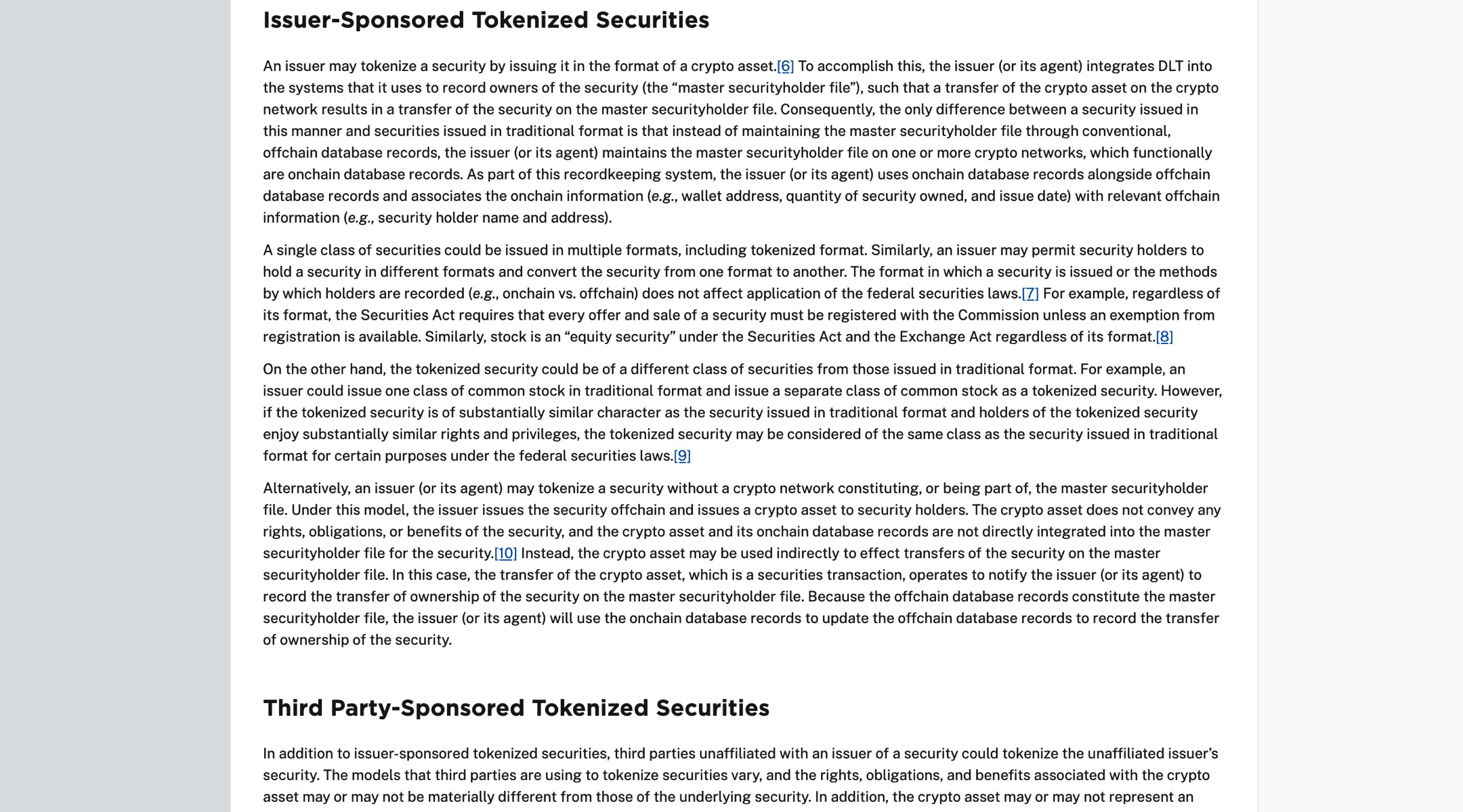
Issuer-Led: Technological Upgrade, No Change in Rights Essence

In the issuer-led model, blockchain is directly integrated into the securities holder registration system. Whether the on-chain ledger is used as the primary registration system or in parallel with an off-chain database, the core logic remains the same—the transfer of on-chain assets simultaneously triggers changes in the official holder register for the security. The SEC particularly emphasizes that this structure differs from traditional securities only in the registration technology; it does not involve changes in the nature of the security, rights and obligations, or regulatory requirements. The same class of security can exist simultaneously in traditional and tokenized forms, and issuance and trading still fully apply the Securities Act and the Securities Exchange Act.

The document also mentions that issuers could theoretically issue tokenized securities of a "different class" from traditional securities, but the SEC adds a key qualification: if the tokenized security is "substantially identical" to the traditional security in terms of rights and obligations, it may still be considered the same class in specific legal contexts. This statement is not encouraging structural complexity but reiterating that the judgment standard is always based on "rights and economic substance."

Third-Party-Led: Prudential Supervision, Risks and Rights Need Reassessment

In contrast, third-party-led tokenization structures are placed under a more cautious regulatory lens. According to the document, when a third party tokenizes an existing security without the issuer's participation, the on-chain asset may not represent ownership of the underlying security, nor does it necessarily constitute a claim against the issuer. More critically, token holders must additionally bear the risks of the third party itself (such as custody risk, bankruptcy risk), risks that do not exist when directly holding the original security.

Based on this difference, the document further divides third-party tokenization into two typical models:

  • Custodial Tokenized Securities: Essentially "securities entitlement certificates," meaning the third party uses the token form to prove the holder's indirect interest in the securities it custodies (e.g., tokenized entitlement certificates issued by a custodian);
  • Synthetic Tokenized Securities: Closer to structured notes or security-based swaps, financial instruments issued by a third party to track the price performance of the underlying security, granting no shareholder rights (e.g., tokenized derivatives pegged to stock prices).
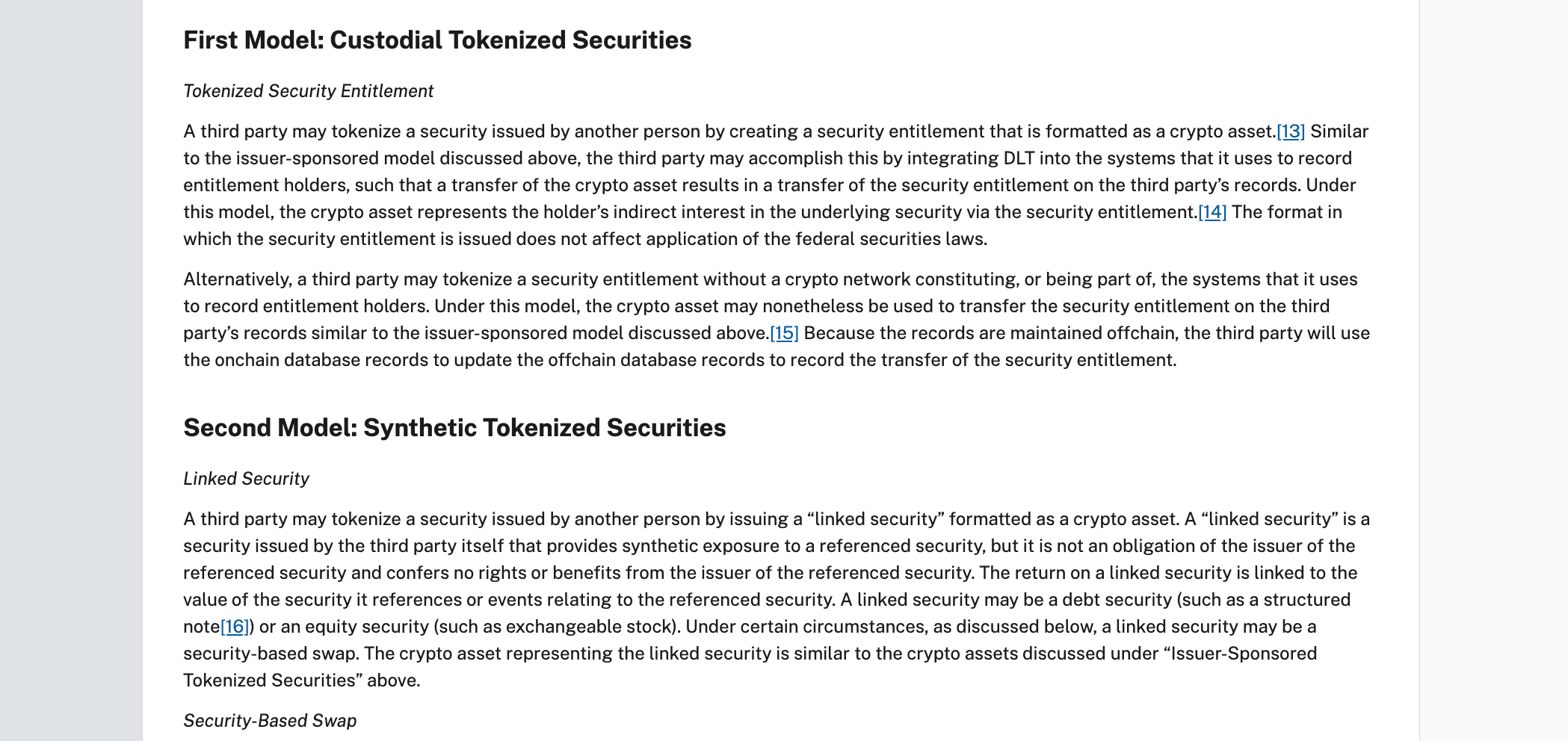
Although third-party-led tokenization structures carry many risks, they still meet certain demands in the market. For some investors, such products offer a relatively convenient and low-cost investment avenue. For example, some small investors may not be able to directly participate in trading stocks of certain large companies. Through custodial or synthetic tokenized securities issued by third parties, they can gain similar investment opportunities with a lower barrier to entry. Additionally, some investors are attracted by the innovative form and potential high returns of tokenized securities, and although they may understand the risks, they are still willing to bear certain risks for possible rewards.

Core Principle: Form Does Not Change Liability or Attribute

Throughout the text, the SEC repeatedly emphasizes not the compliance of the technological path, but an unchanging regulatory logic: as long as the economic substance of a financial instrument meets the definition of a security or derivative, the application of federal securities laws will not change due to "tokenization". Name, packaging method, or even the use of blockchain are not determining factors.

From this perspective, this new guidance is more like a "structural clarification note." It does not make value judgments on the future of tokenized securities but clarifies a premise: in the U.S. legal system, tokenization can only change the form, not the liability and attribute. Subsequent market developments will unfold under this premise.

Back to the Real-World: Which "Tokenized Stocks" Are Being Redefined?

If interpreted only at the textual level, this new guidance might seem like just a clarification of classification structure; but placed in the context of the real market, its direction is quite clear. What it responds to is precisely a batch of "tokenized stock" practices that have already come to the forefront.

The most typical division first appears on the point of whether the issuer participates. In the path of direct issuer participation, tokenization is seen more as a technological upgrade of the registration and settlement system. Around the time this guidance was released, asset management firm F/m Investments had already submitted an application to the SEC, hoping to maintain the holder records of its Treasury ETF on a permissioned blockchain. The common feature of such attempts is that: blockchain is merely incorporated into the existing securities infrastructure, and the legal relationship between the issuer and investors remains unchanged. Precisely because of this, although this path progresses slowly, it has always been within a framework that the SEC can understand and engage with.

In stark contrast is another type of practice that entered the market earlier and is more controversial. Taking Robinhood's "tokenized U.S. stocks" product launched in Europe as an example, its trading experience and price linkage methods are highly similar to real stocks, but the related tokens are not authorized by the issuers. Similar market chaos was also reflected in rumors about "OpenAI tokenized equity"—previously, some third-party platforms claimed to offer "OpenAI on-chain equity certificates," attracting investor attention. Subsequently, OpenAI publicly denied any association with any "tokenized equity", an action that actually highlighted the core problem of such structures—the on-chain asset does not represent a direct claim to the issuer's equity. In the SEC's context, this type of product is closer to a synthetic exposure constructed by a third party, rather than a real stock.
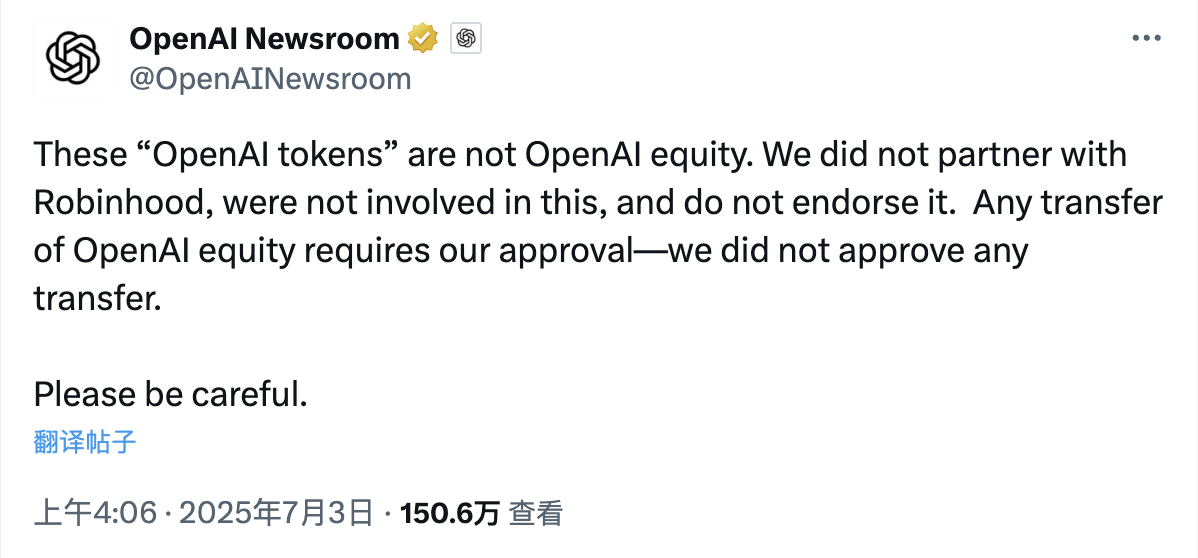
A similar situation also appears in "tokenized stocks" products launched by some crypto-native platforms. Whether providing securities entitlement certificates through custody or tracking stock price performance through contract structures, these products function "like stocks," but in terms of legal relationship, the entity investors face has shifted from the issuing company to the platform or intermediary itself. This is precisely the real-world context in which the SEC repeatedly emphasizes third-party risks in the new guidance.

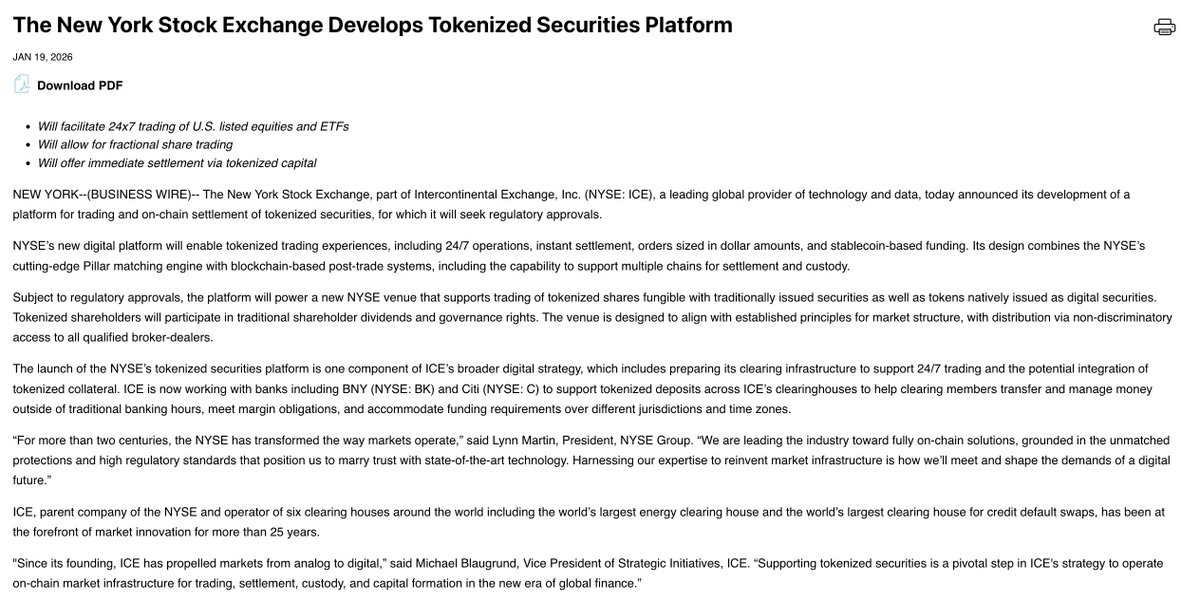
Conversely, those frequently mentioned attempts that consistently emphasize "compliance first"—such as Kraken's xStocks plan, and internal explorations around tokenized stocks and ETFs by the NYSE and DTCC—their commonality lies not in how advanced the technology is, but in whether the issuer, custody, clearing, and regulatory responsibilities are fully integrated into the existing system. The slow progress of these projects恰恰说明恰恰说明 (precisely illustrates) that there is no "get on the bus first, then buy a ticket" shortcut for tokenization in the U.S. market.
Conclusion: Tokenization is Not a Shortcut, But a "Revealing Mirror" of Responsibility

The essence of this SEC guidance is an "identity calibration"—before tokenization moves from concept to落地 (landing), first clarify "what is equity, and who is bearing the responsibility."

In U.S. regulatory logic, blockchain is never a tool to circumvent securities laws. Whether tokenization can be established depends on whether the issuer participates, whether rights and obligations are clear, and whether risks are correctly assumed: if these three conditions are met, it is a technological upgrade of the existing financial system; if one is missing, the so-called "tokenized stock" is, in the eyes of regulators, another type of financial product.

Therefore, the boundary drawn by this document is not one of "permitted vs. prohibited," but rather a "screening question on responsibility"—it is reclassifying the tokenization practices in the market: some are evolving towards securities infrastructure, while others must正视 (face squarely) their "non-equity" nature.

For the market, this might not be a bad thing. At least from now on, tokenization is no longer a vague and enticing label, but a path that must be taken seriously, with no room for speculation.

Related Links

《OpenAI Angrily Denounces Robinhood's Unauthorized Use, Whose Interests Do Tokenized Stocks Touch?》

《Robinhood Rewrites the Global Trading Landscape, Stock-like Tokens Enter an Era of Dimensionality Reduction Strike》

《NYSE Plans to Launch 7*24 Hour Tokenized Stock Trading, "Competitors" Are Stunned》

Preguntas relacionadas

QWhat are the two main categories of tokenized securities as defined by the SEC's new guidance?

AThe SEC's guidance categorizes tokenized securities into two main types: Issuer-led Tokenized Securities (led by the security issuer or its agent) and Third-party-led Tokenized Securities (initiated by a third party unrelated to the issuer).

QAccording to the SEC, what is the key difference between an issuer-led tokenized security and a traditional security?

AThe key difference is only the technology used for the holder registration system. The nature of the security, its rights, obligations, and regulatory requirements do not change. A transfer of the on-chain asset triggers a change in the official holder register.

QWhat significant risk do investors face with third-party-led tokenized securities that is not present with direct ownership of the underlying security?

AInvestors bear additional risks specific to the third party, such as custody risk and the risk of the third party's bankruptcy, which are not inherent risks of directly holding the original security.

QHow does the SEC's guidance fundamentally view the role of blockchain technology in the context of tokenized securities?

AThe SEC views blockchain as a potential upgrade to registration and settlement infrastructure, not as a tool to circumvent existing federal securities laws. The economic substance of the financial instrument, not its form or packaging, determines its regulatory treatment.

QWhich real-world example from the article illustrates a third-party tokenization attempt that was publicly disavowed by the underlying company?

AThe article cites an example where a third-party platform claimed to offer 'OpenAI chain-based equity certificates,' which was subsequently publicly denied by OpenAI, highlighting that the on-chain asset did not represent a direct claim on the issuer's equity.

Lecturas Relacionadas

Google and Amazon Simultaneously Invest Heavily in a Competitor: The Most Absurd Business Logic of the AI Era Is Becoming Reality

In a span of four days, Amazon announced an additional $25 billion investment, and Google pledged up to $40 billion—both direct competitors pouring over $65 billion into the same AI startup, Anthropic. Rather than a typical venture capital move, this signals the latest escalation in the cloud wars. The core of the deal is not equity but compute pre-orders: Anthropic must spend the majority of these funds on AWS and Google Cloud services and chips, effectively locking in massive future compute consumption. This reflects a shift in cloud market dynamics—enterprises now choose cloud providers based on which hosts the best AI models, not just price or stability. With OpenAI deeply tied to Microsoft, Anthropic’s Claude has become the only viable strategic asset for Google and Amazon to remain competitive. Anthropic’s annualized revenue has surged to $30 billion, and it is expanding into verticals like biotech, positioning itself as a cross-industry AI infrastructure layer. However, this funding comes with constraints: Anthropic’s independence is challenged as it balances two rival investors, its safety-first narrative faces pressure from regulatory scrutiny, and its path to IPO introduces new financial pressures. Globally, this accelerates a "tri-polar" closed-loop structure in AI infrastructure, with Microsoft-OpenAI, Google-Anthropic, and Amazon-Anthropic forming exclusive model-cloud alliances. In contrast, China’s landscape differs—investments like Alibaba and Tencent backing open-source model firm DeepSeek reflect a more decoupled approach, though closed-source models from major cloud providers still dominate. The $65 billion bet is ultimately about securing a seat at the table in an AI-defined future—where missing the model layer means losing the cloud war.

marsbitHace 1 hora(s)

Google and Amazon Simultaneously Invest Heavily in a Competitor: The Most Absurd Business Logic of the AI Era Is Becoming Reality

marsbitHace 1 hora(s)

Computing Power Constrained, Why Did DeepSeek-V4 Open Source?

DeepSeek-V4 has been released as a preview open-source model, featuring 1 million tokens of context length as a baseline capability—previously a premium feature locked behind enterprise paywalls by major overseas AI firms. The official announcement, however, openly acknowledges computational constraints, particularly limited service throughput for the high-end DeepSeek-V4-Pro version due to restricted high-end computing power. Rather than competing on pure scale, DeepSeek adopts a pragmatic approach that balances algorithmic innovation with hardware realities in China’s AI ecosystem. The V4-Pro model uses a highly sparse architecture with 1.6T total parameters but only activates 49B during inference. It performs strongly in agentic coding, knowledge-intensive tasks, and STEM reasoning, competing closely with top-tier closed models like Gemini Pro 3.1 and Claude Opus 4.6 in certain scenarios. A key strategic product is the Flash edition, with 284B total parameters but only 13B activated—making it cost-effective and accessible for mid- and low-tier hardware, including domestic AI chips from Huawei (Ascend), Cambricon, and Hygon. This design supports broader adoption across developers and SMEs while stimulating China's domestic semiconductor ecosystem. Despite facing talent outflow and intense competition in user traffic—with rivals like Doubao and Qianwen leading in monthly active users—DeepSeek has maintained technical momentum. The release also comes amid reports of a new funding round targeting a valuation exceeding $10 billion, potentially setting a new record in China’s LLM sector. Ultimately, DeepSeek-V4 represents a shift toward open yet realistic infrastructure development in the constrained compute landscape of Chinese AI, emphasizing engineering efficiency and domestic hardware compatibility over pure model scale.

marsbitHace 1 hora(s)

Computing Power Constrained, Why Did DeepSeek-V4 Open Source?

marsbitHace 1 hora(s)

Trading

Spot
Futuros

Artículos destacados

Qué es $S$

Entendiendo SPERO: Una Visión General Completa Introducción a SPERO A medida que el panorama de la innovación continúa evolucionando, la aparición de tecnologías web3 y proyectos de criptomonedas juega un papel fundamental en la configuración del futuro digital. Un proyecto que ha atraído la atención en este campo dinámico es SPERO, denotado como SPERO,$$s$. Este artículo tiene como objetivo reunir y presentar información detallada sobre SPERO, para ayudar a entusiastas e inversores a comprender sus fundamentos, objetivos e innovaciones dentro de los dominios web3 y cripto. ¿Qué es SPERO,$$s$? SPERO,$$s$ es un proyecto único dentro del espacio cripto que busca aprovechar los principios de descentralización y tecnología blockchain para crear un ecosistema que promueva la participación, la utilidad y la inclusión financiera. El proyecto está diseñado para facilitar interacciones de igual a igual de nuevas maneras, proporcionando a los usuarios soluciones y servicios financieros innovadores. En su esencia, SPERO,$$s$ tiene como objetivo empoderar a los individuos al proporcionar herramientas y plataformas que mejoren la experiencia del usuario en el espacio de las criptomonedas. Esto incluye habilitar métodos de transacción más flexibles, fomentar iniciativas impulsadas por la comunidad y crear caminos para oportunidades financieras a través de aplicaciones descentralizadas (dApps). La visión subyacente de SPERO,$$s$ gira en torno a la inclusividad, buscando cerrar brechas dentro de las finanzas tradicionales mientras aprovecha los beneficios de la tecnología blockchain. ¿Quién es el Creador de SPERO,$$s$? La identidad del creador de SPERO,$$s$ sigue siendo algo oscura, ya que hay recursos públicos limitados que proporcionan información de fondo detallada sobre su(s) fundador(es). Esta falta de transparencia puede derivarse del compromiso del proyecto con la descentralización, una ética que muchos proyectos web3 comparten, priorizando las contribuciones colectivas sobre el reconocimiento individual. Al centrar las discusiones en torno a la comunidad y sus objetivos colectivos, SPERO,$$s$ encarna la esencia del empoderamiento sin señalar a individuos específicos. Como tal, comprender la ética y la misión de SPERO sigue siendo más importante que identificar a un creador singular. ¿Quiénes son los Inversores de SPERO,$$s$? SPERO,$$s$ cuenta con el apoyo de una diversa gama de inversores que van desde capitalistas de riesgo hasta inversores ángeles dedicados a fomentar la innovación en el sector cripto. El enfoque de estos inversores generalmente se alinea con la misión de SPERO, priorizando proyectos que prometen avances tecnológicos sociales, inclusión financiera y gobernanza descentralizada. Estas fundaciones de inversores suelen estar interesadas en proyectos que no solo ofrecen productos innovadores, sino que también contribuyen positivamente a la comunidad blockchain y sus ecosistemas. El respaldo de estos inversores refuerza a SPERO,$$s$ como un contendiente notable en el dominio de proyectos cripto que evoluciona rápidamente. ¿Cómo Funciona SPERO,$$s$? SPERO,$$s$ emplea un marco multifacético que lo distingue de los proyectos de criptomonedas convencionales. Aquí hay algunas de las características clave que subrayan su singularidad e innovación: Gobernanza Descentralizada: SPERO,$$s$ integra modelos de gobernanza descentralizada, empoderando a los usuarios para participar activamente en los procesos de toma de decisiones sobre el futuro del proyecto. Este enfoque fomenta un sentido de propiedad y responsabilidad entre los miembros de la comunidad. Utilidad del Token: SPERO,$$s$ utiliza su propio token de criptomoneda, diseñado para servir diversas funciones dentro del ecosistema. Estos tokens permiten transacciones, recompensas y la facilitación de servicios ofrecidos en la plataforma, mejorando la participación y la utilidad general. Arquitectura en Capas: La arquitectura técnica de SPERO,$$s$ apoya la modularidad y escalabilidad, permitiendo la integración fluida de características y aplicaciones adicionales a medida que el proyecto evoluciona. Esta adaptabilidad es fundamental para mantener la relevancia en el cambiante paisaje cripto. Participación de la Comunidad: El proyecto enfatiza iniciativas impulsadas por la comunidad, empleando mecanismos que incentivan la colaboración y la retroalimentación. Al nutrir una comunidad sólida, SPERO,$$s$ puede abordar mejor las necesidades de los usuarios y adaptarse a las tendencias del mercado. Enfoque en la Inclusión: Al ofrecer tarifas de transacción bajas e interfaces amigables para el usuario, SPERO,$$s$ busca atraer a una base de usuarios diversa, incluyendo a individuos que anteriormente pueden no haber participado en el espacio cripto. Este compromiso con la inclusión se alinea con su misión general de empoderamiento a través de la accesibilidad. Cronología de SPERO,$$s$ Entender la historia de un proyecto proporciona información crucial sobre su trayectoria de desarrollo y hitos. A continuación se presenta una cronología sugerida que mapea eventos significativos en la evolución de SPERO,$$s$: Fase de Conceptualización e Ideación: Las ideas iniciales que forman la base de SPERO,$$s$ fueron concebidas, alineándose estrechamente con los principios de descentralización y enfoque comunitario dentro de la industria blockchain. Lanzamiento del Whitepaper del Proyecto: Tras la fase conceptual, se lanzó un whitepaper completo que detalla la visión, los objetivos y la infraestructura tecnológica de SPERO,$$s$ para generar interés y retroalimentación de la comunidad. Construcción de Comunidad y Primeras Interacciones: Se realizaron esfuerzos de divulgación activa para construir una comunidad de primeros adoptantes y posibles inversores, facilitando discusiones en torno a los objetivos del proyecto y obteniendo apoyo. Evento de Generación de Tokens: SPERO,$$s$ llevó a cabo un evento de generación de tokens (TGE) para distribuir sus tokens nativos a los primeros seguidores y establecer liquidez inicial dentro del ecosistema. Lanzamiento de la dApp Inicial: La primera aplicación descentralizada (dApp) asociada con SPERO,$$s$ se puso en marcha, permitiendo a los usuarios interactuar con las funcionalidades centrales de la plataforma. Desarrollo Continuo y Alianzas: Actualizaciones y mejoras continuas a las ofertas del proyecto, incluyendo alianzas estratégicas con otros actores en el espacio blockchain, han moldeado a SPERO,$$s$ en un jugador competitivo y en evolución en el mercado cripto. Conclusión SPERO,$$s$ se erige como un testimonio del potencial de web3 y las criptomonedas para revolucionar los sistemas financieros y empoderar a los individuos. Con un compromiso con la gobernanza descentralizada, la participación comunitaria y funcionalidades diseñadas de manera innovadora, allana el camino hacia un paisaje financiero más inclusivo. Como con cualquier inversión en el espacio cripto que evoluciona rápidamente, se anima a los posibles inversores y usuarios a investigar a fondo y participar de manera reflexiva con los desarrollos en curso dentro de SPERO,$$s$. El proyecto muestra el espíritu innovador de la industria cripto, invitando a una mayor exploración de sus innumerables posibilidades. Mientras el viaje de SPERO,$$s$ aún se desarrolla, sus principios fundamentales pueden, de hecho, influir en el futuro de cómo interactuamos con la tecnología, las finanzas y entre nosotros en ecosistemas digitales interconectados.

72 Vistas totalesPublicado en 2024.12.17Actualizado en 2024.12.17

Qué es $S$

Qué es AGENT S

Agent S: El Futuro de la Interacción Autónoma en Web3 Introducción En el paisaje en constante evolución de Web3 y las criptomonedas, las innovaciones están redefiniendo constantemente cómo los individuos interactúan con las plataformas digitales. Uno de estos proyectos pioneros, Agent S, promete revolucionar la interacción humano-computadora a través de su marco agente abierto. Al allanar el camino para interacciones autónomas, Agent S busca simplificar tareas complejas, ofreciendo aplicaciones transformadoras en inteligencia artificial (IA). Esta exploración detallada profundizará en las complejidades del proyecto, sus características únicas y las implicaciones para el dominio de las criptomonedas. ¿Qué es Agent S? Agent S se presenta como un marco agente abierto innovador, diseñado específicamente para abordar tres desafíos fundamentales en la automatización de tareas informáticas: Adquisición de Conocimiento Específico del Dominio: El marco aprende inteligentemente de diversas fuentes de conocimiento externas y experiencias internas. Este enfoque dual le permite construir un rico repositorio de conocimiento específico del dominio, mejorando su rendimiento en la ejecución de tareas. Planificación a Largo Plazo de Tareas: Agent S emplea planificación jerárquica aumentada por la experiencia, un enfoque estratégico que facilita la descomposición y ejecución eficiente de tareas complejas. Esta característica mejora significativamente su capacidad para gestionar múltiples subtareas de manera eficiente y efectiva. Manejo de Interfaces Dinámicas y No Uniformes: El proyecto introduce la Interfaz Agente-Computadora (ACI), una solución innovadora que mejora la interacción entre agentes y usuarios. Utilizando Modelos de Lenguaje Multimodal de Gran Escala (MLLMs), Agent S puede navegar y manipular diversas interfaces gráficas de usuario sin problemas. A través de estas características pioneras, Agent S proporciona un marco robusto que aborda las complejidades involucradas en la automatización de la interacción humana con las máquinas, preparando el terreno para una multitud de aplicaciones en IA y más allá. ¿Quién es el Creador de Agent S? Si bien el concepto de Agent S es fundamentalmente innovador, la información específica sobre su creador sigue siendo elusiva. El creador es actualmente desconocido, lo que resalta ya sea la etapa incipiente del proyecto o la elección estratégica de mantener a los miembros fundadores en el anonimato. Independientemente de la anonimidad, el enfoque sigue siendo en las capacidades y el potencial del marco. ¿Quiénes son los Inversores de Agent S? Dado que Agent S es relativamente nuevo en el ecosistema criptográfico, la información detallada sobre sus inversores y patrocinadores financieros no está documentada explícitamente. La falta de información disponible públicamente sobre las bases de inversión u organizaciones que apoyan el proyecto plantea preguntas sobre su estructura de financiamiento y hoja de ruta de desarrollo. Comprender el respaldo es crucial para evaluar la sostenibilidad del proyecto y su posible impacto en el mercado. ¿Cómo Funciona Agent S? En el núcleo de Agent S se encuentra una tecnología de vanguardia que le permite funcionar de manera efectiva en diversos entornos. Su modelo operativo se basa en varias características clave: Interacción Humano-Computadora Similar a la Humana: El marco ofrece planificación avanzada de IA, esforzándose por hacer que las interacciones con las computadoras sean más intuitivas. Al imitar el comportamiento humano en la ejecución de tareas, promete elevar las experiencias de los usuarios. Memoria Narrativa: Empleada para aprovechar experiencias de alto nivel, Agent S utiliza memoria narrativa para hacer un seguimiento de las historias de tareas, mejorando así sus procesos de toma de decisiones. Memoria Episódica: Esta característica proporciona a los usuarios una guía paso a paso, permitiendo que el marco ofrezca apoyo contextual a medida que se desarrollan las tareas. Soporte para OpenACI: Con la capacidad de ejecutarse localmente, Agent S permite a los usuarios mantener el control sobre sus interacciones y flujos de trabajo, alineándose con la ética descentralizada de Web3. Fácil Integración con APIs Externas: Su versatilidad y compatibilidad con varias plataformas de IA aseguran que Agent S pueda encajar sin problemas en ecosistemas tecnológicos existentes, convirtiéndolo en una opción atractiva para desarrolladores y organizaciones. Estas funcionalidades contribuyen colectivamente a la posición única de Agent S dentro del espacio cripto, ya que automatiza tareas complejas y de múltiples pasos con una intervención humana mínima. A medida que el proyecto evoluciona, sus posibles aplicaciones en Web3 podrían redefinir cómo se desarrollan las interacciones digitales. Cronología de Agent S El desarrollo y los hitos de Agent S pueden encapsularse en una cronología que resalta sus eventos significativos: 27 de septiembre de 2024: El concepto de Agent S fue lanzado en un documento de investigación integral titulado “Un Marco Agente Abierto que Usa Computadoras Como un Humano”, mostrando las bases del proyecto. 10 de octubre de 2024: El documento de investigación fue puesto a disposición del público en arXiv, ofreciendo una exploración profunda del marco y su evaluación de rendimiento basada en el benchmark OSWorld. 12 de octubre de 2024: Se lanzó una presentación en video, proporcionando una visión visual de las capacidades y características de Agent S, involucrando aún más a posibles usuarios e inversores. Estos marcadores en la cronología no solo ilustran el progreso de Agent S, sino que también indican su compromiso con la transparencia y la participación comunitaria. Puntos Clave Sobre Agent S A medida que el marco Agent S continúa evolucionando, varios atributos clave destacan, subrayando su naturaleza innovadora y potencial: Marco Innovador: Diseñado para proporcionar un uso intuitivo de las computadoras similar a la interacción humana, Agent S aporta un enfoque novedoso a la automatización de tareas. Interacción Autónoma: La capacidad de interactuar de manera autónoma con las computadoras a través de GUI significa un salto hacia soluciones informáticas más inteligentes y eficientes. Automatización de Tareas Complejas: Con su metodología robusta, puede automatizar tareas complejas y de múltiples pasos, haciendo que los procesos sean más rápidos y menos propensos a errores. Mejora Continua: Los mecanismos de aprendizaje permiten a Agent S mejorar a partir de experiencias pasadas, mejorando continuamente su rendimiento y eficacia. Versatilidad: Su adaptabilidad en diferentes entornos operativos como OSWorld y WindowsAgentArena asegura que pueda servir a una amplia gama de aplicaciones. A medida que Agent S se posiciona en el paisaje de Web3 y criptomonedas, su potencial para mejorar las capacidades de interacción y automatizar procesos significa un avance significativo en las tecnologías de IA. A través de su marco innovador, Agent S ejemplifica el futuro de las interacciones digitales, prometiendo una experiencia más fluida y eficiente para los usuarios en diversas industrias. Conclusión Agent S representa un audaz avance en la unión de la IA y Web3, con la capacidad de redefinir cómo interactuamos con la tecnología. Aunque aún se encuentra en sus primeras etapas, las posibilidades para su aplicación son vastas y atractivas. A través de su marco integral que aborda desafíos críticos, Agent S busca llevar las interacciones autónomas al primer plano de la experiencia digital. A medida que nos adentramos más en los reinos de las criptomonedas y la descentralización, proyectos como Agent S sin duda desempeñarán un papel crucial en la configuración del futuro de la tecnología y la colaboración humano-computadora.

353 Vistas totalesPublicado en 2025.01.14Actualizado en 2025.01.14

Qué es AGENT S

Cómo comprar S

¡Bienvenido a HTX.com! Hemos hecho que comprar Sonic (S) sea simple y conveniente. Sigue nuestra guía paso a paso para iniciar tu viaje de criptos.Paso 1: crea tu cuenta HTXUtiliza tu correo electrónico o número de teléfono para registrarte y obtener una cuenta gratuita en HTX. Experimenta un proceso de registro sin complicaciones y desbloquea todas las funciones.Obtener mi cuentaPaso 2: ve a Comprar cripto y elige tu método de pagoTarjeta de crédito/débito: usa tu Visa o Mastercard para comprar Sonic (S) al instante.Saldo: utiliza fondos del saldo de tu cuenta HTX para tradear sin problemas.Terceros: hemos agregado métodos de pago populares como Google Pay y Apple Pay para mejorar la comodidad.P2P: tradear directamente con otros usuarios en HTX.Over-the-Counter (OTC): ofrecemos servicios personalizados y tipos de cambio competitivos para los traders.Paso 3: guarda tu Sonic (S)Después de comprar tu Sonic (S), guárdalo en tu cuenta HTX. Alternativamente, puedes enviarlo a otro lugar mediante transferencia blockchain o utilizarlo para tradear otras criptomonedas.Paso 4: tradear Sonic (S)Tradear fácilmente con Sonic (S) en HTX's mercado spot. Simplemente accede a tu cuenta, selecciona tu par de trading, ejecuta tus trades y monitorea en tiempo real. Ofrecemos una experiencia fácil de usar tanto para principiantes como para traders experimentados.

716 Vistas totalesPublicado en 2025.01.15Actualizado en 2025.03.21

Cómo comprar S

Discusiones

Bienvenido a la comunidad de HTX. Aquí puedes mantenerte informado sobre los últimos desarrollos de la plataforma y acceder a análisis profesionales del mercado. A continuación se presentan las opiniones de los usuarios sobre el precio de S (S).

活动图片