Read 500 Pages of Reports from Five Institutions for You, This One Article is Enough for the Crypto Annual Outlook

marsbitPublicado a 2025-12-25Actualizado a 2025-12-25

Resumen

This comprehensive analysis synthesizes key insights from leading crypto research reports (Delphi Digital, Messari, Four Pillars, Coinbase, a16z) for the 2026 outlook. A consensus emerges: the era of pure 4-year speculative cycles is ending, replaced by structural maturation driven by liquidity convergence, infrastructure development, and regulatory clarity. Major themes include: 1. **Agentic Finance:** AI agents will become primary economic actors, managing capital and executing complex DeFi strategies autonomously, necessitating new "Know Your Agent" (KYA) identity protocols and machine-native settlement layers. 2. **Super-App Integration:** User-friendly "super-apps" will bundle complex crypto experiences (payments, investing, lending) into simple interfaces, hiding technical complexities to drive mass adoption, often powered by stablecoins. 3. **Ownership & Utility Shift:** Value will accrue to "Ownership Coins" with revenue-sharing models and real-world utility, moving beyond pure governance tokens. This includes tokenized real-world assets (RWA) and protocols finding product-market fit, like DePIN for AI computational needs. 4. **Privacy Renaissance:** Privacy-focused technologies and assets (e.g., Zcash) are predicted for a resurgence as essential hedges against surveillance and for enabling competitive advantages and sophisticated on-chain wealth management. 5. **Institutional & Regulatory Formalization:** With clearer US regulation (e.g., anticipated legislatio...

Author:Eli5DeFi

Compiled by: Deep Tide TechFlow

As the crypto industry moves towards 2026, leading research institutions are gradually reaching a consensus:

"The era of purely speculative cycles is fading away."

It is being replaced by structural maturity driven by liquidity convergence, infrastructure development, and industry consolidation, rather than short-term narrative-driven market fluctuations.

Here are the core viewpoints of major crypto research institutions on the 2026 outlook (saving you the time of reading hundreds of pages of reports):

Core Summary:

  • "Death of the Cycle": Research institutions unanimously agree that the traditional 4-year halving speculative cycle is gradually fading. The future will be dominated by structural maturity, with value increasingly focused on "Ownership Coins" with revenue-sharing models and projects with real-world applications, rather than short-term speculative narratives.

  • The Rise of "Agentic Finance": Major institutions (such as Delphi Digital, a16z, Coinbase) predict that AI Agents will become major economic participants. This will drive the development of "Know Your Agent" (KYA) identity protocols and machine-native settlement layers, technologies that go beyond human manual capabilities.

  • Super-App Consolidation: As US regulation gradually becomes clearer (research from Four Pillars, Messari, etc.), complex crypto experiences will be integrated into user-friendly "Super-Apps" and privacy-supporting blockchains. These technologies will hide technical details, driving mass adoption.

Delphi Digital's View: Infrastructure, Applications, and Markets

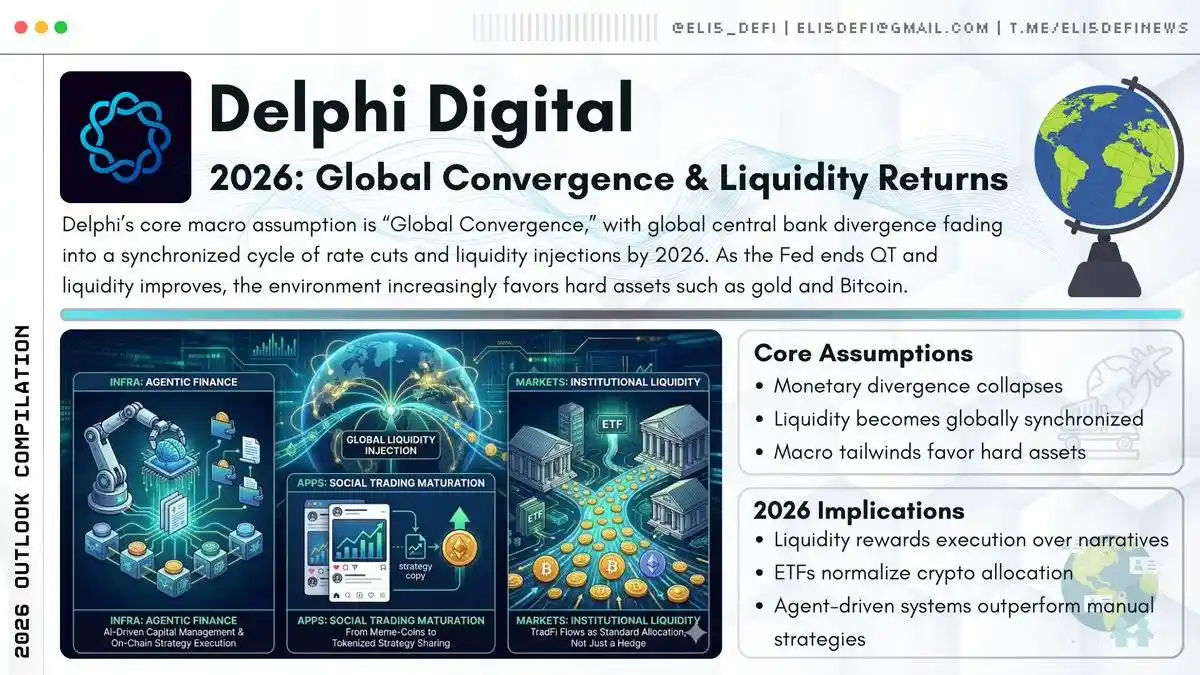
Delphi Digital's macro hypothesis is based on "Global Convergence." They predict that by 2026, the divergence in monetary policies of global central banks will end, shifting towards a unified cycle of interest rate cuts and liquidity injection. After the Federal Reserve ends quantitative tightening (QT), improved global liquidity will benefit hard assets like gold and Bitcoin.
2026 Outlook:

  1. Agentic Finance

A major expansion in infrastructure is reflected in the rise of "Agentic Finance." AI agents will no longer be just chatbots but will actively manage capital, execute complex decentralized finance (DeFi) strategies, and optimize yields on-chain without human intervention.

  1. Social Trading and the "Pump" Economy

On the consumer application side, Delphi highlighted the stickiness of platforms like @Pumpfun and predicted the maturation of "Social Trading." The trend will shift from simple meme coin speculation to more complex copy-trading hierarchies, with strategy sharing becoming a tokenized product.

  1. Institutional Liquidity

Market structure will change with the further adoption of Exchange Traded Funds (ETFs). Traditional finance (TradFi) liquidity will enter the crypto market, not just as a hedging tool but as a standard portfolio allocation driven by macro liquidity easing.

Click to view the full report:

  • Infrastructure 2026 Outlook

  • Applications 2026 Outlook

  • Markets 2026 Outlook

Messari: 2026 Crypto Industry Outlook - Market Structure and the Rise of Utility

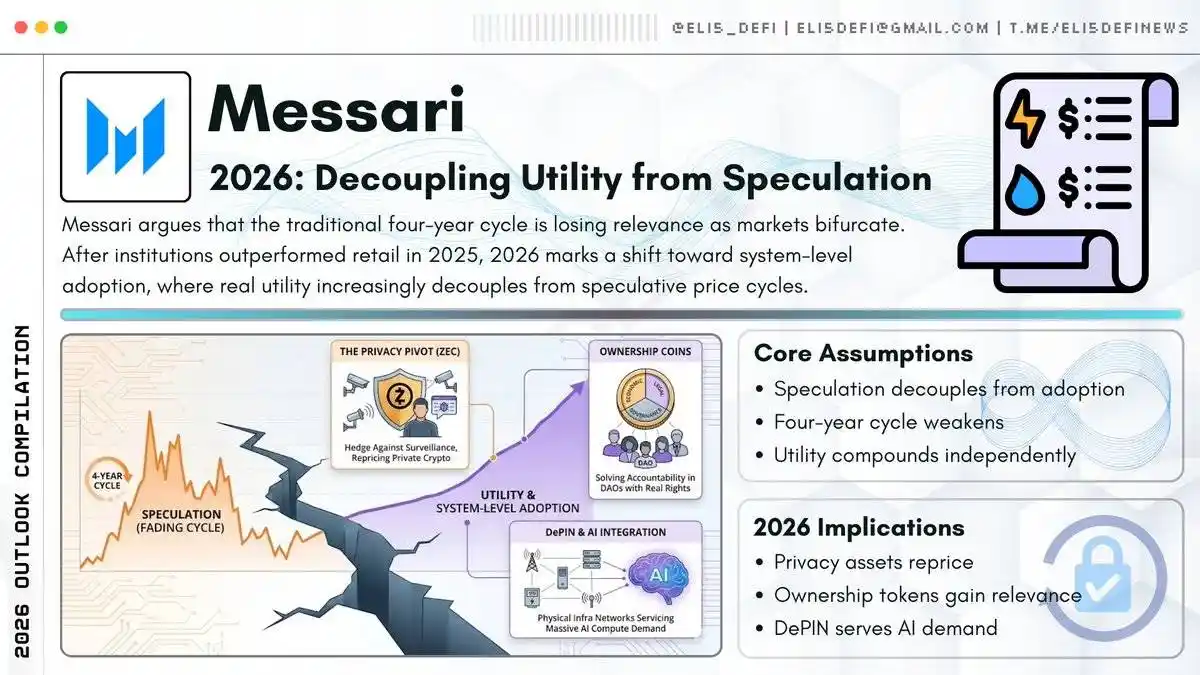
Messari's core argument is "The Separation of Utility and Speculation." They believe the traditional "four-year cycle" model is gradually losing relevance, and the market is moving towards differentiation. They hypothesize that 2025 was a year where institutional investors prevailed and retail investors were frustrated, while 2026 will become the era of "system-level applications," not just speculative games of asset prices.
2026 Outlook:

  1. Privacy Shift ($ZEC)

Messari presents a contrarian growth view: the revival of the privacy sector. They specifically mention assets like @Zcash (ZEC), not just as "privacy coins" but as necessary hedges against increasing surveillance and corporate control, predicting a repricing opportunity for "privacy cryptocurrencies."

  1. Ownership Coins

2026 will see a new token classification—"Ownership Coins." These tokens combine economic, legal, and governance rights. Messari believes these tokens have the potential to solve the accountability crisis in Decentralized Autonomous Organizations (DAOs) and may spawn the first projects with market capitalizations reaching billions of dollars.

  1. DePIN and AI Integration

The research also delves into the potential of DePIN (Decentralized Physical Infrastructure Networks), expecting these protocols to find market fit in the real world by meeting the massive demand for computing and data in the AI field.

Read the full report: 2026 Crypto Industry Report

Four Pillars: Regulatory Restructuring and Super-Apps

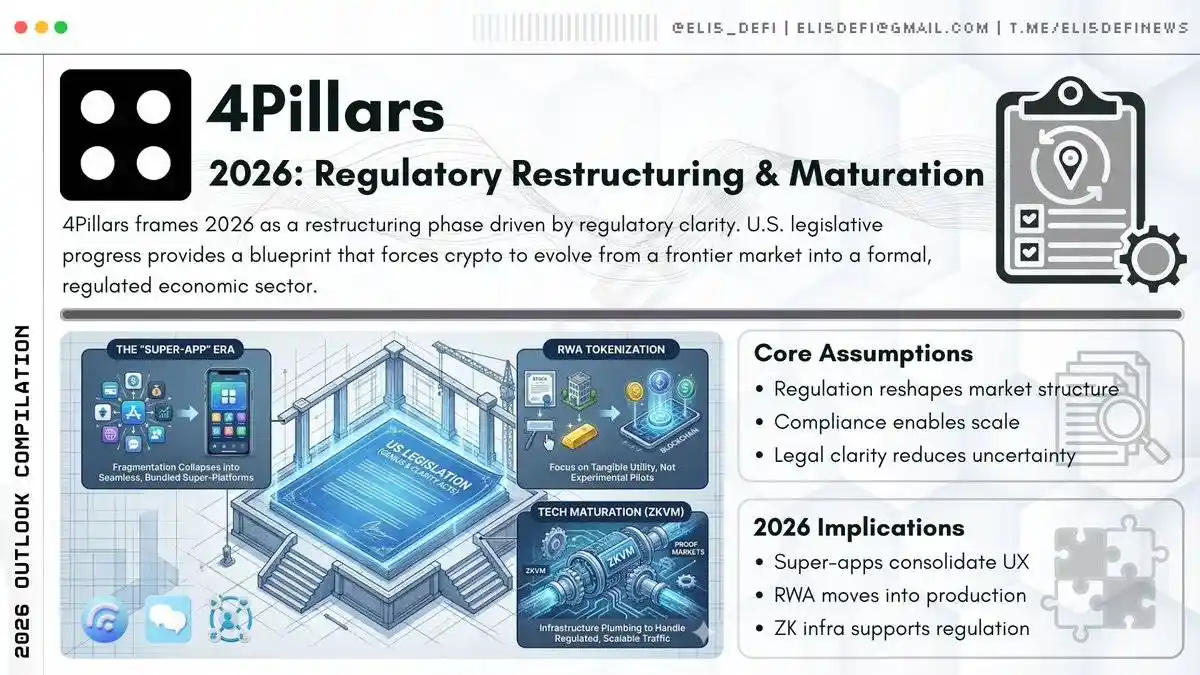
Four Pillars' 2026 outlook revolves around "Regulatory Restructuring." Their core assumption is that US legislative actions (specifically mentioning the GENIUS and CLARITY acts) will become the blueprint for driving comprehensive market reform.

This regulatory clarity will act as a catalyst, transforming the market from a "wild west" state into a formal economic sector.
Four Pillars' 2026 Outlook

  1. The Era of Super-Apps

Four Pillars predict that the current fragmented crypto application ecosystem will gradually consolidate into "Super-Apps." These platforms, driven by stablecoins, will integrate payment, investment, and lending functions, completely simplifying blockchain complexity and enhancing user experience.

  1. RWA Tokenization

As the market restructures, the tokenization of stocks and traditional assets will become a trend, but the focus will be on actual utility rather than experimental projects.

  1. Technological Maturation

On the technical front, the report emphasizes the importance of Zero-Knowledge Virtual Machines (ZKVM) and Proof Markets on Ethereum. They are seen as critical technological infrastructure to handle the traffic scale of emerging regulatory bodies.

Read the full report: 2026 Outlook: Restructuring and a Century-Long Perspective

Coinbase: 2026 Crypto Market Outlook - Markets, Regulation, and Adoption

Coinbase's report presents the view of "Death of the Cycle." They explicitly state that 2026 will mark the end of the traditional Bitcoin halving cycle theory. Future markets will be driven by structural factors: including macro demand for alternative stores of value and the formalization of the crypto industry as a medium-sized alternative asset class.

2026 Outlook:

  1. Tokenomics 2.0

A shift from "governance-only" tokens to "revenue-linked" models. Protocols will gradually introduce token buyback-and-burn or fee-sharing mechanisms (complying with new regulations) to better align token holder interests with platform success.

  1. Digital Asset Trading 2.0 (DAT 2.0)

The crypto market will move towards more professionalized trading models, particularly the procurement and trading of "sovereign block space." Block space will be regarded as a critical resource in the digital economy.

  1. Intersection of AI and Crypto

Coinbase predicts that AI agents will heavily utilize crypto payment channels, driving demand for "crypto-native settlement layers." These layers can support continuous micro-transactions between machines, a need that traditional payment systems cannot meet.

Read the full report: 2026 Crypto Market Outlook

a16z Crypto: 2026 Outlook - The Future of Internet-Native Finance and AI

a16z Crypto's outlook is based on a core hypothesis: "The internet becomes the bank." They believe that the flow of value will become as free as the flow of information. The current friction between the on-chain and off-chain worlds is the main bottleneck, and 2026 will be the year this barrier is eliminated through better infrastructure.
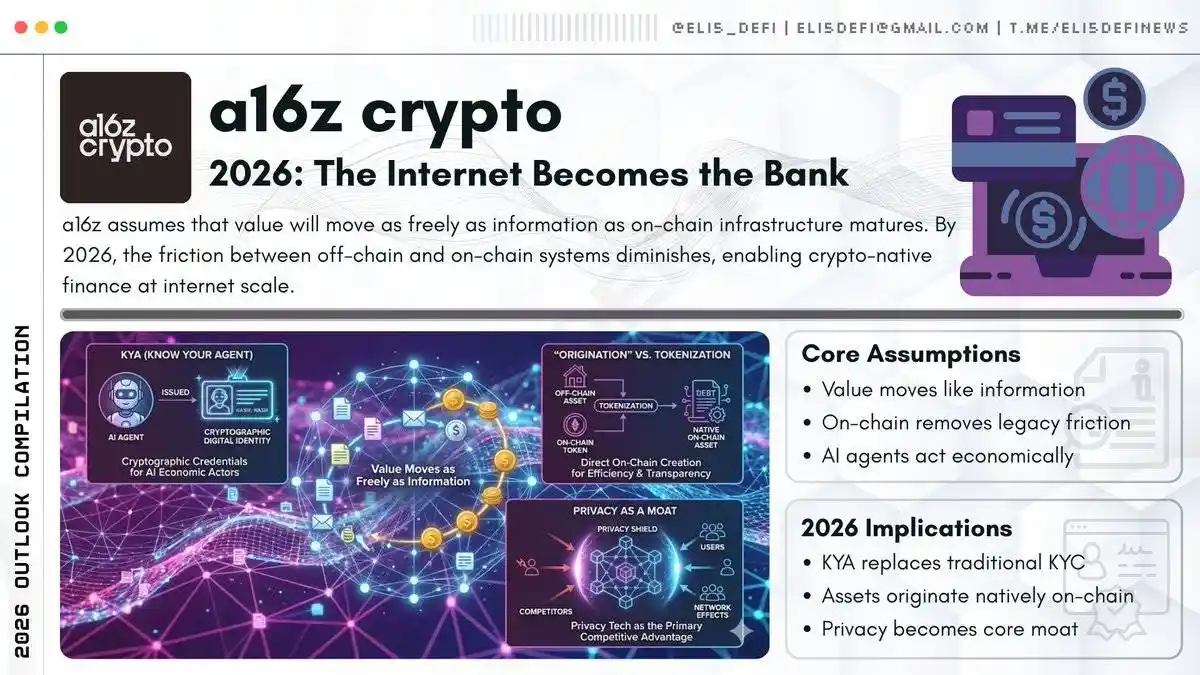
a16z Crypto's 2026 Outlook

  1. KYA (Know Your Agent)

As AI Agents become major economic participants, identity verification will shift from traditional KYC (Know Your Customer) to KYA (Know Your Agent). AI agents will require cryptographically signed credentials to conduct transactions, giving rise to a whole new layer of identity infrastructure.

  1. "Asset Origination" VS "Asset Tokenization"

a16z predicts the market will gradually shift from tokenizing off-chain assets (e.g., buying treasury bonds and putting them on-chain) to generating debt and assets directly on-chain. This shift can not only reduce service costs but also greatly enhance transparency.

  1. Privacy as a Moat

In a world of prevalent open-source code, a16z emphasizes that privacy technology (especially the ability to maintain state privacy) will become the most important competitive advantage for blockchains. This will create strong network effects for privacy-supporting blockchains.

  1. Wealth Management for All

The combination of AI and crypto payment channels will democratize complex wealth management (such as asset rebalancing, tax-loss harvesting), making services previously available only to high-net-worth individuals accessible to ordinary users.

Read the full report: Major Trends in Crypto for 2026

Summary

The 2026 crypto industry outlook shows that structural maturity will replace speculative cycles, driven by liquidity convergence, regulatory clarity, and infrastructure.

Major research institutions unanimously agree that value will concentrate on settlement layers, aggregation platforms, and systems capable of attracting real users and capital.

Future opportunities will shift from chasing cycles to understanding capital flows. 2026 will reward projects that quietly build infrastructure, distribution capabilities, and trust at scale.

Preguntas relacionadas

QWhat is the consensus view among leading research institutions regarding the future of crypto speculation cycles?

ALeading research institutions agree that the era of pure speculative cycles is fading. The future will be driven by structural maturity, including liquidity convergence, infrastructure development, and industry consolidation, rather than short-term narrative-driven market volatility.

QWhat is 'Agentic Finance' and why is it considered a major trend for 2026?

A'Agentic Finance' refers to the rise of AI Agents as primary economic actors. These agents will autonomously manage capital, execute complex DeFi strategies, and optimize yields on-chain without human intervention. This trend is expected to drive the development of 'Know Your Agent' (KYA) identity protocols and machine-native settlement layers.

QHow do reports predict the role of 'Super-Apps' in the crypto space by 2026?

AReports predict that fragmented crypto applications will consolidate into user-friendly 'Super-Apps.' These platforms, often privacy-focused and driven by stablecoins, will integrate payments, investments, and lending, simplifying blockchain complexity and driving mass adoption by hiding technical details.

QWhat are 'Ownership Coins' and how do they differ from traditional tokens?

A'Ownership Coins' are a new token classification that combines economic, legal, and governance rights. They are designed to address accountability crises in DAOs and focus on revenue-sharing models and real-world utility, moving beyond mere governance tokens to better align token holder interests with platform success.

QWhy is privacy highlighted as a critical area of growth and competition in the 2026 crypto outlook?

APrivacy is emphasized as a key competitive advantage and growth area due to increasing surveillance and corporate control. Technologies like zero-knowledge proofs and privacy-focused blockchains (e.g., Zcash) are expected to see renewed interest, offering essential hedging tools and enabling state privacy, which will create strong network effects.

Lecturas Relacionadas

STRC Breaks Below $95: Why Does It Continue to Depeg? Is There Default Risk?

"STRC Falls Below $95: Why the Persistent Depegging and Is There Default Risk?" The article discusses the recent decline in the price of STRC, a perpetual preferred stock issued by Strategy (MSTR) designed to trade around a $100 par value. As of publication, STRC traded at $94.65, raising market concerns. STRC is described as a high-yield cash flow product, offering an 11.50% annual dividend paid monthly. Its "preferred" status grants it priority over common stock for dividends and in liquidation. Key reasons cited for the price depegging include: 1. **Bitcoin's Price Drop:** MSTR's assets are heavily tied to Bitcoin (BTC), which fell over 21% from its recent high, pressuring all Strategy-related products. 2. **Competitive Pressure:** Rival Strive Asset Management's similar product, SATA, offers daily dividends and has maintained its $100 par value with a ~13% yield. In response, Strategy has proposed changing STRC's dividend frequency from monthly to bi-weekly, pending shareholder vote. 3. **Technical Selling:** A break below $100 may have triggered algorithmic selling and stop-losses, exacerbating the decline. Regarding default risk, the analysis suggests it is currently low. Strategy founder Michael Saylor confirmed the June 2026 dividend rate remains at 11.50% with no cuts or suspensions. The company's massive reserve of 843,706 BTC provides a significant backstop for its obligations. Industry opinions are mixed. Some analysts view the BTC holdings as reliable support for dividends, while critics like Peter Schiff warn of potential dividend cuts leading to price crashes and lawsuits. Others highlight inflation risk and the company's ability to reduce dividends without a formal default. In summary, STRC's drop is attributed to BTC volatility, competition, and technical factors. While immediate default risk appears contained, the product faces challenges from market conditions and competitive dynamics.

marsbitHace 44 min(s)

STRC Breaks Below $95: Why Does It Continue to Depeg? Is There Default Risk?

marsbitHace 44 min(s)

AI Trading Cools, South Korean Stocks Plunge 1.8%, Spot Gold Rises 1%, Bitcoin Dives

A sell-off in AI-related stocks, triggered by Broadcom's disappointing earnings forecast, sent shockwaves through global markets. South Korea's KOSPI led Asia's decline, plunging 1.8% as the risks from concentrated chip stock gains and surging leveraged investments came to the fore. The tech-heavy Nasdaq 100 futures fell 0.5% following Broadcom's 14% after-hours plunge, which signaled a slower-than-expected transition to AI clients. This pullback extended Wall Street's weakness, halting the S&P 500's nine-day rally amid hawkish Fed signals and renewed Middle East tensions. South Korean authorities convened an emergency meeting, pledging "immediate measures" against market volatility and warning of record-high stock margin debt. The adjustment rippled across assets: Bitcoin fell to around $64,000, its lowest since February, while safe-haven gold rose 1% on bargain hunting. Oil prices dipped on Middle East ceasefire news. Market analysts noted the sell-off was driven by profit-taking after massive gains, particularly in chip stocks like Samsung and SK Hynix, which now dominate the KOSPI. Wall Street banks are divided on Korea's outlook, with Goldman Sachs raising its target while Citigroup and others warn of overvaluation and a potential bubble. Bridgewater's Ray Dalio noted that great technological shifts often create bubbles. Meanwhile, Fed officials' hints at potential future rate hikes added to the cautious mood ahead of key U.S. jobs data.

华尔街日报Hace 1 hora(s)

AI Trading Cools, South Korean Stocks Plunge 1.8%, Spot Gold Rises 1%, Bitcoin Dives

华尔街日报Hace 1 hora(s)

Seeking Alpha's Hot Article: Why Might the U.S. Stock Market Crash in June?

In a recent Seeking Alpha article, financial professor and analyst Damir Tokic argues that the US stock market may be poised for a significant crash in June 2026. The core thesis centers on a "mega-bubble" in equities, particularly within the technology sector, which has driven the S&P 500 to near-record valuations, with a Shiller P/E ratio exceeding 40—a level comparable to the 2000 dot-com bubble. Tokic identifies two primary catalysts for a potential collapse. First, he points to unsustainable market exuberance fueled by what he terms the "Trump Stimulus"—massive AI capital expenditure by tech giants, which he believes is politically driven and cannot last. Second, and more urgently, he highlights the escalating Iran war as a critical threat. The ongoing closure of the Strait of Hormuz has created a severe global energy supply crunch. Strategic petroleum reserves are projected to hit critically low operational levels by June, potentially causing oil prices to spike above $200 per barrel and triggering a severe, supply-driven inflationary shock. This scenario, Tokic warns, would force the Federal Reserve's hand. Despite currently maintaining a dovish bias, the Fed would likely be compelled to officially pivot to a hawkish stance at its June FOMC meeting to combat soaring inflation and bond yields. He contends that such a shift—or even a failure to act, which would destroy Fed credibility—could be the trigger that punctures the market bubble. The resulting downturn, he concludes, could rival the bear markets of 2000 and 2008, advising investors to prepare for a major correction.

marsbitHace 1 hora(s)

Seeking Alpha's Hot Article: Why Might the U.S. Stock Market Crash in June?

marsbitHace 1 hora(s)

Trading

Spot
Futuros

Artículos destacados

Cómo comprar ONE

¡Bienvenido a HTX.com! Hemos hecho que comprar Harmony (ONE) sea simple y conveniente. Sigue nuestra guía paso a paso para iniciar tu viaje de criptos.Paso 1: crea tu cuenta HTXUtiliza tu correo electrónico o número de teléfono para registrarte y obtener una cuenta gratuita en HTX. Experimenta un proceso de registro sin complicaciones y desbloquea todas las funciones.Obtener mi cuentaPaso 2: ve a Comprar cripto y elige tu método de pagoTarjeta de crédito/débito: usa tu Visa o Mastercard para comprar Harmony (ONE) al instante.Saldo: utiliza fondos del saldo de tu cuenta HTX para tradear sin problemas.Terceros: hemos agregado métodos de pago populares como Google Pay y Apple Pay para mejorar la comodidad.P2P: tradear directamente con otros usuarios en HTX.Over-the-Counter (OTC): ofrecemos servicios personalizados y tipos de cambio competitivos para los traders.Paso 3: guarda tu Harmony (ONE)Después de comprar tu Harmony (ONE), guárdalo en tu cuenta HTX. Alternativamente, puedes enviarlo a otro lugar mediante transferencia blockchain o utilizarlo para tradear otras criptomonedas.Paso 4: tradear Harmony (ONE)Tradear fácilmente con Harmony (ONE) en HTX's mercado spot. Simplemente accede a tu cuenta, selecciona tu par de trading, ejecuta tus trades y monitorea en tiempo real. Ofrecemos una experiencia fácil de usar tanto para principiantes como para traders experimentados.

251 Vistas totalesPublicado en 2024.12.12Actualizado en 2026.06.02

Cómo comprar ONE

Discusiones

Bienvenido a la comunidad de HTX. Aquí puedes mantenerte informado sobre los últimos desarrollos de la plataforma y acceder a análisis profesionales del mercado. A continuación se presentan las opiniones de los usuarios sobre el precio de ONE (ONE).

活动图片