RaveDAO drops 12% – Will whales push RAVE prices even lower?

ambcryptoPublicado a 2026-07-01Actualizado a 2026-07-01

Resumen

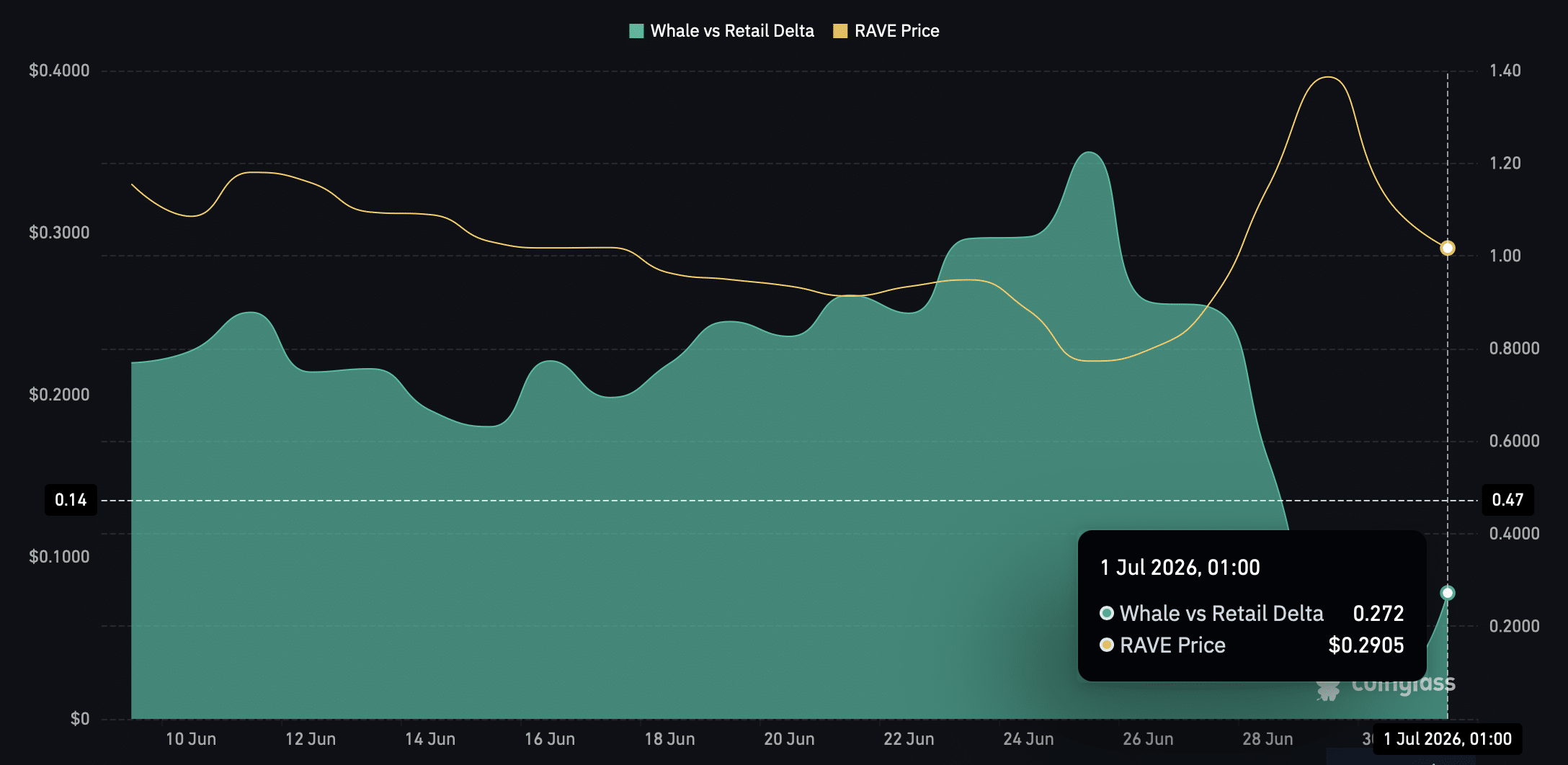
RaveDAO (RAVE) has declined 12% in the past 24 hours, with the downtrend potentially continuing due to intense selling pressure from whale investors. Key indicators point to a weakening market: the Bull Bear Power (BBP) shows bullish conviction fading, while the Accumulation/Distribution (A/D) line confirms dominant selling activity. Data identifies whales as the primary force behind the sell-off, with a whale-retail delta reading climbing to 0.272. Their influence is significant given their control over the vast majority of RAVE's supply on BSC, Base, and Ethereum chains. Concurrently, spot demand has collapsed, with net flows plunging to approximately -$269,000. With whale selling ongoing, spot demand absent, and technical indicators deteriorating, RAVE's price remains in a precarious position and is vulnerable to further declines.

RaveDAO [RAVE] has slipped another 12% over the past day at press time. The broader outlook offers little to lean on, and with spot demand almost entirely absent, on the chart as much as in the order books, the price could swing lower still from its current level.

RAVE bulls retreat as conviction fades

Recent chart data points to weakening conviction among the investors who once read RAVE as bullish.

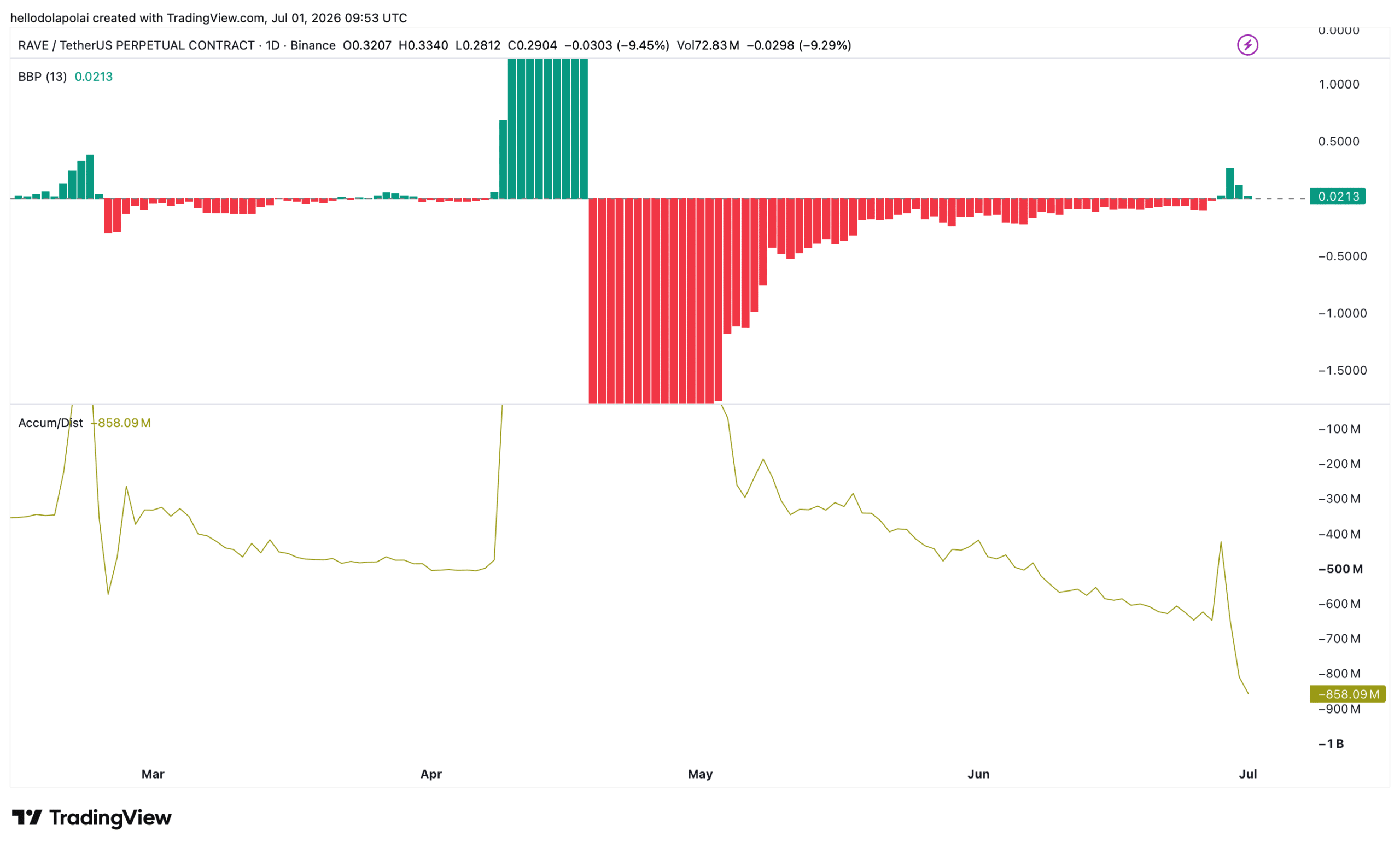
At the time of writing, the Bull Bear Power (BBP) indicator, which gauges whether bulls or bears hold sway over the market, showed that bulls were in control, though their grip has loosened considerably.
Source: TradingView

The histogram carries the same message, sliding from deep green to a lower green reading, a sign that bulls are gradually stepping back and unwinding their RAVE positions. RAVE’s Accumulation/Distribution (A/D) indicator provided the most accurate reading on the sell-off, with selling dominating trade over the last 24 hours as the A/D line fell.

Should BBP keep declining and possibly flip negative while A/D continues to plummet, the price would sit in an increasingly precarious position.

Whales drive the sell-off

The sell-off carries added weight because the data pins whales as the driving force, and they look set to offload even more of the asset.

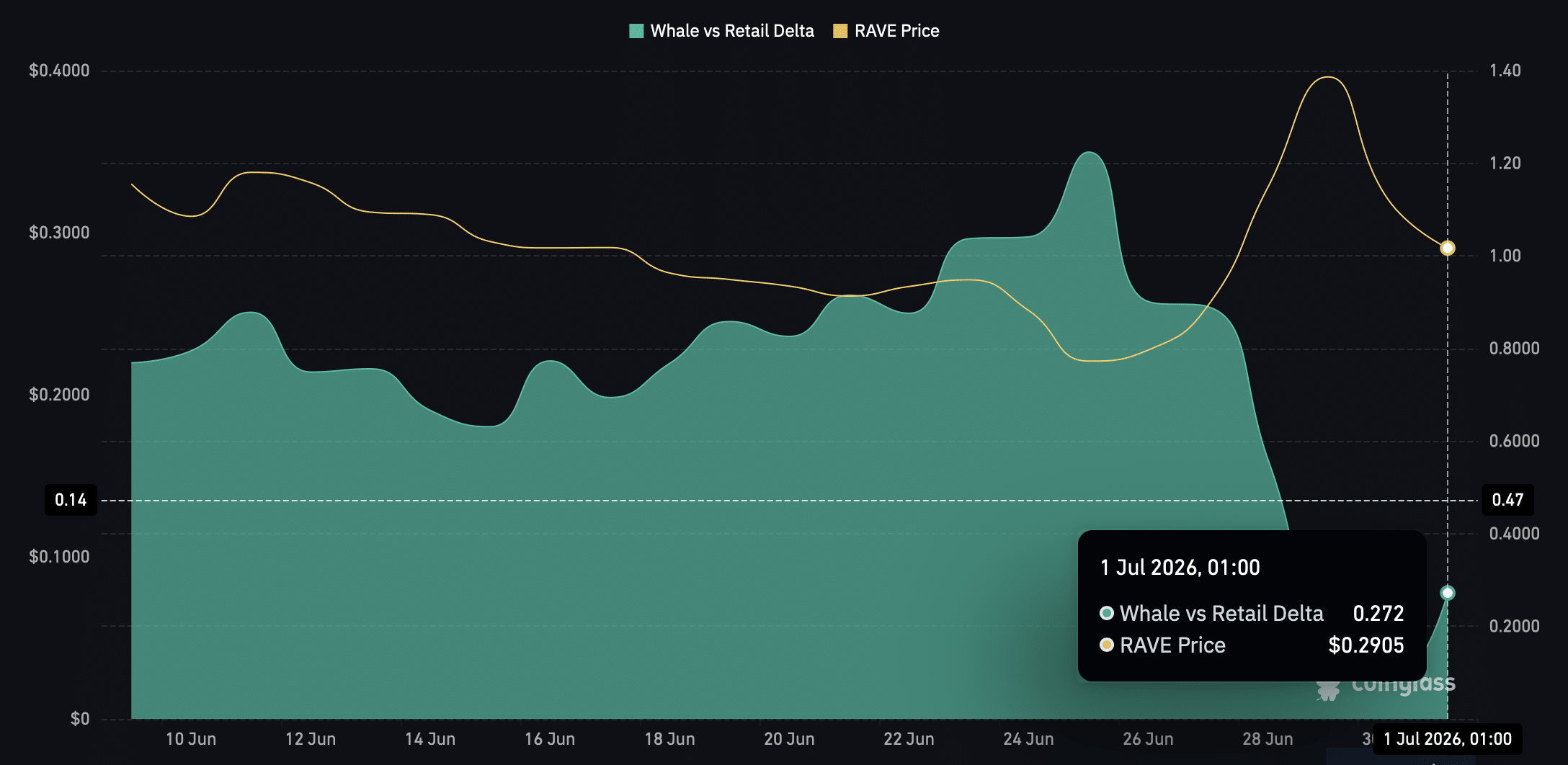
At the time of writing, the whale‐retail delta, a metric tracking which cohort is buying or selling, shows whales in the lead, with the reading climbing to 0.272.
Source: CoinGlass

In RAVE’s case, that influence is difficult to overlook, with CoinMarketCap data showing this cohort controls the majority of supply across the three chains where the token trades.

On BSC, the top ten wallets hold 93.03% of the supply, while the figures stand at 87.38% on Base and 97.42% on Ethereum. Concentration on this scale means whale activity during stretches like this often overshadows retail investor positioning.

RAVE spot demand weakens

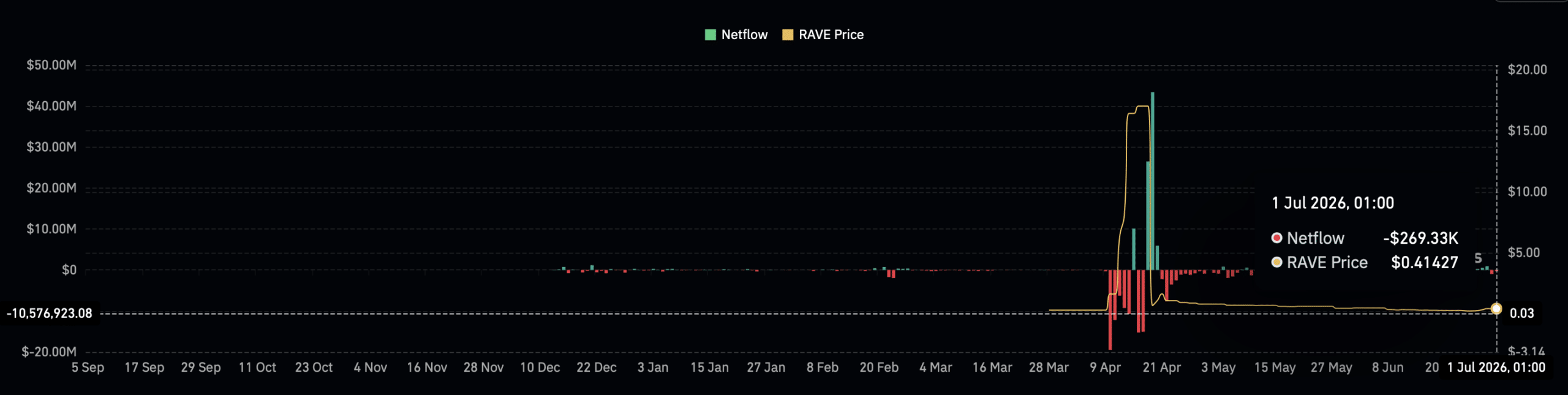
RAVE’s spot demand has fallen over the past day, reversing the buying that had propped up the asset earlier in the week.
Source: CoinGlass

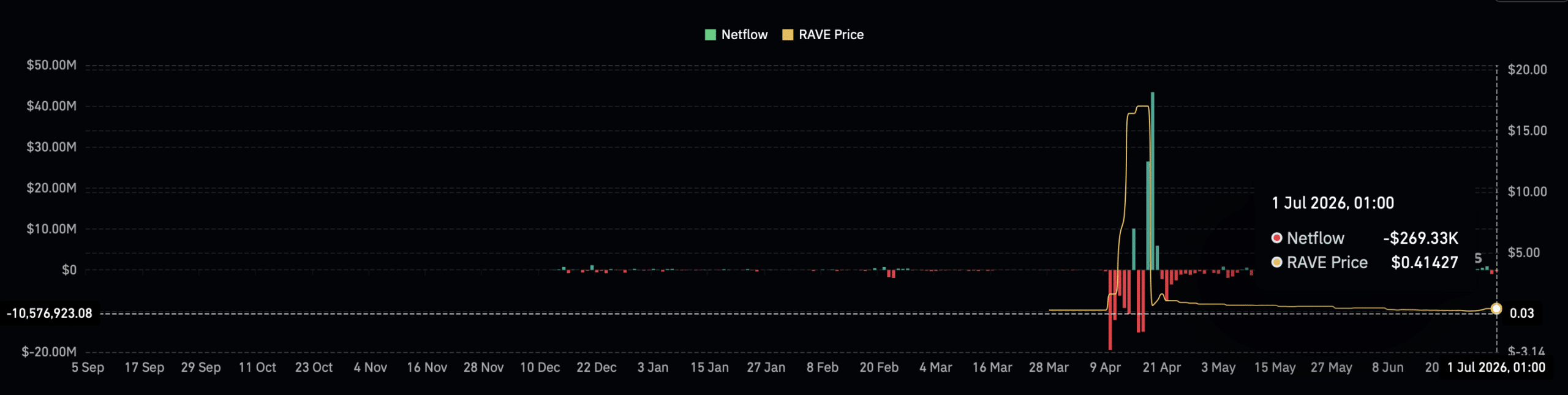
At press time, netflow has plunged to around ‐$269,000 over the past day. A decline of this kind does price no favors, particularly while broader market sentiment remains soft.

However, a further drop would reinforce the bearish outlook already sitting in the market and push RAVE lower on the chart.


Final Summary

  • RAVE has shed another 12% over the past day as whale wallets drove an intensifying sell-off.
  • Weakening spot demand and softening BBP and A/D readings left the price exposed to further downside if selling pressure holds.


Criptos en tendencia

Preguntas relacionadas

QAccording to the article, what percentage has RaveDAO (RAVE) fallen in the past day?

ARaveDAO (RAVE) has fallen by 12% over the past day.

QWhat do the declining Bull Bear Power (BBP) and Accumulation/Distribution (A/D) indicators suggest about RAVE's price outlook?

AThe declining BBP and falling A/D indicators suggest weakening conviction among bulls and dominant selling pressure, leaving the price in a precarious position and exposed to further downside.

QWhich investor group is identified as the main driving force behind the current RAVE sell-off?

AWhales are identified as the main driving force behind the current RAVE sell-off.

QHow concentrated is whale ownership of RAVE across its trading chains, according to the article?

AWhale ownership is extremely concentrated. The top ten wallets hold 93.03% of the supply on BSC, 87.38% on Base, and 97.42% on Ethereum.

QWhat does the article state about RAVE's spot demand and netflow at press time?

ARAVE's spot demand has weakened, and the netflow over the past day has plunged to approximately -$269,000, which does not favor the price.

Lecturas Relacionadas

The Most Secretive Winners of the AI Boom

"The Most Hidden AI Winners" An unlikely group of companies are emerging as major beneficiaries of the AI boom, not from designing chips, but from supplying critical materials and components essential for advanced semiconductor manufacturing. These 'hidden winners' are traditional manufacturers whose deep expertise in materials science has become indispensable. Japanese companies are leading this trend. Toto, globally known for bathroom fixtures, has seen its stock surge 145% over the past year, driven by its 40-year-old semiconductor ceramics business, which now contributes over half of its operating profit. Its electrostatic chucks are vital for advanced chip production and require years of expertise to manufacture. Similarly, Nittobo, a 128-year-old textile firm, controls 90% of the market for T-glass, a low-expansion glass fiber essential for AI chip substrates. Ajinomoto, the world's largest MSG producer, dominates the market (80-95% share) for ABF insulating film used in chip packaging. The core insight is that chasing "advanced" chips paradoxically increases reliance on traditional, high-precision material science where supply cannot be quickly replicated. These materials are now critical bottlenecks in the AI supply chain. This trend is mirrored in China's A股 market, framed by the theme of 'import substitution'. Companies like Zhongci Dianzi (electrostatic chucks) and Honghe Technology (ultra-thin electronic cloth) are making progress, but face the test of scaling production and matching Japanese rivals' quality. The key tension lies in the slow change of market perception. While profit structures rapidly shift towards high-margin tech components, these firms retain their traditional industry classifications, creating a valuation gap that is gradually closing as their roles in the AI ecosystem become undeniable.

链捕手Hace 2 min(s)

The Most Secretive Winners of the AI Boom

链捕手Hace 2 min(s)

DeFi Enters a Moment of Value Reassessment: Risks and Opportunities Behind the $70 Billion TVL

DeFi Enters a Moment of Value Reassessment: Peril and Opportunity Behind $70 Billion TVL On July 1st, the total value locked (TVL) across all DeFi protocols fell below $70 billion to approximately $69.358 billion, hitting its lowest point since February 2024. This decline signals a significant contraction in DeFi liquidity and marks a new adjustment phase for the industry, far from its 2021 peak of over $180 billion. The primary drivers of this TVL drop are a general decrease in crypto market risk appetite, which leads capital to exit volatile sectors like DeFi first, and the fading effectiveness of the high-yield liquidity incentive models that fueled the initial DeFi boom. Many protocols' high TVL figures were built on temporary subsidy-driven capital rather than genuine demand. Furthermore, capital is migrating to newer narratives like AI, RWA, and modular infrastructure. This cooldown exposes DeFi's growth bottlenecks: innovation has slowed with rampant protocol copycats, real yields have normalized to single digits, and poor user experience continues to hinder mass adoption beyond crypto-natives. However, the TVL decline does not spell the end for DeFi. The metric itself is limited, as it fluctuates with underlying asset prices. The industry is shifting from capital accumulation to efficiency competition, leveraging Layer 2 solutions and modular architecture to do more with less locked value. Crucially, DeFi is expanding into real-world financial use cases like the tokenization of real-world assets (RWA) and the growth of the stablecoin ecosystem, moving its value proposition from speculative token subsidies to real cash flows. In conclusion, while short-term pressures from liquidity contraction and user growth stagnation persist, the sector is undergoing a necessary value reassessment. DeFi is transitioning from a subsidy-driven, hype-based era toward a more mature, rational, and efficiency-focused phase, with long-term growth hinging on meeting real-world financial needs through RWA, stablecoins, and robust infrastructure.

marsbitHace 21 min(s)

DeFi Enters a Moment of Value Reassessment: Risks and Opportunities Behind the $70 Billion TVL

marsbitHace 21 min(s)

Trading

Spot

Artículos destacados

Cómo comprar PUSH

¡Bienvenido a HTX.com! Hemos hecho que comprar Push Protocol (PUSH) sea simple y conveniente. Sigue nuestra guía paso a paso para iniciar tu viaje de criptos.Paso 1: crea tu cuenta HTXUtiliza tu correo electrónico o número de teléfono para registrarte y obtener una cuenta gratuita en HTX. Experimenta un proceso de registro sin complicaciones y desbloquea todas las funciones.Obtener mi cuentaPaso 2: ve a Comprar cripto y elige tu método de pagoTarjeta de crédito/débito: usa tu Visa o Mastercard para comprar Push Protocol (PUSH) al instante.Saldo: utiliza fondos del saldo de tu cuenta HTX para tradear sin problemas.Terceros: hemos agregado métodos de pago populares como Google Pay y Apple Pay para mejorar la comodidad.P2P: tradear directamente con otros usuarios en HTX.Over-the-Counter (OTC): ofrecemos servicios personalizados y tipos de cambio competitivos para los traders.Paso 3: guarda tu Push Protocol (PUSH)Después de comprar tu Push Protocol (PUSH), guárdalo en tu cuenta HTX. Alternativamente, puedes enviarlo a otro lugar mediante transferencia blockchain o utilizarlo para tradear otras criptomonedas.Paso 4: tradear Push Protocol (PUSH)Tradear fácilmente con Push Protocol (PUSH) en HTX's mercado spot. Simplemente accede a tu cuenta, selecciona tu par de trading, ejecuta tus trades y monitorea en tiempo real. Ofrecemos una experiencia fácil de usar tanto para principiantes como para traders experimentados.

225 Vistas totalesPublicado en 2024.12.13Actualizado en 2026.06.02

Cómo comprar PUSH

Discusiones

Bienvenido a la comunidad de HTX. Aquí puedes mantenerte informado sobre los últimos desarrollos de la plataforma y acceder a análisis profesionales del mercado. A continuación se presentan las opiniones de los usuarios sobre el precio de PUSH (PUSH).

活动图片