Ranger Public Offering Introduces New Features, Can a Grassroots Team Win Market Trust?

marsbitPublicado a 2026-01-08Actualizado a 2026-01-08

Resumen

On January 6th, Ranger Finance, a DEX aggregator on Solana, launched its ICO for the RNGR token via the MetaDAO platform to raise funds and accelerate development. The project aims to address fragmented liquidity and poor execution quality in the derivatives market by using an intelligent order routing system that scans multiple venues for optimal trade execution. It also offers a unified interface for managing diverse trading positions and plans to introduce cross-margin support. The public sale, running until January 10th, has a minimum fundraising target of $6 million. If exceeded, Ranger will initiate a buyback plan to repurchase and burn tokens at the difference between the ICO and listing price. The total token supply is 25,625,000, with 10 million allocated to the ICO. Team tokens (29.6% of supply) are subject to performance-based vesting, unlocking at multiples of the ICO price (2x to 32x). Ranger raised $1.9 million in December 2024 from investors like RockawayX and Asymmetric. The team, including co-founders with backgrounds at SolanaFM and mtnCapital, is partially anonymous, which may pose trust issues despite alignment incentives. Currently, the ICO has raised $2.9 million from nearly 1,800 investors, with market predictions suggesting a high probability of exceeding $30 million.

On January 6th, the public offering (ICO) for Ranger Finance, a DEX aggregator on the Solana blockchain, officially launched. This public offering is conducted through the MetaDAO platform to raise funds for Ranger's token, RNGR, aiming to expand the team's capabilities and accelerate development.

Currently, the daily derivatives trading volume on Solana, Arbitrum, and Hyperliquid reaches approximately $50 billion. However, most trading platforms still lock each order to a single trading venue, leading to fragmented liquidity, reduced execution quality, and ultimately a worse experience for traders. Ranger's core intelligent order routing system scans integrated trading venues in real-time, assesses liquidity depth, intelligently splits large orders, and executes trades at the optimal price.
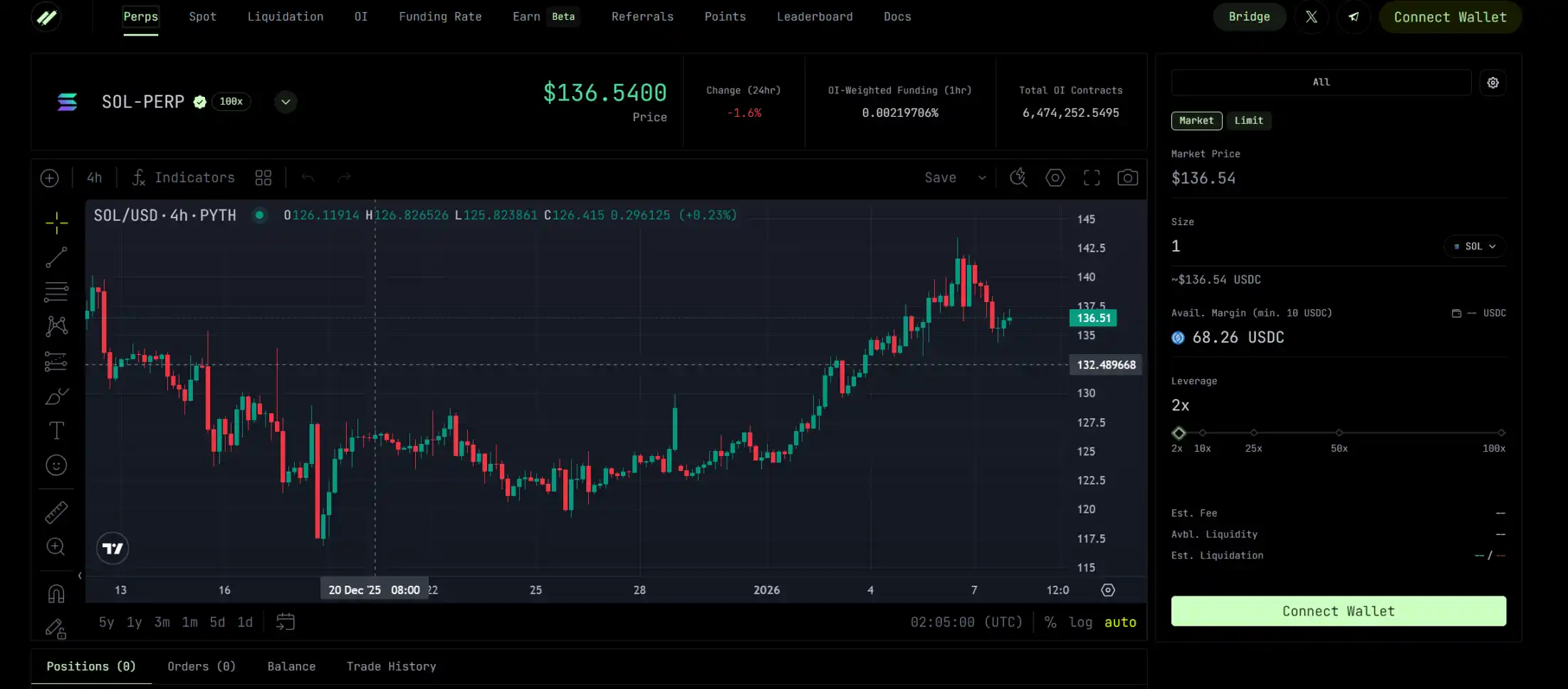
Ranger Finance also provides an intuitive interface for managing diverse trading positions, all operable on a single platform. The cross-margin support system (coming soon) allows the use of multiple assets in a single wallet as collateral, enabling greater flexibility and capital efficiency.

Public Offering Minimum Target $6 Million, Team Sets Performance-Based Unlock

The public offering runs until January 10th, with the officially announced minimum fundraising target of $6 million and a monthly spending limit of $250,000 (project founders can use this amount at their discretion each month without submitting a DAO proposal. The DAO reserves the right to adjust this amount in the future). Ranger point holders have priority in committing funds to the ICO. This priority is allocated proportionally among all point holders, with the remaining portion then allocated proportionally among non-point committers.

If the fundraising exceeds the minimum target ($6 million), Ranger will initiate a buyback plan, repurchasing tokens within 90 days based on the difference between the ICO price and the post-listing price. The repurchased tokens will be burned.

Ranger's total token supply is 25,625,000. The ICO token pool consists of 10 million tokens. Existing investors are allocated a total of 4,356,250 tokens (with a 24-month linear vesting period).

Notably, the project has specifically set up performance rewards. Team performance reward package: 7,600,000 tokens (18-month lock-up period, then unlocked based on price, using a 3-month TWAP as a benchmark, unlocking at 2x, 4x, 8x, 16x, and 32x the ICO price).

Ambassadors and ecosystem partners: 768,750 tokens (25% unlocked immediately, remaining 25% vested linearly over 6 months).

The remaining supply is for providing liquidity, with 20% of the raised funds plus 2 million tokens to be deposited into FutarchyAMM, and 900,000 tokens to be deposited unilaterally into Meteora's liquidity pool.

Previously Raised Funding at a $30 Million Valuation

In December 2024, during a period of excitement in the crypto market, Ranger completed a $1.9 million funding round led by RockawayX, with participation from Asymmetric, Big Brain Holdings, RISE Capital, and Anagram, among others.

This year, Ranger not only launched tokenized stocks based on xStocks but also acquired the strategy protocol Voltr in November.

Public information about the Ranger team is relatively limited. Its co-founder, Fathurrahman Faizal, graduated from Singapore Management University and previously served as COO at SolanaFM. Another co-founder, Barrett Williams, is also a co-founder of mtnCapital and has invested in the on-chain order book trading protocol BULK and MetaDAO.

The team allocation accounts for 29.6% of the total supply, unlocking only upon reaching ICO price milestones (e.g., 2x, 4x, 8x, 16x, 32x FDV). This incentive mechanism aligns with investor interests and is one of the few highlights. The team emphasizes "no pre-mining" and transparent governance but lacks specific links for verification, which may raise trust issues. The project claims to be built on TechFlow but does not disclose core developer experience.

Overall, the team's anonymity aligns with DeFi culture, but for a project seeking to raise millions in a public offering, this could be a potential risk point.
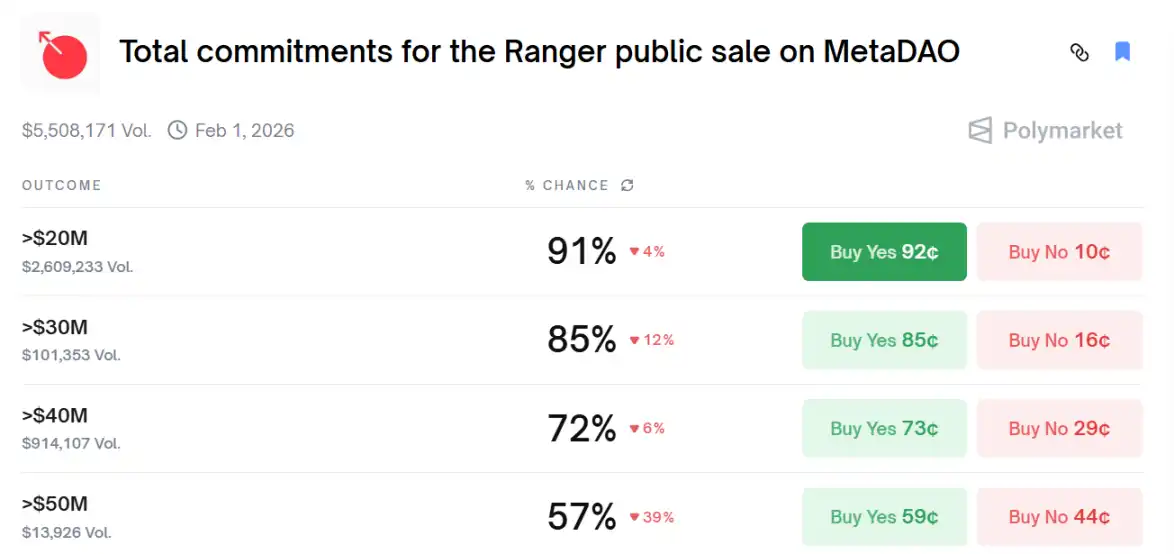
As of now, the official website shows that fundraising has reached $2.9 million, with nearly 1,800 investors participating. Polymarket data indicates an 85% probability that the market is betting on the public offering subscription amount exceeding $30 million.


Preguntas relacionadas

QWhat is the main purpose of Ranger Finance's ICO and on which platform is it being conducted?

AThe ICO aims to raise funds for Ranger Finance's RNGR token to expand team capabilities and accelerate development. It is being conducted on the MetaDAO platform.

QWhat is the core technological solution that Ranger Finance provides to address liquidity fragmentation in decentralized exchanges?

ARanger Finance's core solution is its smart order routing system, which scans integrated trading venues in real-time, assesses liquidity depth, intelligently splits large orders, and executes trades at the best available price.

QWhat is the minimum fundraising target for the Ranger ICO and what happens if this target is exceeded?

AThe minimum fundraising target is $6 million. If this target is exceeded, Ranger will initiate a buyback plan within 90 days to repurchase tokens at the difference between the ICO price and the post-listing price, with the repurchased tokens being burned.

QHow is the team's token allocation structured to align their incentives and investor interests?

AThe team's allocation of 7,600,000 tokens has an 18-month lockup period, followed by unlocks based on price milestones. These unlocks occur when the token's 3-month TWAP reaches 2x, 4x, 8x, 16x, and 32x the ICO price.

QWhat are some of the potential trust issues or risks associated with the Ranger Finance project mentioned in the article?

APotential risks include the team's relatively anonymous nature, which is common in DeFi but a concern for a project seeking a public sale. The article also notes a lack of specific links to substantiate claims of 'no pre-mining' and transparent governance, as well as undisclosed core developer experience.

Lecturas Relacionadas

TechFlow Intelligence Bureau: Chip Stocks Lose Trillions in a Single Day, Bitcoin Falls Below $60,000, US-Iran Conflict Escalates

**Daily Tech & Markets Roundup: AI Advances, Market Turmoil, and Geopolitical Tensions** **AI / LLMs**: Anthropic's internal report on AI self-improvement sparked serious discussions about Recursive Self-Improvement (RSI). Meanwhile, debate continues on AI coding tools after Claude was accused of introducing bugs into the rsync codebase. In positive news, DeepSeek V4 Flash impressed in local deployment tests, and GitHub Copilot now supports custom endpoints for local models. A surprising research turn suggests removing chain-of-thought prompting can sometimes improve LLM performance. **Crypto / Web3**: Bitcoin plunged below $60,000, with its RSI hitting levels last seen during the COVID-19 crash, driven by strong U.S. jobs data reviving interest rate hike fears. Discussions highlight Ethereum DeFi's continued lack of a smooth consumer payment layer. **Chips / Hardware**: Chip stocks suffered a massive sell-off, with the Philadelphia Semiconductor Index posting its worst single-day drop in six years, erasing over a trillion dollars in value. Marvell, Micron, AMD, and Intel were among the biggest losers. **Tech Companies**: A leaked Microsoft document revealing goals to make Copilot "addictive" drew criticism. LinkedIn founder Reid Hoffman left Microsoft's board to focus full-time on his AI agent startup, Manus. Google was revealed to be paying SpaceX $920 million monthly for AI training compute. **Markets & Macro**: A blowout U.S. jobs report (172k vs. 80k expected) crushed hopes for near-term rate cuts, sending Treasury yields soaring and triggering a broad market sell-off. CEOs from Kraft, McDonald's, and Whirlpool simultaneously warned U.S. consumers are exhausting their savings. **Geopolitics**: U.S.-Iran tensions escalated with missile/drone interceptions and U.S. strikes on Iranian radar sites, keeping the critical Strait of Hormuz largely closed since late February and posing ongoing oil supply risks. **The Bottom Line**: The strong jobs data acted as a single trigger for correlated sell-offs across equities, crypto, and chips. Underlying the volatility is a stark contradiction between robust employment data and warnings of consumer weakness, alongside geopolitical risks that could reignite inflation, leaving markets to price in a fraught macro outlook with no clear "soft landing" path.

marsbitHace 58 min(s)

TechFlow Intelligence Bureau: Chip Stocks Lose Trillions in a Single Day, Bitcoin Falls Below $60,000, US-Iran Conflict Escalates

marsbitHace 58 min(s)

It Took Me a Year to See the Bitter Truth About Agent Payments

After a year building infrastructure for the Agent economy, engaging with major players like Stripe, Visa, and Coinbase, the author shares a sobering analysis of the current state of Agent payments. The core finding is a stark lack of genuine, immediate demand across most envisioned use cases. The article breaks down four key market segments: 1. **Agent-to-Merchant (Consumer Shopping):** For most product categories (e.g., clothing, electronics), conversational AI shopping is a step backwards from visual e-commerce interfaces. While agents excel at understanding needs, they can't replace side-by-side product comparison. Real merchant interest is defensive "Agent Engine Optimization," not driven by current customer demand. Potential exists for high-frequency, low-decision purchases (like food delivery) or navigating complex store UIs, but these require massive B2C distribution channels dominated by giants like Amazon. 2. **Agent-to-API (Developer Services):** Developers already have subscriptions and billing relationships for APIs (compute, data). Prepaid balances solve micro-payment issues for low transaction volumes. A deeper structural problem is that major SaaS vendors' business models rely on enterprise contracts, resisting granular pay-per-call pricing. While protocols like MPP and x402 serve the long tail of niche services, this market is small and developers are historically low-willingness-to-pay. 3. **Agent-to-Agent:** This remains largely theoretical with minimal transaction volume. While it represents a long-term bet on a fundamentally new transaction infrastructure (sub-second, micro-penny to million-dollar, multi-party settlements), it does not constitute a present market. 4. **Agent-to-Finance:** This is the only category with existing, paying demand. Integrating AI into financial workflows (trading, portfolio management) is a natural evolution and enables new capabilities like autonomous rebalancing. However, competition favors established, regulated institutions. The "real problem" is not moving money between agents, but the broader challenge of **coordination**—orchestrating work between agents and humans, verifying outcomes, and settling results. Payment is just one component of settlement, which is itself part of coordination. Companies that solve the coordination layer will subsume payment, not the other way around. While well-funded incumbents build defensively for a long-term future, startups must find where the market is today—which, for the author's team, lies outside these four categories in an area of real, growing, and underserved activity.

marsbitHace 1 hora(s)

It Took Me a Year to See the Bitter Truth About Agent Payments

marsbitHace 1 hora(s)

It Took Me a Year to See the Hard Truth About Agent Payments

**Title: It Took Me a Year to See the Hard Truth About Agent Payments** Over the past year, I've worked on infrastructure for the Agent economy, engaging with major players like Stripe, Visa, Coinbase, and numerous startups. The findings reveal a stark reality: genuine, widespread demand for Agent-based payments does not yet exist. **Key Observations:** * **Agent-to-Merchant (Shopping):** The user experience for AI shopping often falls short, especially for visual product discovery. While AI excels at understanding needs, conversational interfaces can't yet replace browsing and comparing multiple products visually. Current merchant interest is largely defensive ("Agent Engine Optimization") for a future that hasn't arrived. High-frequency, low-friction purchases (like food delivery) are potential fits, but lack open APIs and face high AI inference costs. Simpler, more affordable, or cross-language interactions for complex UIs are a niche opportunity but require massive consumer distribution to scale. * **Agent-to-API (Developer Tools):** Developer payment needs for APIs (computing, data, models) are already met through subscriptions and prepaid credits. The core challenge is not payment friction but supplier economics: most large SaaS providers prefer enterprise contracts over micropayments for API calls. Protocols like MPP and x402 suit the long-tail of smaller services but cater to a developer market historically reluctant to pay for these tools. Major infrastructure needs at the top of the stack are already being addressed. * **Agent-to-Agent (Machine Commerce):** This is a long-term vision with almost no current transaction volume. While a future with high-speed, high-frequency, multi-party machine-to-machine transactions would require novel infrastructure, it remains theoretical. The market is not here yet. * **Agent-to-Finance:** This is the only category with clear, present demand. Financial professionals and DeFi users already pay for tools, and AI augmentation is a natural evolution. Autonomous AI agents can enable entirely new financial strategies. However, competition is fierce from established, regulated incumbents who can more easily layer AI onto their existing products. **The Core Insight:** Companies, especially giants with long time horizons, are building defensively for a potential future of mass machine commerce. For them, early investment is a low-cost hedge. For startups, the current market reality is different. The primary challenge isn't just moving money between agents (payments). The larger, unsolved problem is **orchestration** – coordinating work between agents and humans, verifying outcomes, and then settling. Payment is just a part of settlement, which is just a part of orchestration. Companies that solve the orchestration problem will subsume payments, not the other way around. After a year of building, we see the real, growing, and underserved market opportunity lies in this broader domain of orchestration.

链捕手Hace 2 hora(s)

It Took Me a Year to See the Hard Truth About Agent Payments

链捕手Hace 2 hora(s)

Claude Opus 4.8 Finds a $4.5 Billion Bug: The AI Era is Mass-Producing Hackers

A researcher discovered a critical "infinite mint" vulnerability in the Zcash cryptocurrency's Orchard protocol using Claude Opus 4.8, leading to a swift fix but also a 50% market drop, erasing billions in value. This incident highlights a new era where powerful, accessible AI models are dramatically lowering the barrier to finding software vulnerabilities. Previously, the security community feared specialized models like Claude Mythos Preview, capable of finding decades-old zero-day exploits. The Zcash case, however, involved a publicly available, general-purpose model. This shift makes advanced security auditing—and attack capabilities—accessible to far more people, not just experts. The mass democratization of vulnerability discovery brings a dual challenge: a flood of low-quality, AI-generated false reports that overwhelm maintainers, and the real, rapid uncovering of deep, dangerous bugs. Open-source projects, often understaffed and unfunded, are particularly vulnerable to this "attention DDoS." The article cites examples like curl shutting down its bug bounty program due to the unsustainable workload. Our perceived digital safety has often been luck, relying on the high cost and effort required to find deeply hidden flaws in complex systems, as seen with historical vulnerabilities like Heartbleed or Baron Samedit. AI changes this cost structure, effectively "mass-producing flashlights" to illuminate every corner of our codebase. While large companies operate extensive security chains involving external white-hat hackers and massive defensive operations, the global cybersecurity workforce faces a severe shortage, especially of experienced personnel capable of analyzing complex threats and coordinating fixes. The core dilemma emerges: AI makes *finding* bugs cheap and scalable, but *fixing* them remains a slow, expensive, and human-intensive process. The article concludes that AI won't destroy the internet but acts as a bright light, revealing that our digital existence is not inherently secure but is precariously maintained by ongoing human effort. The true cost in the AI era may not be discovery, but whether there will be enough people left willing and able to do the hard work of repair.

marsbitHace 2 hora(s)

Claude Opus 4.8 Finds a $4.5 Billion Bug: The AI Era is Mass-Producing Hackers

marsbitHace 2 hora(s)

Trading

Spot
Futuros

Artículos destacados

Cómo comprar WIN

¡Bienvenido a HTX.com! Hemos hecho que comprar WINkLink (WIN) sea simple y conveniente. Sigue nuestra guía paso a paso para iniciar tu viaje de criptos.Paso 1: crea tu cuenta HTXUtiliza tu correo electrónico o número de teléfono para registrarte y obtener una cuenta gratuita en HTX. Experimenta un proceso de registro sin complicaciones y desbloquea todas las funciones.Obtener mi cuentaPaso 2: ve a Comprar cripto y elige tu método de pagoTarjeta de crédito/débito: usa tu Visa o Mastercard para comprar WINkLink (WIN) al instante.Saldo: utiliza fondos del saldo de tu cuenta HTX para tradear sin problemas.Terceros: hemos agregado métodos de pago populares como Google Pay y Apple Pay para mejorar la comodidad.P2P: tradear directamente con otros usuarios en HTX.Over-the-Counter (OTC): ofrecemos servicios personalizados y tipos de cambio competitivos para los traders.Paso 3: guarda tu WINkLink (WIN)Después de comprar tu WINkLink (WIN), guárdalo en tu cuenta HTX. Alternativamente, puedes enviarlo a otro lugar mediante transferencia blockchain o utilizarlo para tradear otras criptomonedas.Paso 4: tradear WINkLink (WIN)Tradear fácilmente con WINkLink (WIN) en HTX's mercado spot. Simplemente accede a tu cuenta, selecciona tu par de trading, ejecuta tus trades y monitorea en tiempo real. Ofrecemos una experiencia fácil de usar tanto para principiantes como para traders experimentados.

355 Vistas totalesPublicado en 2024.12.11Actualizado en 2025.03.21

Cómo comprar WIN

Discusiones

Bienvenido a la comunidad de HTX. Aquí puedes mantenerte informado sobre los últimos desarrollos de la plataforma y acceder a análisis profesionales del mercado. A continuación se presentan las opiniones de los usuarios sobre el precio de WIN (WIN).

活动图片