Racing to Be the First Stock: The Substance, Capabilities, and Ambition of China's Largest Independent Model Company

marsbitPublicado a 2025-12-23Actualizado a 2025-12-23

Resumen

Zhipu AI, China's largest independent large language model (LLM) company by revenue, has passed its listing hearing on the Hong Kong Stock Exchange with a valuation of RMB 24.377 billion. Its IPO filing provides the first clear look at the financials of a major Chinese LLM player. From 2022 to 2024, Zhipu's revenue grew at a 130% CAGR, reaching RMB 310 million in 2024. Nearly 85% of its revenue comes from on-premise model deployments for enterprise clients, with the remainder from its MaaS (Model-as-a-Service) platform. Despite rapid revenue growth, the company reported significant adjusted net losses, driven overwhelmingly by R&D expenses which reached RMB 1.59 billion in H1 2025. A major portion of these costs is attributed to computing power, essential for training its flagship models. A key part of Zhipu's strategy is a "land and expand" approach: using strategic price cuts on its MaaS platform to attract a large user base (over 1.2 million enterprise developers) and then converting them into high-value on-premise clients. The release of its powerful open-source base model, GLM-4.5/4.6, which ranks among the top global models in several benchmarks, led to an exponential increase in API calls and token consumption. The company is betting that continued heavy R&D investment is necessary to stay at the forefront of the intensely competitive global AI market. Its leadership believes that possessing a superior base model is the ultimate product and the key to long-term grow...

24.377 billion yuan—this is the latest valuation confirmed by Zhipu in its prospectus made public on the 17th after passing the Hong Kong Stock Exchange's hearing. For the first time, people know exactly the valuation amount of a major Chinese large model company.

This is an opportune moment. Three years have passed since ChatGPT dropped a bombshell in the industry. After the frenzy of the "hundred-model battle," the remaining Chinese large model players, having proven that their innovation and technical capabilities are second to none, are now sprinting toward the capital markets.

During this critical transition period from "youth to adulthood," the market expects large model companies to demonstrate to everyone how "novel, tech-showcasing" model technology transitions into end-to-end落地 (landing/implementation) of "practical, adaptable" large models.

As the first company to successfully "come ashore" (go public/secure funding) from the hundred-model battle, Zhipu's answer is not entirely satisfactory. The scale of losses disclosed in the prospectus far exceeds revenue growth, and R&D expenses are still increasing significantly, showing no sign of stopping the "cash burn."

If this were a mature company, such a balance sheet would be quite unsatisfactory. But large models are special.

Zhipu is one of China's earliest independent large model companies, yet it is less than 6 years old. The reason the AI industry excites countless people is its revolutionary potential for the future, which is difficult to deduce directly from past history because change often happens suddenly and exponentially at a certain moment.

This is Zhipu's bet, or what could be called its vision. Before the arrival of the AGI future that many firmly believe in, Zhipu hopes to be as prepared as possible. This involves a series of complex trade-offs and also convincing the market to believe.

Making people believe—this is a gamble full of hope.

Core Data Summary

Zhipu's core commercial revenue primarily consists of localized deployment and cloud deployment. The former refers to providing large model privatization deployment for B-end customers, while the latter provides model API interfaces and token调用 (calling/invocation) services to users via its MaaS platform.

The prospectus shows that based on 2024 revenue, in the enterprise LLM field, Zhipu is already China's largest independent large model vendor and the second-largest large model vendor overall, surpassing Alibaba and SenseTime, with a market share of 6.6%.

From 2022 to 2024, Zhipu's revenues were RMB 60 million, RMB 120 million, and RMB 310 million, respectively, with a CAGR of 130%. Revenues for H1 2024 and H1 2025 were RMB 40 million and RMB 190 million, respectively, a year-on-year increase of over 300%;

Nearly 85% of Zhipu's revenue comes from the localized deployment business, primarily distributed across vertical industries such as internet technology, public services, telecommunications, traditional enterprises, consumer electronics, as well as retail, media, and consulting;

In H1 2025, Zhipu's overseas revenue proportion rapidly increased to nearly 12%, mainly from markets in Malaysia and Singapore. Under the "Belt and Road" strategy, Zhipu is helping overseas countries deploy sovereign large models, achieving a breakthrough of zero for the出海 (going global) of China's large model technology;

From 2022 to 2024 and H1 2025, Zhipu's gross margins were 54.6%, 64.6%, 56.3%, and 50.0%, respectively. For comparison, domestic software outsourcing company China Software typically has around 30%. Zhipu's gross margin for localized large model deployment business is not low;

Notably, the decline in gross margin is mainly due to price fluctuations in the MaaS platform business. Affected by market price wars, Zhipu increased price cuts to gain more customers and application scenarios;

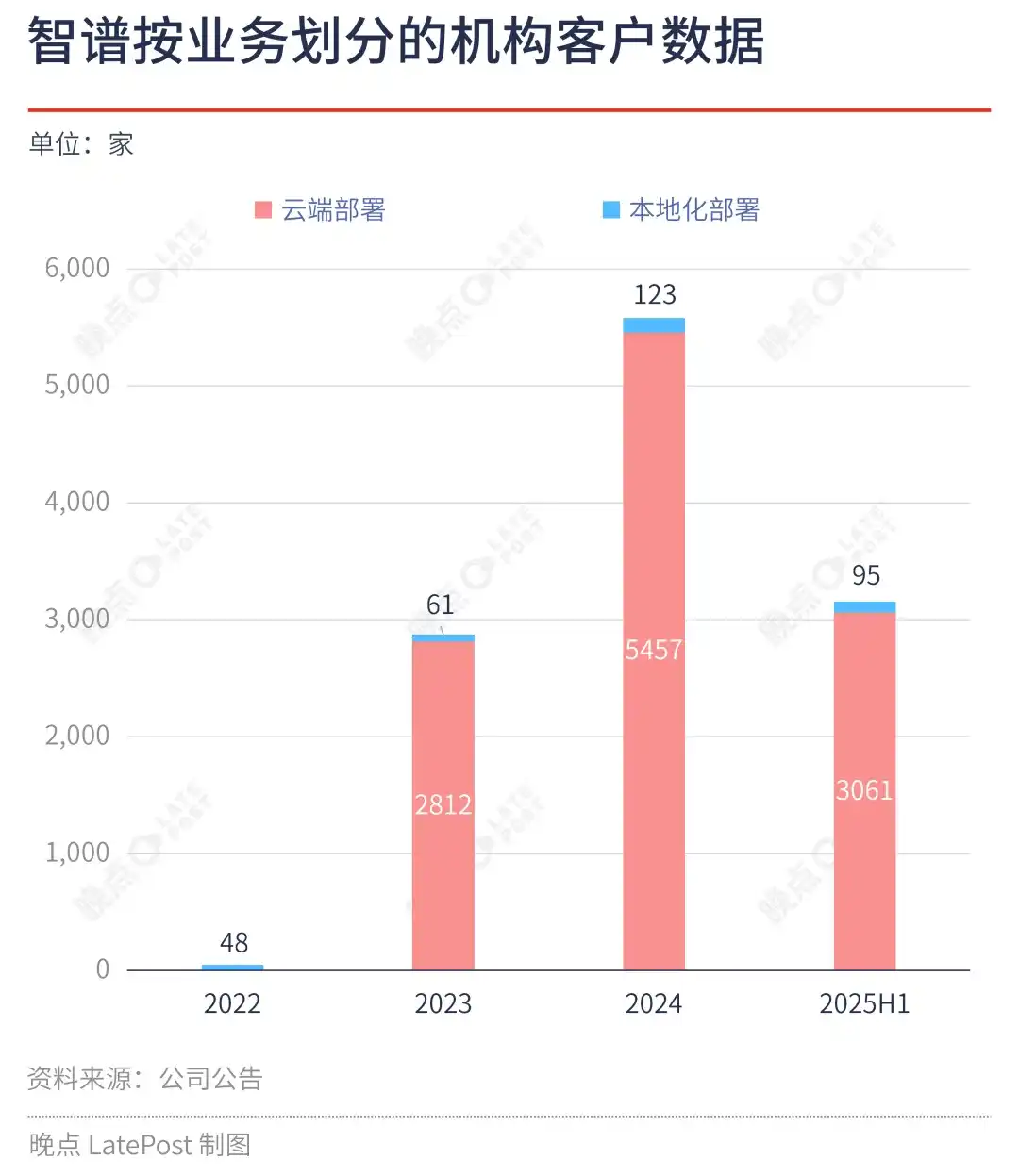
The result of this is that in H1 2025, Zhipu had 95 and 3061 institutional customers for localized and cloud deployment respectively, while the full-year 2024 figures were 123 and 5457 institutional customers. The price reduction in the MaaS business not only increased the number of cloud institutional customers but also had a significant引流 (diversion/traffic acquisition) effect on the localized deployment business;

As of Q3 2025, the company's models have empowered over 80 million end-user devices and more than 45 million developers, and it has over 12,000 institutional customers, a significant increase from the 8,000 customers in H1 2025.

Additionally, in November 2025, Zhipu's daily token consumption reached 4.2 trillion, compared to 500 million in 2022. This is the result of Zhipu releasing its new generation GLM 4.5/4.6 open-source base models and a direct reflection of user volume and调用量 (call volume).

Revenue is More Important Than Anything, But Revenue Requires Patience

In its prospectus, Zhipu introduces a "vertical and horizontal strategy" narrative for the growth prospects of commercial revenue.

Vertically, price reductions and capacity expansion in the MaaS platform business have attracted a wide range of users and application scenarios. Introducing more users will divert traffic to the localized deployment business. This "MaaS traffic acquisition + localized monetization" model will initially build a cycle of customers and commerce.

Horizontally, similar to OpenAI and Anthropic, Zhipu's MaaS platform is highly flexible and scalable. Unlike the traditional impression of heavy-delivery customization projects, Zhipu points out that the enterprise MaaS projects, which constitute the vast majority of revenue, deliver more general model capabilities, thus enabling faster scaling of token call volumes.

The vertical customer cycle model and the horizontal general solution capability scaling reinforce Zhipu's label as China's independent model company with the largest revenue volume. This is the commercial superposition effect Zhipu anticipates. The revenue scale of the MaaS platform business is highly likely to achieve超额增长 (supernormal growth). According to Zhipu's predictions, future revenue from localized deployment and cloud business will be split fifty-fifty. Zhipu is willing to sacrifice gross margin for this: unlike the high margins of localized projects, cloud business has lower gross margins because significant costs are spent on computing power procurement. This is also an inevitable result of the strategic price reduction in MaaS, a necessary compromise for short-term market share争夺 (competition).
The Model is the Product, the Product is Growth

A popular saying in the large model industry is "the model is the product." This reflects a very simple first principle: users pay for the strongest model, and the process of building the model itself is creating a highly competitive product.

This also constitutes the core growth logic of MaaS. In the second half of this year, Zhipu's latest release, the GLM 4.5/4.6 base model, was the first to natively integrate reasoning, coding, and agent capabilities within a single model. Particularly in coding, GLM ranks并列第一 (joint first) with models from Anthropic and OpenAI on Code Arena. After its release, call volume on its MaaS platform grew exponentially.

Similar to the "vertical and horizontal strategy" in the first part, powerful model products are expected to trigger a data flywheel effect, which would be the most ideal moat in large model competition. Zhipu's commercialization goals will be realized within a complete platform encompassing the latest models, APIs, and development tools. MaaS becomes an "operating system"-level infrastructure for the AI era, serving thousands of industries and organizations of all sizes—from individuals and small development teams to large enterprises. And on this complete platform, there is no交付 (delivery/customization), only product managers.

According to data in Zhipu's prospectus, MaaS has over 2.9 million enterprise and application developers, making it one of the most active large model API platforms in China. Currently, 9 out of the top 10 internet companies in China are using Zhipu's GLM large model. Among them, the GLM Coding package (a standardized large model product for developers with monthly subscription fees) gained over 150,000 paid developers within two months of launch, with annual recurring revenue quickly exceeding 100 million yuan.

The Cost of the Strongest Model

The代价 (cost/price) Zhipu paid for the judgment that "users pay for the strongest model" is fully revealed in the prospectus.

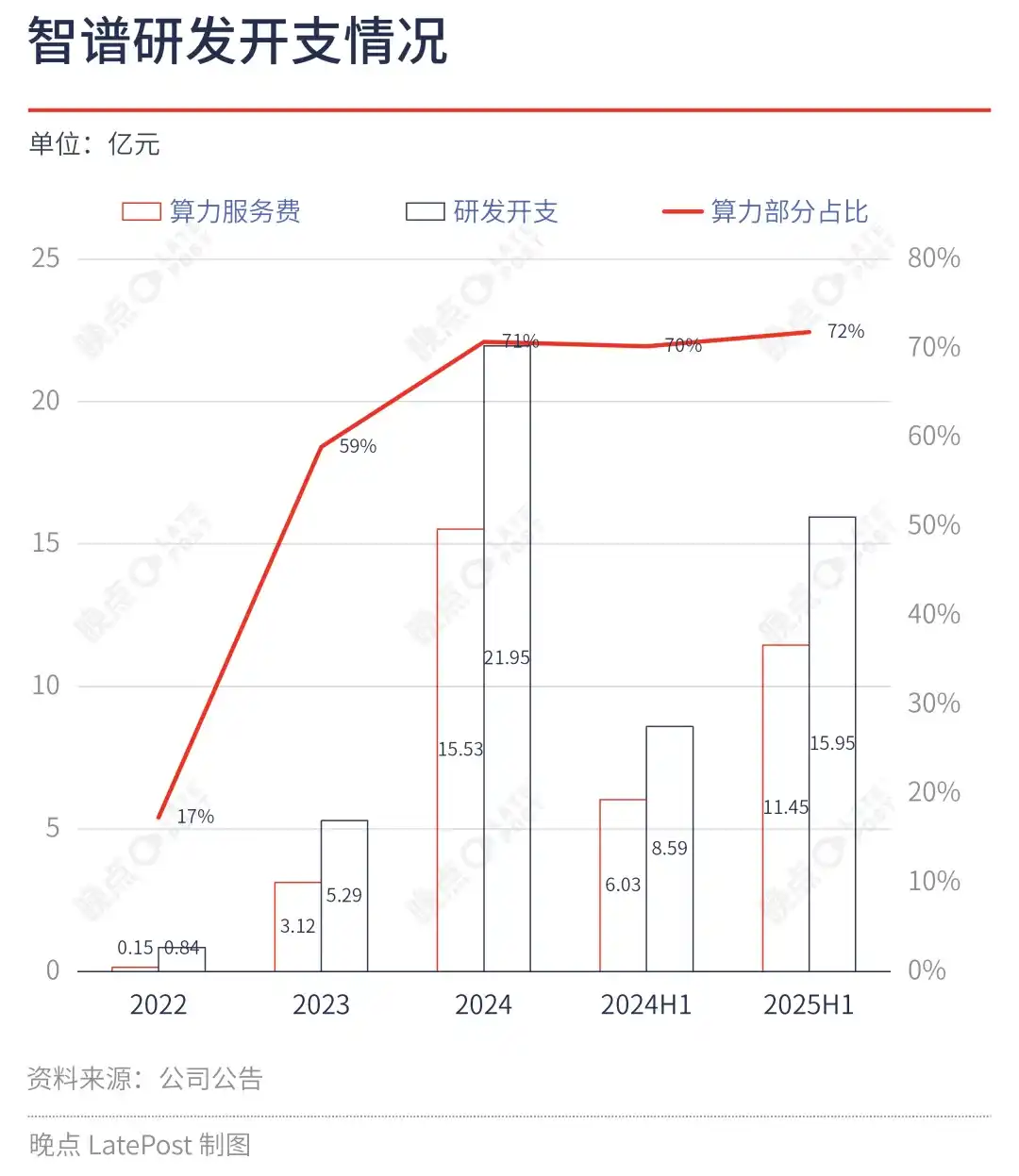
From 2022 to 2024, and the first half of this year, Zhipu's adjusted net losses were RMB 97 million, RMB 621 million, RMB 2.466 billion, and RMB 1.752 billion, respectively. R&D expenses were RMB 80 million, RMB 530 million, RMB 2.20 billion, and RMB 1.59 billion, constituting the vast majority.

Zhipu points out that computing service fees as a proportion of R&D expenses rapidly increased from an initial 17% to over 70%. This means a large part of R&D costs is used to purchase computing power,同步 (synchronizing) with the rapid growth in MaaS platform call volume.

On one hand, extremely high R&D investment is Zhipu's冷静的战略选择 (calm strategic choice). Pre-training base model capabilities themselves consume immense computing power. As AGI development progresses, it needs to衍生出 (derive/evolve) more application models to improve the comprehensive performance capabilities of agents, thereby solidifying its comparative advantage in underlying model capabilities and attracting more developers and customers;

On the other hand, in the foreseeable medium term, competition among large tech companies around large models will not cool down. This is a race with no end in sight in the short to medium term and extremely intense ranking competition. Only by始终维持 (consistently maintaining) a position in the top tier can one gain market recognition and attract capital.

Therefore, "边跑边补能" (refueling while running) is the only option.
Unlike the dot-com bubble around the year 2000, participants in the large model competition all know that although long-term cash burn is not a good commercial narrative, it is a market consensus. While model capabilities and market size are changing强烈快速 (strongly and rapidly), staying at the table is paramount. When people look forward to the systemic changes brought by AI, creating a market space worth trillions of dollars, Zhipu is betting that a larger market space will create more revenue growth opportunities and more significant scale effects. Powerful base model capabilities and the MaaS business model both suggest a higher monetary multiplier. This is an arithmetic problem everyone playing the AI game understands.

Burning cash attempts to ensure Zhipu has a place in the AI-dominated future.

Professionalism, Focus, and the Implied Price of Perseverance

AGI is a long tug-of-war. In the words of Zhipu CEO Zhang Peng, it's like "running a marathon at a sprint pace." This contradictory description explains both sides of Zhipu: it诠释了 (interprets/illustrates) Zhipu's technical perseverance and also explains the reason for choosing capitalization.

Born out of the Knowledge Engineering Laboratory of Tsinghua University's Computer Science Department, Zhipu was officially established in 2019. Starting from the underlying architecture of base large models, Zhipu has continuously率先推出 (taken the lead in launching) multiple domestic "first models," accumulating a set of domestically original model portfolios.

Taking the base model GLM-4.5 released in July this year as an example, according to data from Frost & Sullivan, GLM-4.5 achieved the following leading positions globally.

Based on the evaluation results of 12 industry-standard benchmark tests conducted in July 2025, GLM-4.5 ranked third globally, first in China, and top among global open-source models;

In September 2025, according to the LLM Hallucination Leaderboard in the field of Retrieval-Augmented Generation (RAG), GLM-4.5's hallucination rate was the second lowest globally and the lowest in China;

Since the release of GLM-4.5 until now, Zhipu's token consumption on OpenRouter has consistently ranked among the global top ten and the top three in China;

During the same period, Zhipu's paid API revenue on OpenRouter exceeded the sum of all domestic models.

In the second week of December, Zhipu open-sourced GLM multimodal and agent series models for five consecutive days. On the Hugging Face Trending list's top 10, Zhipu occupied 5 spots.
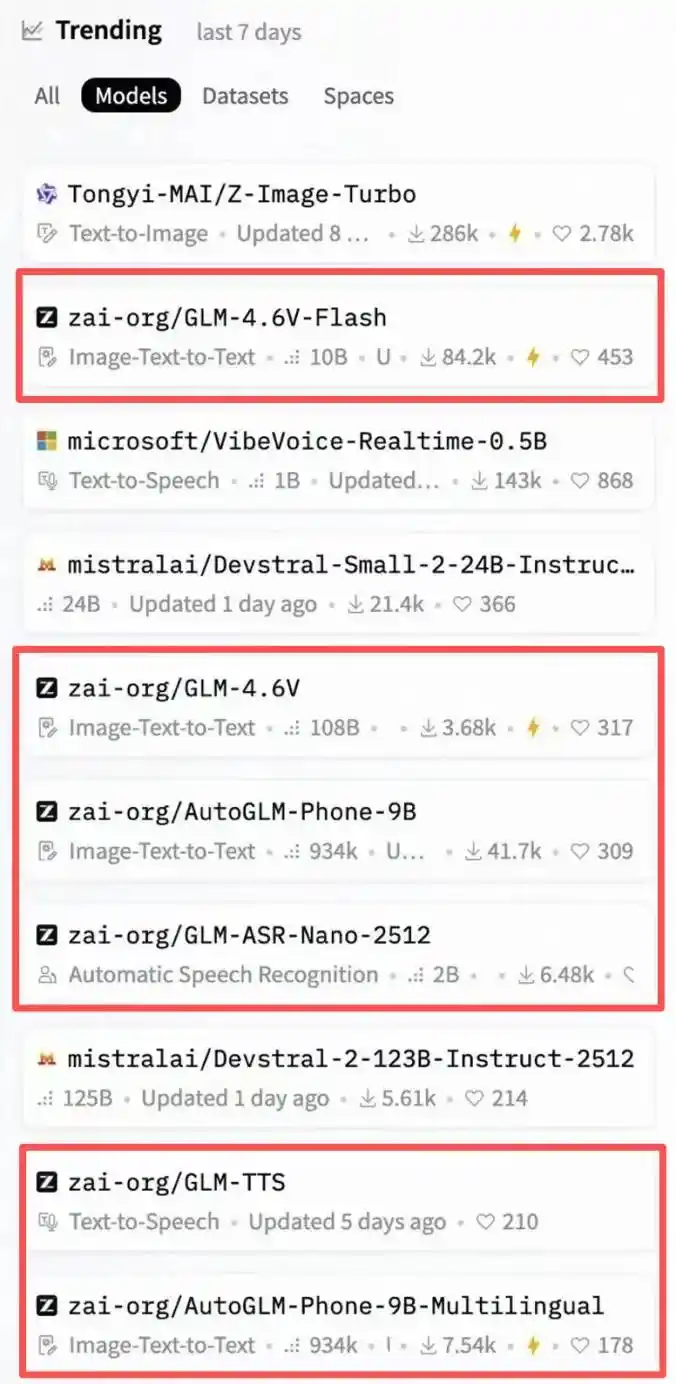
This included not only AutoGLM, which can operate mobile phones on behalf of users, but also the GLM-4.6V multimodal large model, the GLM-ASR series speech recognition models, the GLMTTS industrial-grade text-to-speech system, and core technological achievements in video generation. At first glance, this move seems almost contrary to the logic emphasizing commercialization and profitability. However, at this sensitive time before listing, Zhipu's open-source strategy显示出 (shows/displays) the strong vision of a technology-core AI company. Promoting the prosperity of the entire AI technology stack and open-source community knows no time节点 (node/moment), even during the critical stage when an AI company's growth phase shifts from technical competition to capital operation.

This气质 (temperament/character) is precisely why Zhipu was initially called the Chinese company "most like OpenAI."

As OpenAI recently suspended several non-core projects, including the Sora video generation model, and concentrated all resources within an eight-week period on improving the performance and user experience of its core product, ChatGPT, the two companies' model routes have once again converged: model capability itself is decisive, and other matters should give way to it.

The only major difference might be the huge disparity in valuations between Chinese and US AI companies. OpenAI's ultra-high valuation and continuous financing ensure it has a constant supply of ammunition for model R&D even without going public. Chinese large model enterprises, however, have valuations that are lower by more than an order of magnitude, even though Zhipu is one of the best performers among them. In its 6 years since founding, Zhipu has raised over 8 rounds of financing, with a cumulative financing scale exceeding RMB 8.3 billion.

Now, Zhipu needs a broader market to raise more sufficient ammunition. The capital market's reaction will confirm the substance of independent large model companies represented by Zhipu, thereby pricing the entire Chinese large model industry.

The Future Battle

There is not yet an independent large model company listed on the Chinese capital market for reference. Various doubts surrounding the fierce competition in large models still permeate (弥散) the market. During the growth stage of tech companies, measuring their fundamentals and growth potential using financial profitability indicators is basically无效的 (ineffective). What measures the commercial value or growth logic of such companies are often multiple complex dimensions such as revenue performance, product capability, market space, and business model, and most importantly, expectations for the future.

技术乐观主义者 (Techno-optimists) firmly believe in the future outlined by artificial intelligence. Two days after Zhipu publicly released its prospectus, another large model company, MiniMax, also disclosed its prospectus. Whoever ultimately succeeds in listing first will undoubtedly leave a profound mark on the history of artificial intelligence development.

AI is an infinite war of intelligence concerning productivity and social transformation. The battle has just begun.


Preguntas relacionadas

QWhat is the latest valuation of Zhipu AI as confirmed in its Hong Kong IPO filing, and why is this significant?

AZhipu AI's latest valuation is 24.377 billion yuan, as confirmed in its Hong Kong IPO filing. This is significant because it is the first time the exact valuation of a major Chinese large language model (LLM) company has been publicly disclosed.

QAccording to the article, what are the two main components of Zhipu AI's core commercial revenue?

AZhipu AI's core commercial revenue is primarily composed of revenue from localized deployment (providing private LLM deployment for B2B clients) and cloud deployment (providing model API interfaces and token call services through its MaaS platform).

QWhat strategic reason does the article give for Zhipu AI's decision to lower prices on its MaaS platform, despite the negative impact on毛利率 (gross margin)?

AZhipu AI strategically lowered prices on its MaaS platform to gain more customers and access more application scenarios. This 'MaaS引流 + 本地化变现' (MaaS traffic acquisition + localized monetization) model is intended to build a customer and commercial loop, sacrificing short-term毛利率 for long-term market share.

QWhat does the phrase '模型即产品' (the model is the product) imply about the growth logic of MaaS platforms like Zhipu's?

AThe phrase '模型即产品' implies that users pay for the most powerful model, and the process of building the model itself is equivalent to creating a highly competitive product. A strong model product can trigger a data flywheel effect, which is considered an ideal moat in LLM competition and is the core growth logic for MaaS.

QHow does the article characterize the difference in valuation and funding environment between Chinese AI companies like Zhipu and their U.S. counterparts like OpenAI?

AThe article characterizes the difference as a '巨大落差' (huge gap). U.S. AI companies like OpenAI have ultra-high valuations and continuous financing, ensuring ample resources for R&D even without an IPO. In contrast, Chinese LLM companies have valuations that are '低了不止一个数量级' (lower by more than an order of magnitude), meaning Zhipu, despite being a top performer, needs the public market to raise sufficient capital.

Lecturas Relacionadas

Polymarket's "2028 Presidential Election" Volume King Is... LeBron James???

An article from Odaily Planet Daily, authored by Azuma, discusses a peculiar phenomenon observed on the prediction market platform Polymarket regarding the "2028 US Presidential Election" event. Despite having a real-time probability of less than 1%, unlikely candidates such as NBA star LeBron James (with $48.41 million in trading volume), celebrity Kim Kardashian ($33.84 million), and even ineligible figures like Elon Musk ($23.14 million) and New York City Mayor Zohran Mamdani ($18.39 million) account for approximately 70% of the total trading volume. In contrast, high-probability candidates like Vice President JD Vance ($10.58 million), California Governor Gavin Newsom ($15.71 million), and Secretary of State Marco Rubio ($9.32 million) have significantly lower trading activity. The article explains that this counterintuitive trend is not driven by irrational speculation but by rational strategies. Polymarket offers a 4% annualized holding reward for certain markets, including the 2028 election, to maintain long-term pricing accuracy. This yield exceeds the current 5-year US Treasury rate (3.98%), attracting large investors ("whales") to hold "NO" shares on low-probability candidates for risk-free returns. Additionally, some users utilize a platform feature that allows converting a set of "NO" shares into corresponding "YES" shares for better liquidity or pricing efficiency, rather than directly buying "YES" shares for their preferred candidates. Thus, the seemingly absurd trading activity is strategically motivated.

marsbitHace 26 min(s)

Polymarket's "2028 Presidential Election" Volume King Is... LeBron James???

marsbitHace 26 min(s)

Dialogue with ViaBTC CEO Yang Haipo: Is the Essence of Blockchain a Libertarian Experiment?

"ViaBTC CEO Yang Haipo: Blockchain as a Hardcore Libertarian Experiment" In a deep-dive interview, ViaBTC CEO Yang Haipo reframes the essence of blockchain, arguing it is not merely a new technology or infrastructure but a hardcore libertarian experiment. This experiment, born from the 2008 financial crisis and decades of cypherpunk ideology, tests a fundamental question: to what extent can freedom and self-organization exist without centralized trust? The discussion highlights the experiment's verified outcomes. On one hand, it has proven its core value of censorship resistance, providing critical financial lifelines for entities like WikiLeaks and individuals in hyperinflationary or sanctioned countries via tools like stablecoins. However, Yang points out a key paradox: the most successful product, USDT, is itself a centralized compromise, showing users prioritize a less-controlled pipeline over pure decentralization. On the other hand, the experiment has exposed the severe costs of this freedom—a "dark forest" without safeguards. Events like the collapses of LUNA, Celsius, and FTX, resulting in massive wealth destruction and prison sentences for founders, underscore the system's fragility and the inherent risks of an unregulated environment. Yang observes that despite decentralized protocols, human nature inevitably recreates centralized power structures, speculative frenzies, and narrative-driven cycles (from ICOs to Meme coins), where emotion and belonging often trump technological substance. Looking forward, he believes blockchain's future is significant but niche. Its real value lies in serving specific, real-world needs for financial sovereignty and bypassing traditional controls, not as a universal infrastructure replacing all centralized systems. For the average participant, Yang's crucial advice is to cultivate independent judgment. True freedom is not holding a crypto wallet, but possessing a mind resilient to groupthink and narrative hype in a high-risk, often irrational market.

marsbitHace 41 min(s)

Dialogue with ViaBTC CEO Yang Haipo: Is the Essence of Blockchain a Libertarian Experiment?

marsbitHace 41 min(s)

Trading

Spot
Futuros

Artículos destacados

Qué es $S$

Entendiendo SPERO: Una Visión General Completa Introducción a SPERO A medida que el panorama de la innovación continúa evolucionando, la aparición de tecnologías web3 y proyectos de criptomonedas juega un papel fundamental en la configuración del futuro digital. Un proyecto que ha atraído la atención en este campo dinámico es SPERO, denotado como SPERO,$$s$. Este artículo tiene como objetivo reunir y presentar información detallada sobre SPERO, para ayudar a entusiastas e inversores a comprender sus fundamentos, objetivos e innovaciones dentro de los dominios web3 y cripto. ¿Qué es SPERO,$$s$? SPERO,$$s$ es un proyecto único dentro del espacio cripto que busca aprovechar los principios de descentralización y tecnología blockchain para crear un ecosistema que promueva la participación, la utilidad y la inclusión financiera. El proyecto está diseñado para facilitar interacciones de igual a igual de nuevas maneras, proporcionando a los usuarios soluciones y servicios financieros innovadores. En su esencia, SPERO,$$s$ tiene como objetivo empoderar a los individuos al proporcionar herramientas y plataformas que mejoren la experiencia del usuario en el espacio de las criptomonedas. Esto incluye habilitar métodos de transacción más flexibles, fomentar iniciativas impulsadas por la comunidad y crear caminos para oportunidades financieras a través de aplicaciones descentralizadas (dApps). La visión subyacente de SPERO,$$s$ gira en torno a la inclusividad, buscando cerrar brechas dentro de las finanzas tradicionales mientras aprovecha los beneficios de la tecnología blockchain. ¿Quién es el Creador de SPERO,$$s$? La identidad del creador de SPERO,$$s$ sigue siendo algo oscura, ya que hay recursos públicos limitados que proporcionan información de fondo detallada sobre su(s) fundador(es). Esta falta de transparencia puede derivarse del compromiso del proyecto con la descentralización, una ética que muchos proyectos web3 comparten, priorizando las contribuciones colectivas sobre el reconocimiento individual. Al centrar las discusiones en torno a la comunidad y sus objetivos colectivos, SPERO,$$s$ encarna la esencia del empoderamiento sin señalar a individuos específicos. Como tal, comprender la ética y la misión de SPERO sigue siendo más importante que identificar a un creador singular. ¿Quiénes son los Inversores de SPERO,$$s$? SPERO,$$s$ cuenta con el apoyo de una diversa gama de inversores que van desde capitalistas de riesgo hasta inversores ángeles dedicados a fomentar la innovación en el sector cripto. El enfoque de estos inversores generalmente se alinea con la misión de SPERO, priorizando proyectos que prometen avances tecnológicos sociales, inclusión financiera y gobernanza descentralizada. Estas fundaciones de inversores suelen estar interesadas en proyectos que no solo ofrecen productos innovadores, sino que también contribuyen positivamente a la comunidad blockchain y sus ecosistemas. El respaldo de estos inversores refuerza a SPERO,$$s$ como un contendiente notable en el dominio de proyectos cripto que evoluciona rápidamente. ¿Cómo Funciona SPERO,$$s$? SPERO,$$s$ emplea un marco multifacético que lo distingue de los proyectos de criptomonedas convencionales. Aquí hay algunas de las características clave que subrayan su singularidad e innovación: Gobernanza Descentralizada: SPERO,$$s$ integra modelos de gobernanza descentralizada, empoderando a los usuarios para participar activamente en los procesos de toma de decisiones sobre el futuro del proyecto. Este enfoque fomenta un sentido de propiedad y responsabilidad entre los miembros de la comunidad. Utilidad del Token: SPERO,$$s$ utiliza su propio token de criptomoneda, diseñado para servir diversas funciones dentro del ecosistema. Estos tokens permiten transacciones, recompensas y la facilitación de servicios ofrecidos en la plataforma, mejorando la participación y la utilidad general. Arquitectura en Capas: La arquitectura técnica de SPERO,$$s$ apoya la modularidad y escalabilidad, permitiendo la integración fluida de características y aplicaciones adicionales a medida que el proyecto evoluciona. Esta adaptabilidad es fundamental para mantener la relevancia en el cambiante paisaje cripto. Participación de la Comunidad: El proyecto enfatiza iniciativas impulsadas por la comunidad, empleando mecanismos que incentivan la colaboración y la retroalimentación. Al nutrir una comunidad sólida, SPERO,$$s$ puede abordar mejor las necesidades de los usuarios y adaptarse a las tendencias del mercado. Enfoque en la Inclusión: Al ofrecer tarifas de transacción bajas e interfaces amigables para el usuario, SPERO,$$s$ busca atraer a una base de usuarios diversa, incluyendo a individuos que anteriormente pueden no haber participado en el espacio cripto. Este compromiso con la inclusión se alinea con su misión general de empoderamiento a través de la accesibilidad. Cronología de SPERO,$$s$ Entender la historia de un proyecto proporciona información crucial sobre su trayectoria de desarrollo y hitos. A continuación se presenta una cronología sugerida que mapea eventos significativos en la evolución de SPERO,$$s$: Fase de Conceptualización e Ideación: Las ideas iniciales que forman la base de SPERO,$$s$ fueron concebidas, alineándose estrechamente con los principios de descentralización y enfoque comunitario dentro de la industria blockchain. Lanzamiento del Whitepaper del Proyecto: Tras la fase conceptual, se lanzó un whitepaper completo que detalla la visión, los objetivos y la infraestructura tecnológica de SPERO,$$s$ para generar interés y retroalimentación de la comunidad. Construcción de Comunidad y Primeras Interacciones: Se realizaron esfuerzos de divulgación activa para construir una comunidad de primeros adoptantes y posibles inversores, facilitando discusiones en torno a los objetivos del proyecto y obteniendo apoyo. Evento de Generación de Tokens: SPERO,$$s$ llevó a cabo un evento de generación de tokens (TGE) para distribuir sus tokens nativos a los primeros seguidores y establecer liquidez inicial dentro del ecosistema. Lanzamiento de la dApp Inicial: La primera aplicación descentralizada (dApp) asociada con SPERO,$$s$ se puso en marcha, permitiendo a los usuarios interactuar con las funcionalidades centrales de la plataforma. Desarrollo Continuo y Alianzas: Actualizaciones y mejoras continuas a las ofertas del proyecto, incluyendo alianzas estratégicas con otros actores en el espacio blockchain, han moldeado a SPERO,$$s$ en un jugador competitivo y en evolución en el mercado cripto. Conclusión SPERO,$$s$ se erige como un testimonio del potencial de web3 y las criptomonedas para revolucionar los sistemas financieros y empoderar a los individuos. Con un compromiso con la gobernanza descentralizada, la participación comunitaria y funcionalidades diseñadas de manera innovadora, allana el camino hacia un paisaje financiero más inclusivo. Como con cualquier inversión en el espacio cripto que evoluciona rápidamente, se anima a los posibles inversores y usuarios a investigar a fondo y participar de manera reflexiva con los desarrollos en curso dentro de SPERO,$$s$. El proyecto muestra el espíritu innovador de la industria cripto, invitando a una mayor exploración de sus innumerables posibilidades. Mientras el viaje de SPERO,$$s$ aún se desarrolla, sus principios fundamentales pueden, de hecho, influir en el futuro de cómo interactuamos con la tecnología, las finanzas y entre nosotros en ecosistemas digitales interconectados.

72 Vistas totalesPublicado en 2024.12.17Actualizado en 2024.12.17

Qué es $S$

Qué es AGENT S

Agent S: El Futuro de la Interacción Autónoma en Web3 Introducción En el paisaje en constante evolución de Web3 y las criptomonedas, las innovaciones están redefiniendo constantemente cómo los individuos interactúan con las plataformas digitales. Uno de estos proyectos pioneros, Agent S, promete revolucionar la interacción humano-computadora a través de su marco agente abierto. Al allanar el camino para interacciones autónomas, Agent S busca simplificar tareas complejas, ofreciendo aplicaciones transformadoras en inteligencia artificial (IA). Esta exploración detallada profundizará en las complejidades del proyecto, sus características únicas y las implicaciones para el dominio de las criptomonedas. ¿Qué es Agent S? Agent S se presenta como un marco agente abierto innovador, diseñado específicamente para abordar tres desafíos fundamentales en la automatización de tareas informáticas: Adquisición de Conocimiento Específico del Dominio: El marco aprende inteligentemente de diversas fuentes de conocimiento externas y experiencias internas. Este enfoque dual le permite construir un rico repositorio de conocimiento específico del dominio, mejorando su rendimiento en la ejecución de tareas. Planificación a Largo Plazo de Tareas: Agent S emplea planificación jerárquica aumentada por la experiencia, un enfoque estratégico que facilita la descomposición y ejecución eficiente de tareas complejas. Esta característica mejora significativamente su capacidad para gestionar múltiples subtareas de manera eficiente y efectiva. Manejo de Interfaces Dinámicas y No Uniformes: El proyecto introduce la Interfaz Agente-Computadora (ACI), una solución innovadora que mejora la interacción entre agentes y usuarios. Utilizando Modelos de Lenguaje Multimodal de Gran Escala (MLLMs), Agent S puede navegar y manipular diversas interfaces gráficas de usuario sin problemas. A través de estas características pioneras, Agent S proporciona un marco robusto que aborda las complejidades involucradas en la automatización de la interacción humana con las máquinas, preparando el terreno para una multitud de aplicaciones en IA y más allá. ¿Quién es el Creador de Agent S? Si bien el concepto de Agent S es fundamentalmente innovador, la información específica sobre su creador sigue siendo elusiva. El creador es actualmente desconocido, lo que resalta ya sea la etapa incipiente del proyecto o la elección estratégica de mantener a los miembros fundadores en el anonimato. Independientemente de la anonimidad, el enfoque sigue siendo en las capacidades y el potencial del marco. ¿Quiénes son los Inversores de Agent S? Dado que Agent S es relativamente nuevo en el ecosistema criptográfico, la información detallada sobre sus inversores y patrocinadores financieros no está documentada explícitamente. La falta de información disponible públicamente sobre las bases de inversión u organizaciones que apoyan el proyecto plantea preguntas sobre su estructura de financiamiento y hoja de ruta de desarrollo. Comprender el respaldo es crucial para evaluar la sostenibilidad del proyecto y su posible impacto en el mercado. ¿Cómo Funciona Agent S? En el núcleo de Agent S se encuentra una tecnología de vanguardia que le permite funcionar de manera efectiva en diversos entornos. Su modelo operativo se basa en varias características clave: Interacción Humano-Computadora Similar a la Humana: El marco ofrece planificación avanzada de IA, esforzándose por hacer que las interacciones con las computadoras sean más intuitivas. Al imitar el comportamiento humano en la ejecución de tareas, promete elevar las experiencias de los usuarios. Memoria Narrativa: Empleada para aprovechar experiencias de alto nivel, Agent S utiliza memoria narrativa para hacer un seguimiento de las historias de tareas, mejorando así sus procesos de toma de decisiones. Memoria Episódica: Esta característica proporciona a los usuarios una guía paso a paso, permitiendo que el marco ofrezca apoyo contextual a medida que se desarrollan las tareas. Soporte para OpenACI: Con la capacidad de ejecutarse localmente, Agent S permite a los usuarios mantener el control sobre sus interacciones y flujos de trabajo, alineándose con la ética descentralizada de Web3. Fácil Integración con APIs Externas: Su versatilidad y compatibilidad con varias plataformas de IA aseguran que Agent S pueda encajar sin problemas en ecosistemas tecnológicos existentes, convirtiéndolo en una opción atractiva para desarrolladores y organizaciones. Estas funcionalidades contribuyen colectivamente a la posición única de Agent S dentro del espacio cripto, ya que automatiza tareas complejas y de múltiples pasos con una intervención humana mínima. A medida que el proyecto evoluciona, sus posibles aplicaciones en Web3 podrían redefinir cómo se desarrollan las interacciones digitales. Cronología de Agent S El desarrollo y los hitos de Agent S pueden encapsularse en una cronología que resalta sus eventos significativos: 27 de septiembre de 2024: El concepto de Agent S fue lanzado en un documento de investigación integral titulado “Un Marco Agente Abierto que Usa Computadoras Como un Humano”, mostrando las bases del proyecto. 10 de octubre de 2024: El documento de investigación fue puesto a disposición del público en arXiv, ofreciendo una exploración profunda del marco y su evaluación de rendimiento basada en el benchmark OSWorld. 12 de octubre de 2024: Se lanzó una presentación en video, proporcionando una visión visual de las capacidades y características de Agent S, involucrando aún más a posibles usuarios e inversores. Estos marcadores en la cronología no solo ilustran el progreso de Agent S, sino que también indican su compromiso con la transparencia y la participación comunitaria. Puntos Clave Sobre Agent S A medida que el marco Agent S continúa evolucionando, varios atributos clave destacan, subrayando su naturaleza innovadora y potencial: Marco Innovador: Diseñado para proporcionar un uso intuitivo de las computadoras similar a la interacción humana, Agent S aporta un enfoque novedoso a la automatización de tareas. Interacción Autónoma: La capacidad de interactuar de manera autónoma con las computadoras a través de GUI significa un salto hacia soluciones informáticas más inteligentes y eficientes. Automatización de Tareas Complejas: Con su metodología robusta, puede automatizar tareas complejas y de múltiples pasos, haciendo que los procesos sean más rápidos y menos propensos a errores. Mejora Continua: Los mecanismos de aprendizaje permiten a Agent S mejorar a partir de experiencias pasadas, mejorando continuamente su rendimiento y eficacia. Versatilidad: Su adaptabilidad en diferentes entornos operativos como OSWorld y WindowsAgentArena asegura que pueda servir a una amplia gama de aplicaciones. A medida que Agent S se posiciona en el paisaje de Web3 y criptomonedas, su potencial para mejorar las capacidades de interacción y automatizar procesos significa un avance significativo en las tecnologías de IA. A través de su marco innovador, Agent S ejemplifica el futuro de las interacciones digitales, prometiendo una experiencia más fluida y eficiente para los usuarios en diversas industrias. Conclusión Agent S representa un audaz avance en la unión de la IA y Web3, con la capacidad de redefinir cómo interactuamos con la tecnología. Aunque aún se encuentra en sus primeras etapas, las posibilidades para su aplicación son vastas y atractivas. A través de su marco integral que aborda desafíos críticos, Agent S busca llevar las interacciones autónomas al primer plano de la experiencia digital. A medida que nos adentramos más en los reinos de las criptomonedas y la descentralización, proyectos como Agent S sin duda desempeñarán un papel crucial en la configuración del futuro de la tecnología y la colaboración humano-computadora.

337 Vistas totalesPublicado en 2025.01.14Actualizado en 2025.01.14

Qué es AGENT S

Cómo comprar S

¡Bienvenido a HTX.com! Hemos hecho que comprar Sonic (S) sea simple y conveniente. Sigue nuestra guía paso a paso para iniciar tu viaje de criptos.Paso 1: crea tu cuenta HTXUtiliza tu correo electrónico o número de teléfono para registrarte y obtener una cuenta gratuita en HTX. Experimenta un proceso de registro sin complicaciones y desbloquea todas las funciones.Obtener mi cuentaPaso 2: ve a Comprar cripto y elige tu método de pagoTarjeta de crédito/débito: usa tu Visa o Mastercard para comprar Sonic (S) al instante.Saldo: utiliza fondos del saldo de tu cuenta HTX para tradear sin problemas.Terceros: hemos agregado métodos de pago populares como Google Pay y Apple Pay para mejorar la comodidad.P2P: tradear directamente con otros usuarios en HTX.Over-the-Counter (OTC): ofrecemos servicios personalizados y tipos de cambio competitivos para los traders.Paso 3: guarda tu Sonic (S)Después de comprar tu Sonic (S), guárdalo en tu cuenta HTX. Alternativamente, puedes enviarlo a otro lugar mediante transferencia blockchain o utilizarlo para tradear otras criptomonedas.Paso 4: tradear Sonic (S)Tradear fácilmente con Sonic (S) en HTX's mercado spot. Simplemente accede a tu cuenta, selecciona tu par de trading, ejecuta tus trades y monitorea en tiempo real. Ofrecemos una experiencia fácil de usar tanto para principiantes como para traders experimentados.

712 Vistas totalesPublicado en 2025.01.15Actualizado en 2025.03.21

Cómo comprar S

Discusiones

Bienvenido a la comunidad de HTX. Aquí puedes mantenerte informado sobre los últimos desarrollos de la plataforma y acceder a análisis profesionales del mercado. A continuación se presentan las opiniones de los usuarios sobre el precio de S (S).

活动图片