Quid Pro Quo or Crypto? Congress Probes UAE Deal as LiquidChain Emerges as Secure Institutional Alternative

bitcoinistPublicado a 2026-02-05Actualizado a 2026-02-05

Resumen

High politics and decentralized finance collide as a U.S. congressional inquiry probes potential conflicts of interest involving World Liberty Financial (WLFI) and foreign entities, including UAE dealings and investments from figures like Justin Sun. Lawmakers question whether crypto projects are being used for political influence, highlighting vulnerabilities in personality-driven ventures. This scrutiny creates an institutional shift toward infrastructure-focused alternatives like LiquidChain ($LIQUID), a Layer 3 protocol that unifies Bitcoin, Ethereum, and Solana into a single execution layer. Emphasizing code over connections, LiquidChain offers a trustless, interoperable environment, attracting presale investment of over $526K as capital flees politically sensitive assets for verifiable, utility-driven solutions.

High politics and decentralized finance just collided in Washington, and lawmakers aren’t happy.

A formal inquiry into potential conflicts of interest surrounding World Liberty Financial (WLFI) has triggered alarm bells across the sector. At the center of the storm sits a letter from Rep. Jamie Raskin (D-MD) and Rep. Robert Garcia (D-CA), probing whether foreign entities, specifically those connected to recent UAE dealings and investments from figures like Justin Sun, are using crypto projects as a vehicle for political influence.
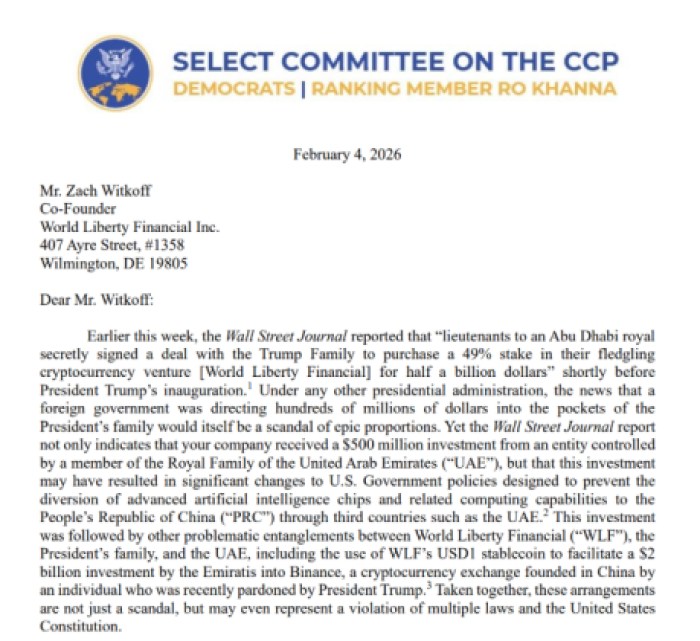

It’s not just about blockchain mechanics; the concern focuses on the ‘quid pro quo’ potential of opaque financial structures. When a project is tied intrinsically to a political figurehead, large foreign investments raise national security questions: are these purchases of tokens, or purchases of access?

The probe highlights a critical vulnerability in personality-driven crypto ventures. If the underlying value proposition relies on connections rather than code, the project becomes a lightning rod for regulatory enforcement.

This scrutiny creates a vacuum in the institutional DeFi sector. While D.C. dissects the tangled web of WLFI’s foreign ties, the market is quietly shifting capital toward infrastructure-heavy alternatives that prioritize code over connections.

The volatility of politically exposed assets is driving smart money toward verifiable, tech-first solutions. That flight to quality is evident in the rising interest surrounding LiquidChain ($LIQUID), a Layer 3 protocol designed to solve fragmentation without the geopolitical baggage.

Escaping Geopolitical Risk Through LiquidChain’s Unified Layer

The congressional probe into World Liberty Financial exposes a fatal flaw in centralized, personality-centric DeFi: counterparty risk. When a protocol relies on opaque dealings with foreign sovereign wealth funds or controversial crypto tycoons, ‘decentralization’ becomes little more than a marketing slogan.

In contrast, LiquidChain is capitalizing on the market’s demand for a trustless execution environment. Rather than relying on boardroom deals to move liquidity, LiquidChain utilizes a Layer 3 architecture to fuse Bitcoin, Ethereum, and Solana into a single execution layer.

That distinction matters because institutions require certainty. They can’t allocate capital to platforms where the regulatory status hinges on the outcome of an election or a congressional hearing. LiquidChain’s ‘Deploy-Once’ architecture allows developers to build applications that access liquidity across all major chains simultaneously, removing the need for risky, fragmented bridges or politically sensitive partnerships.

By creating a Unified Liquidity Layer, the protocol offers the interoperability that WLFI promised, but delivers it through verifiable smart contracts rather than handshake deals in Dubai.

For the developer ecosystem, this represents a massive efficiency unlock. Instead of writing distinct code for the EVM (Ethereum) and SVM (Solana), LiquidChain’s Cross-Chain VM handles the translation.

As regulatory heat increases on projects like WLFI, infrastructure plays that solve the ‘wrapped asset risk’ problem. where assets are pegged and potentially manipulated, are becoming the preferred safe harbor for long-term capital.

EXPLORE LIQUIDCHAIN ON ITS PRESALE PAGE

$LIQUID Presale Gains Traction Amidst Regulatory Uncertainty

While headlines scream about subpoenas and congressional letters, on-chain data reveals a divergence in where retail and developer capital is actually flowing. The LiquidChain presale has quietly accelerated, with the project raising over $526K to date.

Unlike the hype-driven cycles of meme coins or political tokens, this capital injection suggests a methodical accumulation by investors betting on infrastructure over narrative.

At the current entry price of $0.0135, the market is pricing $LIQUID as an early-stage infrastructure bet. The tokenomics model positions $LIQUID not just as a governance token, but as the transaction fuel for the entire cross-chain environment. Every time a user swaps $SOL for $BTC or engages in DeFi activities across the unified layer, the protocol generates demand for the token.

This utility-driven demand contrasts sharply with the speculative nature of tokens currently under the congressional microscope. It’s easy to see why it could be one of the next crypto to explode.

The timing of this capital raise is notable. As investors rotate out of high-risk, politically sensitive assets, they’re seeking ‘picks and shovels’ plays, protocols that facilitate the industry’s growth regardless of which political party holds power.

With liquidity staking incentives encouraging long-term holding, LiquidChain is positioning itself to capture the volume that is fleeing from regulatory uncertainty.

BUY YOUR $LIQUID TODAY

This article is for informational purposes only and does not constitute financial advice. Cryptocurrency investments carry high risk, including the potential loss of principal. Always perform your own due diligence.


Preguntas relacionadas

QWhat is the main concern raised by the congressional inquiry into World Liberty Financial (WLFI)?

AThe main concern is whether foreign entities, particularly those linked to recent dealings with the UAE and investments from figures like Justin Sun, are using cryptocurrency projects as a vehicle for political influence, creating potential 'quid pro quo' situations and national security risks.

QHow does LiquidChain aim to address the vulnerabilities exposed by the WLFI probe?

ALiquidChain addresses these vulnerabilities by offering a trustless, tech-first solution with its Layer 3 architecture that unifies Bitcoin, Ethereum, and Solana into a single execution layer, prioritizing verifiable smart contracts and code over opaque political connections and partnerships.

QWhat key technological feature does LiquidChain use to solve the problem of blockchain fragmentation?

ALiquidChain uses its 'Deploy-Once' architecture and Cross-Chain VM, which allows developers to build applications that can access liquidity across all major chains simultaneously, eliminating the need for risky bridges and reducing fragmentation.

QWhat is the current status of the LiquidChain ($LIQUID) presale and what does it indicate about investor sentiment?

AThe LiquidChain presale has raised over $526K, indicating a methodical accumulation by investors who are betting on long-term infrastructure solutions rather than hype-driven or politically sensitive narrative tokens amidst regulatory uncertainty.

QHow does the utility of the $LIQUID token differ from the tokens under congressional scrutiny?

AThe $LIQUID token is designed as a utility token that serves as the governance and transaction fuel for the entire cross-chain environment, generating demand through actual platform use, in contrast to the speculative and politically exposed nature of the tokens under investigation.

Lecturas Relacionadas

Stuck Polymarket: The Real Test After Riding the Traffic Boom Has Arrived

Polymarket, a leading prediction market platform, is facing significant technical challenges as its growth outpaces its current infrastructure on Polygon. Users are experiencing laggy transactions, unresponsive orders, and delayed confirmations, severely impacting the trading experience. In response, DeFi Engineering VP Josh Stevens outlined a comprehensive engineering overhaul. The plan includes reducing on-chain data delays, fixing order cancellation issues, rebuilding the central limit order book (CLOB), improving website performance, and developing a unified SDK and API. A major revelation was the ongoing "chain migration," indicating a potential move away from Polygon. The core issue is that Polymarket has evolved from a simple prediction market into a high-frequency trading platform, making Polygon's limitations—such as block space, gas fees, and block time—a ceiling for further growth. The migration is not just a simple chain switch but a fundamental rebuild of its trading system to support more complex products like perpetual contracts (Perps). This announcement has sparked competition among chains like Solana, Sui, and Algorand, all vying to host Polymarket. For Polygon, losing this key application, which contributes significantly to its gas fee revenue, would be a major setback. The real test for Polymarket is no longer attracting users but proving it can provide a stable, reliable trading environment that retains them.

Odaily星球日报Hace 4 min(s)

Stuck Polymarket: The Real Test After Riding the Traffic Boom Has Arrived

Odaily星球日报Hace 4 min(s)

Lowering Expectations for BTC's Next Bull Market

The author, Alex Xu, explains his decision to significantly reduce his Bitcoin holdings (from full to ~30% of his portfolio) during the current bull cycle, citing a lowered long-term outlook for BTC's price appreciation in the next cycle. He outlines six key reasons for this reduced expectation: 1. **Diminished Growth Drivers:** The narrative of exponential user adoption has largely played out with institutional ETF adoption. The next major growth phase—adoption by sovereign national reserves or central banks—seems unlikely in the near future. 2. **Personal Opportunity Cost:** More attractive investment opportunities have emerged in other assets, such as undervalued companies. 3. **Industry-Wide Contraction:** The broader crypto industry is struggling, with most Web3 business models (SocialFi, GameFi, DePIN) failing. This overall萧条 (depression) reduces the fundamental demand and consensus for Bitcoin. 4. **Strain on Major Buyer:** MicroStrategy, a major corporate buyer of BTC, faces rising financing expenses for its debt, which could slow its purchasing rate and create significant marginal pressure on the market. 5. **Increased Competition from Gold:** The emergence of "tokenized gold" has closed the functional gap (portability, divisibility) between physical gold and Bitcoin, offering a strong competitor in the non-sovereign store-of-value space. 6. **Security Budget Concerns:** The block reward halving continues to exacerbate the long-standing issue of funding Bitcoin's network security, with new fee source explorations like Ordinals and L2s largely failing. The author's decision to hold a significant (though reduced) position reflects a cautious, not bearish, outlook. He remains open to increasing his exposure if the fundamental reasons for his skepticism change or if new positive catalysts emerge.

marsbitHace 42 min(s)

Lowering Expectations for BTC's Next Bull Market

marsbitHace 42 min(s)

Can Iran 'Control' the Strait of Hormuz?

Iran has announced a comprehensive plan to assert control over the strategic Strait of Hormuz, a critical global oil shipping chokepoint. The proposed measures include requiring all vessels to obtain Iranian permission for passage, imposing fees for security, environmental protection, and navigation management—preferably paid in Iranian rials—and absolutely banning Israeli ships. Vessels from countries deemed hostile by Iran’s top security bodies may also be barred. Analysts suggest Iran’s motives are multifaceted: increasing pressure on the U.S. and Israel by leveraging control over oil transit to influence global prices and inflation; creating a new revenue stream, potentially exceeding $7.7 billion annually, to counter Western sanctions and support postwar reconstruction; and using transit permissions as bargaining chips in future negotiations, notably with the U.S. However, the plan faces significant practical and diplomatic challenges. Enforcing comprehensive interception and fee collection in the busy waterway, patrolled by international military forces, would be difficult. The U.S. has already countering with a blockade of Iranian ports and threats to intercept any ship paying fees, potentially strangling Iran’s oil exports and fee revenue. Broad international opposition, led by European and Gulf states, and legal controversies further complicate implementation. The proposal may ultimately serve more as a negotiating tactic than a feasible policy, with its execution remaining highly uncertain.

marsbitHace 1 hora(s)

Can Iran 'Control' the Strait of Hormuz?

marsbitHace 1 hora(s)

Trading

Spot
Futuros
活动图片




