Qubic Unveils 3-Phase Rollout For Dogecoin Mining Attack

bitcoinistPublicado a 2026-03-25Actualizado a 2026-03-25

Resumen

Qubic has announced a three-phase plan to transition its mining operations from Monero (XMR) to Dogecoin (DOGE), starting on April 1. The shift is designed to be deliberate and methodical rather than instantaneous. Phase 1 (beginning April 1) serves as a testing period where Monero mining remains active 50% of the time, while Dogecoin runs at 100% in "test mode." Computor revenue during this phase remains in XMR only. Phase 2 allows computors to choose between XMR and DOGE revenue, with XMR gradually phased out. Those opting for DOGE will no longer receive XMR. Phase 3 completes the transition, with revenue switching entirely to DOGE, XMR mining disabled, and both DOGE mining and AI training running at full capacity. Qubic claims its network is now three times faster after recent optimizations, which it says will help handle the increased load. The team cited Dogecoin’s significantly larger daily emission value—approximately $1.44 million compared to Monero’s—as the key economic incentive for the switch.

Qubic will begin its staged transition from Monero to Dogecoin mining on April 1. Via X, the Qubic team layed out a three-phase rollout that it says is designed to move deliberately rather than flip the network over in a single step.

In a post published Tuesday, the project said “the transition from Monero to Dogecoin doesn’t happen overnight” and that its core team had designed a three-phase process in which “each phase is evaluated before moving forward.” The framing is notable given Qubic’s increasingly explicit language around its mining strategy. The headline objective, as the team describes it, is to reach a final state where “DOGE + AI” run “simultaneously, full time.”

3-Phase Rollout For Dogecoin Mining Shift

The first phase begins April 1 and is positioned as a testing period lasting one to two epochs. During that stage, computor revenue remains denominated in XMR only, Monero mining remains active 50% of the time, and Dogecoin enters what Qubic calls “test mode” while running on mainnet at 100%. AI training continues alongside it. In other words, Qubic is not immediately removing the existing Monero-based incentive structure, but introducing DOGE at full operational intensity before revenue is switched over.

The second phase is the actual migration. For one to two epochs, computors will be able to choose between XMR and DOGE revenue, with XMR beginning to phase out and DOGE phasing in with a top-up applied. Qubic also said that computors who opt to bring DOGE “are no longer eligible for XMR.”

By the third and final phase, Qubic says computor revenue will be DOGE only. The XMR dispatcher will be turned off completely, DOGE will remain active 100% of the time, and AI training will also run at 100%. “No rushing. No shortcuts. Just disciplined execution,” the team wrote.
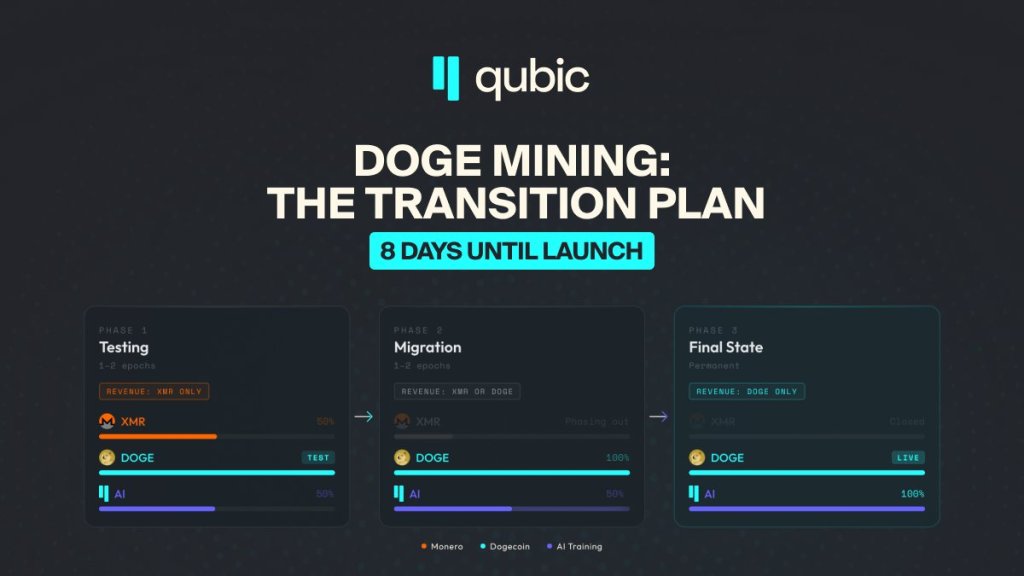
Source: X @_Qubic_

Qubic paired that roadmap with a performance claim aimed directly at the April 1 launch window. On March 23, the project said its network had become “3x faster” on live mainnet, with tick times reduced from 2 seconds a year ago to 1 second and now 0.6 seconds after the latest core optimization.

“Every share a miner submits gets validated through Oracle Machines in a single tick,” Qubic wrote. “Faster ticks mean faster confirmations, a more efficient pipeline, and a network that can handle the load when April 1st hits. The network got faster right before it needed to be.”

The economic case for targeting Dogecoin is straightforward in Qubic’s telling. In a March 20 post, the team pointed to its earlier Monero campaign, saying it went from less than 2% of Monero’s hashrate to “51%+ dominance in a live takeover event,” while generating more than $3.5 million in mining revenue and finding over 26,000 XMR blocks.

Dogecoin, it argued, is a much larger prize. “DOGE produces roughly 14.4 million coins per day. At current prices, that’s approximately $1.44M in daily emission, roughly 10x what Monero was producing,” the team wrote. “The same playbook. A much bigger target.”

At press time, DOGE traded at $0.09752.
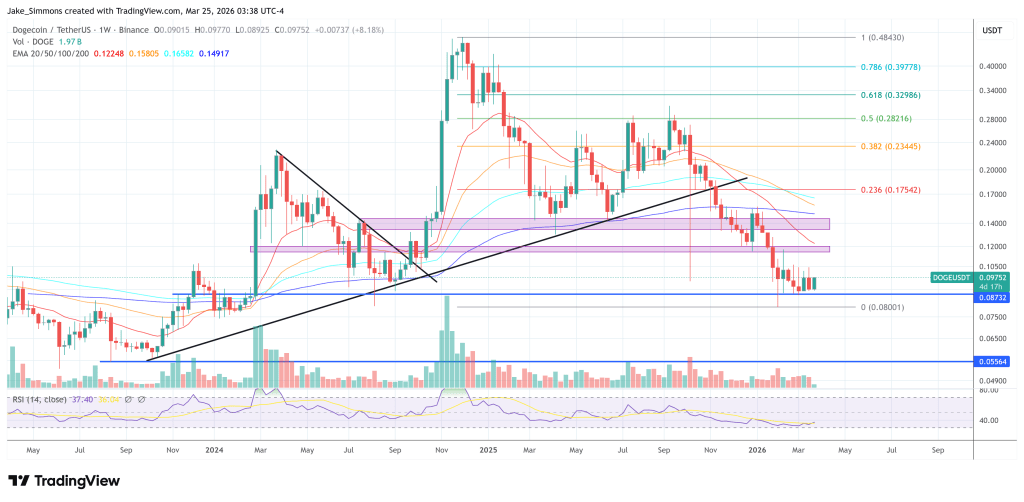
DOGE holds above key support, 1-week chart | Source: DOGEUSDT on TradingView.com

Preguntas relacionadas

QWhat is the start date for Qubic's transition from Monero to Dogecoin mining?

AApril 1.

QHow many phases are in Qubic's rollout plan for the Dogecoin mining shift?

AThree phases.

QIn the final phase, what will be the only form of computor revenue?

ADOGE only.

QWhat performance improvement did Qubic claim its network achieved on March 23?

AIt became 3x faster on live mainnet, with tick times reduced to 0.6 seconds.

QWhat economic reason did Qubic give for targeting Dogecoin instead of Monero?

ADogecoin produces approximately $1.44M in daily emission, which is roughly 10x what Monero was producing.

Lecturas Relacionadas

From Theft to Re-entry: How Was $292 Million "Laundered"?

A sophisticated crypto laundering operation was executed following the $292 million hack of Kelp DAO on April 18. The attack, attributed to the North Korean Lazarus group, began with anonymous infrastructure preparation using Tornado Cash to fund wallets untraceably. The hacker exploited a vulnerability in Kelp’s cross-chain bridge, stealing 116,500 rsETH. To avoid crashing the market, the attacker used Aave and Compound as laundering tools—depositing the stolen rsETH as collateral to borrow $190 million in clean, liquid ETH. This move triggered a bank run on Aave, causing an $8 billion drop in TVL. After consolidating funds, the attacker fragmented them across hundreds of wallets to evade detection. A major breakpoint was THORChain, where over $460 million in volume—30 times its usual activity—was processed in 24 hours, converting ETH into Bitcoin. This shift to Bitcoin’s UTXO model exponentially increased tracing complexity by shattering funds into countless untraceable fragments. The final destination was Tron-based USDT, the primary channel for illicit crypto flows. From there, funds were cashed out via OTC brokers in China and Southeast Asia, using unlicensed underground banks and UnionPay networks outside Western sanctions scope. Ultimately, the laundered money supports North Korea’s weapons programs, which rely heavily on crypto hacking for foreign currency. The incident underscores structural challenges in DeFi: its openness, composability, and lack of central control make such laundering not just possible, but inherently difficult to prevent.

marsbitHace 32 min(s)

From Theft to Re-entry: How Was $292 Million "Laundered"?

marsbitHace 32 min(s)

Google and Amazon Simultaneously Invest Heavily in a Competitor: The Most Absurd Business Logic of the AI Era Is Becoming Reality

In a span of four days, Amazon announced an additional $25 billion investment, and Google pledged up to $40 billion—both direct competitors pouring over $65 billion into the same AI startup, Anthropic. Rather than a typical venture capital move, this signals the latest escalation in the cloud wars. The core of the deal is not equity but compute pre-orders: Anthropic must spend the majority of these funds on AWS and Google Cloud services and chips, effectively locking in massive future compute consumption. This reflects a shift in cloud market dynamics—enterprises now choose cloud providers based on which hosts the best AI models, not just price or stability. With OpenAI deeply tied to Microsoft, Anthropic’s Claude has become the only viable strategic asset for Google and Amazon to remain competitive. Anthropic’s annualized revenue has surged to $30 billion, and it is expanding into verticals like biotech, positioning itself as a cross-industry AI infrastructure layer. However, this funding comes with constraints: Anthropic’s independence is challenged as it balances two rival investors, its safety-first narrative faces pressure from regulatory scrutiny, and its path to IPO introduces new financial pressures. Globally, this accelerates a "tri-polar" closed-loop structure in AI infrastructure, with Microsoft-OpenAI, Google-Anthropic, and Amazon-Anthropic forming exclusive model-cloud alliances. In contrast, China’s landscape differs—investments like Alibaba and Tencent backing open-source model firm DeepSeek reflect a more decoupled approach, though closed-source models from major cloud providers still dominate. The $65 billion bet is ultimately about securing a seat at the table in an AI-defined future—where missing the model layer means losing the cloud war.

marsbitHace 6 hora(s)

Google and Amazon Simultaneously Invest Heavily in a Competitor: The Most Absurd Business Logic of the AI Era Is Becoming Reality

marsbitHace 6 hora(s)

Trading

Spot
Futuros
活动图片





