Qubic Reveals How Its Dogecoin Mining Launch Will Work Starting April 1

bitcoinistPublicado a 2026-03-31Actualizado a 2026-03-31

Resumen

Qubic has detailed its transition to Dogecoin mining, set to begin on April 1, through a three-phase mainnet rollout. The move shifts Qubic from a mixed model of Monero mining and AI training to a parallel system where external ASIC miners handle Dogecoin via Scrypt algorithm, while Qubic’s own computational resources focus entirely on its AI project, Aigarth. The process uses a bridge called "Doge Connect" to link external miners to Qubic’s network, validate shares, and manage payouts. Monero mining will be phased out gradually over the transition. Miners will be paid in Cubics rather than direct DOGE, as Qubic will sell mined DOGE for stablecoins and buy back Cubics for redistribution—a mechanism expected to yield roughly 10% higher returns than standard Dogecoin mining. The system is designed to support multiple chains in the future, though Dogecoin is the initial focus.

Qubic used a March 30 AMA to lay out the mechanics behind its Dogecoin mining rollout, with core tech lead Joetom outlining a three-phase mainnet transition that begins April 1. The shift matters because it is designed to move Qubic away from its current split between Monero-linked outsourced mining and AI training into a model where both activities run at full scale in parallel.

The presentation centered on what Qubic calls its internal “Doge Connect” architecture, a bridge that links external Scrypt miners to Qubic’s network while redirecting Qubic’s own CPU and GPU resources fully toward its AI initiative, Aigarth. Joetom said the system relies on a dispatcher that connects to pools, translates mining tasks between the Dogecoin and Qubic networks, validates shares, and feeds results back through Qubic’s infrastructure.

“So how does this work? We call it internally Dodge Connect,” he said. “We bridge basically the mining power from outside ... with ASIC miners, we use the Scrypt algorithm and you can connect to any of the Qubic pools. So for you as a miner, nothing changes.”

That bridge is not limited to a single coin, at least in theory. Joetom said the task and messaging system was built generically enough that Qubic could support multiple chains or switch to other mineable assets later. For now, the focus is Dogecoin, with the longer-term goal of running Qubic’s AI research at full capacity while using outsourced mining as a revenue engine.

Qubic Starts Dogecoin Mining Transition

The rollout itself will happen in three stages, with each phase expected to last one to two weeks if testing goes as planned. Phase one begins on mainnet April 1 and is framed as a validation period, covering task distribution, solution handling, pool communications, and public statistics. During that phase, Qubic will reduce its current Monero “marathons” from three days per week to two, beginning a gradual shift away from XMR mining.

Joetom described the process as a controlled crossover rather than a hard cut. “We will reduce this starting with phase one to two days per week,” he said. “So they will basically cross each other and at the end of phase two the Monero stuff will be removed.”

By the final state, he said, the network is meant to reach “100% AI training and 100% outsourced mining.” In practice, that means Qubic’s CPUs and GPUs would be dedicated to Aigarth research, while Dogecoin mining would be handled externally by ASIC miners connected through Qubic pools.

One of the more important economic details from the AMA was the payout model. Rather than distributing DOGE directly, Qubic plans to sell outsourced mining proceeds for stablecoins, use those funds to buy back Cubics, and then redistribute Cubics to miners. Joetom called the mechanism a “buyback” system and said the team expects it to make mining through Qubic more attractive than mining Dogecoin alone.

“We assume that we will see an acceleration for the DOGE revenue,” he said. “Meaning that the Qubic revenue when you mine DOGE via Qubic you will see approximately 10% more revenue than if you would go only for doge.”

The technical path also leans heavily on Qubic’s oracle infrastructure. Shares submitted through the network are validated internally, with oracle machines acting as the source of truth for whether a mined share is accepted. That makes the integration more than a simple mining proxy; it effectively routes Dogecoin-related work through Qubic’s own validation and accounting model.

For miners, the immediate takeaway is operational rather than conceptual. Joetom said older hardware such as Antminer L3 units can still participate, even if newer machines like the L9 offer stronger economics. Public testing is expected to open April 1, with connection details to be shared through Qubic’s Discord and pool operators.

At press time, DOGE traded at $0.09.
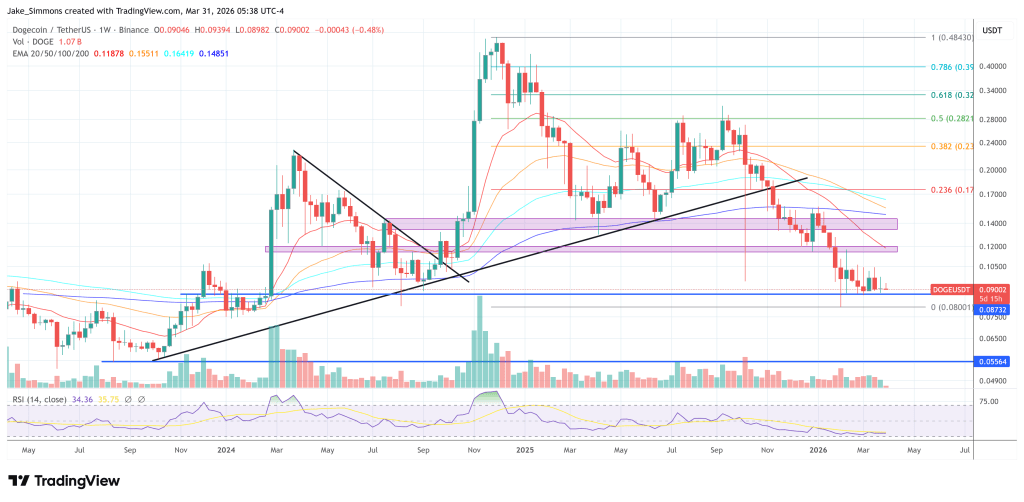
DOGE hovers above key support, 1-month chart | Source: DOGEUSDT on TradingView.com

Preguntas relacionadas

QWhat is the main purpose of Qubic's Dogecoin mining rollout starting April 1?

AThe main purpose is to transition Qubic away from its current split between Monero-linked outsourced mining and AI training into a model where both activities run at full scale in parallel, dedicating Qubic's CPU and GPU resources fully to its AI initiative Aigarth while using outsourced mining for Dogecoin as a revenue engine.

QHow does Qubic's 'Doge Connect' architecture function?

ADoge Connect is a bridge that links external Scrypt miners to Qubic's network. It uses a dispatcher to connect to pools, translates mining tasks between the Dogecoin and Qubic networks, validates shares, and feeds results back through Qubic's infrastructure, allowing ASIC miners to connect to Qubic pools without changing their operations.

QWhat are the three phases of the mainnet transition and what happens in phase one?

AThe rollout will happen in three phases, each expected to last one to two weeks. Phase one begins on mainnet April 1 and is a validation period covering task distribution, solution handling, pool communications, and public statistics. During this phase, Qubic will reduce its current Monero 'marathons' from three days per week to two.

QHow will Qubic handle payouts for Dogecoin miners using its system?

ARather than distributing DOGE directly, Qubic plans to sell the outsourced mining proceeds for stablecoins, use those funds to buy back Cubics (Qubic's native token), and then redistribute Cubics to the miners. This 'buyback' system is expected to provide approximately 10% more revenue than mining Dogecoin alone.

QWhat role does Qubic's oracle infrastructure play in the new mining system?

AQubic's oracle machines act as the source of truth for validating whether a mined share is accepted. Shares submitted through the network are validated internally, making the integration more than a simple mining proxy by effectively routing Dogecoin-related work through Qubic's own validation and accounting model.

Lecturas Relacionadas

A Nation Blocks Chips, a Giant Buys a Nuclear Power Plant: Why It's Time to Seriously Consider DeAI

**Title: Great Powers Blockade Chips, Giants Buy Nuclear Plants: Why It's Time to Seriously Consider DeAI** In May 2026, the US closed loopholes for Chinese firms to acquire advanced NVIDIA chips via overseas subsidiaries. That same month, Kenya halted a $1B geothermal data center project involving Microsoft, fearing its immense energy consumption. Meanwhile, Huawei announced mass production of its Ascend AI chip. These disparate events underscore a new reality: the competition for computing power ("compute") has escalated beyond the tech industry, becoming a geopolitical and infrastructural battleground. A new era of oligopoly is forming, with control over the AI stack—from GPU chips (NVIDIA) and cloud platforms (AWS, Azure, Google Cloud) to foundational models (OpenAI, Anthropic)—concentrating in a few Western "AI Octopus" corporations. This centralization creates systemic risks: pricing power and platform lock-in for users, infrastructure fragility, and a widening "compute divide" that threatens to marginalize nations without independent AI capacity. An "AI Iron Curtain" is deepening through export controls. In response, some nations like Saudi Arabia and the UAE are investing heavily to buy compute power, aiming to transition from oil to AI economies. The EU seeks to triple its compute capacity by 2030 to reduce dependency. However, the spending gap is vast, with four US tech giants alone planning ~$750B in AI capex for 2026. The race is increasingly constrained by energy, with AI tasks consuming up to 1000x more power than web searches, pushing firms to even acquire nuclear plants. This landscape is fueling interest in Decentralized AI (DeAI). It proposes a third way: using open protocols to coordinate a global network of idle GPUs, independent developers, and data centers, creating an AI infrastructure without a single controlling entity. Leveraging blockchain and cryptographic verification, DeAI aims to break market concentration, disperse energy demands, reduce geopolitical dependencies, and enhance transparency. While still nascent in performance and stability, DeAI's core promise is not immediate superiority but providing a crucial alternative architecture to resist monopoly, censorship, and centralized power. As specialized AI hardware costs fall and open-source models flourish, the window to build this foundation is open. The very existence of such competition serves as a vital check against the inevitable abuse of concentrated power.

marsbitHace 36 min(s)

A Nation Blocks Chips, a Giant Buys a Nuclear Power Plant: Why It's Time to Seriously Consider DeAI

marsbitHace 36 min(s)

Outpoll Review: A Prediction Market Platform Built for Active Traders

Outpoll Review: A Prediction Market Platform Built for Active Traders In recent years, prediction markets have grown from a niche sector to a mainstream arena, attracting billions in trading volume and institutional capital. However, the user experience and tools for traders have not kept pace. Outpoll, a new global prediction market platform, aims to fill this gap by providing enhanced trading infrastructure for active and professional traders. Built on standard prediction market principles, Outpoll allows users to trade on the outcome of specific events. It uses fully collateralized contracts with USDC settlement, charges a competitive 0.1% fee per trade, and provides clear settlement rules upfront to minimize disputes. A key focus for Outpoll is its professional-grade trading tools. The platform supports limit and market orders, as well as take-profit and stop-loss orders for open positions—features uncommon in prediction markets. For automated trading, Outpoll offers comprehensive REST and WebSocket APIs, enabling portfolio management, price arbitrage, and integration with existing tools. The platform also features a creator-led market model, where approved experts and community leaders can create and manage markets for niche topics under platform supervision. Its integrated interface combines news feeds directly with trading functions, allowing users to monitor events and manage positions seamlessly. Outpoll launched with a native Android app (available on Google Play) and plans an iOS version later this year. In summary, Outpoll distinguishes itself with trader-focused tools, practical APIs, transparent and collateralized markets, integrated news, and an expanding creator program. For active traders, its advanced order types and API access alone make it a platform worth watching. Outpoll is now globally accessible via outpoll.com and Google Play.

marsbitHace 45 min(s)

Outpoll Review: A Prediction Market Platform Built for Active Traders

marsbitHace 45 min(s)

Bitwise: Crypto Becomes a Contrarian Investment, Three Logics to Understand the Current Market

**Summary** Matt Hougan, Bitwise's CIO, analyzes the current crypto market through three key lenses, arguing it has shifted from a momentum-driven to a contrarian investment. **1) Crypto Becomes a Contrarian Play:** The market is weak, with major assets like Bitcoin and Ethereum down significantly. Capital has moved to hot sectors like AI, leaving crypto as an "unloved" asset class. This transforms crypto investing from trend-following to a test of patience and fundamental analysis. Investors now favor projects with solid fundamentals (e.g., Hyperliquid) over speculative ones. **2) Regulatory Overhang:** The uncertain fate of the U.S. CLARITY Act, a major crypto regulatory framework, is a key headwind. With its passage in 2024 seen as far from guaranteed (estimates range from 30-55%), institutional capital remains on the sidelines, choosing less risky alternatives like AI stocks. The market needs clarity—whether the bill passes or fails—more than any specific outcome to move decisively. **3) Capital Rotates to New Fundamentals:** This cycle differs from past bear markets where money fled to Bitcoin. Now, capital seeks smaller assets with strong use cases. While major cryptos fell in May 2024, tokens like Hyperliquid (+72%), Zcash (+50%), and XLM (+44%) rallied on their specific fundamentals. This rotation confirms the new contrarian, fundamentals-driven logic and signals the bear market may be in its later stages. **Conclusion:** Short-term pressure persists due to regulatory uncertainty and competition from AI narratives. Investing in crypto now requires a contrarian mindset—acting against the crowd and focusing on fundamental value. Patience and targeting high-quality projects based on their merits are essential for capturing long-term gains.

marsbitHace 1 hora(s)

Bitwise: Crypto Becomes a Contrarian Investment, Three Logics to Understand the Current Market

marsbitHace 1 hora(s)

ChatGPT Might Be Disappearing Soon

OpenAI announced at its "Intelligence at Work" event that its coding assistant, Codex, will be fully integrated into the ChatGPT app within weeks. This move marks a strategic shift from a conversational AI (Chat) towards a unified "agentic" platform capable of execution. Codex, originally launched to compete with Anthropic's Claude Code, has grown rapidly to 5 million weekly active users, with 20% being non-developers like analysts and designers. Its enterprise revenue now constitutes 40% of OpenAI's total. The integration is the first step in creating a super-app combining ChatGPT (interface), Codex (execution engine), and the Atlas browser (web access). OpenAI also unveiled new Codex features: specialized Agent plugins for six professional roles, an "Annotations" tool for direct document editing, and a "Sites" function to turn work into shareable web apps. Internally, this reflects a power shift; the Codex team now leads core product strategy. While the ChatGPT brand remains for its vast user base, the platform's future is focused on autonomous agents that perform tasks, not just chat. The article notes that competition with Claude Code pushed OpenAI's development, with Codex competing on cost-effectiveness and accessibility rather than raw coding quality. It concludes that the essence of "ChatGPT" is evolving from a chatbot into an AI agent platform, with the name potentially becoming a legacy symbol of its original function.

marsbitHace 1 hora(s)

ChatGPT Might Be Disappearing Soon

marsbitHace 1 hora(s)

Trading

Spot
Futuros
活动图片