Quantum Computing Will Trigger A Bitcoin Supply Shock: Michael Saylor

bitcoinistPublicado a 2025-12-20Actualizado a 2025-12-20

Resumen

Quantum computing will not break Bitcoin but instead harden it, according to Michael Saylor. In response to a future quantum threat, a coordinated global upgrade to quantum-resistant encryption will be enforced. Active Bitcoin holders will migrate their coins to secure new wallets, while lost or inaccessible coins will remain permanently frozen. This process will enhance network security, reduce the effective supply of Bitcoin, and trigger a deflationary event. Saylor argues that the upgrade is inevitable and that the market will ultimately reach consensus, despite Bitcoin’s decentralized nature. The result will be a clearer accounting of lost BTC and a stronger, more secure network.

Quantum computing has become a durable risk narrative for Bitcoin. This week, Galaxy Digital head of research Alex Thorn sat down with Strategy executive chairman Michael Saylor addressing the issue, shortly after Saylor posted his own “Bitcoin Quantum Leap” thesis on X.

“The Bitcoin Quantum Leap: Quantum computing won’t break Bitcoin—it will harden it. The network upgrades, active coins migrate, lost coins stay frozen. Security goes up. Supply comes down. Bitcoin grows stronger,” Saylor wrote on Dec. 16, 2025.

Saylor Doubles Down On Freezing Dormant Bitcoin

In Thorn’s interview, Saylor’s argument is less a cryptography lesson than a coordination claim: when a quantum threat is broadly recognized, the response will not be optional, and Bitcoin will follow the same upgrade logic as the rest of the digital economy.

“There’s going to be a point when the world will form a consensus that there’s a quantum threat. We’re not there now, but you won’t miss it because the United States government will direct all of the defense contractors to upgrade their encryption algorithms to be quantum resistant,” Saylor said.

He described a cascade in which major platforms ship standardized quantum-resistant libraries across consumer devices and core financial systems, with enforced timelines and re-authentication requirements. In that scenario, Saylor suggested, Bitcoin’s transition would be a software upgrade problem, not an existential crisis.

“They will ship an upgrade and they will say [...] please install the new client software and reauthenticate yourself. And you’ve got X days, 90 days, 30 days... And if you don’t, we’re going to freeze your funds. For your own good,” Saylor said.

Saylor repeatedly returned to incentives as the decisive factor. In his view, owners of meaningful balances will not rationally opt out of an upgrade that preserves access to their holdings, and the same logic extends to the broader ecosystem’s ability to reach rough consensus.

“The Bitcoin network just runs on software. There’s going to be a quantum upgrade. It’s going to have quantum resistant encryption libraries,” he said, adding that he would expect those to align with widely adopted standards shipped across operating systems and enterprise infrastructure.

Where his answer becomes more explicitly market-relevant is in the downstream implication: coins that can be migrated will be migrated, and coins that cannot be migrated — because the holders are deceased or keys are irretrievable — would remain stranded. Saylor framed that as a security hardening event that also forces a clearer accounting of lost supply.

“We’re going to re-encrypt all the Bitcoin and all the wallets [...] It’s going to get re-encrypted if the holders of the private keys are alive and if they like money,” he said. “If they’re dead, they’re not going to re-encrypt. And if they’ve lost the keys, they’re not going to re-encrypt.”

Bitcoin Supply Shock Imminent

That is where the “deflationary event” language enters: the upgrade, in his view, would effectively separate recoverable BTC from unrecoverable BTC in a way the market would have to price. “This is going to be a massive upgrade to network security and it’s going to be a massive deflationary event,” Saylor said. “And we’re going to get the answer to the age old question, how much BTC has been lost?”

Saylor also addressed the common objection that decentralization makes coordinated upgrades impractical. He argued the opposite: decentralized networks still converge when sufficiently motivated, and global supply chains and defense ecosystems coordinate under pressure despite being fragmented across thousands of entities.

“You think you’re not going to get consensus? All the smart people with money in the world that thought it was smart to put their money on the crypto network, you think they’re the people too stupid to want to upgrade?” he said.

In his framing, the practical difference versus a bank-driven migration is timing. A centralized institution can enforce a short deadline; Bitcoin, because it is global and permissionless, would likely take longer, on the order of months to years, but would still converge. “We’re probably going to do this over the course of 30 days or 90 days. It’ll probably take two years or one year,” Saylor said.

At press time, BTC traded at $88,000.
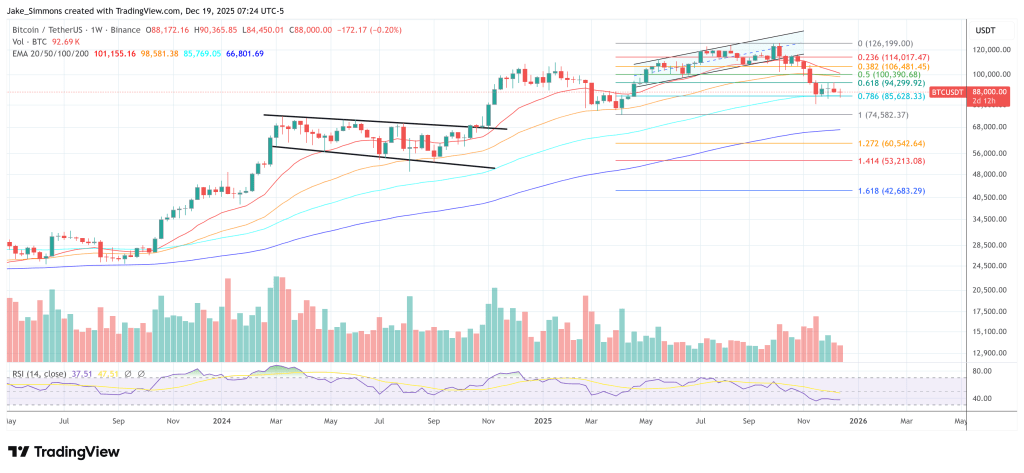
Bitcoin remains between the 0.618 and 0.786 Fib, 1-week chart | Source: BTCUSDT on TradingView.com

Preguntas relacionadas

QWhat is Michael Saylor's main argument about quantum computing and Bitcoin?

AMichael Saylor argues that quantum computing will not break Bitcoin but will instead harden it. He believes the network will upgrade, active coins to quantum-resistant encryption, while lost coins remain frozen. This process will increase security, reduce supply, and make Bitcoin stronger.

QAccording to Saylor, what will trigger the global consensus to upgrade encryption algorithms?

ASaylor states that the United States government will direct all defense contractors to upgrade their encryption algorithms to be quantum-resistant, which will signal a broad recognition of the quantum threat and trigger a global consensus for upgrades.

QHow does Saylor describe the process of Bitcoin's quantum upgrade?

ASaylor describes it as a software upgrade where quantum-resistant encryption libraries will be shipped. Users will be required to install new client software and reauthenticate within a deadline (e.g., 30-90 days), or their funds will be frozen for security reasons.

QWhy does Saylor believe the quantum upgrade will be a deflationary event for Bitcoin?

AHe explains that the upgrade will separate recoverable BTC (migrated by active users) from unrecoverable BTC (held by deceased or key-losers), effectively reducing the circulating supply and forcing the market to account for lost coins, thus creating a deflationary shock.

QHow does Saylor counter the argument that decentralization makes coordinated upgrades impractical?

ASaylor argues that decentralized networks can still reach consensus when motivated, citing examples like global supply chains and defense ecosystems coordinating under pressure. He believes Bitcoin holders, being smart and financially invested, will rationally choose to upgrade to protect their assets.

Lecturas Relacionadas

First Batch of Keynote Speakers and Partners Announced! Web2+3 Summit: Defining the Next Generation of Digital Economy

Web2+3 Summit: Defining the Next Generation of Digital Economy The 6th BEYOND International Technology Innovation Expo (BEYOND Expo 2026), Asia's largest tech and ecosystem exhibition, is launching a dedicated Web2+3 stage for the first time. Co-hosted by BEYOND Expo and ChainNeXT Group, the Web3 Summit will take place from May 28–30, 2026. Against the backdrop of accelerating global tech integration, the boundaries between Web2 and Web3 are rapidly blurring. With clearer global regulations for blockchain-driven internet (Web3) and the special issuance of a Hong Kong dollar stable币 license by the Hong Kong SAR government on April 10, 2026, Web3's decentralized principles are quickly merging with traditional industries (Web2) such as e-commerce, finance, and artificial intelligence. Focused on blockchain-driven digital economy elements, the summit will center on three core principles—implementability, commercial viability, and compliance. It will bring together top Web3 experts to discuss key integration areas like stablecoin payment finance (PayFi), real-world asset tokenization (RWA), and decentralized AI (DeAI), unveiling new opportunities for industrial innovation. The first wave of confirmed speakers includes Jack Kong (Director of Hong Kong Cyberport, Chairman of Nano Labs), Yat Siu (Chairman of Animoca Brands), Michael Wu (Co-founder & CEO of Amber Group), Michael Heinrich (Co-founder & CEO of 0G), and Art Abal (Co-founder of Vana). More Web3 ecosystem pioneers, AI, and fintech experts will be announced soon. Core forum topics include: - Web2+DeAI: New AI Paradigms Driven by Decentralized Infrastructure - Web2+RWA: Real-World Asset Tokenization and Global Liquidity - Web2+PayFi: Cross-Border Payments and Financial Innovation Powered by Crypto Infrastructure - Web2+3 AI: Autonomous Agents and the Crypto Economy - Web2+3 Wealth: On-Chain and Off-Chain Integrated Investment Ecosystems - Web2+3 Commerce: A New Landscape for Global Trade Driven by Stablecoins Additional agenda details will be released in the near future.

marsbitHace 1 hora(s)

First Batch of Keynote Speakers and Partners Announced! Web2+3 Summit: Defining the Next Generation of Digital Economy

marsbitHace 1 hora(s)

Trading

Spot
Futuros

Artículos destacados

Cómo comprar FRAX

¡Bienvenido a HTX.com! Hemos hecho que comprar FRAX (FRAX) sea simple y conveniente. Sigue nuestra guía paso a paso para iniciar tu viaje de criptos.Paso 1: crea tu cuenta HTXUtiliza tu correo electrónico o número de teléfono para registrarte y obtener una cuenta gratuita en HTX. Experimenta un proceso de registro sin complicaciones y desbloquea todas las funciones.Obtener mi cuentaPaso 2: ve a Comprar cripto y elige tu método de pagoTarjeta de crédito/débito: usa tu Visa o Mastercard para comprar FRAX (FRAX) al instante.Saldo: utiliza fondos del saldo de tu cuenta HTX para tradear sin problemas.Terceros: hemos agregado métodos de pago populares como Google Pay y Apple Pay para mejorar la comodidad.P2P: tradear directamente con otros usuarios en HTX.Over-the-Counter (OTC): ofrecemos servicios personalizados y tipos de cambio competitivos para los traders.Paso 3: guarda tu FRAX (FRAX)Después de comprar tu FRAX (FRAX), guárdalo en tu cuenta HTX. Alternativamente, puedes enviarlo a otro lugar mediante transferencia blockchain o utilizarlo para tradear otras criptomonedas.Paso 4: tradear FRAX (FRAX)Tradear fácilmente con FRAX (FRAX) en HTX's mercado spot. Simplemente accede a tu cuenta, selecciona tu par de trading, ejecuta tus trades y monitorea en tiempo real. Ofrecemos una experiencia fácil de usar tanto para principiantes como para traders experimentados.

618 Vistas totalesPublicado en 2026.03.03Actualizado en 2026.03.03

Cómo comprar FRAX

Qué es MANTRA

I. Introducción al ProyectoMANTRA es una Blockchain de Capa 1 centrada en la Seguridad, capaz de adherirse y hacer cumplir los requisitos regulatorios del mundo real. Construida para Instituciones y Desarrolladores, MANTRA ofrece una Blockchain sin permisos para aplicaciones con permisos.Características Clave: * Construida utilizando Cosmos SDK, compatible con IBC, con soporte para CosmWasm * Asegurada a través de un conjunto de validadores PoS soberanos * Escalable hasta 10k TPS * Módulos, SDKs y APIs integrados para crear, comerciar y gestionar RWAs que cumplan con la regulación * Experiencia de Usuario Mejorada para integrar a usuarios e instituciones no nativas en Web3.1) Información BásicaNombre: MANTRA (OM)III. Enlaces RelacionadosDocumento Técnico:https://docs.mantrachain.io/Sitio web oficial:https://www.mantrachain.io/Exploradores:https://mintscan.io/mantraRedes Sociales:https://x.com/MANTRA_ChainNota: La introducción al proyecto proviene de los materiales publicados o proporcionados por el equipo oficial del proyecto, que es solo para referencia y no constituye asesoramiento de inversión. HTX no se hace responsable de ninguna pérdida directa o indirecta resultante.

507 Vistas totalesPublicado en 2026.03.04Actualizado en 2026.03.04

Qué es MANTRA

Cómo comprar MANTRA

¡Bienvenido a HTX.com! Hemos hecho que comprar Mantra (MANTRA) sea simple y conveniente. Sigue nuestra guía paso a paso para iniciar tu viaje de criptos.Paso 1: crea tu cuenta HTXUtiliza tu correo electrónico o número de teléfono para registrarte y obtener una cuenta gratuita en HTX. Experimenta un proceso de registro sin complicaciones y desbloquea todas las funciones.Obtener mi cuentaPaso 2: ve a Comprar cripto y elige tu método de pagoTarjeta de crédito/débito: usa tu Visa o Mastercard para comprar Mantra (MANTRA) al instante.Saldo: utiliza fondos del saldo de tu cuenta HTX para tradear sin problemas.Terceros: hemos agregado métodos de pago populares como Google Pay y Apple Pay para mejorar la comodidad.P2P: tradear directamente con otros usuarios en HTX.Over-the-Counter (OTC): ofrecemos servicios personalizados y tipos de cambio competitivos para los traders.Paso 3: guarda tu Mantra (MANTRA)Después de comprar tu Mantra (MANTRA), guárdalo en tu cuenta HTX. Alternativamente, puedes enviarlo a otro lugar mediante transferencia blockchain o utilizarlo para tradear otras criptomonedas.Paso 4: tradear Mantra (MANTRA)Tradear fácilmente con Mantra (MANTRA) en HTX's mercado spot. Simplemente accede a tu cuenta, selecciona tu par de trading, ejecuta tus trades y monitorea en tiempo real. Ofrecemos una experiencia fácil de usar tanto para principiantes como para traders experimentados.

231 Vistas totalesPublicado en 2026.03.04Actualizado en 2026.03.04

Cómo comprar MANTRA

Discusiones

Bienvenido a la comunidad de HTX. Aquí puedes mantenerte informado sobre los últimos desarrollos de la plataforma y acceder a análisis profesionales del mercado. A continuación se presentan las opiniones de los usuarios sobre el precio de A (A).

活动图片