Quant enters crucial supply zone: Will QNT’s 24% weekly rally falter?

ambcryptoPublicado a 2026-03-21Actualizado a 2026-03-21

Resumen

Quant (QNT) has surged 24.14% in the past week, significantly outperforming Bitcoin, which declined 2.64%. The altcoin is approaching a critical supply zone between $80 and $88, a key resistance area. While QNT has shown strength by rebounding from the long-term demand zone of $55–$60, its weekly chart still reflects a bearish structure, with the RSI below 50 and OBV not trending higher. Key resistance levels to watch are $88, $105, and $135. A daily close above $88 could signal a bullish continuation, while rejection at $80 and a drop below $75 may indicate a bearish reversal. Traders are advised to consider taking profits in the $80–$88 zone or wait for a clear breakout above $88 or breakdown below $75 for directional bias.

At press time, Quant [QNT] rallied 4.91% in 24 hours and was up by 24.14% over the past week. These were impressive numbers for the mid-cap altcoin, especially in comparison to Bitcoin [BTC]. The leading crypto has shed 2.64% over the past week and was oscillating about the $70k level.

In the coming days and weeks, BTC could make another push higher toward $80k. This could provide fuel for altcoins to climb higher, but only a few altcoins have already shown strength.

Quant could be one of them. It has a higher timeframe bearish trend but has reacted positively at the long-term demand zone at $55-$60. In March, QNT rebounded swiftly from $60.92 to $80.72, a 32.5% move in two weeks.

Quant is likely to rally to the Value Area High
Source: QNT/USDT on TradingView

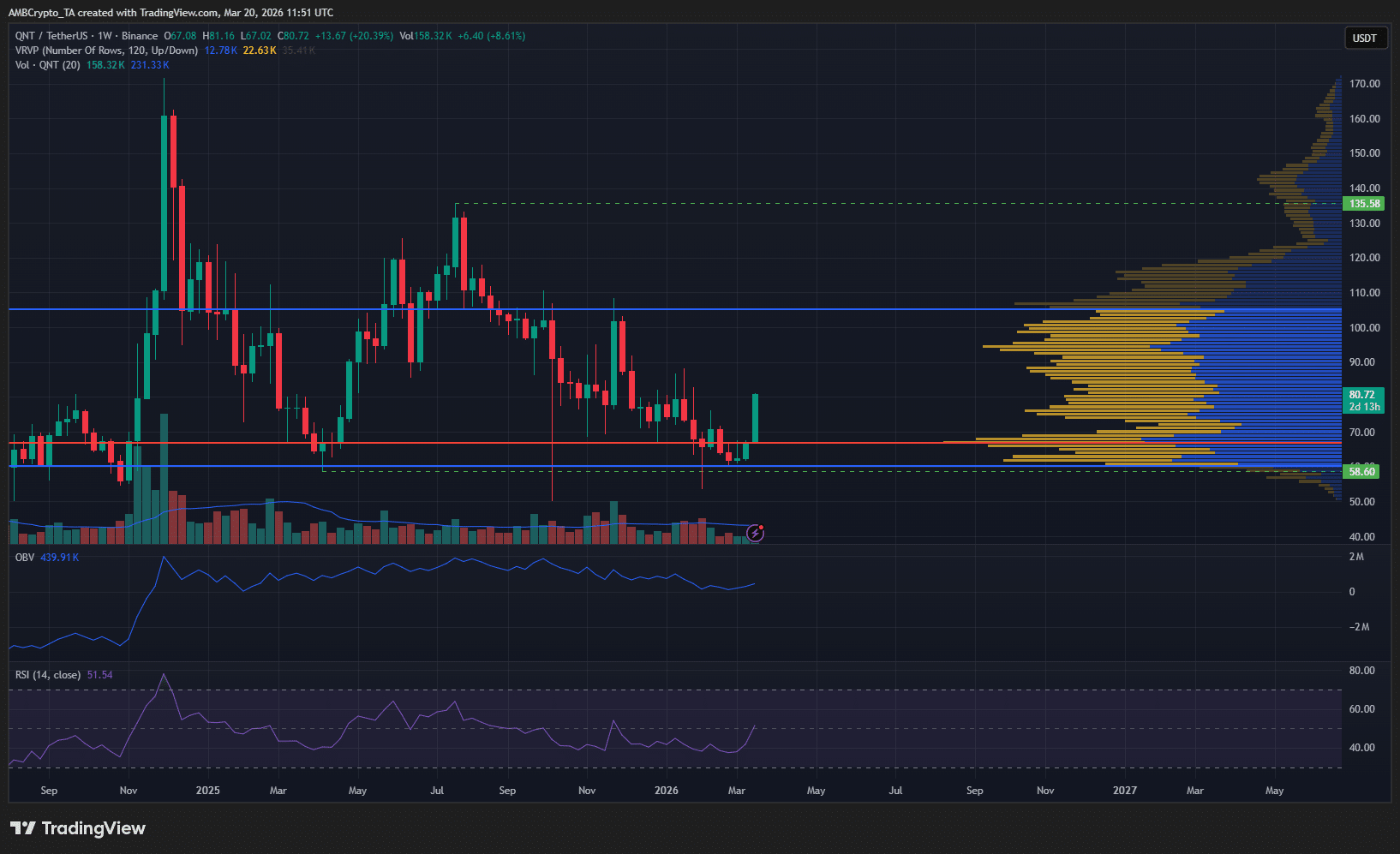
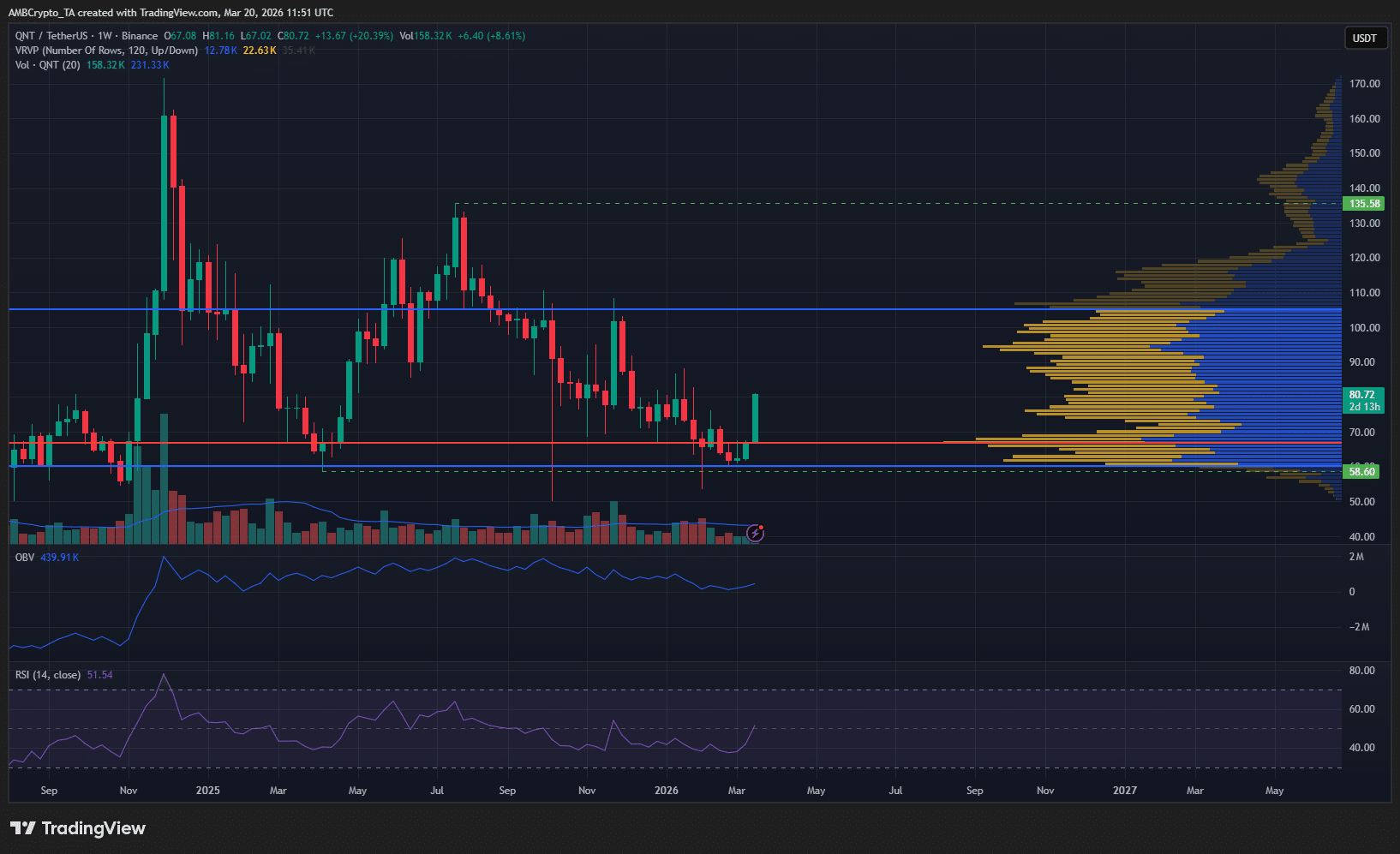
The weekly chart showed a long-term bullish swing structure but a bearish internal structure. Even after the strong gains in March, the local swing high at $88.3 remained unbroken.

The Visible Range’s Value Area was between $60 and $105, with the Point of Control at $67. That means the high-volume node shifted into bullish control, which was encouraging for bulls. However, they still had a long way to go before they could maintain their momentum.

Since April 2025, QNT has been stuck within the $58.60-$135.58 levels. The $88, $105, and $135 levels were the next key resistances to the north for QNT to overcome.

The OBV has not trended higher lately, and the RSI has remained below the neutral 50 level. The structure and technical indicators remained bearishly poised on the weekly timeframe.

QNT is at a make-or-break region
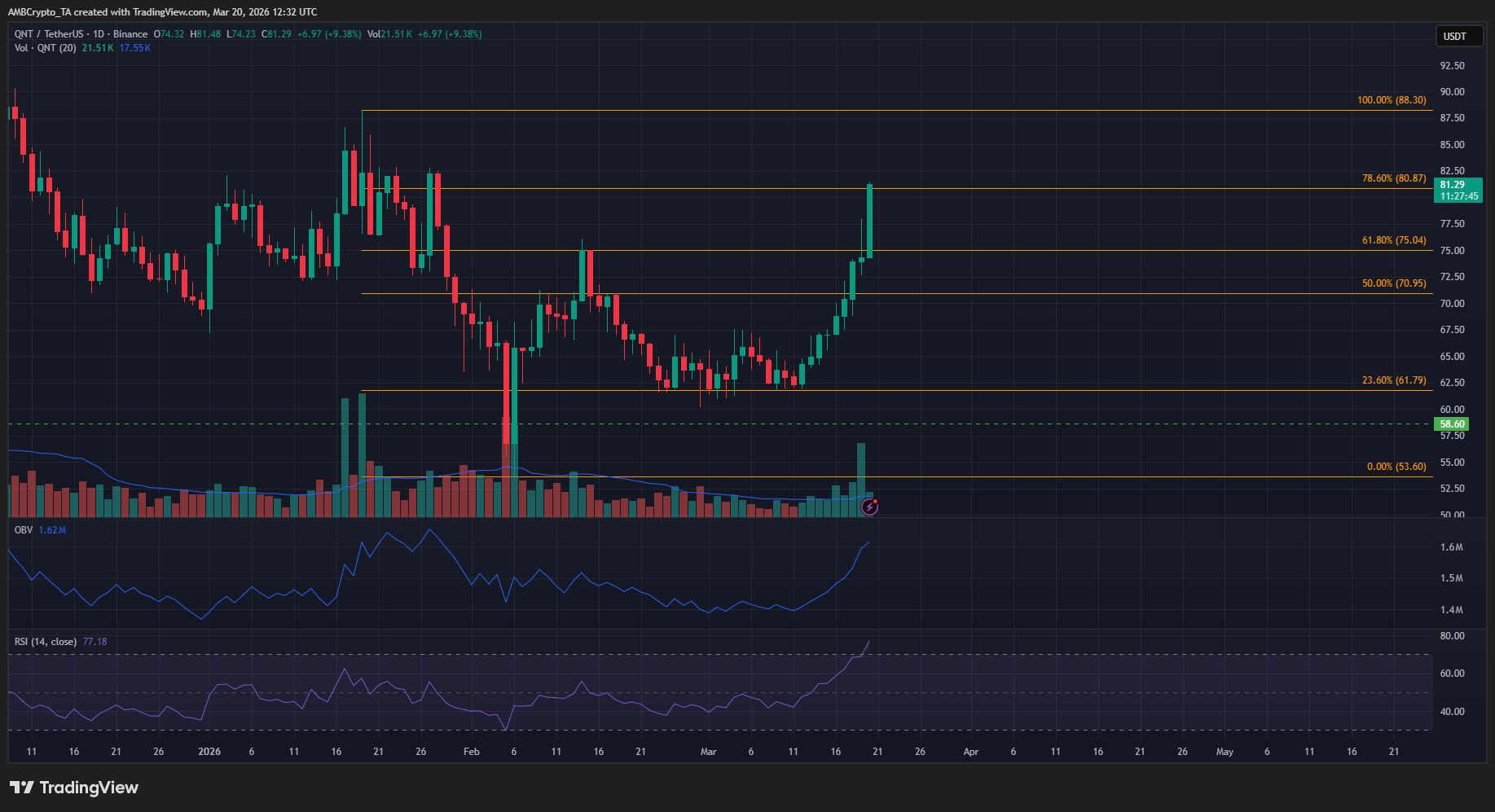
Source: QNT/USDT on TradingView

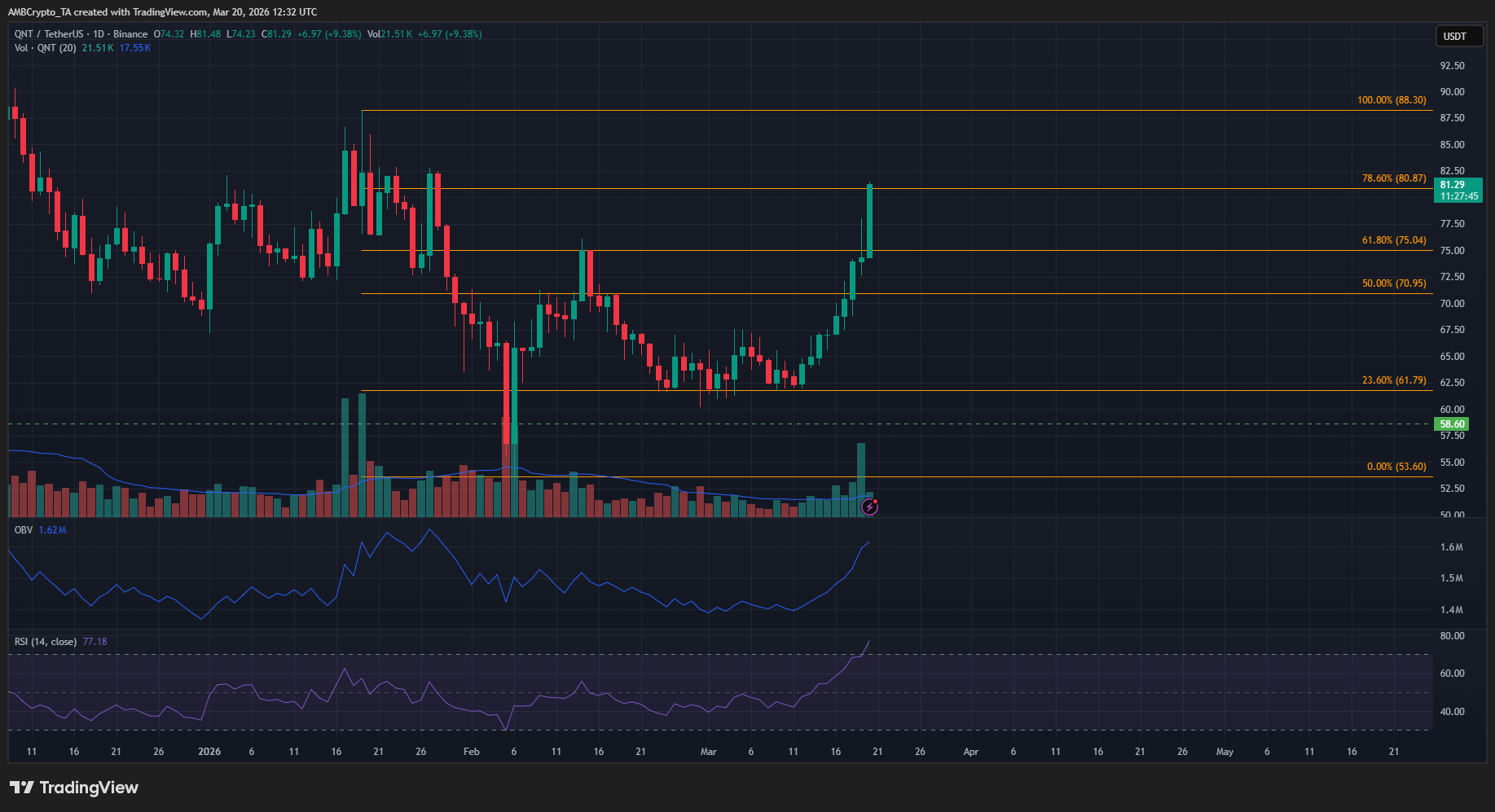
On the 1-day chart, the swing structure was bearish. This drop in January and February was used to plot a set of Fibonacci retracement levels (orange). The $75.04 and $80.87 levels were the levels that demarcated the golden pocket within the retracement.

If the bears were going to take control, they were most likely to do it within this price range. Yet, it has not happened so far.

So swing traders looking to go long should wait, while those looking to sell QNT can do so and book profits. It is unclear where the next leg will go.

A daily session closing above $88 would be a strong sign of a bullish continuation. Meanwhile, rejection from $80 and a subsequent fall below $75 would be indicative of a bearish trend’s renewal.


Final Summary

  • QNT traders already in long positions can look to take profits as the price enters the $80-$88 resistance zone.
  • Swing traders can wait for $75 or $88 to be breached to decide their next directional bias.

Preguntas relacionadas

QWhat is the current weekly and 24-hour price performance of Quant (QNT) as mentioned in the article?

AAt press time, Quant (QNT) had rallied 4.91% in 24 hours and was up by 24.14% over the past week.

QWhat are the key resistance levels that QNT needs to overcome to the north, according to the weekly chart analysis?

AThe key resistance levels to the north for QNT are $88, $105, and $135.

QWhat is the significance of the Fibonacci retracement's 'golden pocket' levels on the 1-day chart for QNT?

AThe 'golden pocket' levels, $75.04 and $80.87, are the price range where bears are most likely to take control, making it a critical zone for a potential trend reversal.

QWhat would a daily closing price above $88 indicate for QNT's price action?

AA daily session closing above $88 would be a strong sign of a bullish continuation for QNT.

QWhat trading advice is given to swing traders who are currently in long positions on QNT?

ASwing traders already in long positions are advised to look to take profits as the price enters the $80-$88 resistance zone.

Lecturas Relacionadas

a16z: AI's 'Amnesia', Can Continuous Learning Cure It?

The article "a16z: AI's 'Amnesia' – Can Continual Learning Cure It?" explores the limitations of current large language models (LLMs), which, like the protagonist in the film *Memento*, are trapped in a perpetual present—unable to form new memories after training. While methods like in-context learning (ICL), retrieval-augmented generation (RAG), and external scaffolding (e.g., chat history, prompts) provide temporary solutions, they fail to enable true internalization of new knowledge. The authors argue that compression—the core of learning during training—is halted at deployment, preventing models from generalizing, discovering novel solutions (e.g., mathematical proofs), or handling adversarial scenarios. The piece introduces *continual learning* as a critical research direction to address this, categorizing approaches into three paths: 1. **Context**: Scaling external memory via longer context windows, multi-agent systems, and smarter retrieval. 2. **Modules**: Using pluggable adapters or external memory layers for specialization without full retraining. 3. **Weights**: Enabling parameter updates through sparse training, test-time training, meta-learning, distillation, and reinforcement learning from feedback. Challenges include catastrophic forgetting, safety risks, and auditability, but overcoming these could unlock models that learn iteratively from experience. The conclusion emphasizes that while context-based methods are effective, true breakthroughs require models to compress new information into weights post-deployment, moving from mere retrieval to genuine learning.

marsbitHace 58 min(s)

a16z: AI's 'Amnesia', Can Continuous Learning Cure It?

marsbitHace 58 min(s)

Can a Hair Dryer Earn $34,000? Deciphering the Reflexivity Paradox in Prediction Markets

An individual manipulated a weather sensor at Paris Charles de Gaulle Airport with a portable heat source, causing a Polymarket weather market to settle at 22°C and earning $34,000. This incident highlights a fundamental issue in prediction markets: when a market aims to reflect reality, it also incentivizes participants to influence that reality. Prediction markets operate on two layers: platform rules (what outcome counts as a win) and data sources (what actually happened). While most focus on rules, the real vulnerability lies in the data source. If reality is recorded through a specific source, influencing that source directly affects market settlement. The article categorizes markets by their vulnerability: 1. **Single-point physical data sources** (e.g., weather stations): Easily manipulated through physical interference. 2. **Insider information markets** (e.g., MrBeast video details): Insiders like team members use non-public information to trade. Kalshi fined a剪辑师 $20,000 for insider trading. 3. **Actor-manipulated markets** (e.g., Andrew Tate’s tweet counts): The subject of the market can control the outcome. Evidence suggests Tate’sociated accounts coordinated to profit. 4. **Individual-action markets** (e.g., WNBA disruptions): A single person can execute an event to profit from their pre-placed bets. Kalshi and Polymarket handle these issues differently. Kalshi enforces strict KYC, publicly penalizes insider trading, and reports to regulators. Polymarket, with its anonymous wallet-based system, has historically been more permissive, arguing that insider information improves market accuracy. However, it cooperated with authorities in the "Van Dyke case," where a user traded on classified government information. The core paradox is reflexivity: prediction markets are designed to discover truth, but their financial incentives can distort reality. The more valuable a prediction becomes, the more likely participants are to influence the event itself. The market ceases to be a mirror of reality and instead shapes it.

marsbitHace 2 hora(s)

Can a Hair Dryer Earn $34,000? Deciphering the Reflexivity Paradox in Prediction Markets

marsbitHace 2 hora(s)

Trading

Spot
Futuros
活动图片