Pyth to launch reserve using buybacks from DAO treasury funds

cointelegraphPublicado a 2025-12-12Actualizado a 2025-12-12

Resumen

The Pyth Network, a blockchain oracle provider, announced it will use one-third of its protocol revenue to buy back PYTH tokens on the open market through its DAO treasury. This strategy aims to establish a network reserve and boost both revenue and token value. The PYTH token has declined over 80% in the past year, despite a brief surge after Pyth partnered with the U.S. government to publish economic data onchain. At the time of writing, PYTH was trading around $0.063, down 1.3% in 24 hours. The move follows a similar proposal from Aave’s DAO in October, though community reactions remain uncertain, citing past criticisms of token buyback schemes in other projects like Mango Markets.

The Pyth Network, a blockchain oracle provider, said it will convert a portion of its revenue into PYTH token purchases as part of a reserve strategy.

In a Friday blog post, Pyth said the tokens it buys on the open market with one-third of the protocol’s revenue through its decentralized autonomous organization (DAO) would constitute the network’s reserve. The network said the strategy was designed to increase revenue and token purchases.

“[I]t’s time to rewrite the market data economy on a global level,” said Pyth.
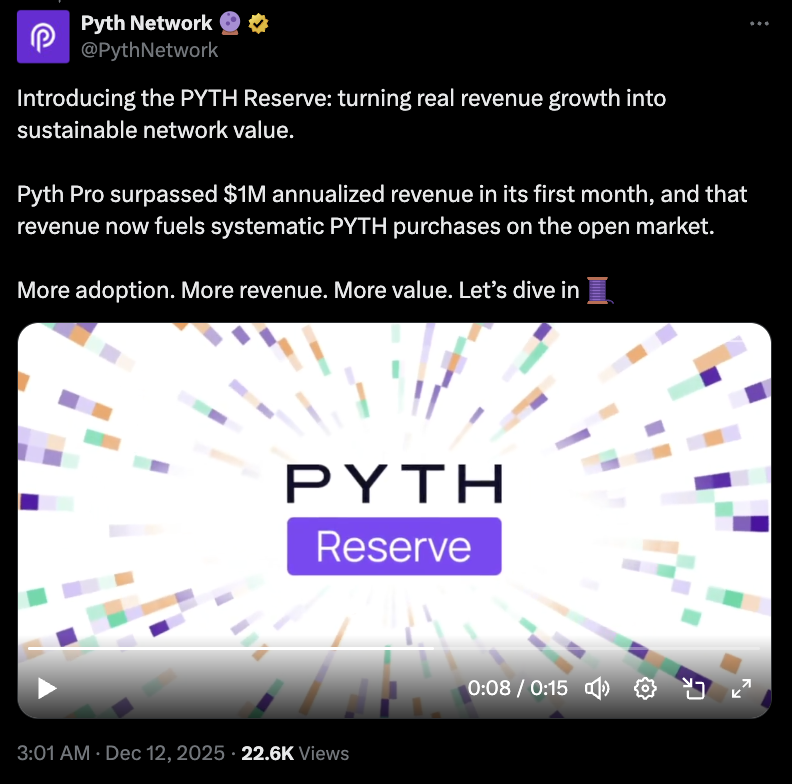
Source: Pyth

The price of the Pyth Network token (PYTH) has dropped by more than 80% over the past year, despite a brief surge when the platform deepened ties to the US government. The Trump administration announced in August that the company and Chainlink would be responsible for publishing the country’s economic data onchain.

According to data from Nansen, the PYTH price decreased by about 1.3% over the previous 24 hours, reaching about $0.063 at the time of publication.

Related: Grayscale launches Pyth investment fund

Aave DAO proposed a similar buyback initiative in October

The DAO behind the Aave protocol introduced a proposal that would use $50 million of its annual revenue to repurchase its native token, Aave (AAVE). As of Friday, it did not appear that the proposal had been approved.

It’s unclear how Pyth users may respond to the plan. In 2024, when Mango Markets suggested a buyback program to purchase its MNGO tokens, co-founder Daffy Durairaj accused the creators of “untrustworthy behavior and self-dealing.”

Magazine: When privacy and AML laws conflict: Crypto projects’ impossible choice

Criptos en tendencia

Lecturas Relacionadas

Robinhood CEO: The Tokenization Wave of U.S. Stocks is Coming, America Must Not Be Left Behind

We are at the early stage of a global supercycle for asset tokenization, a transformative force reshaping finance. Robinhood has actively expanded this frontier outside the US, recently launching Robinhood Chain, a public EVM chain designed for Real World Assets (RWA) and focused on stock tokens. It enables global users to access over 190 US stocks backed 1:1 by underlying securities. However, a key gap remains: these tokenized stocks are not yet available within the United States itself. In the US, the debate around stock tokenization centers on its practical value, given existing low-cost access to equities. Critics question the need, but this misses the core innovation: tokenizing premium financial assets to make them portable, programmable, self-custodied, and tradable 24/7 within an open financial ecosystem. This is more than moving stocks onto a blockchain; it's rebuilding the foundational infrastructure of asset ownership. For US investors, this new infrastructure offers three core advantages: 1. **Real-time clearing and settlement**, enhancing market resilience by eliminating the systemic risks and capital burdens inherent in the traditional T+2/T+1 settlement cycle, as starkly revealed during events like the GameStop volatility. 2. **Native 24/7 trading capability**, allowing all investors to manage risk and react to global news outside standard market hours, a tool previously largely accessible only to institutions. 3. **Greater user control and portability of assets**, enabling instant transfers between platforms and into DeFi. This self-custody model fosters competition among service providers and unlocks new use cases like lending and using tokens as collateral. Realizing these benefits in the US requires more than technology; it necessitates modernizing a century-old securities regulatory framework built for legacy infrastructure. Policymakers must act swiftly to adapt rules for this new paradigm while preserving investor protections. Other jurisdictions are advancing, and the US risks being left behind in shaping the future of asset ownership—a future largely built around American assets and innovation. Tokenizing publicly traded stocks is just the beginning, paving the way for broadening access to other asset classes like private equity. US investors deserve to participate in this innovation.

marsbitHace 23 min(s)

Robinhood CEO: The Tokenization Wave of U.S. Stocks is Coming, America Must Not Be Left Behind

marsbitHace 23 min(s)

BIT Trading Moment: BTC Buying Pressure Rises but Bearish Sentiment Remains Strong, 50-Month EMA Difficult to Break, SK Hynix Attempts to Stabilize Memory

BIT Trading Hours: BTC Buying Rebounds but Bearish Sentiment Persists; 50-Month EMA Presents Resistance; SK Hynix Attempts to Stabilize the Memory Sector. Bitcoin briefly reclaimed $65,000, its first time since August 10th, showing a temporary decoupling from traditional risk assets pressured by soaring long-term U.S. Treasury yields. Key support is seen at $62k-$63k, with resistance near the 50-month Exponential Moving Average around $65.4k. While on-chain data indicates recovering spot demand, potentially signaling a local bottom, the options market remains skewed bearish. BIT analysis notes significant downside risk remains if historical bear market patterns repeat, with a potential drop to ~$45.5k. Global equity markets faced intense selling pressure, driven by a bond market storm. The U.S. 30-year yield hit a multi-year high above 5.33%, raising global funding costs. The AI sector was at the epicenter of the sell-off, with the Philadelphia Semiconductor Index plunging ~5% as investors questioned the sustainability of massive AI capital expenditures amid high debt costs. Storage stocks like Micron led declines. SK Hynix's announcement of a major share buyback provided some stability to the memory sector during after-hours trading. However, most tech stocks remained under pressure. In Asia, South Korean and Japanese indices fell sharply, heavily impacted by chip stock declines. Chinese robotics company Unitree Tech had a volatile market debut on Shanghai's STAR Market, soaring over 600% at one point before paring gains, making its founder a billionaire. Despite this individual success, the broader robotics sector in A-shares sold off heavily. Key upcoming events include the U.S. 20-year Treasury auction and the release of the Federal Reserve's July meeting minutes, which will be crucial tests for bond market stability and monetary policy expectations.

marsbitHace 25 min(s)

BIT Trading Moment: BTC Buying Pressure Rises but Bearish Sentiment Remains Strong, 50-Month EMA Difficult to Break, SK Hynix Attempts to Stabilize Memory

marsbitHace 25 min(s)

Trading

Spot

Artículos destacados

Cómo comprar DAO

¡Bienvenido a HTX.com! Hemos hecho que comprar DAO Maker (DAO) sea simple y conveniente. Sigue nuestra guía paso a paso para iniciar tu viaje de criptos.Paso 1: crea tu cuenta HTXUtiliza tu correo electrónico o número de teléfono para registrarte y obtener una cuenta gratuita en HTX. Experimenta un proceso de registro sin complicaciones y desbloquea todas las funciones.Obtener mi cuentaPaso 2: ve a Comprar cripto y elige tu método de pagoTarjeta de crédito/débito: usa tu Visa o Mastercard para comprar DAO Maker (DAO) al instante.Saldo: utiliza fondos del saldo de tu cuenta HTX para tradear sin problemas.Terceros: hemos agregado métodos de pago populares como Google Pay y Apple Pay para mejorar la comodidad.P2P: tradear directamente con otros usuarios en HTX.Over-the-Counter (OTC): ofrecemos servicios personalizados y tipos de cambio competitivos para los traders.Paso 3: guarda tu DAO Maker (DAO)Después de comprar tu DAO Maker (DAO), guárdalo en tu cuenta HTX. Alternativamente, puedes enviarlo a otro lugar mediante transferencia blockchain o utilizarlo para tradear otras criptomonedas.Paso 4: tradear DAO Maker (DAO)Tradear fácilmente con DAO Maker (DAO) en HTX's mercado spot. Simplemente accede a tu cuenta, selecciona tu par de trading, ejecuta tus trades y monitorea en tiempo real. Ofrecemos una experiencia fácil de usar tanto para principiantes como para traders experimentados.

358 Vistas totalesPublicado en 2024.12.11Actualizado en 2026.06.02

Cómo comprar DAO

Discusiones

Bienvenido a la comunidad de HTX. Aquí puedes mantenerte informado sobre los últimos desarrollos de la plataforma y acceder a análisis profesionales del mercado. A continuación se presentan las opiniones de los usuarios sobre el precio de DAO (DAO).

活动图片