PwC Drops Guard On Crypto After US Digital Asset Rule Changes

bitcoinistPublicado a 2026-01-06Actualizado a 2026-01-06

Resumen

PwC, one of the Big Four accounting firms, has reversed its cautious approach toward cryptocurrency following new U.S. regulatory developments, including the Genius Act which regulates stablecoins. The firm is now actively promoting the use of digital asset technology, particularly stablecoins, to improve payment efficiency. This shift reflects growing institutional acceptance of crypto assets, especially stablecoins, which have seen increased adoption globally—including in Hong Kong, Japan, and Europe. Despite recent market consolidation, the stablecoin market cap remains strong near its all-time high at $307 billion. Meanwhile, Bitcoin is trading around $92,900, up 6% over the past week.

Big Four accounting firm PwC has reversed its cautious stance on crypto after regulatory developments related to the space in the United States.

PwC Has Softened Its Stance On Crypto

According to a report from the Financial Times, PwC has changed its strategy around digital assets following the new laws passed by Donald Trump’s administration. PricewaterhouseCoopers, PwC in short, is a multinational professional services network headquartered in London. It provides services such as audits, tax planning, and business consulting to companies worldwide.

PwC is the second-largest firm of its kind and part of the Big Four accounting firms. Previously, the British company steered clear of crypto-related work in the US like other Big Four firms, but it seems that stance has now changed. The shift has come as the US has made advancements in its crypto regulatory framework. Among the new laws is the Genius Act, which regulates stablecoins, digital assets pegged to a fiat currency like the US Dollar (USD).

“The Genius Act and the regulatory rulemaking around stablecoin, I expect, will create more conviction around leaning into that product and that asset class,” said Paul Griggs, senior partner at PwC US, in an interview with FT.

Griggs added that PwC has been pitching companies on how they can use digital asset technology, with stablecoins as a means of improving payment systems’ efficiency, cited as one example.

PwC and other Big Four firms budging on crypto showcases the legislative momentum that the industry has had recently, with traditional finance increasingly unable to ignore the sector. Stablecoins, in particular, have been witnessing growing adoption. Beyond the American Genius Act, this class of digital assets also attracted regulatory attention in other parts of the world.

Hong Kong introduced a stablecoin issuer licensing framework last year, while Japan observed the launch of its first yen-based token. In Europe, major banks have come together to work on a euro-pegged coin, aiming to challenge the sector’s USD dominance. The positive regulation in 2025 meant that the space witnessed some sharp growth, with the market cap exploring new records, as data from DefiLlama shows.
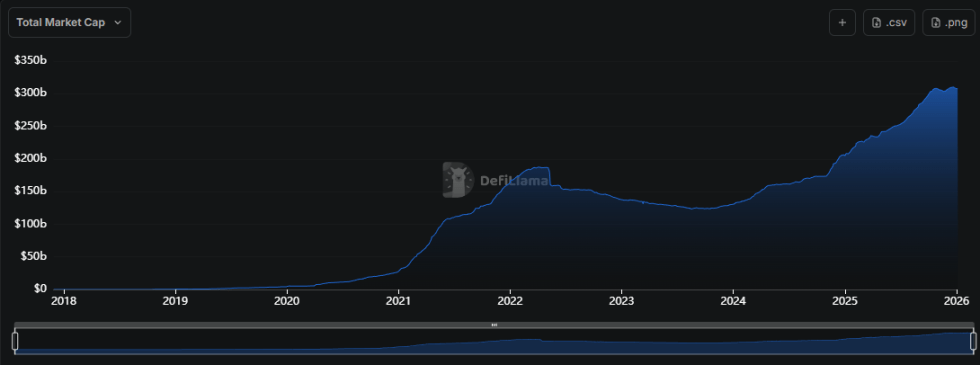
The trend in the market cap of all stablecoins over the last several years | Source: DefiLlama

The sector hasn’t been unaffected by the wider slowdown in crypto since October, however. From the above chart, it’s visible that the stablecoin market cap has seen consolidation in the last few months.

Nonetheless, while other parts of the market have shrunken, these fiat-tied tokens still have their combined market cap sitting at $307 billion today, which is very close to the all-time high (ATH).

Bitcoin Price

At the time of writing, Bitcoin is trading around $92,900, up nearly 6% over the last week.

Looks like the price of the coin has shot up over the last few days | Source: BTCUSDT on TradingView


Preguntas relacionadas

QWhy has PwC reversed its cautious stance on crypto in the US?

APwC reversed its cautious stance on crypto due to new regulatory developments in the United States, including the Genius Act which regulates stablecoins, providing more clarity and conviction for the asset class.

QWhat is the Genius Act mentioned in the article?

AThe Genius Act is a new US law that regulates stablecoins, which are digital assets pegged to a fiat currency like the US Dollar.

QHow does PwC plan to help companies with digital asset technology?

APwC has been pitching companies on how they can use digital asset technology, with stablecoins cited as a means to improve payment systems' efficiency.

QWhat is the current market cap of all stablecoins according to the article?

AThe combined market cap of all stablecoins is $307 billion, which is very close to the all-time high.

QWhat was the price of Bitcoin at the time of writing the article?

AAt the time of writing, Bitcoin was trading around $92,900, up nearly 6% over the last week.

Lecturas Relacionadas

Soaring Over Tenfold Within the Year: The Frenzy Over SK Hynix Leveraged Products

South China Morning Post The leveraged ETF tracking SK Hynix has surged over tenfold year-to-date, fueled by intense market speculation on the memory chip sector. By June 22, the value of the 'South Korea 2x Long SK Hynix ETF' listed in Hong Kong had skyrocketed by more than 1,061% since the start of the year, while its asset size exploded over twenty times from the end of last year. The rally is driven by AI-driven demand for high-bandwidth memory (HBM), with SK Hynix recently sampling its next-generation HBM4E product. However, industry professionals warn of significant risks. Leveraged ETFs magnify both gains and losses. During a recent market correction, while the underlying SK Hynix stock fell 19.1%, its double-leveraged ETF dropped nearly 38%. Korean regulators noted that such products could theoretically lose 60% in a single day. Additionally, these ETFs face risks like time decay in volatile markets, liquidity spirals during mass redemptions, and extreme price dislocations from market-making failures, as seen in early June when an ETF moved opposite to its underlying stock. The trading is predominantly driven by retail investors, with institutional capital largely absent due to the products' high volatility. Analysts caution that with the semiconductor sector at elevated valuations and facing geopolitical and supply chain uncertainties, leveraged ETFs pose a substantial threat of amplified losses for uninformed investors.

marsbitHace 7 min(s)

Soaring Over Tenfold Within the Year: The Frenzy Over SK Hynix Leveraged Products

marsbitHace 7 min(s)

18 Months, Over 50x Surge: KIOXIA's Epic Comeback

KIOXIA, a NAND flash memory giant, staged a dramatic comeback driven by AI demand. After a period of significant losses, a failed merger, and missed HBM opportunities, its 2024 IPO began modestly. However, fueled by explosive demand for AI data storage, its stock price skyrocketed over 50 times within 18 months, making it Japan's most valuable company, surpassing Toyota. Its Q1 FY2026 profit guidance soared 30-fold year-over-year, with 2026 NAND capacity already sold out. Key to its success is its 3D NAND technology, BiCS FLASH. As the inventor of NAND, KIOXIA advanced its technology through generations, reaching over 200 layers by 2023. Key innovations include CBA (CMOS directly Bonded to Array), which separately manufactures control circuits and memory arrays for better performance, and OPS (On Pitch Select Gate) to increase density. The company is now developing high-capacity packages like an 8TB solution stacking 32 dies. Looking beyond NAND, KIOXIA is exploring 3D DRAM with its OCTRAM technology, using oxide semiconductor transistors for ultra-low leakage to reduce power consumption. This fundamental research differs from HBM and represents a long-term bet to extend its 3D expertise from NAND into future DRAM architectures. KIOXIA's story highlights how technological assets and shifting market cycles can rapidly transform a company's fortunes. While questions remain about sustaining growth beyond the current AI boom, its resurgence demonstrates that in semiconductors, being down does not necessarily mean being out.

marsbitHace 17 min(s)

18 Months, Over 50x Surge: KIOXIA's Epic Comeback

marsbitHace 17 min(s)

Market Trends in U.S. Stocks (June 23): Peak at Listing? SpaceX Loses Over $800 Billion in Three Days, Tech Stocks Experience Severe Internal Divergence

Stock Market Trends (June 23): Did SpaceX Peak at IPO? The company loses over $800 billion in market value in three days as a sharp divergence unfolds within the tech sector. SpaceX's post-IPO decline of over 20%, falling below its first-day close, reflects a swift market repricing. The catalyst is a clear shift in narrative from "AI platform potential" to concerns over rising capital costs, as its $8.57 billion IPO and subsequent $20 billion debt offering are earmarked for acquisitions and refinancing existing bridge loans rather than de-leveraging. While high-valuation tech stocks like Google, Meta, Amazon, and Microsoft faced pressure, Micron surged nearly 7% to a record high following a strategic supply deal with Anthropic for HBM and memory, highlighting robust, tangible demand in AI infrastructure. The broader market saw funds rotate into more defensive industrial and financial names. Macro factors included a dip in oil prices to a three-month low on news of a US-Iran framework deal, though logistical hurdles for resuming full Strait of Hormuz shipments remain. Key events ahead include Nvidia's shareholder meeting, Micron's earnings, and the May PCE inflation data. The latter will be crucial in determining whether the sell-off in high-valuation growth stocks, which appears to have just begun, will persist.

marsbitHace 27 min(s)

Market Trends in U.S. Stocks (June 23): Peak at Listing? SpaceX Loses Over $800 Billion in Three Days, Tech Stocks Experience Severe Internal Divergence

marsbitHace 27 min(s)

Interview with MicroStrategy CEO: Beyond the 32 BTC Selling Stir, 6 Trillion AI Agents are the Ultimate Endgame for Bitcoin

Interview with Strategy CEO: Beyond the 32 BTC Sale, 6 Trillion AI Agents are Bitcoin's Ultimate Endgame Strategy CEO Phong Le discusses the recent sale of 32 BTC, clarifying it was a minor, strategic move to demonstrate operational liquidity and internal process robustness to creditors and rating agencies, not a reaction to market fears. He emphasizes Strategy's disciplined, data-driven decision-making framework involving its board and complex financial modeling, distancing the company from centralized "black box" operations seen elsewhere in crypto. Le outlines the company's resilience and long-term focus, citing the "doing nothing" strategy during the 2022 bear market as a testament to its conviction in Bitcoin's underlying value proposition for global sovereignty and freedom. He reveals that generative AI was instrumental in developing their Stretch (STRC) preferred stock product, cutting development time from years to months. The most visionary part of the discussion centers on Agentic AI. Le envisions a future with 6 trillion autonomous AI agents conducting commerce, particularly in off-world environments like Mars, which would naturally adopt decentralized crypto rails and seek yield-bearing assets like Bitcoin as a core store of value. Finally, Le addresses the STRC product, expressing confidence it will return to its $100 par value through reserve replenishment and the initiation of dividend payments, and dismisses concerns about competition with stablecoins. He concludes by affirming Strategy's philosophy of expanding Bitcoin access through all available means, from self-custody to ETFs, to onboard the next wave of users.

marsbitHace 55 min(s)

Interview with MicroStrategy CEO: Beyond the 32 BTC Selling Stir, 6 Trillion AI Agents are the Ultimate Endgame for Bitcoin

marsbitHace 55 min(s)

Trading

Spot
Futuros
活动图片