PwC Drops Guard On Crypto After US Digital Asset Rule Changes

bitcoinistPublicado a 2026-01-06Actualizado a 2026-01-06

Resumen

PwC, one of the Big Four accounting firms, has reversed its cautious approach toward cryptocurrency following new U.S. regulatory developments, including the Genius Act which regulates stablecoins. The firm is now actively promoting the use of digital asset technology, particularly stablecoins, to improve payment efficiency. This shift reflects growing institutional acceptance of crypto assets, especially stablecoins, which have seen increased adoption globally—including in Hong Kong, Japan, and Europe. Despite recent market consolidation, the stablecoin market cap remains strong near its all-time high at $307 billion. Meanwhile, Bitcoin is trading around $92,900, up 6% over the past week.

Big Four accounting firm PwC has reversed its cautious stance on crypto after regulatory developments related to the space in the United States.

PwC Has Softened Its Stance On Crypto

According to a report from the Financial Times, PwC has changed its strategy around digital assets following the new laws passed by Donald Trump’s administration. PricewaterhouseCoopers, PwC in short, is a multinational professional services network headquartered in London. It provides services such as audits, tax planning, and business consulting to companies worldwide.

PwC is the second-largest firm of its kind and part of the Big Four accounting firms. Previously, the British company steered clear of crypto-related work in the US like other Big Four firms, but it seems that stance has now changed. The shift has come as the US has made advancements in its crypto regulatory framework. Among the new laws is the Genius Act, which regulates stablecoins, digital assets pegged to a fiat currency like the US Dollar (USD).

“The Genius Act and the regulatory rulemaking around stablecoin, I expect, will create more conviction around leaning into that product and that asset class,” said Paul Griggs, senior partner at PwC US, in an interview with FT.

Griggs added that PwC has been pitching companies on how they can use digital asset technology, with stablecoins as a means of improving payment systems’ efficiency, cited as one example.

PwC and other Big Four firms budging on crypto showcases the legislative momentum that the industry has had recently, with traditional finance increasingly unable to ignore the sector. Stablecoins, in particular, have been witnessing growing adoption. Beyond the American Genius Act, this class of digital assets also attracted regulatory attention in other parts of the world.

Hong Kong introduced a stablecoin issuer licensing framework last year, while Japan observed the launch of its first yen-based token. In Europe, major banks have come together to work on a euro-pegged coin, aiming to challenge the sector’s USD dominance. The positive regulation in 2025 meant that the space witnessed some sharp growth, with the market cap exploring new records, as data from DefiLlama shows.
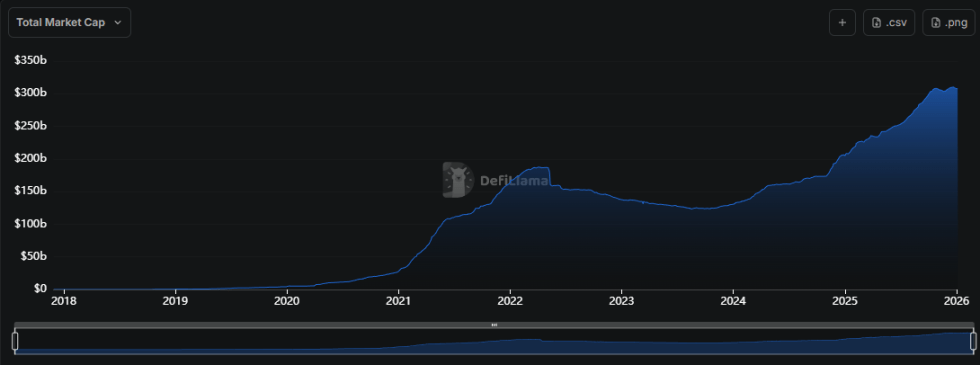
The trend in the market cap of all stablecoins over the last several years | Source: DefiLlama

The sector hasn’t been unaffected by the wider slowdown in crypto since October, however. From the above chart, it’s visible that the stablecoin market cap has seen consolidation in the last few months.

Nonetheless, while other parts of the market have shrunken, these fiat-tied tokens still have their combined market cap sitting at $307 billion today, which is very close to the all-time high (ATH).

Bitcoin Price

At the time of writing, Bitcoin is trading around $92,900, up nearly 6% over the last week.

Looks like the price of the coin has shot up over the last few days | Source: BTCUSDT on TradingView


Preguntas relacionadas

QWhy has PwC reversed its cautious stance on crypto in the US?

APwC reversed its cautious stance on crypto due to new regulatory developments in the United States, including the Genius Act which regulates stablecoins, providing more clarity and conviction for the asset class.

QWhat is the Genius Act mentioned in the article?

AThe Genius Act is a new US law that regulates stablecoins, which are digital assets pegged to a fiat currency like the US Dollar.

QHow does PwC plan to help companies with digital asset technology?

APwC has been pitching companies on how they can use digital asset technology, with stablecoins cited as a means to improve payment systems' efficiency.

QWhat is the current market cap of all stablecoins according to the article?

AThe combined market cap of all stablecoins is $307 billion, which is very close to the all-time high.

QWhat was the price of Bitcoin at the time of writing the article?

AAt the time of writing, Bitcoin was trading around $92,900, up nearly 6% over the last week.

Lecturas Relacionadas

Not Speculation but a Necessity: The 4 Unique Values of Prediction Markets

Polymarket's recent $4 billion funding round and soaring valuation of $15 billion highlight the explosive growth of prediction markets, with trading volume reaching $25.7 billion in March 2026—a 10.6% monthly increase. This analysis argues that prediction markets serve critical non-speculative functions, positioning them as essential tools rather than mere gambling platforms. Prediction markets offer four unique values: entertainment consumption, insurance-like protection, risk hedging, and truth discovery. Firstly, they stimulate economic activity by engaging users in event-based betting, similar to the broader sports industry. Secondly, they act as a form of decentralized insurance, allowing users to hedge against specific, well-defined risks (e.g., weather events) transparently and without traditional overhead costs. Thirdly, institutions and individuals use these markets to hedge against geopolitical and commodity price risks, as demonstrated during the U.S.-Iran conflict and the launch of 24/7 commodity markets on platforms like Kalshi. Finally, prediction markets counter media bias by aggregating crowd-sourced information, often achieving 30% higher accuracy than surveys due to users' vested interests. Experts like Bitwise’s Jeff Park and SIG’s Jeff Yass emphasize the markets' role in risk transfer and financial innovation. As these platforms evolve, they are poised to become trillion-dollar markets, offering more reliable, decentralized mechanisms for information pricing and risk management.

marsbitHace 19 min(s)

Not Speculation but a Necessity: The 4 Unique Values of Prediction Markets

marsbitHace 19 min(s)

Interview with Jeff Hoffman: How Web3 and AI Are Reshaping the Trillion-Dollar Social Travel Market

Interview with Jeff Hoffman: Web3 and AI Reshaping the Trillion-Dollar Social Travel Market Jeff Hoffman, co-founder of Priceline, discusses how Web3 and AI are transforming the social travel industry. He highlights that the current travel market is fragmented and inefficient, dominated by traditional online travel agencies (OTAs) that act as intermediaries with opaque models. Web3 introduces direct connections, transparency, and faster settlements, shifting value back to travelers. Key trends driving this change include demand for flexible rewards, digital payments, and trust in communities over ads. Hoffman joined Staynex not for its Web3 label, but because it addresses industry inefficiencies by integrating booking, payments, AI-driven itineraries, and rewards into a single ecosystem. This Web2.5 model combines Web2 scale with Web3 incentives. He emphasizes the team’s focus on execution over hype as a key reason for his involvement. Looking ahead, blockchain will enable transparent rewards and seamless cross-border payments, while AI provides personalization. Together, they will turn travel into a continuous relationship rather than a transaction. Hoffman predicts traditional OTAs will persist, but value will shift to platforms that own payment, loyalty, and community networks. Social travel represents a significant, underestimated opportunity in Web3.

marsbitHace 49 min(s)

Interview with Jeff Hoffman: How Web3 and AI Are Reshaping the Trillion-Dollar Social Travel Market

marsbitHace 49 min(s)

Trading

Spot
Futuros
活动图片




