Push to End Crypto Staking Double Taxation Gains Momentum in Washington

bitcoinistPublicado a 2025-12-23Actualizado a 2025-12-23

Resumen

As crypto staking becomes more widespread, U.S. lawmakers are pushing for clearer tax rules to avoid double taxation and simplify compliance. A bipartisan group of 18 House representatives has urged the IRS to update its guidance, arguing that taxing staking rewards only upon sale—rather than at receipt—would better reflect actual economic gains and reduce administrative burdens. They warn that current policies may discourage staking, which is crucial for blockchain security. Additionally, the newly introduced Digital Asset PARITY Act proposes a de minimis exemption for small stablecoin transactions and defers income recognition from staking for up to five years. These efforts reflect a growing consensus in Congress for more coherent crypto tax policies ahead of key 2026 tax changes.

As crypto staking shifts from a niche activity to a mainstream practice, long-standing gaps in U.S. tax policy are coming under closer scrutiny in Washington, with lawmakers warning that unclear and inconsistent rules could discourage participation in blockchain networks and complicate compliance for millions of investors.

Related Reading: Bitcoin Long-Term Holders Stay Resilient, But Profits Haven’t Fully Arrived – Here’s What To Know

With the 2026 tax year nearing, 18 bipartisan House lawmakers have urged the Internal Revenue Service to review staking tax guidance, arguing it results in double taxation, creating administrative burdens and failing to reflect actual economic gains, especially during volatile markets.
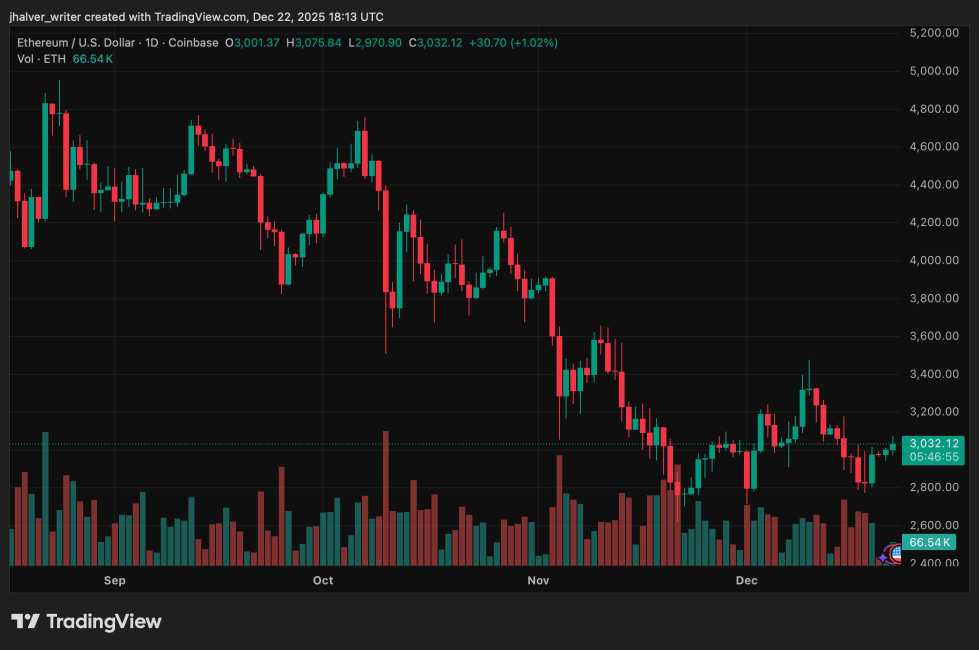
ETH's price trends to the downside on the daily chart. Source: ETHUSD on Tradingview

Lawmakers Press IRS Ahead of 2026

In a letter led by Representative Mike Carey, lawmakers asked whether any administrative barriers stand in the way of updating staking guidance before the end of the year. They argue that taxing rewards only at the point of sale would better capture actual economic gain while reducing reporting complexity.

The group also warned that current rules may discourage staking participation, which plays a critical role in securing proof-of-stake blockchains and maintaining network resilience.

The timing is deliberate. Several tax provisions are set to expire in 2026, and lawmakers want clarity on staking before broader tax debates take precedence. They also noted that prolonged uncertainty could invite unfavorable court rulings that lock in interpretations through precedent rather than policy.

The PARITY Act and Broader Crypto Tax Reform

Alongside the IRS letter, Representatives Steven Horsford and Max Miller have introduced a discussion draft known as the Digital Asset PARITY Act.

The proposal takes a wider view of crypto taxation, including a de minimis exemption for regulated stablecoin payments used in everyday transactions. Small gains or losses from these payments would generally not be taxed, mirroring existing treatment for low-value foreign currency exchanges.

For staking and mining, the PARITY Act stops short of eliminating immediate taxation but proposes allowing taxpayers to defer income recognition for up to five years.

Supporters say this could provide interim relief while lawmakers work toward permanent clarity. The bill also extends wash-sale rules and certain securities tax provisions to actively traded digital assets, aiming to curb abuse without expanding loopholes.

What Comes Next for Crypto Investors

Together, these efforts signal growing consensus in Congress that crypto taxation needs refinement rather than piecemeal fixes. While no changes are guaranteed, the push to address staking double taxation reflects a shift toward more technical, outcome-focused policymaking.

Related Reading: XRP ETFs Attract Global Pension Funds And Insurers, Canary CEO Reveals

For investors and network participants, the next year could determine whether staking remains burdened by uncertainty or moves toward a clearer, more predictable tax framework.

Cover image from ChatGPT, ETHUSD chart from Tradingview

Criptos en tendencia

Preguntas relacionadas

QWhat is the main issue with current U.S. tax policy regarding crypto staking that lawmakers are addressing?

AThe main issue is that current tax rules result in double taxation, create administrative burdens, and fail to reflect actual economic gains, especially during volatile markets.

QHow many bipartisan House lawmakers have urged the IRS to review staking tax guidance ahead of the 2026 tax year?

A18 bipartisan House lawmakers have urged the IRS to review staking tax guidance.

QWhat specific change in taxation timing do lawmakers propose to better capture actual economic gain from staking rewards?

ALawmakers propose taxing staking rewards only at the point of sale, rather than immediately, to better capture actual economic gain and reduce reporting complexity.

QWhat is the name of the proposed draft legislation that addresses broader crypto taxation, including a de minimis exemption for stablecoin payments?

AThe proposed draft legislation is called the Digital Asset PARITY Act.

QHow does the PARITY Act propose to handle income recognition for staking and mining rewards?

AThe PARITY Act proposes allowing taxpayers to defer income recognition from staking and mining rewards for up to five years, providing interim relief while seeking permanent clarity.

Lecturas Relacionadas

Annual Salary of Millions Competing for Electricians, Meta Rushes to Open Its Own Technical School

The AI boom is facing an unexpected bottleneck: a severe shortage of skilled construction workers and electricians. As tech giants like Meta, OpenAI, and Alphabet race to build massive data centers—such as OpenAI's $16 billion "Stargate" project—they are hitting a critical labor wall. The U.S. needs an estimated 130,000 more electricians, 240,000 construction workers, and 150,000 supervisors by 2030 for AI infrastructure alone, but tens of thousands of electrician jobs go unfilled each year. While AI companies offer high premiums, with electricians earning up to $280,000 annually, worker scarcity still causes massive losses—delays on a single project can cost $14.2 million per month. The complexity of building AI data centers, which require immense power (equivalent to powering hundreds of thousands of homes), sophisticated electrical systems, and advanced liquid cooling solutions, demands highly skilled technicians who are in short supply. To combat this, companies are investing heavily in training. Meta has committed $115 million to a free training school offering tuition, housing, and stipends, targeting 5,000 new workers. OpenAI is partnering with unions to secure skilled labor. These efforts are paying off, with a significant rise in Gen Z interest in trade schools over college. However, the power demands are staggering. AI data centers are driving a rapid surge in electricity consumption, projected to account for up to 12% of U.S. power use by 2028 and raising costs for consumers. Furthermore, the construction boom is project-based, leading to a potential future glut of trained workers once building peaks, which could depress wages industry-wide. The race for AI supremacy now depends as much on skilled hands as on advanced chips.

marsbitHace 59 min(s)

Annual Salary of Millions Competing for Electricians, Meta Rushes to Open Its Own Technical School

marsbitHace 59 min(s)

OpenAI No Longer Sells Its Most Expensive Model for Profit

OpenAI is shifting its business strategy away from promoting its most expensive, flagship models for every task. Recent price cuts—80% for GPT-5.6 Luna and 20% for Terra—signal a deeper change: the company now actively advises users that many tasks don't require the most powerful model. Instead, OpenAI recommends a tiered approach: use the high-end GPT-5.6 Sol for complex planning and analysis, then delegate execution to cheaper models like Luna. This mirrors moves by Anthropic, which recently launched Claude Opus 5 at half the price of its top model, Fable 5. Both companies are de-emphasizing flagship models as primary revenue drivers, using them instead for brand prestige and technological showcases. The industry is entering a "mass-market" phase, similar to automotive, where high-volume, cost-effective models handle daily operations and drive scale. OpenAI's price reductions are partly enabled by AI models themselves optimizing underlying code and infrastructure, creating a self-reinforcing cycle of efficiency gains and cost reduction. Competition is shifting from "who is smartest" to "who offers the best value." The goal is no longer selling individual models but fostering widespread API adoption and ecosystem lock-in. By making AI calls cheap and ubiquitous, companies like OpenAI aim to become the indispensable, utility-like infrastructure powering automated workflows—the "water and electricity" of software, quietly embedded everywhere.

marsbitHace 59 min(s)

OpenAI No Longer Sells Its Most Expensive Model for Profit

marsbitHace 59 min(s)

Trading

Spot

Artículos destacados

Cómo comprar PUSH

¡Bienvenido a HTX.com! Hemos hecho que comprar Push Protocol (PUSH) sea simple y conveniente. Sigue nuestra guía paso a paso para iniciar tu viaje de criptos.Paso 1: crea tu cuenta HTXUtiliza tu correo electrónico o número de teléfono para registrarte y obtener una cuenta gratuita en HTX. Experimenta un proceso de registro sin complicaciones y desbloquea todas las funciones.Obtener mi cuentaPaso 2: ve a Comprar cripto y elige tu método de pagoTarjeta de crédito/débito: usa tu Visa o Mastercard para comprar Push Protocol (PUSH) al instante.Saldo: utiliza fondos del saldo de tu cuenta HTX para tradear sin problemas.Terceros: hemos agregado métodos de pago populares como Google Pay y Apple Pay para mejorar la comodidad.P2P: tradear directamente con otros usuarios en HTX.Over-the-Counter (OTC): ofrecemos servicios personalizados y tipos de cambio competitivos para los traders.Paso 3: guarda tu Push Protocol (PUSH)Después de comprar tu Push Protocol (PUSH), guárdalo en tu cuenta HTX. Alternativamente, puedes enviarlo a otro lugar mediante transferencia blockchain o utilizarlo para tradear otras criptomonedas.Paso 4: tradear Push Protocol (PUSH)Tradear fácilmente con Push Protocol (PUSH) en HTX's mercado spot. Simplemente accede a tu cuenta, selecciona tu par de trading, ejecuta tus trades y monitorea en tiempo real. Ofrecemos una experiencia fácil de usar tanto para principiantes como para traders experimentados.

251 Vistas totalesPublicado en 2024.12.13Actualizado en 2026.06.02

Cómo comprar PUSH

Discusiones

Bienvenido a la comunidad de HTX. Aquí puedes mantenerte informado sobre los últimos desarrollos de la plataforma y acceder a análisis profesionales del mercado. A continuación se presentan las opiniones de los usuarios sobre el precio de PUSH (PUSH).

活动图片













