Pump.fun Launches Direct Investment, Spending $3 Million to Buy 12 New Memes

marsbitPublicado a 2026-01-20Actualizado a 2026-01-20

Resumen

Pump.fun, a leading Meme token launch platform, has announced the creation of its investment arm, Pump Fund. The fund will launch its first initiative, the Build in Public (BiP) hackathon, this month. With a total allocation of $3 million, it plans to invest $250,000 into each of 12 new tokens launched on its platform, valuing each project at $10 million. Beyond funding, selected projects will receive mentorship from Pump.fun’s founders and additional resources. This marks Pump.fun’s first direct financial endorsement of specific Meme tokens, signaling strong support for promising new projects. The platform, known for its substantial revenue—reportedly over $954.8 million historically—aims to reinvest in the ecosystem beyond token buybacks. The BiP hackathon encourages founders to publicly build products after launching a token on Pump.fun. Key requirements include retaining at least 10% of the token supply and maintaining active communication with supporters via social media and live streams. Project selection will prioritize organic user growth, genuine market appeal, and long-term sustainability over hype. Applications opened on January 19 and will run for 30 days. The first winning projects will be announced on February 18, though the program will continue indefinitely. For those tracking potential opportunities, new tokens on Pump.fun—especially those tagged with Pump Fund or BiP—are worth monitoring closely in the coming weeks.

Original | Odaily Planet Daily (@OdailyChina)

Author | Azuma (@azuma_eth)

On the morning of January 20, Pump.fun officially announced the launch of its investment division, Pump Fund. Pump Fund will initiate its first project, the Build in Public (BiP) hackathon, this month, investing $3 million in 12 new tokens issued through the platform, with $250,000 allocated to each token, corresponding to a valuation of $10 million. In addition to financial support, Pump.fun will also provide professional guidance from its founders and other substantial resources.

As the project with the strongest revenue-generating capability in the entire Meme sector, this is the first time Pump.fun has openly expressed its support for specific Meme tokens through official channels with real money (the attitude may be more important than the funding scale). Therefore, the selected tokens are highly likely to become the seed candidates in the Meme sector in the coming period.

Pump.fun's Revenue-Generating Capability

Pump.fun's staggering revenue capability is no secret. Data compiled by analyst Adam (@Adam_Tehc) on Dune shows that Pump.fun's historical total revenue has reached $954.8 million. Although daily revenue has significantly declined as the Meme hype cooled, it still amounts to hundreds of thousands of dollars per day.
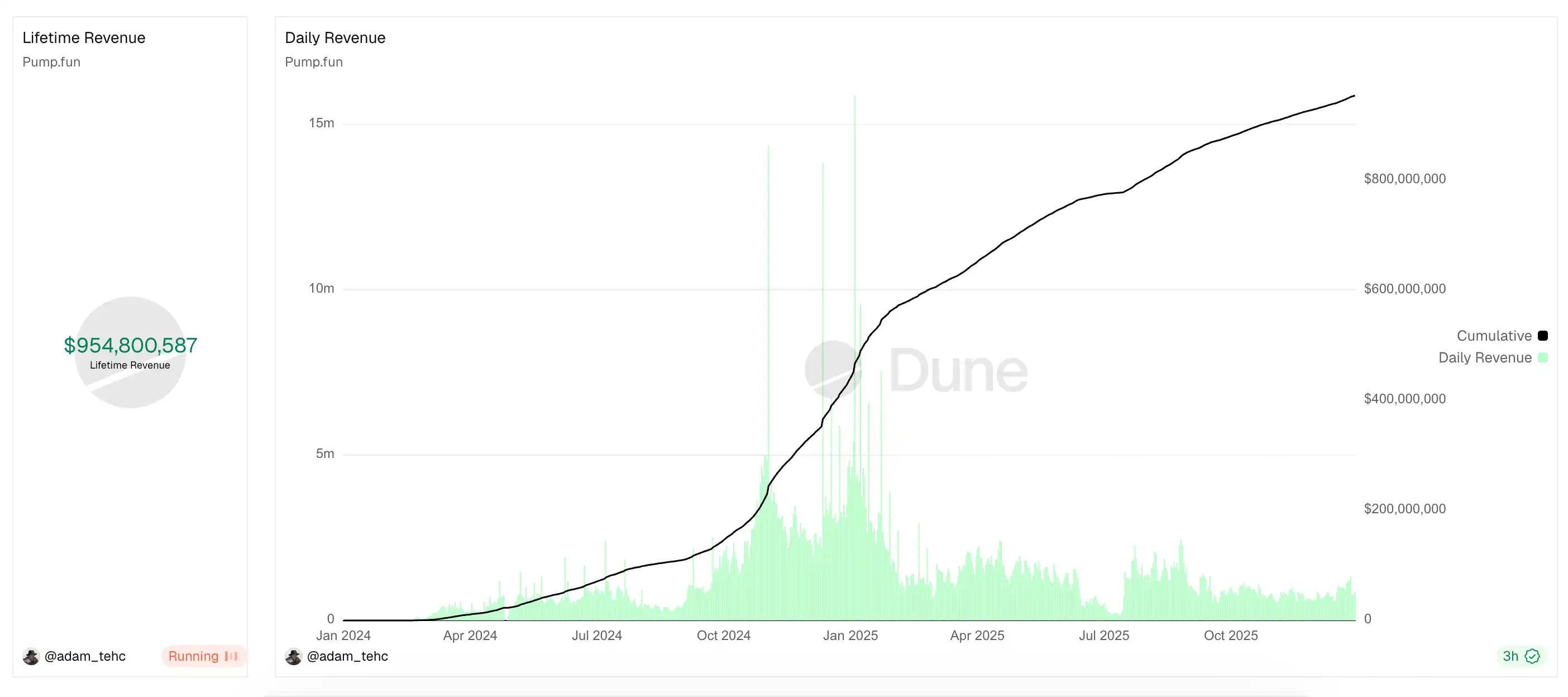
Holding massive real funds, Pump.fun is exploring other paths for ecosystem feedback beyond PUMP token buybacks. Pump Fund and its affiliated BiP hackathon are Pump.fun's latest attempts.

BiP Hackathon Details

According to the description on the BiP hackathon's dedicated page, the project aims to support founders who issue tokens on Pump.fun and publicly build products. Unlike traditional hackathons where participants rely on VCs or judges for evaluation to compete for prizes, the BiP hackathon intends to introduce token performance as a variable, allowing the market to determine whether a project is worth advancing and enabling users to become the earliest investors.

When discussing this key difference, Pump.fun founder Alon stated in an X post: "Before Pump.fun, my co-founder and I tried many different ideas. Consumer finance, DeFi, SocialFi, NFTs—but all failed. One of the biggest problems we encountered was that we found it extremely difficult to get our products in front of users. Trying to reach the right user base was an incredibly tedious task..."

Specifically, the BiP hackathon requires:

  • Participants must issue a token on Pump.fun and then publicly build a product;
  • Participants must also hold at least 10% of the token supply to align interests;
  • Finally, the event strongly encourages founders to speak publicly on social media like X or livestream on Pump.fun to maintain effective communication with the community.

As for the types of participating projects, Pump.fun imposes no restrictions; they are not even limited to cryptocurrency-related products. Projects from different market stages and various verticals can participate.

Regarding how the 12 winning projects will ultimately be selected, Pump.fun did not provide specific rules but pointed out two main principles: First, organic user growth and genuine appeal are preferred over connections and flashy promotions; second, in addition to the appeal of the product itself/social media, the long-term sustainability of the project will also be evaluated.

Key Timelines to Note

According to the BiP hackathon's schedule, applications opened on January 19. Participants are required to launch their tokens at the time of application and begin public building (including livestreaming development progress, regularly sharing updates, and maintaining community interaction). The application window will be open for 30 days. On February 18, Pump.fun will announce the first batch of winning projects and provide funding (at least one will be announced). Considering that some projects may need more time to gain market attention and demonstrate appeal, the program will continue to run long-term.

So the timeline is clear: if you want to spot potential opportunities among this batch of Meme tokens, you need to start paying attention to newly issued tokens on Pump.fun from now on, especially those with the Pump Fund or BiP labels. Although the first batch of winning tokens won't be announced until 30 days later, tokens likely to be selected by Pump.fun will inevitably show competitiveness before then.

Overall, while Pump.fun's event may not drive a collective sentiment recovery in the Meme market, it can at least contribute some new tokens with clearer evaluation dimensions.


Preguntas relacionadas

QWhat is the purpose of Pump Fund's first project, the Build in Public (BiP) hackathon?

AThe BiP hackathon aims to support founders who launch tokens on Pump.fun and publicly build products. It will invest $3 million in 12 new tokens, with $250,000 per token at a $10 million valuation, and provide professional guidance and resources.

QHow much total revenue has Pump.fun generated historically according to data analyst Adam?

APump.fun's historical total revenue has reached $954.8 million.

QWhat are the key requirements for participants in the BiP hackathon?

AParticipants must issue a token on Pump.fun, publicly build a product, hold at least 10% of the token supply to align interests, and are strongly encouraged to communicate publicly on social media like X or via live streams on Pump.fun.

QWhen will Pump.fun announce the first batch of winning projects for the BiP hackathon?

APump.fun will announce the first batch of winning projects on February 18, after the 30-day application window that started on January 19.

QWhat principles will Pump.fun use to select the 12 winning projects in the BiP hackathon?

ASelection will prioritize organic growth and genuine user attraction over relationships and flashy marketing, and will evaluate projects based on long-term sustainability alongside product and social media appeal.

Lecturas Relacionadas

How Many Tokens Away Is Yang Zhilin from the 'Moon Chasing the Light'?

The article explores the intense competition between two leading Chinese AI companies, DeepSeek and Kimi (Moon Dark Side), and the mounting pressure on Yang Zhilin, the founder of Kimi. While DeepSeek re-emerged after 15 months of silence with its powerful V4 model—boasting 1.6 trillion parameters and low-cost, long-context capabilities—Kimi has been focusing on long-context processing and multi-agent systems with its K2.6 model. Yang faces a threefold challenge: technological rivalry, commercialization pressure, and investor expectations. Despite Kimi’s high valuation (reaching $18 billion), its revenue heavily relies on a single product with low paid conversion rates, while DeepSeek’s strategic silence and open-source influence have strengthened its market position and valuation prospects, now targeting over $20 billion. Both companies reflect broader trends in China’s AI ecosystem: Kimi aims for global influence through open-source contributions and agent-based advancements, while DeepSeek prioritizes foundational innovation and hardware independence, notably shifting to Huawei’s chips. Their competition is seen as vital for China’s AI progress, with the gap between top Chinese and U.S. models narrowing to just 2.7% on the Elo rating scale. Ultimately, the article argues that this rivalry, though anxiety-inducing for leaders like Zhilin, is essential for driving innovation and solidifying China’s role in the global AI landscape.

marsbitHace 4 hora(s)

How Many Tokens Away Is Yang Zhilin from the 'Moon Chasing the Light'?

marsbitHace 4 hora(s)

TechFlow Intelligence Bureau: ChatGPT Helps Amateur Mathematician Crack 60-Year-Old Problem, CFTC Sues New York Regulator Over Coinbase and Gemini

An amateur mathematician, with the assistance of ChatGPT, has solved a combinatorial mathematics puzzle originally proposed by Hungarian mathematician Paul Erdős in the 1960s. This marks another milestone in AI-aided mathematical research, demonstrating the evolving capabilities of large language models in formal reasoning. In other AI developments, OpenAI introduced a new privacy filter tool for enterprise API usage, automatically screening sensitive data. Meanwhile, the Qwen3.6-27B model achieved 100 tokens per second on a single RTX 5090 GPU using quantization, significantly lowering the cost barrier for local AI deployment. In crypto and Web3, the U.S. CFTC sued New York’s financial regulator, challenging its oversight of Coinbase and Gemini—a first-of-its-kind federal-state regulatory clash. Following a vulnerability, KelpDAO and major DeFi protocols established a recovery fund. Tether froze $344 million in assets linked to Iran’s central bank upon U.S. Treasury request, highlighting the centralized control risks in stablecoins. Separately, Litecoin underwent a 3-hour chain reorganization to undo a privacy-layer exploit. In the U.S., former President Trump invoked the Defense Production Act to address power grid bottlenecks affecting AI data centers and dismissed the entire National Science Board, raising concerns over research independence. A retail trader gained 250% on a $600k Intel options bet amid AI-related speculation. Xiaomi announced its first performance electric vehicle, targeting rivals like Tesla. Meanwhile, iPhone users reported devices automatically reinstalling a hidden app daily, suspected to be MDM-related. A Chinese securities report noted that A-share institutional crowding has reached its second-longest streak since 2007, signaling high valuations and potential style rotation. The day’s developments reflect a dual narrative: AI is enabling unprecedented individual breakthroughs, while centralized power structures—whether governmental or corporate—are becoming more assertive, underscoring that decentralization is as much a political-economic challenge as a technical one.

marsbitHace 4 hora(s)

TechFlow Intelligence Bureau: ChatGPT Helps Amateur Mathematician Crack 60-Year-Old Problem, CFTC Sues New York Regulator Over Coinbase and Gemini

marsbitHace 4 hora(s)

Trading

Spot
Futuros
活动图片