Pump.fun Launches Direct Investment, Spending $3 Million to Buy 12 New Memes

marsbitPublicado a 2026-01-20Actualizado a 2026-01-20

Resumen

Pump.fun, a leading Meme token launch platform, has announced the creation of its investment arm, Pump Fund. The fund will launch its first initiative, the Build in Public (BiP) hackathon, this month. With a total allocation of $3 million, it plans to invest $250,000 into each of 12 new tokens launched on its platform, valuing each project at $10 million. Beyond funding, selected projects will receive mentorship from Pump.fun’s founders and additional resources. This marks Pump.fun’s first direct financial endorsement of specific Meme tokens, signaling strong support for promising new projects. The platform, known for its substantial revenue—reportedly over $954.8 million historically—aims to reinvest in the ecosystem beyond token buybacks. The BiP hackathon encourages founders to publicly build products after launching a token on Pump.fun. Key requirements include retaining at least 10% of the token supply and maintaining active communication with supporters via social media and live streams. Project selection will prioritize organic user growth, genuine market appeal, and long-term sustainability over hype. Applications opened on January 19 and will run for 30 days. The first winning projects will be announced on February 18, though the program will continue indefinitely. For those tracking potential opportunities, new tokens on Pump.fun—especially those tagged with Pump Fund or BiP—are worth monitoring closely in the coming weeks.

Original | Odaily Planet Daily (@OdailyChina)

Author | Azuma (@azuma_eth)

On the morning of January 20, Pump.fun officially announced the launch of its investment division, Pump Fund. Pump Fund will initiate its first project, the Build in Public (BiP) hackathon, this month, investing $3 million in 12 new tokens issued through the platform, with $250,000 allocated to each token, corresponding to a valuation of $10 million. In addition to financial support, Pump.fun will also provide professional guidance from its founders and other substantial resources.

As the project with the strongest revenue-generating capability in the entire Meme sector, this is the first time Pump.fun has openly expressed its support for specific Meme tokens through official channels with real money (the attitude may be more important than the funding scale). Therefore, the selected tokens are highly likely to become the seed candidates in the Meme sector in the coming period.

Pump.fun's Revenue-Generating Capability

Pump.fun's staggering revenue capability is no secret. Data compiled by analyst Adam (@Adam_Tehc) on Dune shows that Pump.fun's historical total revenue has reached $954.8 million. Although daily revenue has significantly declined as the Meme hype cooled, it still amounts to hundreds of thousands of dollars per day.
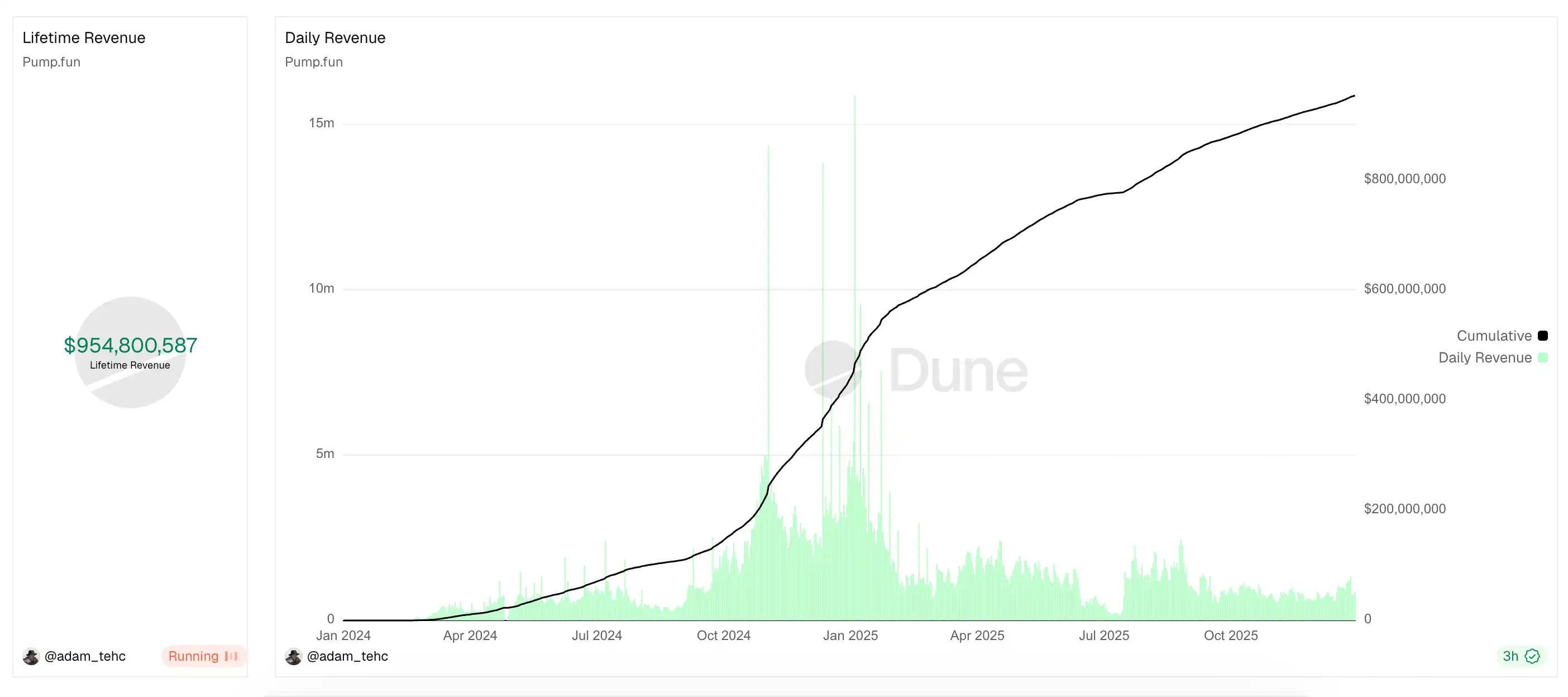
Holding massive real funds, Pump.fun is exploring other paths for ecosystem feedback beyond PUMP token buybacks. Pump Fund and its affiliated BiP hackathon are Pump.fun's latest attempts.

BiP Hackathon Details

According to the description on the BiP hackathon's dedicated page, the project aims to support founders who issue tokens on Pump.fun and publicly build products. Unlike traditional hackathons where participants rely on VCs or judges for evaluation to compete for prizes, the BiP hackathon intends to introduce token performance as a variable, allowing the market to determine whether a project is worth advancing and enabling users to become the earliest investors.

When discussing this key difference, Pump.fun founder Alon stated in an X post: "Before Pump.fun, my co-founder and I tried many different ideas. Consumer finance, DeFi, SocialFi, NFTs—but all failed. One of the biggest problems we encountered was that we found it extremely difficult to get our products in front of users. Trying to reach the right user base was an incredibly tedious task..."

Specifically, the BiP hackathon requires:

  • Participants must issue a token on Pump.fun and then publicly build a product;
  • Participants must also hold at least 10% of the token supply to align interests;
  • Finally, the event strongly encourages founders to speak publicly on social media like X or livestream on Pump.fun to maintain effective communication with the community.

As for the types of participating projects, Pump.fun imposes no restrictions; they are not even limited to cryptocurrency-related products. Projects from different market stages and various verticals can participate.

Regarding how the 12 winning projects will ultimately be selected, Pump.fun did not provide specific rules but pointed out two main principles: First, organic user growth and genuine appeal are preferred over connections and flashy promotions; second, in addition to the appeal of the product itself/social media, the long-term sustainability of the project will also be evaluated.

Key Timelines to Note

According to the BiP hackathon's schedule, applications opened on January 19. Participants are required to launch their tokens at the time of application and begin public building (including livestreaming development progress, regularly sharing updates, and maintaining community interaction). The application window will be open for 30 days. On February 18, Pump.fun will announce the first batch of winning projects and provide funding (at least one will be announced). Considering that some projects may need more time to gain market attention and demonstrate appeal, the program will continue to run long-term.

So the timeline is clear: if you want to spot potential opportunities among this batch of Meme tokens, you need to start paying attention to newly issued tokens on Pump.fun from now on, especially those with the Pump Fund or BiP labels. Although the first batch of winning tokens won't be announced until 30 days later, tokens likely to be selected by Pump.fun will inevitably show competitiveness before then.

Overall, while Pump.fun's event may not drive a collective sentiment recovery in the Meme market, it can at least contribute some new tokens with clearer evaluation dimensions.

Preguntas relacionadas

QWhat is the purpose of Pump Fund's first project, the Build in Public (BiP) hackathon?

AThe BiP hackathon aims to support founders who launch tokens on Pump.fun and publicly build products. It will invest $3 million in 12 new tokens, with $250,000 per token at a $10 million valuation, and provide professional guidance and resources.

QHow much total revenue has Pump.fun generated historically according to data analyst Adam?

APump.fun's historical total revenue has reached $954.8 million.

QWhat are the key requirements for participants in the BiP hackathon?

AParticipants must issue a token on Pump.fun, publicly build a product, hold at least 10% of the token supply to align interests, and are strongly encouraged to communicate publicly on social media like X or via live streams on Pump.fun.

QWhen will Pump.fun announce the first batch of winning projects for the BiP hackathon?

APump.fun will announce the first batch of winning projects on February 18, after the 30-day application window that started on January 19.

QWhat principles will Pump.fun use to select the 12 winning projects in the BiP hackathon?

ASelection will prioritize organic growth and genuine user attraction over relationships and flashy marketing, and will evaluate projects based on long-term sustainability alongside product and social media appeal.

Lecturas Relacionadas

Jensen Huang's CMU Speech: In the AI Era, Don't Just Watch, Build

Jensen Huang, CEO of NVIDIA and a first-generation immigrant, delivered the commencement address to Carnegie Mellon University's class of 2026. He shared his personal journey from a humble background to founding NVIDIA, emphasizing resilience, learning from failure, and the responsibility that comes with leadership. Huang framed the present moment as the dawn of the AI revolution, a shift he believes is more profound than previous computing waves. He described AI as fundamentally resetting computing—moving from human-written software to machines that understand, reason, and use tools. This will create a new industry for generating intelligence and transform every sector. While acknowledging AI's potential to automate tasks and displace some jobs, Huang distinguished between the *tasks* of a job and its core *purpose*. He argued AI will augment human capability, not replace humans. The real risk, he stated, is not AI itself, but people being left behind by those who effectively use AI. He presented AI as a generational opportunity for massive infrastructure investment—in chip factories, data centers, energy grids, and advanced manufacturing—that could re-industrialize nations like the U.S. and bridge the digital divide by making computing and intelligent tools accessible to all. Huang called for a balanced approach: advancing AI safely and responsibly, establishing prudent policies, ensuring broad access, and encouraging universal participation. He urged the graduates not to fear the future but to engage with optimism and ambition, reminding them of CMU's motto, "My heart is in the work." His core message was clear: this is their moment to actively build and shape the AI-powered future, not merely observe it.

marsbitHace 57 min(s)

Jensen Huang's CMU Speech: In the AI Era, Don't Just Watch, Build

marsbitHace 57 min(s)

The Era Has Arrived Where Human Writers Must Prove They Are Not Machines

The article describes an era where AI-generated content is flooding the market, forcing human authors to prove they are not machines. It begins with the example of dozens of AI-written, error-ridden biographies of Henry Kissinger appearing on Amazon within hours of his death, a pattern repeated for other deceased celebrities and even living experts who find fraudulent books under their names. This spam content has exploded, with monthly new book releases on platforms like Amazon reaching 300,000 by late 2025. The issue spans genres, from suspiciously high proportions of AI-written teen romance and self-help books to dangerous, AI-generated foraging guides containing lethal advice. The platforms' automated review systems, designed to catch plagiarism and banned words, are ill-equipped to detect AI-generated text that avoids these pitfalls while being nonsensical or fraudulent. The problem has infiltrated traditional publishing. A major publisher, Hachette, had to recall a bestselling horror novel after AI detection tools suggested 78% of its content was machine-generated. An acclaimed European philosophy book was later revealed to be entirely written by AI under a fake author persona. In response, authors are fighting back. At the 2026 London Book Fair, 10,000 writers published a blank book titled "Don't Steal This Book" containing only their signatures—using emptiness as a protest weapon in an age of AI overproduction. Initiatives like the "Human Author Certification" program have emerged, ironically placing the burden on humans to prove their work is not machine-made. The article warns of a vicious cycle: AI-generated low-quality books pollute the data used to train future AI models, leading to "model collapse" and an ever-worsening flood of digital waste, eroding trust in publishing and devaluing human creativity.

marsbitHace 1 hora(s)

The Era Has Arrived Where Human Writers Must Prove They Are Not Machines

marsbitHace 1 hora(s)

Trading

Spot
Futuros
活动图片