Public Version of Mythos Officially Launched: Analyzing the Advantages and Limitations of AI Smart Contract Auditing

marsbitPublicado a 2026-06-11Actualizado a 2026-06-11

Resumen

Publicly available Mythos, Anthropic's AI model, has officially launched, demonstrating both significant potential and limitations in smart contract security auditing. The article analyzes its capabilities through real-world cases. AI excels in identifying subtle, low-level vulnerabilities through pattern recognition and large-scale code screening. A key example is detecting a storage slot collision between a custom rewards mapping and a third-party library's ReentrancyGuard, a vulnerability easily missed in manual audits. In the recent Zcash incident, AI also rapidly discovered a critical soundness bug that had remained hidden for years. However, AI currently struggles with complex, interconnected scenarios. When tested on the Curve LlamaLend sDOLA exploit, which involved manipulating prices across multiple protocols (Curve pools, lending markets) to trigger liquidations, Fable 5 failed to identify the core cross-protocol attack vector. These scenarios require a deep understanding of DeFi economic models and multi-contract interactions. In conclusion, while AI tools like Mythos significantly boost efficiency in finding standardized, syntactic vulnerabilities, they cannot yet replace expert analysis for complex, business-logic, and cross-protocol attacks. An effective audit workflow combines AI's speed for initial screening with human expertise for in-depth, holistic analysis.

Original Source: Beosin

On June 9th, Anthropic officially launched the public version of Mythos, Claude Fable 5. Previously, Mythos demonstrated outstanding capabilities in security vulnerability discovery, rapidly identifying hidden vulnerabilities within systems, which garnered significant attention in the cybersecurity field.

The recent Zcash incident is a typical example of AI uncovering blockchain vulnerabilities. Security researcher Taylor Hornby, using the Anthropic Claude Opus 4.8 model, discovered a latent Orchard privacy pool soundness vulnerability within just a few hours. This vulnerability, which had gone unnoticed in multiple previous manual audits over four years, theoretically allowed the minting of unlimited undetected fake ZEC, directly causing the price of ZEC to plummet by nearly 40%.

Currently, AI has demonstrated astonishing efficiency in areas such as code pattern matching and batch preliminary screening. Integrating AI into the blockchain and smart contract security audit process is becoming a trend in the Web3 security industry. This article will analyze the strengths and weaknesses of AI in smart contract auditing based on real vulnerability cases and the actual performance of Fable 5.

Advantageous Scenarios for AI Auditing

Case Analysis: Storage Slot Collision

A certain contract used the following two components simultaneously:

1. A custom rewards mapping (used to record user claimable rewards)

2. The Solady library's ReentrancyGuard (to prevent reentrancy attacks)

However, the storage layouts of these two components conflicted.

Among them, Solady's ReentrancyGuard, for ultimate gas optimization, uses a fixed, low-numbered storage slot (typically a slot near constant obtained through specific calculations). The typical logic of the nonReentrant modifier is:

// A simplified versionmodifier nonReentrant() {    // when entering, write guard slot as 0xff...ff(Sentinel Value)    assembly {        if eq(sload(REENTRANCY_GUARD_SLOT), 2) { revert(...) }  // 2 represents locked        sstore(REENTRANCY_GUARD_SLOT, 2)  // locked    }    _;    // recover when function finishes    assembly { sstore(REENTRANCY_GUARD_SLOT, 1) }}

Custom rewards mapping:

mapping(address => uint256) public rewards;

According to Solidity storage layout rules (the first slot of a mapping is calculated from its declaration position), the first slot of the rewards mapping was exactly the same as the fixed guard slot of the ReentrancyGuard.

Attack process (detailed steps):

1. The attacker calls the getReward() function.

2. The nonReentrant modifier triggers, writing the guard slot as 0xffffffffffffffffffffffffffffffffffffffffffffffffffffffffffffffff (all 1s).

3. The contract code subsequently reads rewards[attacker's address] — but due to the slot collision, it actually reads the large value of 0xff...ff from the guard slot.

4. The contract assumes "there is a huge reward," thus transfers that amount of ETH to the attacker, while attempting to zero out rewards[attacker] (but writes back to the same guard slot).

5. Because the modifier restores the slot when the function ends, when the attacker calls getReward() again, the process repeats.

6. The attacker cyclically calls 200 times, successfully extracting a fixed amount of ETH each time, until the contract's available ETH is drained.

It's important to note that this is not a traditional "reentrancy attack" but rather the ReentrancyGuard's own protection mechanism being reverse-engineered by storage collision, turning into a vulnerability for infinite reward claims. Manual audits rarely dig line-by-line into the storage layout of third-party libraries, while AI can instantly perform library version comparison + precise storage slot mapping, directly hitting such "hidden collision" vulnerabilities.

Disadvantageous Scenarios for AI Auditing

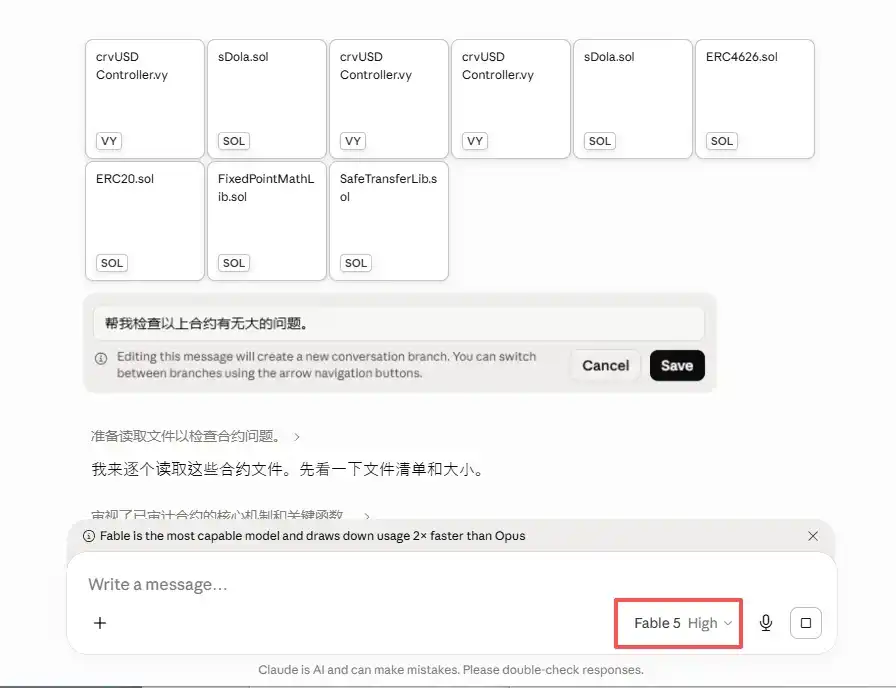
Fable 5 performs excellently in detecting single-contract, pure-code-syntax, low-level storage-class vulnerabilities. However, it still shows obvious limitations when facing cross-protocol combined semantics and multi-contract composite attacks. We used the latest public version Fable 5 to retest contracts related to the Curve LlamaLend sDOLA attack incident. The results confirmed this issue.

This audit involved the following contract list: crvUSD Controller.vy, sDOLA.sol, ERC4626.sol, and other series contracts. Fable 5 failed to identify the core risks corresponding to this attack:
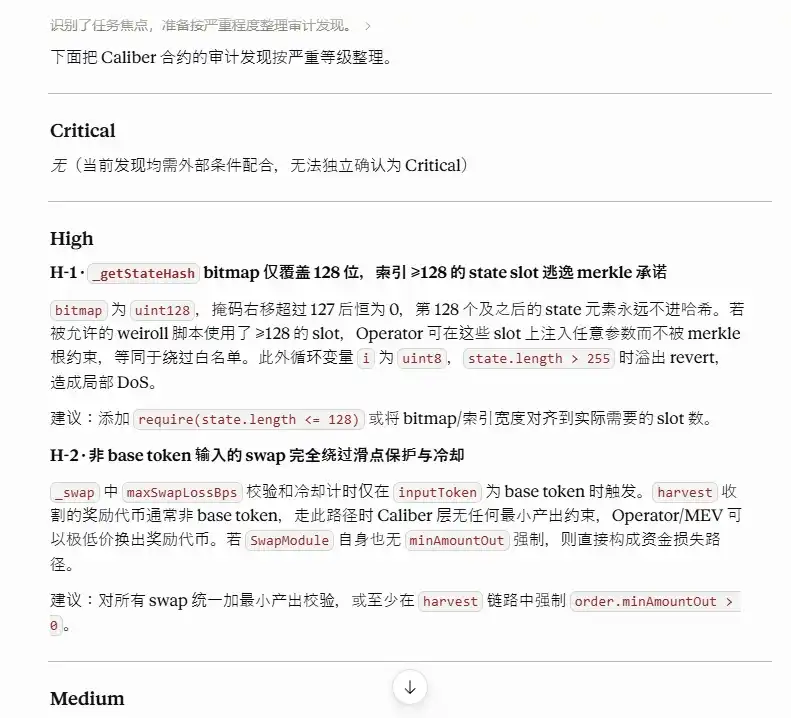
This incident belongs to a typical cross-protocol composite vulnerability. The syntax and logic of a single contract's code are flawless, but the attacker exploits multi-protocol linkage to construct an attack chain:

1. Utilizing flash loan tools to manipulate the price of the Curve liquidity pool, maliciously suppressing the asset price of sDOLA (an ERC-4626 vault share).

2. A large number of lending positions using sDOLA as collateral trigger the liquidation threshold.

3. The attacker executes liquidation operations in batches, profiting from them.

Such vulnerabilities are formed based on DeFi multi-protocol combinations, testing the comprehensive analysis capabilities of AI/audit experts regarding the overall business and protocol economic models. Currently, AI auditing still has shortcomings in cross-protocol combined semantics.

Conclusion

Through actual case testing, it can be seen that Fable 5 effectively uncovers hidden vulnerabilities that are easily missed in manual audits in standardized, detail-oriented scenarios such as storage slot conflicts, code pattern vulnerabilities, single-contract logic flaws, and batch code preliminary screening. However, when dealing with cross-protocol combined semantics, DeFi economic models, multi-contract linkage attacks, and complex business logic vulnerabilities, it struggles to understand the business nature of the on-chain ecosystem and discover composite attack paths. This part still requires analysis led by professional security auditors.

In daily audit work, Beosin has established a mature collaborative audit process combining AI and security audit experts. This not only significantly improves audit efficiency but also better identifies potential detailed risks and complex business logic vulnerabilities, making audit work more efficient, comprehensive, and in-depth.


Preguntas relacionadas

QWhat major AI model was released for public use, and what specific capability in cybersecurity has it demonstrated?

AAnthropic officially released the public version of Mythos, specifically the Claude Fable 5 model. It has demonstrated a strong capability in proactively discovering hidden security vulnerabilities within systems, particularly in areas like storage slot collisions within smart contracts.

QWhat is the key limitation of AI like Claude Fable 5 in smart contract auditing, according to the article's analysis of the Curve LlamaLend sDOLA attack?

AThe key limitation is its difficulty in handling cross-protocol combinatorial semantics and multi-contract interaction attacks. While effective for single-contract, syntax-level vulnerabilities, it struggles to understand the overall business logic and economic models of DeFi protocols that involve interactions between multiple smart contracts.

QDescribe the storage slot collision vulnerability example given in the article. How did AI auditing help discover it?

AThe vulnerability involved a collision between a custom `rewards` mapping and the fixed storage slot used by the Solady library's `ReentrancyGuard`. This allowed an attacker to repeatedly drain ETH by tricking the contract into reading the guard's sentinel value as a massive reward balance. AI auditing excelled here by instantly comparing library versions and precisely mapping storage layouts, pinpointing this 'hidden collision' that manual audits often miss.

QWhat was the outcome of using Anthropic Claude Opus to analyze Zcash, as mentioned in the article?

ASecurity researcher Taylor Hornby used the Anthropic Claude Opus 4.8 model and discovered a critical 'soundness' vulnerability in Zcash's Orchard privacy pool within a few hours. This bug, which had gone undetected through multiple manual audits for four years, could theoretically allow the unlimited minting of undetectable fake ZEC, causing ZEC's price to drop nearly 40%.

QWhat workflow does Beosin advocate for in smart contract security auditing based on the article's conclusion?

ABeosin advocates for a mature, collaborative workflow that combines AI tools with human security audit experts. This synergy leverages AI for efficiency in standardized tasks and detail-oriented vulnerability detection (like pattern matching and initial screening) while relying on human experts to lead the analysis of complex business logic, cross-protocol interactions, and DeFi economic models, resulting in a more efficient, comprehensive, and in-depth audit process.

Lecturas Relacionadas

Why Zhang Yiming Spends 50% of His Time on Seed?

Why does Zhang Yiming devote 50% of his time to Seed, ByteDance's core AI research team, while the company’s high-profile AI products like Doubao appear less dominant in the current market? An analysis reveals that ByteDance, historically a leader in defining trends (e.g., TikTok, Toutiao), has not set major AI industry agendas in the first half of the year, instead following competitors in areas like Agent and productivity tools. ByteDance’s strategy diverges from peers like Tencent and Alibaba, who are integrating AI into holistic productivity systems. While Doubao is highly successful—with 382 million MAU and leading revenue—its very success may create inertia, focusing iterations on improving the AI assistant rather than pioneering disruptive new entry points like Agent-native desktops. Zhang Yiming’s deep investment in Seed, a team of 300+ top researchers from firms like Google DeepMind, signals a long-term bet on foundational model capabilities as the ultimate competitive moat, reminiscent of ByteDance's past wins through superior underlying tech (e.g., recommendation algorithms). However, in the fast-evolving AI era, superior foundational models risk being outpaced by rapid shifts in product-level interaction paradigms and user habits. Zhang is essentially applying his principle of "delayed gratification" to corporate strategy, gambling that Seed’s breakthroughs will eventually make it the indispensable infrastructure for all AI applications, regardless of which product leads the user interface. The core question remains: is the AI era a race for the best product or the most powerful underlying infrastructure? The answer will define ByteDance’s future position.

marsbitHace 3 min(s)

Why Zhang Yiming Spends 50% of His Time on Seed?

marsbitHace 3 min(s)

From 'Speculative Asset' to 'The Next Generation Financial Infrastructure', Crypto is Growing a New TradFi World

From "Speculative Asset" to "Next-Generation Financial Infrastructure": Crypto Is Evolving into a New TradFi World Looking back, the crypto industry has long focused on identifying the "next asset to pump." However, starting around 2026, several developments across different sectors began converging. Stablecoin market cap approached $300 billion, entering a global payments adoption phase. DTCC initiated its first live tokenized asset conversions, while prediction markets expanded into regulated exchanges and brokerages. Simultaneously, AI Agents began using stablecoins autonomously for payments. These seemingly disparate trends share a common thread: the issuance, custody, trading, payment, and settlement capabilities built by the crypto industry over the past decade are now opening to broader financial activities and machine-driven economies. This suggests crypto is maturing beyond a purely speculative market, building a foundational infrastructure layer beneath it. This simultaneous progress occurs because the core components of a new financial system—stablecoins as programmable money APIs, RWA tokenization for traditional assets, prediction markets for price discovery on future events, and AI Agents as new economic actors—have developed independently and are now beginning to interconnect. These elements form the building blocks of a next-generation financial infrastructure. This emerging infrastructure features multi-layered capabilities: 1) Asset issuance and tokenization for a wider range of assets. 2) 24/7 programmable payments and settlement, simplifying global transfers. 3) Continuous trading and price discovery, providing real-time market signals for both humans and software. 4) Advanced identity, permissions, and authorization systems suitable for institutions and AI. 5) Growing connections to real-world legal and regulatory frameworks, providing greater clarity for traditional participants. This shift is reflected in changing funding sources, with more revenue now coming from real-world business flows, an expanding set of participants (including corporate systems and autonomous agents), and more nuanced regulatory discussions focused on rules and boundaries rather than outright prohibition. However, significant challenges remain. Technical confirmation is not legal finality; liability and governance for AI-driven payments are unclear; fragmentation across networks persists; privacy solutions for institutions are needed; and the system currently lacks mature frameworks for credit, insurance, and complex risk management found in traditional finance. In conclusion, 2026 marks a pivotal point where several previously independent pieces of the crypto puzzle started to connect. While far from complete, it signifies crypto's crucial step towards becoming a low-friction, global execution layer for real assets, traditional institutions, and intelligent software, built beneath its vibrant speculative markets.

marsbitHace 53 min(s)

From 'Speculative Asset' to 'The Next Generation Financial Infrastructure', Crypto is Growing a New TradFi World

marsbitHace 53 min(s)

Supporters of Bitcoin BIP-110 Update Have Prepared a 'Last Resort' Plan If the Proposal Is Not Adopted: It Could Radically Change BTC's Value

Supporters of the BIP-110 update for Bitcoin have prepared a contingency plan in case the proposal is not adopted, a move that could radically alter BTC's value. Developer Chris Guida has adapted a proof-of-work code originally created by Luke Dashjr in 2017 for the current version of Bitcoin Knots. This adaptation is described as a last-resort measure to be activated if miners do not signal readiness for BIP-110. The proposal itself is a soft fork aimed at temporarily limiting the storage of arbitrary data in Bitcoin transactions. It introduces stricter limits on new transaction outputs, OP_RETURN fields, and witness data, with rules designed to expire after approximately one year. Guida stated this option needs to remain open if miners were to "conspire to betray Bitcoin." Should the contingency code be used, it could change Bitcoin's current mining algorithm. This change would likely prevent existing ASIC miners from generating blocks on the new chain, leading to a large-scale reorganization of the Bitcoin mining network. Luke Dashjr, another Bitcoin Knots developer, contributed to the code and expressed hope it would not be needed, but sees its existence as useful for a potential crisis. A supporter known as Mechanic argued that the mere possibility of a proof-of-work change could act as a deterrent, emphasizing that Bitcoin's rules should be set by participants and node operators, not miners. While miner signals are tracked for BIP-110 activation, data from the proposal's official tracking page indicates support remains limited.

cryptonews.ruHace 4 hora(s)

Supporters of Bitcoin BIP-110 Update Have Prepared a 'Last Resort' Plan If the Proposal Is Not Adopted: It Could Radically Change BTC's Value

cryptonews.ruHace 4 hora(s)

Why Did Bitcoin's Price Remain Stable and Not Fall Despite the Recent Major Hack? Here's the Secret

The article discusses why Bitcoin's price remained stable despite a recent $100 million hack targeting individual cold wallets, citing insights from experts on "The Wolf of All Streets" channel. Analysts attribute this resilience to significant institutional shifts in the crypto market. Key points include: 1. **Market Maturation:** The crypto market has transitioned from being dominated by individual retail holders to institutional investors. Most new capital now enters via regulated channels like spot ETFs and custodial services (e.g., Coinbase, Anchorage), making vulnerabilities in individual cold wallets less impactful. 2. **Institutional Dominance:** Control over price dynamics has shifted from miners and crypto exchanges to Wall Street and institutional capital. These large players operate with long-term strategies, viewing price corrections as buying opportunities rather than reasons for panic. 3. **Increased Resilience:** Institutional involvement has reduced market sensitivity to negative news. Sellers are largely exhausted, and remaining holders are steadfast. Major financial institutions (e.g., Morgan Stanley, Wells Fargo) are incorporating crypto assets into portfolios, with research teams recommending allocations of 1–6% to Bitcoin. 4. **Risk Perception:** Bitcoin's integration into traditional financial indices has lowered perceived risk among professionals and institutions, further stabilizing its price against isolated security breaches.

cryptonews.ruHace 5 hora(s)

Why Did Bitcoin's Price Remain Stable and Not Fall Despite the Recent Major Hack? Here's the Secret

cryptonews.ruHace 5 hora(s)

Trading

Spot
活动图片