Public Version of Mythos Officially Launched: Analyzing the Advantages and Limitations of AI Smart Contract Auditing

marsbitPublicado a 2026-06-11Actualizado a 2026-06-11

Resumen

Publicly available Mythos, Anthropic's AI model, has officially launched, demonstrating both significant potential and limitations in smart contract security auditing. The article analyzes its capabilities through real-world cases. AI excels in identifying subtle, low-level vulnerabilities through pattern recognition and large-scale code screening. A key example is detecting a storage slot collision between a custom rewards mapping and a third-party library's ReentrancyGuard, a vulnerability easily missed in manual audits. In the recent Zcash incident, AI also rapidly discovered a critical soundness bug that had remained hidden for years. However, AI currently struggles with complex, interconnected scenarios. When tested on the Curve LlamaLend sDOLA exploit, which involved manipulating prices across multiple protocols (Curve pools, lending markets) to trigger liquidations, Fable 5 failed to identify the core cross-protocol attack vector. These scenarios require a deep understanding of DeFi economic models and multi-contract interactions. In conclusion, while AI tools like Mythos significantly boost efficiency in finding standardized, syntactic vulnerabilities, they cannot yet replace expert analysis for complex, business-logic, and cross-protocol attacks. An effective audit workflow combines AI's speed for initial screening with human expertise for in-depth, holistic analysis.

Original Source: Beosin

On June 9th, Anthropic officially launched the public version of Mythos, Claude Fable 5. Previously, Mythos demonstrated outstanding capabilities in security vulnerability discovery, rapidly identifying hidden vulnerabilities within systems, which garnered significant attention in the cybersecurity field.

The recent Zcash incident is a typical example of AI uncovering blockchain vulnerabilities. Security researcher Taylor Hornby, using the Anthropic Claude Opus 4.8 model, discovered a latent Orchard privacy pool soundness vulnerability within just a few hours. This vulnerability, which had gone unnoticed in multiple previous manual audits over four years, theoretically allowed the minting of unlimited undetected fake ZEC, directly causing the price of ZEC to plummet by nearly 40%.

Currently, AI has demonstrated astonishing efficiency in areas such as code pattern matching and batch preliminary screening. Integrating AI into the blockchain and smart contract security audit process is becoming a trend in the Web3 security industry. This article will analyze the strengths and weaknesses of AI in smart contract auditing based on real vulnerability cases and the actual performance of Fable 5.

Advantageous Scenarios for AI Auditing

Case Analysis: Storage Slot Collision

A certain contract used the following two components simultaneously:

1. A custom rewards mapping (used to record user claimable rewards)

2. The Solady library's ReentrancyGuard (to prevent reentrancy attacks)

However, the storage layouts of these two components conflicted.

Among them, Solady's ReentrancyGuard, for ultimate gas optimization, uses a fixed, low-numbered storage slot (typically a slot near constant obtained through specific calculations). The typical logic of the nonReentrant modifier is:

// A simplified versionmodifier nonReentrant() {    // when entering, write guard slot as 0xff...ff(Sentinel Value)    assembly {        if eq(sload(REENTRANCY_GUARD_SLOT), 2) { revert(...) }  // 2 represents locked        sstore(REENTRANCY_GUARD_SLOT, 2)  // locked    }    _;    // recover when function finishes    assembly { sstore(REENTRANCY_GUARD_SLOT, 1) }}

Custom rewards mapping:

mapping(address => uint256) public rewards;

According to Solidity storage layout rules (the first slot of a mapping is calculated from its declaration position), the first slot of the rewards mapping was exactly the same as the fixed guard slot of the ReentrancyGuard.

Attack process (detailed steps):

1. The attacker calls the getReward() function.

2. The nonReentrant modifier triggers, writing the guard slot as 0xffffffffffffffffffffffffffffffffffffffffffffffffffffffffffffffff (all 1s).

3. The contract code subsequently reads rewards[attacker's address] — but due to the slot collision, it actually reads the large value of 0xff...ff from the guard slot.

4. The contract assumes "there is a huge reward," thus transfers that amount of ETH to the attacker, while attempting to zero out rewards[attacker] (but writes back to the same guard slot).

5. Because the modifier restores the slot when the function ends, when the attacker calls getReward() again, the process repeats.

6. The attacker cyclically calls 200 times, successfully extracting a fixed amount of ETH each time, until the contract's available ETH is drained.

It's important to note that this is not a traditional "reentrancy attack" but rather the ReentrancyGuard's own protection mechanism being reverse-engineered by storage collision, turning into a vulnerability for infinite reward claims. Manual audits rarely dig line-by-line into the storage layout of third-party libraries, while AI can instantly perform library version comparison + precise storage slot mapping, directly hitting such "hidden collision" vulnerabilities.

Disadvantageous Scenarios for AI Auditing

Fable 5 performs excellently in detecting single-contract, pure-code-syntax, low-level storage-class vulnerabilities. However, it still shows obvious limitations when facing cross-protocol combined semantics and multi-contract composite attacks. We used the latest public version Fable 5 to retest contracts related to the Curve LlamaLend sDOLA attack incident. The results confirmed this issue.

This audit involved the following contract list: crvUSD Controller.vy, sDOLA.sol, ERC4626.sol, and other series contracts. Fable 5 failed to identify the core risks corresponding to this attack:
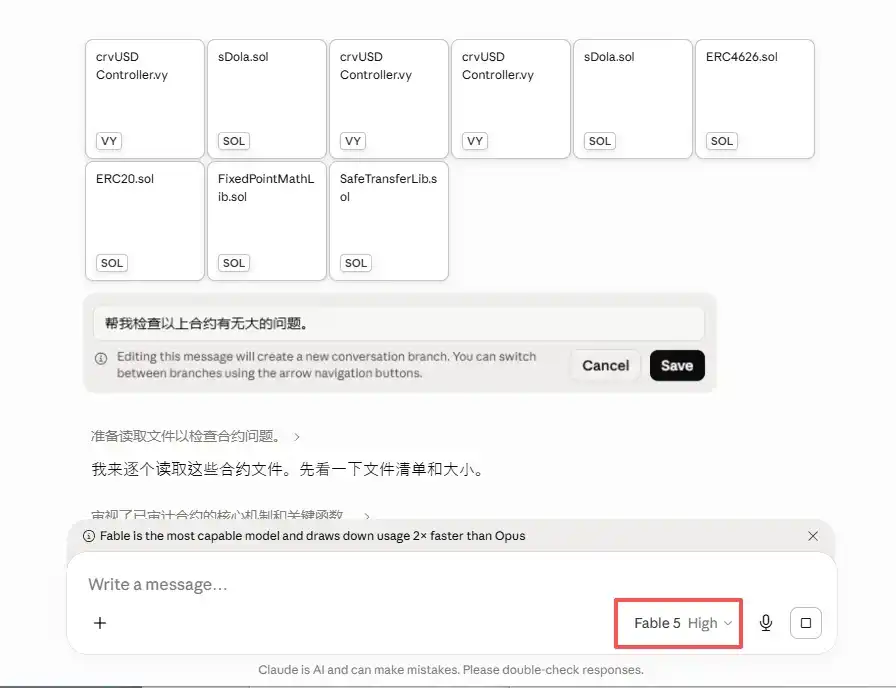
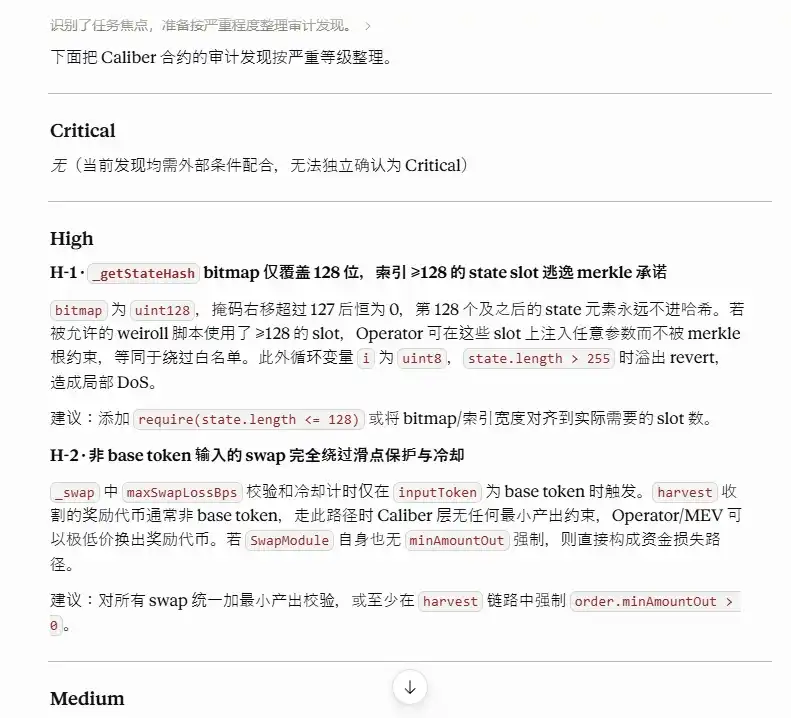
This incident belongs to a typical cross-protocol composite vulnerability. The syntax and logic of a single contract's code are flawless, but the attacker exploits multi-protocol linkage to construct an attack chain:

1. Utilizing flash loan tools to manipulate the price of the Curve liquidity pool, maliciously suppressing the asset price of sDOLA (an ERC-4626 vault share).

2. A large number of lending positions using sDOLA as collateral trigger the liquidation threshold.

3. The attacker executes liquidation operations in batches, profiting from them.

Such vulnerabilities are formed based on DeFi multi-protocol combinations, testing the comprehensive analysis capabilities of AI/audit experts regarding the overall business and protocol economic models. Currently, AI auditing still has shortcomings in cross-protocol combined semantics.

Conclusion

Through actual case testing, it can be seen that Fable 5 effectively uncovers hidden vulnerabilities that are easily missed in manual audits in standardized, detail-oriented scenarios such as storage slot conflicts, code pattern vulnerabilities, single-contract logic flaws, and batch code preliminary screening. However, when dealing with cross-protocol combined semantics, DeFi economic models, multi-contract linkage attacks, and complex business logic vulnerabilities, it struggles to understand the business nature of the on-chain ecosystem and discover composite attack paths. This part still requires analysis led by professional security auditors.

In daily audit work, Beosin has established a mature collaborative audit process combining AI and security audit experts. This not only significantly improves audit efficiency but also better identifies potential detailed risks and complex business logic vulnerabilities, making audit work more efficient, comprehensive, and in-depth.


Preguntas relacionadas

QWhat major AI model was released for public use, and what specific capability in cybersecurity has it demonstrated?

AAnthropic officially released the public version of Mythos, specifically the Claude Fable 5 model. It has demonstrated a strong capability in proactively discovering hidden security vulnerabilities within systems, particularly in areas like storage slot collisions within smart contracts.

QWhat is the key limitation of AI like Claude Fable 5 in smart contract auditing, according to the article's analysis of the Curve LlamaLend sDOLA attack?

AThe key limitation is its difficulty in handling cross-protocol combinatorial semantics and multi-contract interaction attacks. While effective for single-contract, syntax-level vulnerabilities, it struggles to understand the overall business logic and economic models of DeFi protocols that involve interactions between multiple smart contracts.

QDescribe the storage slot collision vulnerability example given in the article. How did AI auditing help discover it?

AThe vulnerability involved a collision between a custom `rewards` mapping and the fixed storage slot used by the Solady library's `ReentrancyGuard`. This allowed an attacker to repeatedly drain ETH by tricking the contract into reading the guard's sentinel value as a massive reward balance. AI auditing excelled here by instantly comparing library versions and precisely mapping storage layouts, pinpointing this 'hidden collision' that manual audits often miss.

QWhat was the outcome of using Anthropic Claude Opus to analyze Zcash, as mentioned in the article?

ASecurity researcher Taylor Hornby used the Anthropic Claude Opus 4.8 model and discovered a critical 'soundness' vulnerability in Zcash's Orchard privacy pool within a few hours. This bug, which had gone undetected through multiple manual audits for four years, could theoretically allow the unlimited minting of undetectable fake ZEC, causing ZEC's price to drop nearly 40%.

QWhat workflow does Beosin advocate for in smart contract security auditing based on the article's conclusion?

ABeosin advocates for a mature, collaborative workflow that combines AI tools with human security audit experts. This synergy leverages AI for efficiency in standardized tasks and detail-oriented vulnerability detection (like pattern matching and initial screening) while relying on human experts to lead the analysis of complex business logic, cross-protocol interactions, and DeFi economic models, resulting in a more efficient, comprehensive, and in-depth audit process.

Lecturas Relacionadas

Crypto Primary Market Investment and Financing Forward-Looking Weekly Report | Stablecoin Regulation Nears Implementation, ETF Funds Continue to Withdraw, Capital Begins Betting on Payment and Cash Flow

Crypto Market Weekly Report (Jun 1-7, 2026): Capital Shifts Focus to Payments & Cash Flow Market data indicates a significant divergence: while traditional institutional funds continue exiting via BTC and ETH ETFs (recording net outflows of $1.72B and $168M this week, respectively), stablecoin supply continues growing. This suggests capital is shifting from speculative asset allocation toward defensive positioning within on-chain liquidity, awaiting new, concrete opportunities. This trend is reflected in venture capital focus. Weekly fundraising fell 27% to $302M, with investments concentrating on infrastructure with tangible revenue potential: 1. **Stablecoin Infrastructure (28% of funding):** Projects like M0 Protocol ($35M raise) are gaining attention as regulatory clarity (e.g., the GENIUS Act) nears, shifting the focus from legitimacy to building payment and settlement networks. 2. **AI Agent Infrastructure (26%):** Investments are moving from conceptual AI Agents towards the execution and economic layers required for a functional "Agent economy." Key raises include OpenRouter ($40M) and Halliday ($20M). 3. **Real World Assets (RWA) (18%):** The search for on-chain yield and cash flow drives continued interest in RWA platforms like Ondo Finance. Security threats are evolving from smart contract exploits toward key management failures, permission control issues, and regulatory execution risks (e.g., court-ordered asset freezes). **Key Takeaways:** The investment thesis is shifting from narrative-driven bets to revenue and cash-flow-generating protocols. Future attention should be on the progression of stablecoin regulations, the commercial validation of AI Agent economies, and the performance of high-revenue protocols like derivatives platforms.

marsbitHace 8 min(s)

Crypto Primary Market Investment and Financing Forward-Looking Weekly Report | Stablecoin Regulation Nears Implementation, ETF Funds Continue to Withdraw, Capital Begins Betting on Payment and Cash Flow

marsbitHace 8 min(s)

Buy an NFT First to Get a Ticket? The Largest World Cup Ticket Slump in History

"Ticketing Woes for 2026 World Cup: NFT 'Right-to-Buy' and High Prices Dampen Sales" Despite anticipation for the 2026 FIFA World Cup, with 48 teams and 104 matches across North America, the tournament faces significant unsold tickets, with approximately 180,000 group-stage tickets still available for resale just before kick-off. This unexpected shortfall is attributed to FIFA's controversial new ticketing strategy, which includes an NFT-based "Right-to-Buy" (RTB) system and opaque, dynamic pricing. FIFA introduced RTBs as digital collectibles (NFTs) sold on its FIFA Collect platform. An RTB grants the holder only the right to purchase a ticket for a specific match later, not the ticket itself. This two-step process, criticized for selling "scarcity" first, saw RTBs priced from tens to hundreds of dollars, generating millions in revenue for FIFA. With many tickets remaining available on official channels, the value of these prepaid purchase rights is now being questioned. Compounding the issue are ticket prices, reported to be 2 to 4 times higher than the 2022 Qatar World Cup, and up to 7 times more for marquee matches. FIFA employed dynamic pricing, common in U.S. sports, but lacked transparency on seat availability and exact locations during sales, frustrating global fans facing high travel costs. This has drawn scrutiny from regulators in New York and New Jersey. FIFA's official resale platform also drew criticism for imposing high fees—roughly 10% on sellers and 17% on buyers, allowing FIFA to profit further from secondary market transactions. While FIFA President Gianni Infantino states over 6 million tickets have been sold, the situation highlights a potential disconnect between fan enthusiasm and willingness to pay under an aggressive commercial model.

marsbitHace 15 min(s)

Buy an NFT First to Get a Ticket? The Largest World Cup Ticket Slump in History

marsbitHace 15 min(s)

Dialogue with Morgan Stanley Executive: Wall Street Isn't Rejecting Bitcoin, It's Just Waiting for the Right Time

In a podcast interview, Amy Oldenburg, Head of Digital Asset Strategy at Morgan Stanley, discusses Wall Street's evolving stance on Bitcoin, explaining the bank's measured approach and the road ahead. Oldenburg, with 26 years at Morgan Stanley, traces her perspective to witnessing transformative tech cycles and her experience in emerging markets, where she observed the need for alternative financial systems like mobile money (e.g., M-Pesa). This background informs her view of Bitcoin's value proposition. She clarifies that Morgan Stanley is "client-driven." Regulatory hurdles, particularly as a bank holding company under Federal Reserve oversight, initially slowed their entry. While the firm couldn't act as quickly as independent asset managers, persistent client demand and a changing regulatory environment led to offerings like their low-fee Bitcoin ETP (MSBT). They are now gradually rolling out spot Bitcoin trading on their E*Trade platform. Regarding advisor adoption, Oldenburg cites a "lack of education" as the primary barrier. Morgan Stanley recommends a 0-2% allocation for more conservative portfolios and 2-4% for aggressive ones, but price volatility and confusion about its place in asset allocation persist. She notes competition for investor attention from AI and commodities. Addressing Bitcoin's price stagnation despite institutional buying, Oldenburg points to a confluence of factors: competing investment narratives (AI, quantum computing) and the complex financial landscape. She suggests a catalyst for Bitcoin as a neutral reserve asset might require a "slow-burn crisis" that exposes fragility in traditional systems. For wider bank adoption, including holding Bitcoin on balance sheets, she identifies the need for regulatory clarity to reduce punitive capital treatment and for the asset to be usable as collateral within financial ecosystems. Looking ahead, Oldenburg predicts steady, moderate adoption growth through 2030 rather than an explosive "J-curve." She emphasizes the importance of differentiating Bitcoin from other crypto assets and expresses concern that the core cypherpunk ethos of self-custody is being diluted as traditional finance enters the space. She concludes that the digital asset field remains in its early stages with significant innovation, like AI agents and micropayments, still to come.

marsbitHace 36 min(s)

Dialogue with Morgan Stanley Executive: Wall Street Isn't Rejecting Bitcoin, It's Just Waiting for the Right Time

marsbitHace 36 min(s)

Trading

Spot
Futuros
活动图片