Public Chains 2025: The Bustle Belongs to the Casino, the Desolation to the Ecosystem

比推Publicado a 2025-12-18Actualizado a 2025-12-18

Resumen

The 2025 public blockchain landscape reveals a stark divide between hype and reality, with a severe concentration of value and widespread "zombification" of projects. Analysis of DeFiLlama's on-chain fee data exposes a critical structural issue: the crypto space is dominated by a "profit concentration and long-tail zombie" era. Notable examples highlight this crisis. Algorand, a chain with a $1 billion market cap and advanced technology, generated a mere $17 in daily fees, while Cardano, a top-10 asset, saw only around $6,000. These "classic chains" are likened to empty, expensive cities with no real economic activity. The biggest value capturers are not the most technologically elegant chains. Tron leads with $1.24 million in daily fees, succeeding as a low-cost payment rail for USDT transfers—crypto's only true mass-adoption use case. Solana ($600k daily) thrives as a high-frequency casino for meme coins and speculation, and Base ($105k daily) demonstrates that distribution (via Coinbase) is more critical than pure technology. The only validated business models generating significant fees are low-cost payments, high-frequency speculation, and, to a lesser extent, Ethereum's asset settlement layer. The VC-driven model is failing. New chains like Sui, Sei, and Starknet, which raised hundreds of millions, show a severe disconnect between their high valuations and meager daily fee revenue (ranging from $320 to $12,000). Their lifecycle often follows a "pump and dump" pattern...

Author: BlockWeeks Block Weekly

In the cryptocurrency market, if you only look at Market Cap, you see a thriving, flourishing digital utopia. Valuations in the tens of billions, grand technical whitepapers, the halo of Turing Award winners... everything looks like the dawn of the next generation of the internet.

But if you put on a different pair of glasses—glasses that only see "on-chain real revenue (Fees)"—you see a completely different, even spine-chilling picture: in this so-called trillion-dollar market, the vast majority of "unicorns" are actually zombies that stopped breathing long ago.

Recently, BlockWeeks conducted a detailed analysis of the "Fees" data for public chains on DeFiLlama, and we discovered an unavoidable structural problem: crypto public chains have entered an era of "extremely concentrated profits and a collectively zombified long tail."
The core data of this article are sourced from DeFiLlama's "Fees / Revenue by Chain" panel (capture time: December 16, 2025). The "Fees" defined here refer to the total fees paid by users on-chain (top-line), serving as an approximate indicator of the scale of on-chain economic activity, not the protocol's net retained income (Protocol Revenue). This article aims to use this open, unified standard to examine the on-chain value capture ability of various public chains.

I. The $17 Humiliation: The Demise of the Technological Utopia

According to the public data we captured from DeFiLlama, the most alarming figure did not come from the million-dollar giants at the top, but from the $17 at the bottom.

This is the daily protocol revenue for Algorand—a chain once crowned the "blockchain trilemma solver," founded by Turing Award winner Silvio Micali, and boasting top-tier technical credentials.

You read that right, not $170,000, but $17.
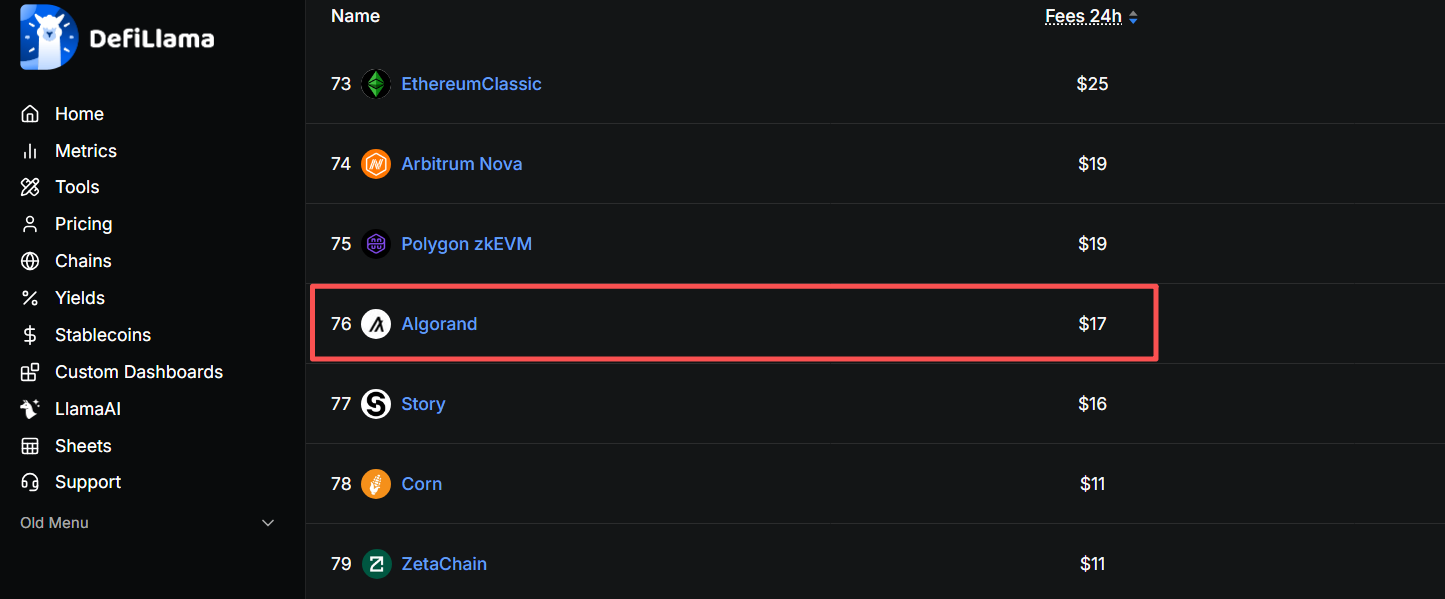
At this very moment, Algorand's market cap remains in the billion-dollar range. A "digital nation" with a billion-dollar market cap generates direct tax revenue from its digital economy that isn't enough to buy four lattes at Starbucks. It shows that despite possessing the most advanced decentralized technology, without real, sustained application demand, its economic value capture ability approaches zero.

This is not just an embarrassment for Algorand; it's the death knell for the entire "classic public chain" camp.

Look at Cardano (ADA), a behemoth consistently in the top 10 by market cap, with millions of token holding addresses. Yet the data tells us its recent average daily on-chain fees hover around $6,000. This means that aside from asset transfers between holders and network maintenance staking, there is a lack of commercial activity on that chain significant enough to generate substantial fees—no large-scale lending, no high-frequency trading, no real, paid value exchange.

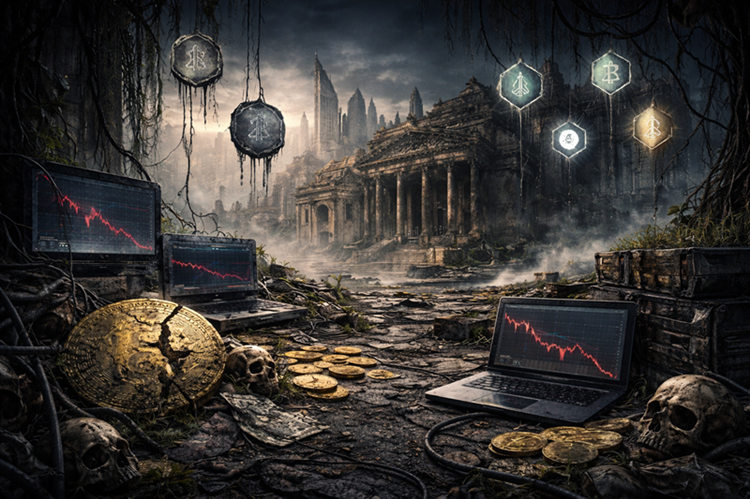
These public chains are like luxurious empty cities built at great expense in the middle of a desert. The infrastructure is complete, the roads are wide, the city hall (foundation) is well-funded, but no citizens (active paying users) are seen on the streets. Their method of sustaining operation is often for the city hall to continuously sell off reserves (dumping tokens) to cover operational costs.

II. The Ugly Victory: Who is Actually Capturing Value?

When shifting focus to the top of the list, a fact that makes "technological purists" even more uncomfortable emerges: the ones making the most money are often not the most "elegant" or "decentralized" in terms of technology.

Topping the chart is Tron, with average daily fees as high as $1.24 million. In the eyes of many elitists, Tron might hardly be considered "technical." But the market has given the ultimate answer by voting with its feet: payments are a rigid demand. Tron carries the vast majority of the global on-chain transfer demand for USDT. In this industry full of speculation and bubbles, Tron has inadvertently become the only payment layer application with mass adoption—even if it merely serves as a shadow banking channel for fiat currencies.

One could say: payments, the oldest and most basic internet need, are currently the only mass adoption in the Crypto world. Tron's success is a powerful mockery of all project teams that pursue "perfect technology" while ignoring "real demand."

Close behind is Solana, with nearly $600,000 in average daily fees. Its success logic is even more straightforward: it is the world's most active on-chain casino. Meme coins, high-frequency DEX trading, front-running—these activities contribute the vast majority of the fees. Solana's moat is no longer TPS, but "attention traffic." The rise of Base is even more disruptive (approx. $105k daily): it proves that distribution channels are far more important than the technology itself. Backed by Coinbase's huge user base, Base delivers a dimensional打击 to other L2s.
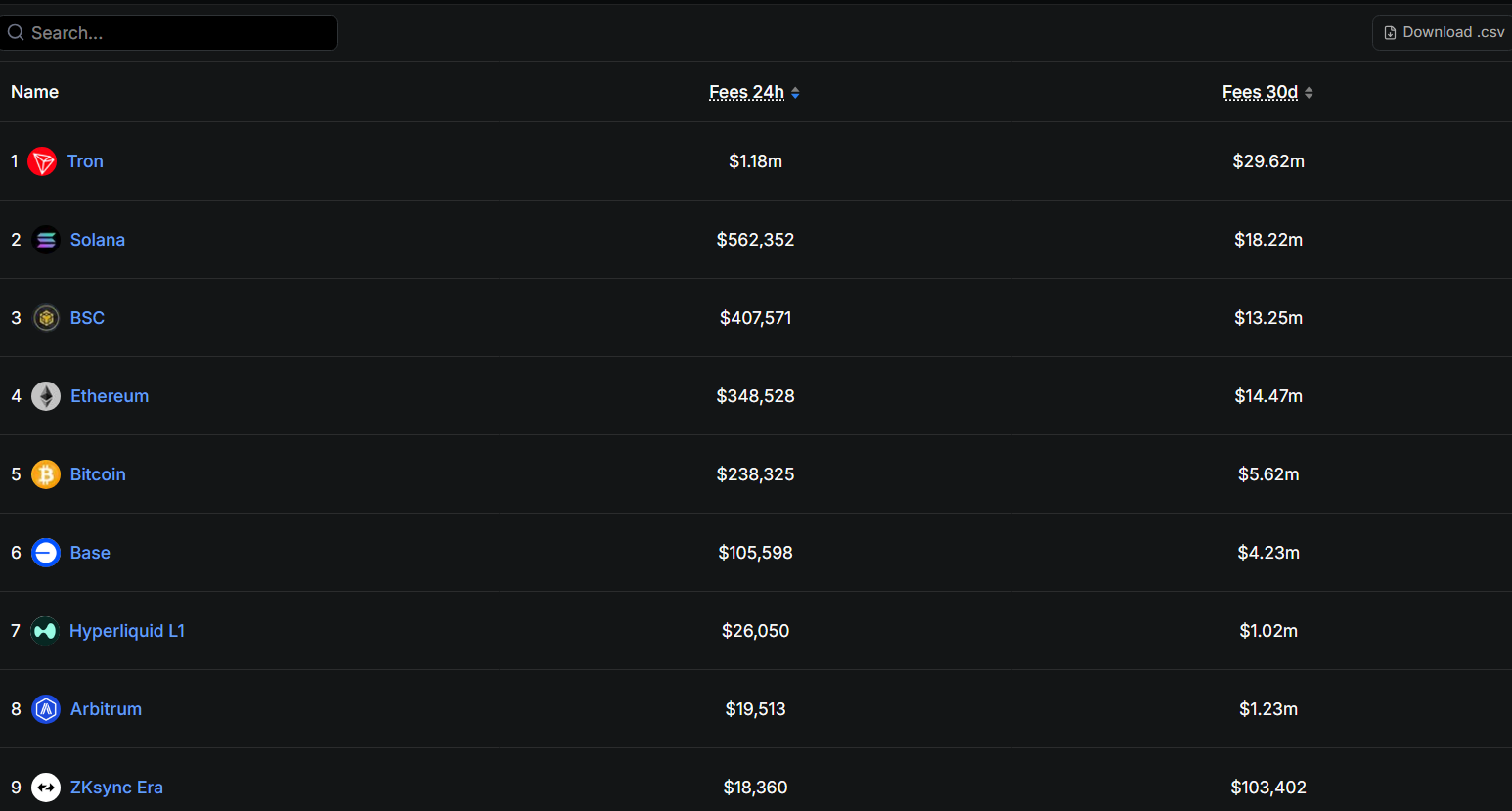
This provides a brutal yet clear revelation: the current Crypto market has only two and a half business models that are verified and can generate large-scale on-chain fees—low-cost payments (Tron), high-frequency speculation (Solana/Base), and the asset settlement layer (Ethereum), which is being constantly eroded by L2s.

Beyond these, those once highly anticipated "enterprise-level applications," "supply chain traceability," and "Web3 social" have, in the face of cold on-chain fee data, at least at this stage, not yet demonstrated规模化付费 demand.

III. The VC Syndicate Dilemma: Why "Peak at Launch"?

This data also reveals another deep crisis: the narrative model for new L1/L2s driven by massive venture capital (VC) financing is facing a brutal reality check regarding monetization.

We see that new public chains like Sui (~$12k daily), Sei (~$320 daily), Starknet (~$10k daily), which launched with great fanfare and raised hundreds of millions or even billions of dollars, have severely inverted链上手续费收入 compared to their fully diluted valuations (FDV) of tens or hundreds of billions.

The standard playbook of the past few years has been: VC investment -> team piles on technical highlights -> attract airdrop farmers to刷取数据 -> token lists on exchanges creating wealth -> retail investors buy into the narrative -> airdrop farmers撤离 -> on-chain activity data plummets.

This is why many new chains have astonishing TPS and hundreds of thousands of daily active users at launch, only to quickly become "ghost towns" months later. Because those users are mercenaries, not residents. When airdrop expectations are realized, when incentive subsidies stop, the real, organic demand is exposed for what it is—daily fee revenues of a few thousand or tens of thousands of dollars simply cannot support billion-dollar valuation dreams.

We are facing severe "block space inflation." The industry has built too many chains, too many L2s, too many data availability (DA) layers, but innovation at the application layer is extremely scarce. This is like狂热ly laying成千上万条光纤 in the early days of broadband internet普及, before Netflix, YouTube, or any killer app that must use this bandwidth has been born.

IV. Investor Awakening: From "Listening to Stories" to "Checking the Books"

For a long time, the valuation logic of the crypto market was built on "dream multiples." The grander the narrative, the richer the imagination, the higher the market cap could fly.

But 2024-2025 is becoming a watershed. As macro liquidity tightens and institutional investors demand more substantial returns, the market is being forced to return to rationality.

For investors, the logic must change:

  1. Beware of "Zombie Coins": If a project has a market cap of billions but daily on-chain fees of only a few hundred or thousand dollars, this extreme "unworthiness" is often the starting point for a long-term decline. Its only support—community faith—will eventually run out.

  2. Focus on "Positive Cash Flow" Ability: Look for ecosystems where users are willing to持续付费 for services even without token incentives. Tron's stablecoin transfer fees, Base and Solana's transaction fees are direct reflections of real demand.

  3. Acknowledge "Channels and Ecosystems are King": Base's success proves that pure technical advantages can hardly be a moat anymore. Giants entering with massive user bases (like Coinbase), or native communities that can breed狂热 cultures, are more valuable assets at the current stage. Purely technical public chains, if they cannot solve the "who will use it and why" problem, will ultimately become Algorand-style academic exhibits.

  4. See Through the VC Game: Stop paying for虚假繁荣 driven by subsidies and airdrops.

Faced with the harsh reality of $17 daily revenue, rather than paying for grand narratives and empty "digital ghost cities," it's better to tighten your purse strings and turn to the few ecosystems that can generate real cash flow and have active paying users.

This is not a denial of the long-term value of all technological exploration, but a necessary清算 of the current畸形的 valuation system. Only when the market learns to pay for "value actually generated," rather than透支 for "stories promised in the future," can this industry usher in a truly healthy dawn.

Important Notes and Evaluation Framework

The core of this article is to use "on-chain fees" as a unified, public ruler to measure the "immediate value capture ability" of various public chains. When reading and citing the conclusions of this article, please be sure to understand the following key background and limitations:

1. General Background Notes

  • Development Stage Differences: Some public chains may be technologically advanced but in their early stages, with a user base not yet formed for scale effects. The data in this article reflects the "current state," not the "ultimate potential."

  • Impact of Fee Models: Some public chains are designed to pursue ultra-low transaction fees (Gas Fee), and their native token prices are low. This means that even if the number of on-chain transactions is considerable, the "total fee revenue" denominated in USD appears tiny. This suggests that evaluating such chains should combine metrics like transaction count and active address number for a comprehensive judgment, but the upper limit of their USD-denominated economic throughput remains an objective fact.

2. Evaluation Notes for Specific Types of Chains

For a fairer discussion, we provide the following evaluation ideas for specific types of projects:

Chain Type This Article's Evaluation & Suggestion
Storage/Service Networks

(e.g., Filecoin, Arweave)

There is indeed a difference in口径. The core value of these networks lies in storage/retrieval services, and their revenue model differs from单纯 transaction fees. DeFiLlama's "Fees" metric may severely underestimate their actual commercial activity. If you are an investor, you should be on their storage market capacity, active交易订单, and real storage revenue streams.
Off-Chain/Consortium Business-Driven Public Chains

(e.g., some enterprise chains)

Data has limitations. DeFiLlama only statistics public on-chain activity, a point BlockWeeks fully agrees with. But we同样疑惑, if the main value of a public chain is not reflected on-chain, then what supports the market cap of its publicly issued tokens used for on-chain governance and security?
Technical Low-Fee/High-TPS Public Chains The design初衷 is good. However, extremely low per-transaction fees mean the value captured by the chain itself and validators is extremely low. The success of this model must rely on extremely high transaction volume to compensate for the low price disadvantage. If low fees fail to attract massive transactions, its economic model may face challenges.
Chains with Ecosystem Traffic Concentrated on CEXs Hard to evaluate. If a public chain's on-chain economic activity is weak and cannot generate sufficient fees, then its practical value and value capture ability as a "decentralized settlement layer" or "smart contract platform" are low. Its value may be closer to a单纯的 "digital collectible."

We始终 believe that in a world of highly concentrated profits, projects in the long tail are almost sentenced to fate unless they find unique application scenarios (like gaming or specific AppChains). Only platforms that can generate cash flow through real, sustained user demand have the potential to survive long-term and outperform the market.


Twitter:https://twitter.com/BitpushNewsCN

Bitpush TG Discussion Group:https://t.me/BitPushCommunity

Bitpush TG Subscription: https://t.me/bitpush

Original Link:https://www.bitpush.news/articles/7596644

Preguntas relacionadas

QWhat is the core metric used in the article to evaluate the health and value capture of public blockchains?

AThe article uses on-chain fees (total fees paid by users) as the core metric, sourced from DeFiLlama's 'Fees / Revenue by Chain' dashboard, to measure the scale of economic activity and value capture.

QAccording to the article, which blockchain has the highest daily on-chain fees, and what is the primary use case driving this activity?

ATron (TRX) has the highest daily on-chain fees at $1.24 million, driven primarily by its role as a low-cost payment layer for USDT stablecoin transfers, serving as a 'shadow banking channel'.

QWhat does the example of Algorand's $17 daily fee revenue illustrate about the current state of many 'classic' public blockchains?

AAlgorand's $17 daily fee revenue, despite its multi-billion dollar valuation and advanced technology, illustrates that many 'classic' public blockchains have become 'zombies'—they lack real, sustained application demand and their economic value capture is nearly zero, making them like 'luxury empty cities in the desert'.

QWhat are the two and a half business models that the article states have been validated to generate large-scale on-chain fees?

AThe two and a half validated business models are: 1. Low-cost payments (exemplified by Tron), 2. High-frequency speculation/gambling (exemplified by Solana and Base), and the half being the asset settlement layer (exemplified by Ethereum, which is being constantly eroded by L2s).

QWhat major shift in investor logic does the article suggest is happening in the 2024-2025 market?

AThe article suggests a shift from valuing projects based on grand narratives and 'dream ratios' to a more rational approach that focuses on 'checking the books'—prioritizing real cash flow-generating ability, active paying users, and avoiding 'zombie coins' with massive valuations but minuscule on-chain revenue.

Lecturas Relacionadas

Who Funds the Agents?

**Summary: Who Funds AI Agents?** OpenAI recently shut down a feature allowing AI agents to shop for users, highlighting the challenge of creating a secure and regulated environment for agent-driven transactions. While payment infrastructure exists, a crucial governance layer—defining spending limits, fraud detection, tax handling, and return policies—is largely missing. The potential is enormous: AI agents already processed $73M across 176M transactions last year, with McKinsey forecasting this could grow to $3-5T in global consumer commerce by 2030. The core competition isn't just about processing payments, which can be very cheap (especially with crypto-based settlement), but about controlling the rules that govern agent spending. Key players like Stripe and Coinbase are racing to dominate this governance layer. Stripe's acquisition of wallet provider Privy allows it to set spending policies, identity checks, and human-in-the-loop approvals directly at the wallet level. Similarly, Coinbase's stack, including its x402 protocol and AgentKit, embeds governance rules. This vertical integration across settlement, wallet, and governance layers is becoming the dominant strategy. Control over the governance layer is where significant future value lies. If agents handle trillions in transactions, even a small fee for managing compliance, fraud prevention, and policy enforcement could generate billions in annual revenue. The companies that successfully integrate across the payment stack will capture value from idle agent balances, transaction fees, and governance services, positioning themselves as the foundational banks of the AI agent economy.

marsbitHace 10 min(s)

Who Funds the Agents?

marsbitHace 10 min(s)

A Nation Blocks Chips, a Giant Buys a Nuclear Power Plant: Why It's Time to Seriously Consider DeAI

**Title: Great Powers Blockade Chips, Giants Buy Nuclear Plants: Why It's Time to Seriously Consider DeAI** In May 2026, the US closed loopholes for Chinese firms to acquire advanced NVIDIA chips via overseas subsidiaries. That same month, Kenya halted a $1B geothermal data center project involving Microsoft, fearing its immense energy consumption. Meanwhile, Huawei announced mass production of its Ascend AI chip. These disparate events underscore a new reality: the competition for computing power ("compute") has escalated beyond the tech industry, becoming a geopolitical and infrastructural battleground. A new era of oligopoly is forming, with control over the AI stack—from GPU chips (NVIDIA) and cloud platforms (AWS, Azure, Google Cloud) to foundational models (OpenAI, Anthropic)—concentrating in a few Western "AI Octopus" corporations. This centralization creates systemic risks: pricing power and platform lock-in for users, infrastructure fragility, and a widening "compute divide" that threatens to marginalize nations without independent AI capacity. An "AI Iron Curtain" is deepening through export controls. In response, some nations like Saudi Arabia and the UAE are investing heavily to buy compute power, aiming to transition from oil to AI economies. The EU seeks to triple its compute capacity by 2030 to reduce dependency. However, the spending gap is vast, with four US tech giants alone planning ~$750B in AI capex for 2026. The race is increasingly constrained by energy, with AI tasks consuming up to 1000x more power than web searches, pushing firms to even acquire nuclear plants. This landscape is fueling interest in Decentralized AI (DeAI). It proposes a third way: using open protocols to coordinate a global network of idle GPUs, independent developers, and data centers, creating an AI infrastructure without a single controlling entity. Leveraging blockchain and cryptographic verification, DeAI aims to break market concentration, disperse energy demands, reduce geopolitical dependencies, and enhance transparency. While still nascent in performance and stability, DeAI's core promise is not immediate superiority but providing a crucial alternative architecture to resist monopoly, censorship, and centralized power. As specialized AI hardware costs fall and open-source models flourish, the window to build this foundation is open. The very existence of such competition serves as a vital check against the inevitable abuse of concentrated power.

marsbitHace 1 hora(s)

A Nation Blocks Chips, a Giant Buys a Nuclear Power Plant: Why It's Time to Seriously Consider DeAI

marsbitHace 1 hora(s)

Outpoll Review: A Prediction Market Platform Built for Active Traders

Outpoll Review: A Prediction Market Platform Built for Active Traders In recent years, prediction markets have grown from a niche sector to a mainstream arena, attracting billions in trading volume and institutional capital. However, the user experience and tools for traders have not kept pace. Outpoll, a new global prediction market platform, aims to fill this gap by providing enhanced trading infrastructure for active and professional traders. Built on standard prediction market principles, Outpoll allows users to trade on the outcome of specific events. It uses fully collateralized contracts with USDC settlement, charges a competitive 0.1% fee per trade, and provides clear settlement rules upfront to minimize disputes. A key focus for Outpoll is its professional-grade trading tools. The platform supports limit and market orders, as well as take-profit and stop-loss orders for open positions—features uncommon in prediction markets. For automated trading, Outpoll offers comprehensive REST and WebSocket APIs, enabling portfolio management, price arbitrage, and integration with existing tools. The platform also features a creator-led market model, where approved experts and community leaders can create and manage markets for niche topics under platform supervision. Its integrated interface combines news feeds directly with trading functions, allowing users to monitor events and manage positions seamlessly. Outpoll launched with a native Android app (available on Google Play) and plans an iOS version later this year. In summary, Outpoll distinguishes itself with trader-focused tools, practical APIs, transparent and collateralized markets, integrated news, and an expanding creator program. For active traders, its advanced order types and API access alone make it a platform worth watching. Outpoll is now globally accessible via outpoll.com and Google Play.

marsbitHace 1 hora(s)

Outpoll Review: A Prediction Market Platform Built for Active Traders

marsbitHace 1 hora(s)

Trading

Spot
Futuros

Artículos destacados

Cómo comprar BILL

¡Bienvenido a HTX.com! Hemos hecho que comprar Billions Network (BILL) sea simple y conveniente. Sigue nuestra guía paso a paso para iniciar tu viaje de criptos.Paso 1: crea tu cuenta HTXUtiliza tu correo electrónico o número de teléfono para registrarte y obtener una cuenta gratuita en HTX. Experimenta un proceso de registro sin complicaciones y desbloquea todas las funciones.Obtener mi cuentaPaso 2: ve a Comprar cripto y elige tu método de pagoTarjeta de crédito/débito: usa tu Visa o Mastercard para comprar Billions Network (BILL) al instante.Saldo: utiliza fondos del saldo de tu cuenta HTX para tradear sin problemas.Terceros: hemos agregado métodos de pago populares como Google Pay y Apple Pay para mejorar la comodidad.P2P: tradear directamente con otros usuarios en HTX.Over-the-Counter (OTC): ofrecemos servicios personalizados y tipos de cambio competitivos para los traders.Paso 3: guarda tu Billions Network (BILL)Después de comprar tu Billions Network (BILL), guárdalo en tu cuenta HTX. Alternativamente, puedes enviarlo a otro lugar mediante transferencia blockchain o utilizarlo para tradear otras criptomonedas.Paso 4: tradear Billions Network (BILL)Tradear fácilmente con Billions Network (BILL) en HTX's mercado spot. Simplemente accede a tu cuenta, selecciona tu par de trading, ejecuta tus trades y monitorea en tiempo real. Ofrecemos una experiencia fácil de usar tanto para principiantes como para traders experimentados.

210 Vistas totalesPublicado en 2026.05.07Actualizado en 2026.06.02

Cómo comprar BILL

Qué es ATWO

I. Introducción al ProyectoArena Two es una plataforma interactiva descentralizada que permite a los fanáticos jugar un papel activo y tokenizado en los resultados de eventos en tiempo real. A diferencia de los modelos de transmisión tradicionales que reducen a los fanáticos a espectadores pasivos, Arena Two aprovecha la tecnología blockchain para permitir que los fanáticos voten directamente en tiempo real e influyan en los resultados en el campo.II. Información del TokenNombre del token: ATWO (Arena Two)III. Enlaces RelacionadosSitio web: https://arenatwo.com/Exploradores: https://basescan.org/token/0x499D35eBE6cEe9B2Ac35Fd003fcBbeeB9CFc7B32Twitter: https://x.com/arenatwoXNota: La introducción del proyecto proviene de los materiales publicados o proporcionados por el equipo oficial del proyecto, que es solo para referencia y no constituye asesoramiento de inversión. HTX no se hace responsable de ninguna pérdida directa o indirecta resultante.

96 Vistas totalesPublicado en 2026.05.18Actualizado en 2026.06.02

Qué es ATWO

Cómo comprar ATWO

¡Bienvenido a HTX.com! Hemos hecho que comprar Arena Two (ATWO) sea simple y conveniente. Sigue nuestra guía paso a paso para iniciar tu viaje de criptos.Paso 1: crea tu cuenta HTXUtiliza tu correo electrónico o número de teléfono para registrarte y obtener una cuenta gratuita en HTX. Experimenta un proceso de registro sin complicaciones y desbloquea todas las funciones.Obtener mi cuentaPaso 2: ve a Comprar cripto y elige tu método de pagoTarjeta de crédito/débito: usa tu Visa o Mastercard para comprar Arena Two (ATWO) al instante.Saldo: utiliza fondos del saldo de tu cuenta HTX para tradear sin problemas.Terceros: hemos agregado métodos de pago populares como Google Pay y Apple Pay para mejorar la comodidad.P2P: tradear directamente con otros usuarios en HTX.Over-the-Counter (OTC): ofrecemos servicios personalizados y tipos de cambio competitivos para los traders.Paso 3: guarda tu Arena Two (ATWO)Después de comprar tu Arena Two (ATWO), guárdalo en tu cuenta HTX. Alternativamente, puedes enviarlo a otro lugar mediante transferencia blockchain o utilizarlo para tradear otras criptomonedas.Paso 4: tradear Arena Two (ATWO)Tradear fácilmente con Arena Two (ATWO) en HTX's mercado spot. Simplemente accede a tu cuenta, selecciona tu par de trading, ejecuta tus trades y monitorea en tiempo real. Ofrecemos una experiencia fácil de usar tanto para principiantes como para traders experimentados.

152 Vistas totalesPublicado en 2026.05.18Actualizado en 2026.06.02

Cómo comprar ATWO

Discusiones

Bienvenido a la comunidad de HTX. Aquí puedes mantenerte informado sobre los últimos desarrollos de la plataforma y acceder a análisis profesionales del mercado. A continuación se presentan las opiniones de los usuarios sobre el precio de A (A).

活动图片