Prompt Engineering Paper Accepted at ICML 2026 Sparks Heated Debate Among Netizens

marsbitPublicado a 2026-07-15Actualizado a 2026-07-15

Resumen

A paper on prompt engineering, titled "Verbalized Sampling (VS)," has been accepted by the prestigious machine learning conference ICML 2026, sparking significant debate online. The paper addresses the problem of "mode collapse" in large language models (LLMs), where models tend to produce repetitive, safe, and homogeneous outputs. Instead of proposing new training algorithms or model architectures, the authors introduce a simple yet effective prompt-based method. The core technique, Verbalized Sampling, instructs the model to generate multiple responses (e.g., five jokes) while also outputting a possible probability value for each. This prompt adjustment alone was shown to significantly increase output diversity by 1.6x to 2.1x in creative writing tasks, without compromising factual accuracy or safety. The authors argue that the root cause of mode collapse lies not in optimization algorithms but in the "typicality bias" present in human preference data used for alignment. Human annotators naturally favor familiar and fluent text, which steers models toward conservative outputs. The VS method aims to counteract this by leveraging the model's inherent pre-training distribution during inference. The paper's acceptance has led to polarized reactions. Critics argue that prompt engineering lacks the theoretical depth and algorithmic innovation expected from top-tier conferences like ICML, questioning its novelty, generalizability across models, and experimental scale. Some draw...

Prompt engineering can get a paper published in ICML these days???

Recently, a guy shared a paper just accepted by ICML 2026 on Reddit, and the post instantly went viral, with the number of comments skyrocketing.

However, everyone was left scratching their heads: Is this for real?
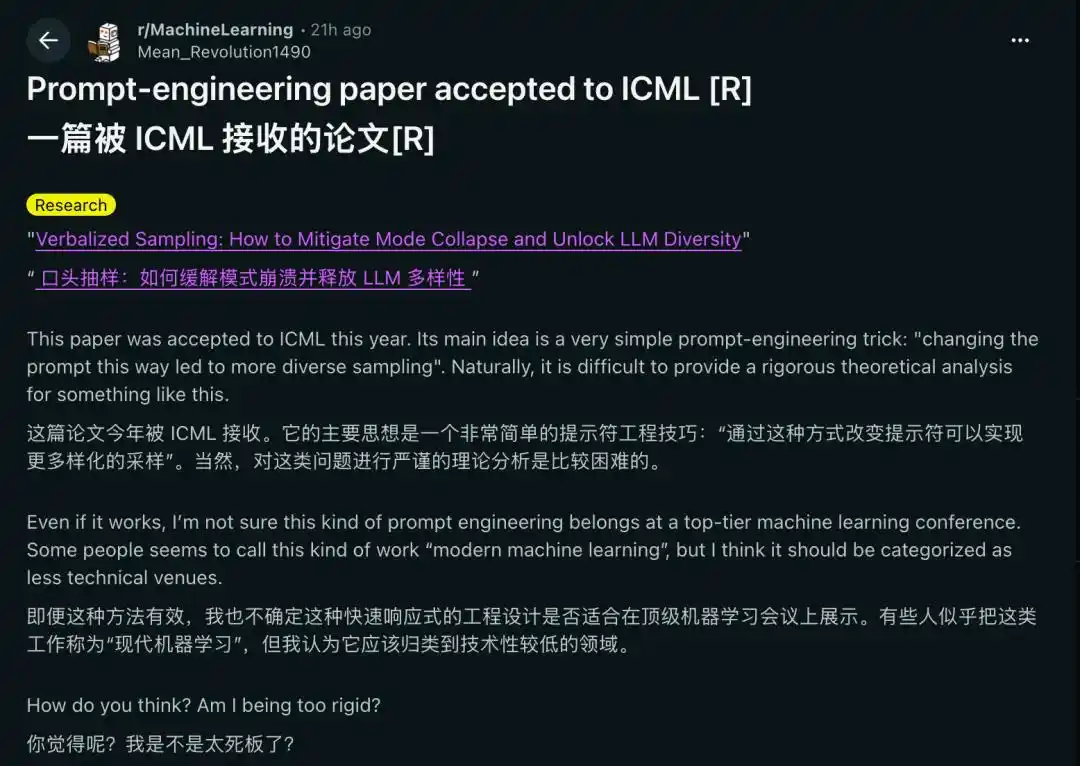
The authors didn't propose any new optimization algorithms or train any new large models. They simply did one thing—

Modified the Prompt.

The paper proposes a method called Verbalized Sampling (VS), which significantly enhances the diversity of large language model outputs and alleviates the long-standing issue of Mode Collapse in LLMs, solely by adjusting the prompt.

It sounds quite practical, but is it right for a mere prompt trick to get into a top-tier conference?

Let's take a look at the paper first before passing judgment.

A Highly Controversial ICML Paper
Have you ever felt that AI is becoming increasingly homogeneous?

Ask it ten times to "Tell me a joke," and the answers you get are often highly similar. This is not only true for creative tasks but also for Q&A, code generation...

This phenomenon is collectively referred to as mode collapse in academia.

Simply put, models increasingly prefer to output the highest probability, safest, and most classic answers, while rejecting alternative creative ideas.
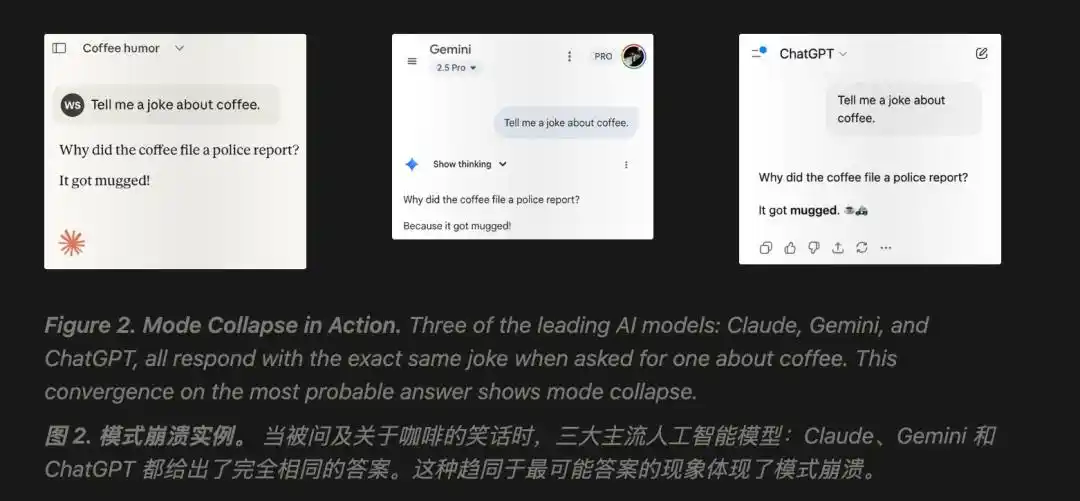
In the past, to solve this model problem, most researchers would first think of adjusting sampling parameters, modifying decoding algorithms, retraining, etc. However, this paper takes a different approach: directly asking the model to output its own sampling process along with the answer.

For example, using the earlier joke-telling scenario, the authors would modify the prompt, requiring the model to:

Generate 5 jokes, while also assigning a possible probability value to each joke.

Then the model can produce more varied and less repetitive answers.

It sounds very simple, doesn't it? In fact, this is the core contribution of the paper—the Verbalized Probability Sampling method. No fine-tuning is needed; just by changing the way of asking, content diversity can be significantly improved.
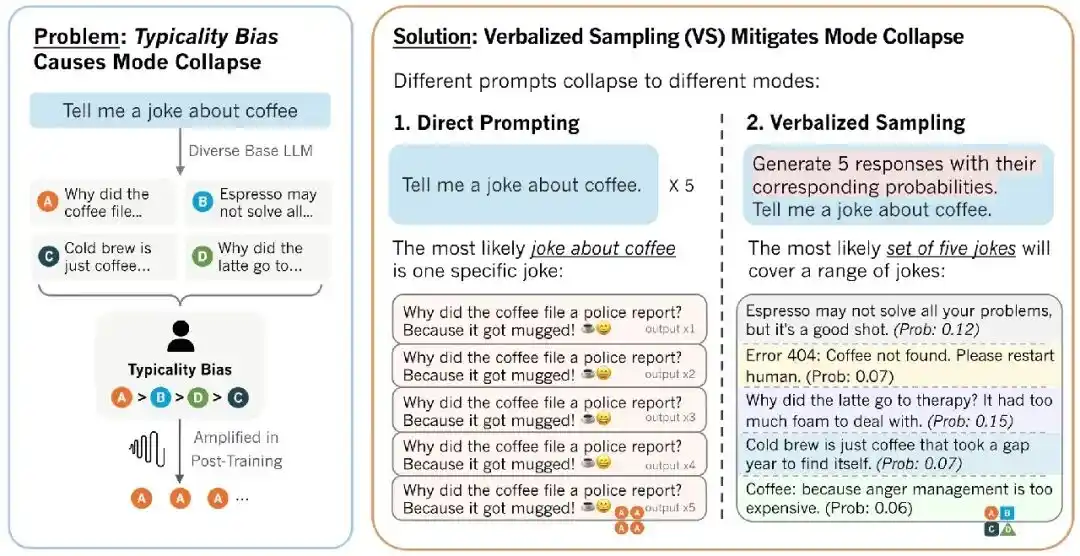
In the paper, however, the authors provide a rigorous argumentation process for this.

First, they address the root cause of the model's uniformity.

Past academia attributed this problem to algorithmic aspects, such as insufficient reward models or improperly set KL penalty terms. This paper delves deeper, suggesting the real root lies in the preference data itself.

They propose a concept called prototypical bias. From a cognitive psychology perspective, human annotators naturally prefer familiar, fluent, conventional text, and instinctively give higher scores to stereotypical, mainstream answers.
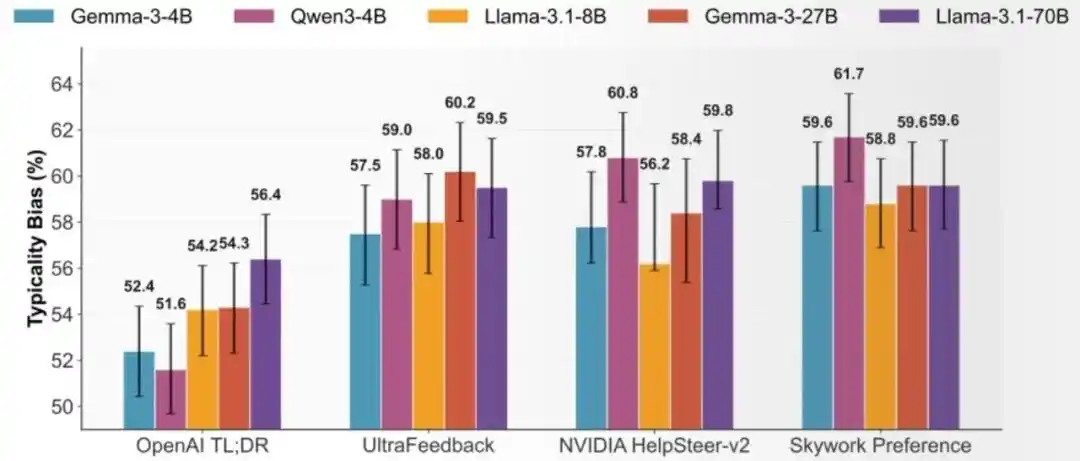
Therefore, even if reward models and optimization algorithms are perfected, as long as the human preference data used for training inherently contains prototypical bias, post-alignment models will still suffer from mode collapse.

The authors tested this repeatedly on five preference datasets and different base models, and the conclusion remained consistent.

After realizing this, the authors argue that since the problem is rooted in the training data, one only needs to consider designing a prompt-based correction scheme during the inference stage. That is, by making the model output the complete probability distribution in the prompt, the model's inherent diverse output distribution from the pre-training phase can be awakened, restoring diversity.

The rest involved running experiments with this method in various scenarios. The results show that in creative writing tasks, diversity was 1.6~2.1 times that of ordinary prompts, without reducing factual accuracy or compromising model safety.

Furthermore, the stronger the model's capabilities and the larger the parameter count, the more pronounced the diversity improvement brought by VS.
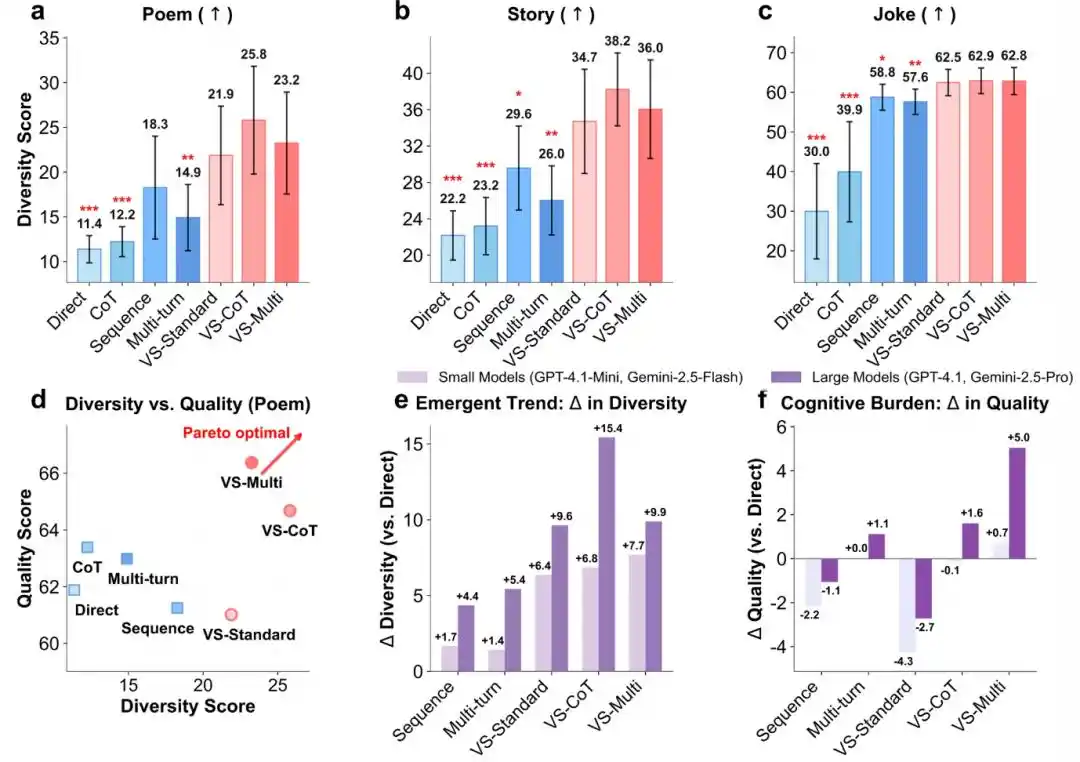
So, while the final method presented in the paper is simple, ICML still passed it.

Reddit Users in a Heated Debate

Under the original post, however, opinions on this paper are polarized.

Many netizens expressed that in the past, ICML featured hardcore innovations like new models, new algorithms, and new theories. Merely optimizing prompts or inference processes doesn't qualify as serious machine learning research.

In comparison, the innovation of this work seems somewhat thin, and several issues exist:

First, similar instruction-writing methods are not unique; some even claimed they were writing prompts like this just yesterday. Second, the theory is difficult to verify because prompts might fail when models are changed, unlike algorithms which are more stable. Third, the experimental scale is limited, insufficient to prove this is a universal law.
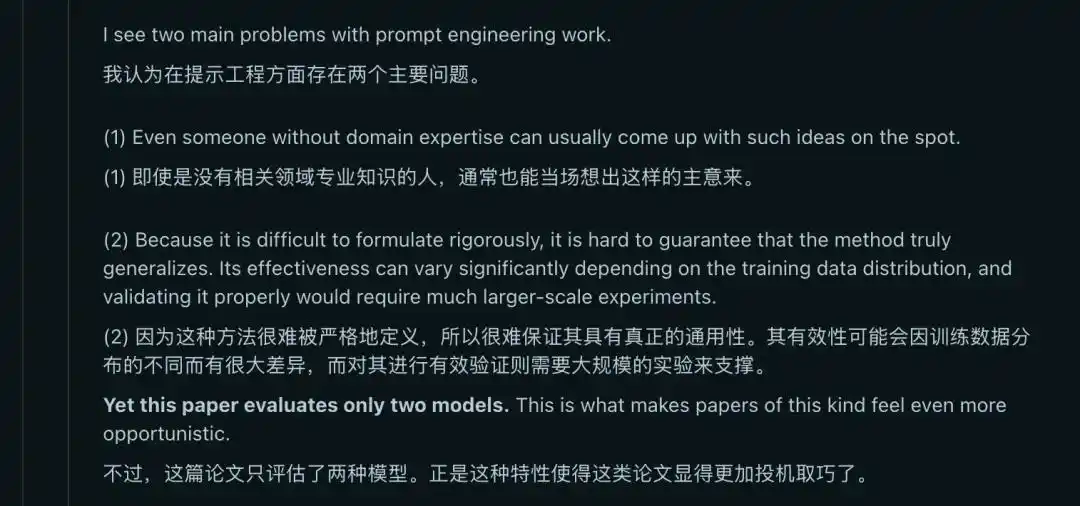
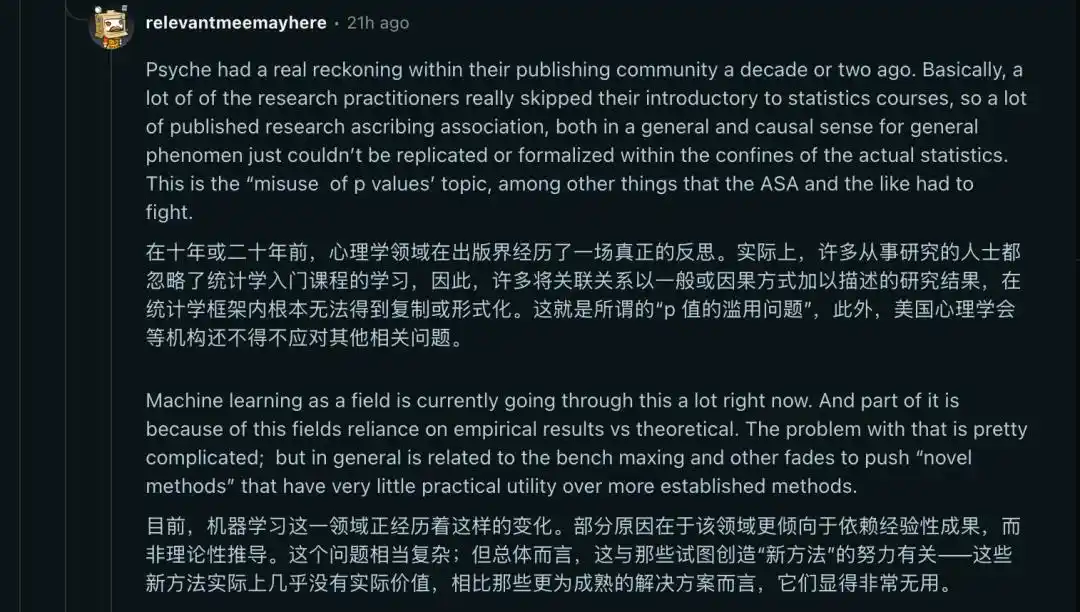
Some netizens directly compared the current state of the machine learning field to the academic crisis in psychology over a decade ago.

Back then, many researchers had weak statistical foundations and misused statistical tools, leading to many papers with unreproducible conclusions and a severe trust crisis in the field. Similarly, the machine learning industry now heavily relies on empirical experiments and undervalues rigorous theoretical support.

The industry is internally competitive, chasing new methods, but there's a widespread atmosphere of excessive hyperparameter tuning and benchmark score chasing. Many so-called innovative algorithms offer little practical value compared to mature baseline models, being packaged as innovative achievements based on tiny metric improvements.

Essentially, these are issues in paper publishing caused by unclear professional standards following the rapid expansion of the discipline.
But supporters argue that scientific research is not about whose method is more complex. As long as the hypothesis is clear, experiments are sufficient, and results are stable and reproducible, it can still be excellent research.

For example, this paper thoroughly explains what mode collapse is and proposes that the real problem lies in prototypical bias—a viewpoint more important than the prompt itself.
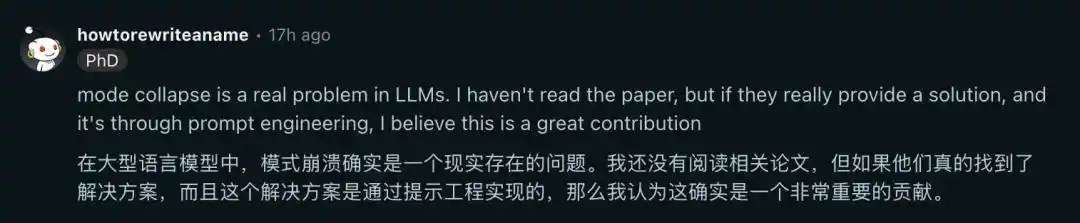
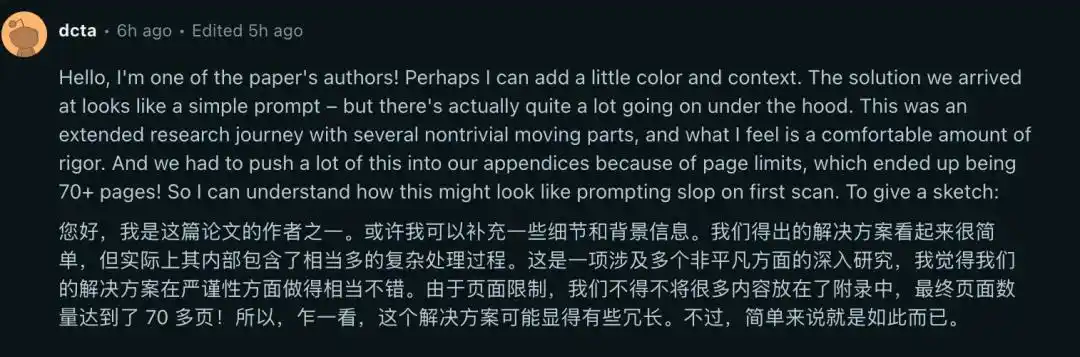
One of the authors also replied in the comments, stating that while the paper appears simple, it actually involves a great deal of complex processing.

The entire work includes complete problem tracing, new theoretical attribution, mathematical derivation, and multi-dimensional quantitative experiments—it's not a shallow, trivial prompt-tuning effort.
Many also mentioned Chain-of-Thought (CoT). When CoT first appeared, it was essentially a one-line prompt:

Let’s think step by step.

But now, almost all reasoning methods can be traced back to CoT. This precisely indicates that prompt engineering is no longer just about writing prompts; it is becoming a new method for studying model behavior.

Over the past decade, machine learning research has almost revolved around training. But now, some usage techniques during the inference stage are gradually moving toward the core of machine learning research.

Perhaps in the coming years, we will see more and more papers like this. They don't add a single line of training code or an extra model parameter, yet they can still change the capability boundaries of large models.

Research Team Introduction

Finally, let's take a look at the research team.

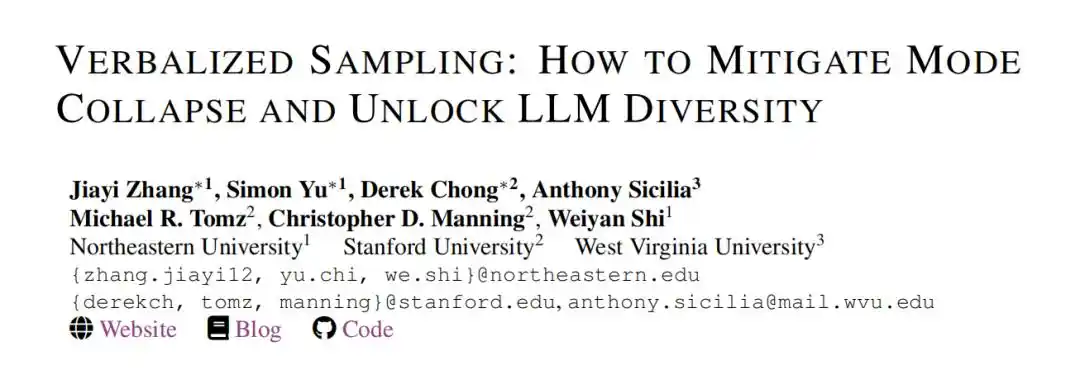
This work was completed by Weiyan Shi's team at Northeastern University (USA) in collaboration with Stanford's Manning Lab and West Virginia University. Jiayi Zhang, Simon Yu, and Derek Chong are listed as co-first authors.

Jiayi Zhang completed her undergraduate studies at the University of Michigan, earning triple bachelor's degrees in Computer Science, Mathematics, and Linguistics. She then pursued a Master's in Computer Science at Northeastern University (USA).

Another paper of hers, "Analyzing the Role of Semantic Representations in the Era of Large Language Models," accepted by the NLP top conference NAACL 2024, also revolves around semantic representation and large models.

Simon Yu is currently pursuing a Ph.D. at Northeastern University (USA), with his main research direction focusing on alignment and reinforcement learning mechanisms in large models. He completed both his bachelor's and master's degrees at the University of Edinburgh and has published several top conference papers.

Besides this paper, another one of his papers, "Unsafer in Many Turns: Benchmarking and Defending Multi-Turn Safety Risks in Tool-Using Agents," was also accepted by ICML 2026.

Derek Chong earned his Master's from Stanford University and is currently a researcher at the Stanford Artificial Intelligence Laboratory. His research primarily focuses on large language models in NLP.

He previously had three years of experience as a founder-entrepreneur and worked at Ello as an Applied Scientist, participating in industry-end AI implementation R&D. He possesses both solid theoretical research skills and rich hands-on practical experience.

References:[1]https://www.reddit.com/r/MachineLearning/comments/1uv1xb3/promptengineering_paper_accepted_to_icml_r/

[2]https://www.linkedin.com/in/jiayizx/[3]https://simonucl.github.io/[4]https://www.linkedin.com/in/derekch/

This article is from the WeChat public account "Qubit" (量子位), author: Focus on Frontier Technology


Criptos en tendencia

Preguntas relacionadas

QWhat is the main contribution of the 'Verbalized Sampling' paper accepted at ICML 2026?

AThe main contribution is a method called 'Verbalized Sampling' (VS), which involves adjusting prompts to ask language models to output their sampling process (e.g., assign probabilities to multiple generated answers). This simple intervention significantly increases the diversity of LLM outputs and mitigates the 'mode collapse' problem without requiring model retraining or new algorithms.

QAccording to the paper, what is identified as the root cause of the mode collapse problem in LLMs?

AThe paper identifies the root cause as 'typicality bias' in the human preference data used for training. This cognitive bias leads human annotators to consistently favor familiar, fluent, and conventional text. Consequently, the reward models trained on this data steer aligned models towards safe, high-probability answers, causing mode collapse.

QWhat are some of the key criticisms from Reddit users regarding this paper's acceptance at ICML?

ACritics argue that the innovation is thin, noting similar prompt techniques are already in use and questioning the method's stability across different models. They also contend that the experimental scale is insufficient to prove a universal law and express concern that the field is drifting towards an over-reliance on empirical results and 'benchmark hacking' rather than rigorous theoretical contributions.

QHow do the paper's supporters defend its value and acceptance at a top-tier conference?

ASupporters argue that good research is defined by clear hypotheses, rigorous experimentation, and reproducible results, not just complexity. They highlight that the paper's core contribution is the novel theoretical insight into the cause of mode collapse (typicality bias). They also compare it to foundational techniques like Chain-of-Thought, suggesting prompt engineering is evolving into a legitimate method for studying model behavior.

QWhat was the observed impact of the Verbalized Sampling method on creative writing tasks?

AIn creative writing tasks, the Verbalized Sampling method increased output diversity by 1.6 to 2.1 times compared to standard prompting, without compromising factual accuracy or model safety. The effectiveness of the method was also shown to be more pronounced in larger, more capable models.

Lecturas Relacionadas

From Being Ignored to the Venture Capital Queen Investing: Has AI Revived This Ultra-Niche Sector?

From obscurity to receiving investment from the "queen of venture capital," AI has revitalized the ultra-niche social networking track. In recent years, the social networking sector experienced a deep freeze in venture capital, with high-profile projects like the video social app "Huayin" (founded by a former WeChat core team member) and the offline-online dating app "Single's Tavern" ultimately failing. These failures underscored the immense difficulty of challenging WeChat's dominance in熟人社交 (close-contact social networking) and the general lack of scalable monetization paths for niche concepts like metaverse, female-only, or Muslim community apps. However, a shift emerged in 2025. "Liangpei," an AI-powered matchmaking company, secured a $2 million angel round from Today Capital, led by renowned investor Xu Xin. Its approach uses AI conversational profiling to create detailed user matches and charges only upon successful connections. Similarly, projects like "Pixel Rhythm" (reportedly focused on AI-assisted content creation for Gen Z overseas) and "Moobius" (AI-native group chat) signal a new trend. The investment logic has fundamentally changed. Instead of pursuing broad, traffic-driven "platform dreams" to compete with giants like WeChat, Douyin, or Soul, the new wave focuses on using AI as a tool to solve specific, high-pain-point problems for targeted, niche user segments. The path to viability now lies in achieving healthy cash flow by solving a concrete problem rather than chasing massive scale.

marsbitHace 18 min(s)

From Being Ignored to the Venture Capital Queen Investing: Has AI Revived This Ultra-Niche Sector?

marsbitHace 18 min(s)

From TrueFi to Elara: Why the Next Stop for On-Chain Finance is Liquidity Infrastructure?

From TrueFi to Elara: Why On-Chain Finance's Next Stage is Liquidity Infrastructure? The article analyzes the evolving focus in decentralized finance, shifting from narrative-driven expansion to robust, operationally sound infrastructure. The author, drawing from experience at TrueFi and building Elara, argues that early DeFi incorrectly assumed technological superiority alone would force adoption. Instead, financial systems evolve through workflow compatibility. Traditional finance prioritizes stability and predictability, creating intentional "viscosity" (friction) through controls, which slows execution but ensures durability. Crypto-native systems minimized friction for rapid experimentation and iteration but often lacked operational safeguards, leading to reflexive liquidity that can disintegrate under stress. The core insight is that sustainable on-chain finance cannot rely solely on isolated products like RWA lending or token incentives. The real opportunity lies in a coordinated financial architecture for liquidity management, collateral coordination, and capital deployment. Elara is presented as an example of this next-generation "programmable treasury infrastructure"—a yield-bearing, dollar-pegged collateral asset designed for capital efficiency and operational flexibility within fragmented digital markets. A key architectural decision separates liquidity from yield generation, allowing the collateral to remain liquid and programmable while accruing value. The funding environment has also shifted. Investors now prioritize operational proof—working systems, integrations, and controls—over visionary narratives. Competitive advantage comes from building systems that endure under real market conditions, not just launching quickly. Ultimately, the path forward is not a sudden replacement of traditional finance but a selective hybridization. Lasting infrastructure will combine the iterative speed of digital assets with the control architecture of traditional finance. Systems like Elara are built to operate efficiently in today's low-viscosity crypto markets while embedding the operational discipline—compliance, reporting, risk management—required to eventually support institutional capital as it gradually integrates with on-chain settlement rails. The focus is not on who launches first, but on who can build infrastructure capable of managing both high-speed digital-native liquidity and the slower, more deliberate flow of institutional capital.

marsbitHace 28 min(s)

From TrueFi to Elara: Why the Next Stop for On-Chain Finance is Liquidity Infrastructure?

marsbitHace 28 min(s)

Understanding the Q2 Crypto Market in 5 Charts: RWA Explosion, Fundamentals Continue to Recover

Summary of Q2 Crypto Market: RWA Boom and Continued Fundamental Recovery The second quarter of 2026 presented a mixed picture for the crypto market. While major crypto asset prices declined by 36% in H1 2026, the fundamentals of the industry showed significant strength. Key highlights from Bitwise's market review include: 1. **Divergence Between Crypto Stocks and Tokens:** Crypto-related public equities, tracked by the Bitwise Crypto Innovators 30 Index, rose 23% in H1, outperforming most major asset classes. This signals robust investment opportunities within the crypto ecosystem, such as Bitcoin miners benefiting from AI and traditional finance firms deepening crypto integration, even during a bear market for tokens. 2. **Substantial Crypto Application Revenue:** Leading decentralized applications generated a combined $5.9 billion in revenue over the past 12 months, with top protocols like PancakeSwap, Hyperliquid, and Aave each nearing $1 billion. This demonstrates the existence of real, revenue-generating businesses within the sector. 3. **Breakout Growth in Real-World Asset (RWA) Tokenization:** The total value of tokenized real-world assets reached a record $33 billion in Q2, up 12% quarterly and 45% year-to-date. Growth is driven by tokenized U.S. Treasuries, corporate credit, equities, and venture capital shares, indicating accelerating institutional adoption. 4. **Expanding Prediction Markets:** Prediction market open interest hit a new high of $1.8 billion in Q2, with sports being a key category. Quarterly trading volume also reached a record $43 billion. Platforms like Polymarket represent a form of mainstream, albeit often unaware, adoption of crypto infrastructure for event betting, with further growth expected around the U.S. midterm elections. 5. **Attractive Profile of Crypto Equities:** The Bitwise Crypto Innovators 30 Index exhibited low 90-day rolling correlations with most major assets (developed market stocks, EM stocks, REITs, bonds, gold) and negative correlation with commodities. This combination of high returns and portfolio diversification is highly attractive to institutional investors. In conclusion, despite weak token prices, core industry fundamentals—including user activity, business revenues, and institutional adoption—continue to advance, building a strong foundation for the next market cycle.

Foresight NewsHace 57 min(s)

Understanding the Q2 Crypto Market in 5 Charts: RWA Explosion, Fundamentals Continue to Recover

Foresight NewsHace 57 min(s)

GPT-5.6 Cracks a 50-Year-Old Math Problem in 1 Hour, 64 AIs Claim the Crown Jewel of Graph Theory

OpenAI announced that its AI model, GPT-5.6 Sol Ultra, has successfully proved the 50-year-old Cycle Double Cover (CDC) conjecture in graph theory in under an hour. This long-standing problem, posed independently by several prominent mathematicians, states that every bridgeless finite undirected graph contains a set of cycles where each edge is covered exactly twice. The breakthrough was achieved using a novel "parallel test-time computation" (TTC) approach. Instead of a single AI working sequentially, the system deployed 64 concurrent AI agents, each exploring distinct proof strategies—from algebraic perspectives to structural induction. The process included strict protocols to avoid common research pitfalls: initial exploration of fundamentally different paths, preventing herd mentality by not revealing the most promising direction, and employing a "critic squad" of agents to rigorously attack and verify every proposed proof step. The system forbade vague assertions, demanding concrete lemmas and constructions. The resulting proof, generated by GPT-5.6 and formatted with Codex, employed a sophisticated multi-step strategy. It first reduced the general case to cubic graphs, then leveraged Tutte's group-flow theorem to establish the existence of a nowhere-zero 8-flow on the graph. A key inventive step was introducing a "two-element set" labeling scheme (Lemma 2.1), which, if satisfied, guarantees a cycle double cover. The AI then transformed this combinatorial condition into a large system of linear equations (Lemma 2.2), using linear algebra over finite fields to conclusively demonstrate that a solution always exists. Researchers highlighted that parallel TTC dramatically compressed the reasoning time, making deep, extended AI problem-solving practically feasible. While some observers marveled at the implications for mathematics and science, others questioned whether parallel breadth can fully substitute for deep, continuous logical chains. Nonetheless, this achievement marks a significant advance in AI's autonomous capacity for high-level abstract reasoning and complex proof generation.

marsbitHace 1 hora(s)

GPT-5.6 Cracks a 50-Year-Old Math Problem in 1 Hour, 64 AIs Claim the Crown Jewel of Graph Theory

marsbitHace 1 hora(s)

Trading

Spot

Artículos destacados

Qué es G$

Entendiendo GoodDollar ($G$): Un Plano para Ingresos Básicos Universales Descentralizados Introducción En el panorama en constante evolución de las criptomonedas y la tecnología blockchain, las iniciativas que buscan abordar problemas sociales apremiantes han ganado una atención creciente. Uno de estos proyectos es GoodDollar ($G$), una solución de ingreso básico universal (UBI) basada en Web3. GoodDollar se esfuerza por abordar la desigualdad y cerrar la brecha de riqueza al crear y distribuir recursos económicos accesibles a aquellos que más los necesitan. A través de su innovador uso de las finanzas descentralizadas (DeFi), GoodDollar presenta un modelo único que podría reformar la forma en que se percibe y se entrega la asistencia financiera a nivel global. ¿Qué es GoodDollar ($G$)? GoodDollar es un protocolo de criptomonedas que facilita la emisión y distribución de tokens digitales, conocidos como $G$, a sus usuarios registrados a diario. Estos tokens funcionan como una forma de ingreso básico universal, promoviendo el empoderamiento financiero para individuos de diversos trasfondos, especialmente aquellos tradicionalmente excluidos del sistema financiero. Operando en la blockchain, GoodDollar utiliza múltiples cadenas, incluyendo Ethereum, Celo y Fuse, asegurando un acceso y una usabilidad amplios. El objetivo fundamental de GoodDollar es hacer que la criptomoneda sea accesible y beneficiosa para todos, independientemente de su punto de partida económico. El Creador de GoodDollar ($G$) Los detalles sobre el creador de GoodDollar permanecen algo oscuros. Sin embargo, se destaca notablemente que el proyecto cuenta con un fuerte respaldo de eToro, una plataforma de inversión ampliamente reconocida que proporcionó la financiación inicial y el apoyo fundamental para el desarrollo de GoodDollar. La visión detrás del proyecto no se basa únicamente en el lucro, sino que se inclina fuertemente hacia el emprendimiento social, buscando un cambio sistémico en la accesibilidad económica. Inversores de GoodDollar ($G$) GoodDollar disfruta del respaldo financiero y apoyo operativo de eToro. Esta asociación ha jugado un papel significativo en el lanzamiento del protocolo y sus desarrollos posteriores. Si bien eToro fue fundamental en el establecimiento de la base del proyecto, GoodDollar visualiza una transición hacia un modelo financiado por su comunidad a largo plazo. Este cambio hacia la financiación comunitaria está en línea con el compromiso de GoodDollar con la descentralización, permitiendo que sus usuarios tengan una participación directa en el futuro del proyecto. ¿Cómo Funciona GoodDollar ($G$)? El marco operativo de GoodDollar se basa en gran medida en los principios de DeFi para generar interés a partir de criptomonedas en staking. Este mecanismo permite al proyecto acuñar y distribuir tokens $G$ como un ingreso básico digital para usuarios en todo el mundo. Varios características clave contribuyen a la unicidad e innovación de GoodDollar: Ingreso Básico Universal (UBI): Cada día, los usuarios registrados reciben tokens gratuitos, estableciendo un flujo de ingresos automático destinado a aliviar las presiones financieras. Modelo Económico Sostenible: La tokenómica del proyecto busca equilibrar la oferta y la demanda de tokens $G$, asegurando que el valor permanezca estable a lo largo del tiempo. Tokens Respaladados por Reservas: Cada token $G$ está respaldado por una reserva de criptomonedas, proporcionándole un valor inherente y confiabilidad, un aspecto crucial para mantener la confianza de los usuarios. Gobernanza Descentralizada: GoodDollar incorpora un enfoque democrático para la toma de decisiones a través de una gobernanza descentralizada impulsada por tokens. Esto permite que los miembros de la comunidad participen activamente en la conformación de la trayectoria del proyecto, haciéndolo verdaderamente impulsado por la comunidad. Accesibilidad Global: GoodDollar ha establecido una considerable huella comunitaria, contando con más de 640,000 miembros en 181 países. Tal alcance generalizado es instrumental para facilitar UBI a escala global. Línea de Tiempo de GoodDollar ($G$) La evolución de GoodDollar está marcada por varios hitos significativos a lo largo de su historia: 2019: El lanzamiento de la billetera GoodDollar marcó el primer paso en la operacionalización de su visión de entregar UBI a través de criptomonedas. 2020: Tras el exitoso lanzamiento de la billetera, el protocolo GoodDollar se presentó oficialmente. Esto marcó una fase crucial en su misión de proporcionar ingresos distribuidos diariamente. 2021: El proyecto avanzó aún más con la introducción de su Organización Autónoma Descentralizada (DAO), fomentando un mayor nivel de participación y gobernanza comunitaria. 2022: GoodDollar presentó su versión 2 (V2) amigable con DeFi, esforzándose por una mayor participación del usuario y eficiencia operativa. El mismo año también se vio el cambio a una estructura de gobernanza descentralizada a través de GoodDAO. 2022: Se conceptualizó una nueva hoja de ruta, enfocándose en iniciativas como un programa de subvenciones diseñado para promover emprendimientos relacionados con $G$ y un Mercado GoodDollar mejorado. Características Clave de GoodDollar ($G$) El proyecto GoodDollar introduce numerosas características críticas destinadas a redefinir el panorama del ingreso básico: Ingreso Básico Universal: Entregar tokens gratuitos diarios a sus usuarios resalta fundamentalmente su misión de eliminar la precariedad económica. Operación Multi-Cadena: Aprovechar múltiples redes de blockchain mejora la accesibilidad y escalabilidad, asegurando una participación más amplia. Compromiso con las Finanzas Descentralizadas: El uso de DeFi permite la financiación sostenible del modelo UBI, reforzando su viabilidad como solución económica. Compromiso y Gobernanza Comunitaria: GoodDollar visualiza un modelo en el que la comunidad influencia las operaciones a través de la participación democrática, fomentando la transparencia y la rendición de cuentas. Comunidad Global: Contar con una comunidad global diversa permite al proyecto implementar soluciones UBI adaptadas a diversos contextos culturales y económicos. Conclusión GoodDollar representa un salto transformador hacia la incorporación de los principios de ingreso básico universal a través del innovador lente de la tecnología blockchain. Al aprovechar las finanzas descentralizadas, el proyecto no solo proporciona una solución a la desigualdad financiera sino que también involucra activamente a los usuarios en su gobernanza y operaciones. Con una comunidad en crecimiento y una hoja de ruta en evolución, GoodDollar se posiciona como un actor significativo en la intersección de las criptomonedas y el bien social, allanando el camino hacia un futuro financiero más equitativo. A medida que continúa evolucionando, el viaje de GoodDollar podría, en última instancia, inspirar otras iniciativas a considerar modelos similares, promoviendo así la causa del empoderamiento económico para todos.

137 Vistas totalesPublicado en 2024.04.05Actualizado en 2024.12.03

Qué es G$

Cómo comprar G

¡Bienvenido a HTX.com! Hemos hecho que comprar Gravity (G) sea simple y conveniente. Sigue nuestra guía paso a paso para iniciar tu viaje de criptos.Paso 1: crea tu cuenta HTXUtiliza tu correo electrónico o número de teléfono para registrarte y obtener una cuenta gratuita en HTX. Experimenta un proceso de registro sin complicaciones y desbloquea todas las funciones.Obtener mi cuentaPaso 2: ve a Comprar cripto y elige tu método de pagoTarjeta de crédito/débito: usa tu Visa o Mastercard para comprar Gravity (G) al instante.Saldo: utiliza fondos del saldo de tu cuenta HTX para tradear sin problemas.Terceros: hemos agregado métodos de pago populares como Google Pay y Apple Pay para mejorar la comodidad.P2P: tradear directamente con otros usuarios en HTX.Over-the-Counter (OTC): ofrecemos servicios personalizados y tipos de cambio competitivos para los traders.Paso 3: guarda tu Gravity (G)Después de comprar tu Gravity (G), guárdalo en tu cuenta HTX. Alternativamente, puedes enviarlo a otro lugar mediante transferencia blockchain o utilizarlo para tradear otras criptomonedas.Paso 4: tradear Gravity (G)Tradear fácilmente con Gravity (G) en HTX's mercado spot. Simplemente accede a tu cuenta, selecciona tu par de trading, ejecuta tus trades y monitorea en tiempo real. Ofrecemos una experiencia fácil de usar tanto para principiantes como para traders experimentados.

161 Vistas totalesPublicado en 2024.12.10Actualizado en 2026.06.02

Cómo comprar G

Qué es @G

Graphite Network, $@G: Conectando TradFi y Web3 Introducción a Graphite Network, $@G En el vibrante mundo de las criptomonedas y los proyectos web3, Graphite Network emerge como un faro de innovación. Con su token nativo, $@G, esta blockchain de Capa-1, Prueba de Autoridad (PoA) está diseñada para cerrar la brecha entre las finanzas tradicionales (TradFi) y el ecosistema Web3 en rápida evolución. A medida que las monedas digitales ganan tracción, Graphite Network se esfuerza por ofrecer una plataforma blockchain que prioriza la seguridad, el cumplimiento y la velocidad, presentándose como un facilitador de confianza y responsabilidad. ¿Qué es Graphite Network, $@G? Graphite Network no es simplemente otro proyecto de blockchain; busca redefinir cómo se perciben la descentralización, la seguridad y la responsabilidad del usuario en el ámbito de las finanzas digitales. El proyecto cuenta con una serie de características distintivas: Blockchain Basada en Reputación: En su núcleo, Graphite Network implementa una política de un usuario, una cuenta, reforzada con mecanismos integrados de Conozca a su Cliente (KYC) y verificación de puntuación. Este diseño asegura un equilibrio entre la privacidad del usuario y la transparencia, un aspecto crítico de las operaciones financieras en el mundo digital actual. Ingreso por Nodos de Punto de Entrada: La red incentiva a los usuarios a establecer nodos de punto de entrada, permitiendo a los operadores ganar recompensas de las transacciones de la red. Este modelo de generación de ingresos no solo aumenta el compromiso del usuario, sino que también refuerza la salud y descentralización de la red. Compatibilidad con EVM: Con una máquina virtual (VM) compatible con Ethereum, Graphite Network permite la integración fluida de aplicaciones descentralizadas (dApps) y contratos inteligentes existentes en Solidity, invitando a los desarrolladores a aprovechar sus capacidades sin modificaciones extensas. Integración de KYC: En una era donde el cumplimiento es primordial, el marco KYC integrado con múltiples niveles de verificación mejora el control sobre las operaciones financieras sin participación obligatoria, estableciendo un precedente para la autonomía del usuario. ¿Quién es el Creador de Graphite Network, $@G? Graphite Network nace de los esfuerzos de la Fundación Graphite, una organización sin fines de lucro dedicada al desarrollo, mantenimiento y evolución de Graphite Network. El compromiso de la fundación subraya la visión del proyecto de crear un entorno blockchain seguro y sostenible enfocado en un compromiso genuino del usuario y el cumplimiento. ¿Quiénes son los Inversores de Graphite Network, $@G? Actualmente, hay información limitada disponible sobre los inversores específicos que respaldan la iniciativa Graphite Network. La organización fundadora, la Fundación Graphite, funciona de manera independiente en la promoción del crecimiento del proyecto mientras busca asociaciones que resuenen con su visión de una plataforma blockchain accesible y en cumplimiento. ¿Cómo Funciona Graphite Network, $@G? La operación de Graphite Network se basa en su único mecanismo de consenso de Prueba de Autoridad, que logra un impresionante equilibrio entre un alto rendimiento y la descentralización. Vamos a profundizar en los diversos componentes que definen su operación: Nodos de Transporte: Sirviendo como nodos de punto de entrada, estos son críticos para el ecosistema. Los operadores pueden ganar ingresos de las transacciones que atraviesan la red, lo que no solo empodera a los usuarios individuales, sino que también refuerza la descentralización de la red. Nodos Autorizados: En el corazón de Graphite Network se encuentran los validadores centrales que se someten a rigurosas pruebas de cumplimiento, que abarcan una sólida verificación KYC junto con evaluaciones técnicas. Este nivel de confianza es esencial para garantizar que las transacciones dentro de la red mantengan un alto nivel de integridad. Sistema de Tickers: Graphite Network emplea un sistema de ticker distintivo para sus tokens envueltos, denotados como @G. Esta característica mejora la claridad en la integración de activos, haciendo que las transacciones de los usuarios sean comprensibles y directas. El enfoque innovador de Graphite Network refleja un paso significativo para abordar los problemas cruciales de las finanzas digitales, posicionándose favorablemente para el futuro a medida que más usuarios transicionan de las formas tradicionales de finanzas al mundo de las aplicaciones descentralizadas. Cronología de Graphite Network, $@G Para entender la progresión y los hitos de Graphite Network, es beneficioso revisar los eventos clave en su cronología: 2021: La creación de Graphite Network por la Fundación Graphite marca el inicio de un nuevo capítulo en el desarrollo de blockchain, centrado en el cumplimiento y el empoderamiento del usuario. Desarrollos Clave: Tras su lanzamiento, la introducción de ingresos por nodos de punto de entrada, el establecimiento de un modelo basado en reputación, la verificación KYC integrada y la provisión de compatibilidad con EVM representan avances significativos en el proyecto. Actividades Recientes: Los esfuerzos continuos de desarrollo y cuidado de la Fundación Graphite se han centrado en aumentar las características de la red mientras fomentan el crecimiento del ecosistema, demostrando un compromiso a largo plazo con la sostenibilidad y la innovación. Puntos Clave Adicionales Más allá de sus componentes fundamentales, Graphite Network abarca varias herramientas y características que refuerzan su usabilidad: Graphite Wallet: Una extensión de Chrome fácil de usar que facilita el acceso a diversas características y aplicaciones de la red a través de cadenas compatibles con Ethereum, mejorando la conveniencia del usuario. Graphite Bridge: Esta utilidad permite transferencias sin problemas de activos de Graphite a través de diferentes redes, fomentando un ecosistema integrado e interoperable. Graphite Explorer: Sirviendo como una herramienta esencial dentro del ecosistema, esta característica permite a los usuarios ver y verificar el código fuente de contratos inteligentes, rastrear transacciones y explorar otra información vital en tiempo real. Graphite Testnet: El proyecto proporciona un entorno de pruebas robusto para los desarrolladores, permitiéndoles asegurar la estabilidad y escalabilidad antes del despliegue en la red principal. Esta iniciativa no solo empodera a los desarrolladores, sino que también mejora la confiabilidad de toda la red. Conclusión Graphite Network, con su token nativo $@G, representa un avance significativo hacia la conexión entre las finanzas tradicionales y la tecnología blockchain de vanguardia. Al centrarse en la seguridad, el cumplimiento y la descentralización, esta plataforma innovadora está lista para liderar la transición hacia la era Web3. A medida que el compromiso del usuario crece y más proyectos aprovechan sus capacidades, Graphite Network está preparada para hacer contribuciones duraderas al paisaje digital en rápida evolución. En conclusión, Graphite Network se erige como un testimonio de lo que se puede lograr cuando el pensamiento innovador se encuentra con las crecientes demandas de las finanzas y la tecnología modernas. A medida que el mundo explora el potencial de las finanzas descentralizadas, Graphite Network sin duda seguirá siendo un jugador notable en este ámbito.

26 Vistas totalesPublicado en 2025.01.06Actualizado en 2025.01.06

Qué es @G

Discusiones

Bienvenido a la comunidad de HTX. Aquí puedes mantenerte informado sobre los últimos desarrollos de la plataforma y acceder a análisis profesionales del mercado. A continuación se presentan las opiniones de los usuarios sobre el precio de G (G).

活动图片