Pricing the Death of Iran's Leader: Where Are the Ethical Boundaries of Prediction Markets?

Odaily星球日报Publicado a 2026-03-02Actualizado a 2026-03-02

Resumen

The article discusses the ethical boundaries of prediction markets, triggered by the death of Iran's Supreme Leader Ayatollah Khamenei in a military strike. Prediction markets like Kalshi and Polymarket had active markets on whether Khamenei would leave office. Kalshi’s CEO opposed profiting from death, refunded fees, and settled trades at pre-death prices to prevent incentivizing harm. This sparked debate: some argue such markets could encourage violence, while others claim it undermines market fairness and hedging value. U.S. senators had previously urged regulators to ban death-related contracts, citing risks of incentivizing real-world harm. The controversy highlights the tension between free market principles and social responsibility in prediction markets.

Original | Odaily Planet Daily (@OdailyChina)

Author | Azuma (@azuma_eth)

Iran has become the focus of the world.

On February 28, the United States and Israel jointly launched a large-scale military strike against Iran. About 30 targets within Iran, including the Iranian presidential palace, were attacked. Iran's Supreme Leader Khamenei was confirmed to have died in the attack.

In this attack, prediction markets once again demonstrated their intelligence value distinct from traditional channels. Hours before the airstrike occurred, the probability in related markets around "whether the U.S. military would attack Iran" had significantly increased, and heavy betting by new addresses was also monitored on-chain — in such globally watched public incidents, the fluctuations of prediction markets once again outpaced the reports of mainstream media.

This should have been another moment for prediction markets to declare victory after the 2024 presidential election, but Khamenei's death has plunged the industry into a major discussion about ethical boundaries.

Does Death Count as Stepping Down?

From a micro perspective, the focus of the contradiction lies in the event of "whether Khamenei will step down as Iran's Supreme Leader." As the most watched dynamic in the Iranian situation, leading platforms such as Kalshi and Polymarket had long provided betting options for related events on their platforms. However, the manner (or rather the speed) in which Khamenei ended his rule clearly took people by surprise.

After Khamenei's death was confirmed, Kalshi CEO Tarek Mansour was the first to express opposition to profiting from individual deaths on social media. "We do not list markets that are directly linked to death. When a market might result in death, we design rules to prevent people from profiting from death."

Given that death is now a fait accompli, Kalshi will handle the event related to "Khamenei stepping down as Supreme Leader" as follows:

  1. Refund all handling fees for this market;
  2. The market will be settled based on the last trading price before the confirmation of Khamenei's death. All positions, regardless of when they were opened, will be settled at this price;
  3. If users built positions after Khamenei's death, Kalshi will fully compensate for the price difference cost.
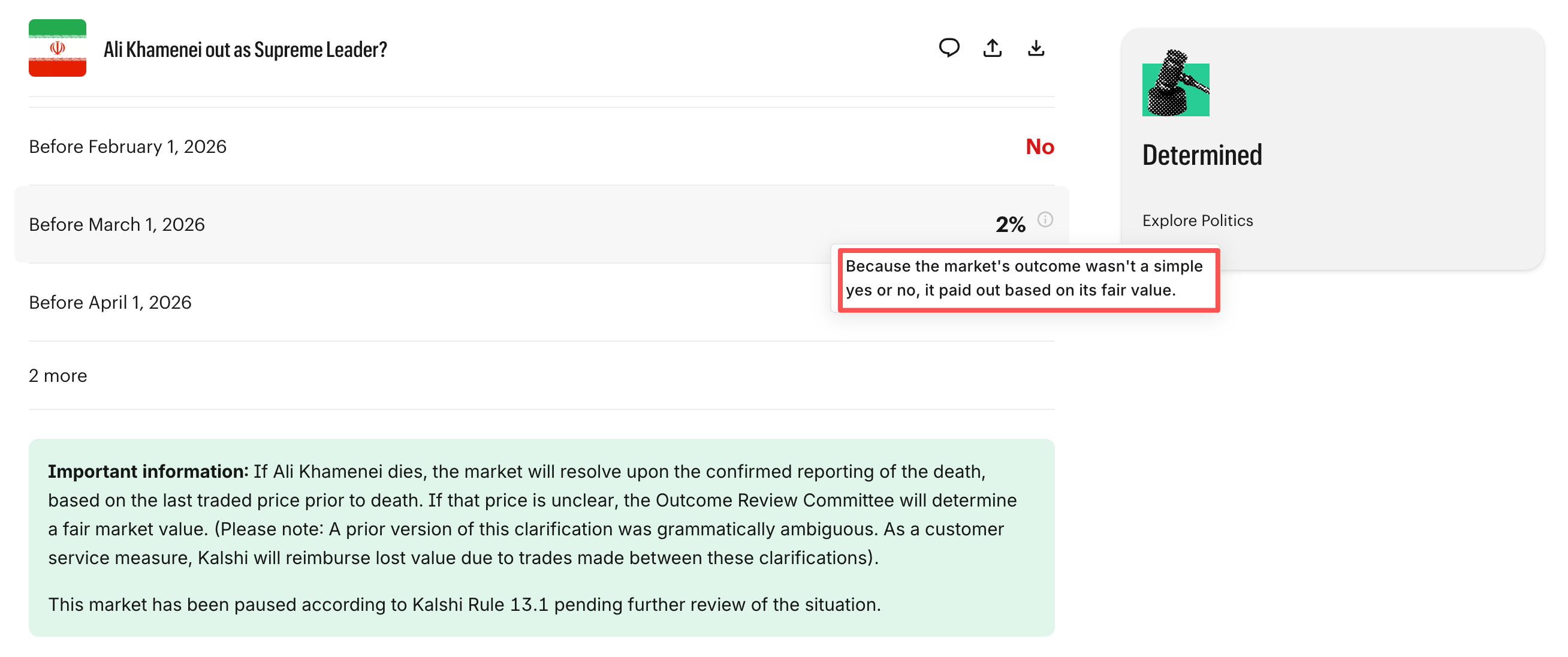
Opening the homepage of the related event on Kalshi shows that the event has been suspended by Kalshi and specially marked. Kalshi also noted that "because the market outcome is not a simple YES or NO, it is settled based on its fair value."

Kalshi's approach has sparked intense discussion in the community.

  • Those supporting Kalshi believe that avoiding events related to "death" aligns with mainstream values and the constraints of regulations on commodity contracts (the regulatory system prediction market events currently fall under). Especially considering that prediction markets have shown a certain reactive force on the real world, if boundaries are not set, over time, betting could indirectly incentivize "physical harm or murder," causing prediction markets to gradually become darknet-like.
  • Those opposing Kalshi believe that this move undermines the original transactional fairness of prediction markets and also damages their hedging value against real-world sudden changes — those who bet YES did not get the expected returns; although Tarek Mansour claimed that "not a single user will lose even $1 in this market," in reality, those who had bet NO and cut losses early cannot receive corresponding compensation.

In contrast, Polymarket has not made any statement on this matter, and the event can still be traded normally. The current price for YES shares for stepping down before March 31 is temporarily quoted at 99.9 cents, and NO at 0.2 cents.
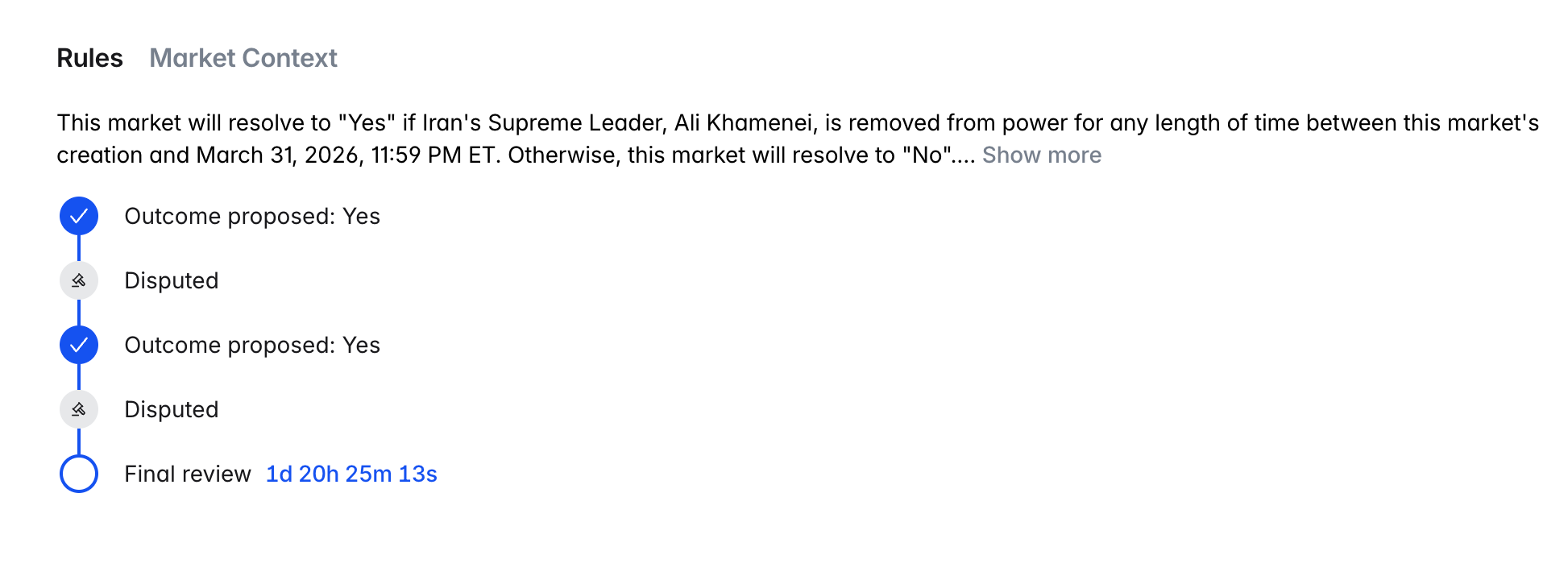
In the judgment rules for this event, Polymarket has stated that "if Khamenei resigns, is detained, or otherwise loses his position or is unable to perform his duties as Supreme Leader of Iran within the time specified by this market, it will be considered removal from office," which seems to cover the unexpected death situation. However, disagreements have still arisen in the settlement process of this event — clearly, there are also divisions within the community.

  • Odaily Note: For details on Polymarket's adjudication mechanism and the handling process in case of disputes, please refer to "Who 'Defines the Facts'? The Truth About Power and the Space for Malice in Polymarket's Adjudication Mechanism."

Calls for Bans from the Regulatory Side

The debate over whether prediction markets should list events related to "individual death" had already been discussed on the regulatory side days before Khamenei's death drew widespread industry attention.

On February 24, just a few days before the end of Khamenei's life, six U.S. Democratic senators, including Adam Schiff, jointly sent a letter to U.S. Commodity Futures Trading Commission (CFTC) Chairman Michael Selig, requesting that the CFTC categorically prohibit any prediction market contracts that use individual death as a settlement condition or are highly related to individual death.

The legal basis cited in the letter is that according to federal commodity regulations, the CFTC has already "categorically prohibited" contracts involving or referring to terrorism, assassination, war, or similar acts.

Adam Schiff and others stated that such events would create incentives for "physical harm or even death," even constituting a "dangerous national security risk" — "These contracts could incentivize real-world harm because they establish economic reward mechanisms for turbulent events or physical injury and encourage actors to influence or bring about these outcomes for personal gain."

The CFTC did not immediately publicly respond to the letter. A few days later, the news of Khamenei's death quickly made headlines in major media outlets, and Kalshi and Polymarket were plunged into a whirlpool of public opinion before regulators had made a clear stance.

Free Market vs. Social Responsibility

Prediction markets offer a new path to glimpse the probability of future events using market mechanisms, but this does not mean prediction markets are necessarily suitable for all events.

From the perspective of the prediction market's own operation, platforms tend to prefer listing events with clearly defined outcomes that are not easily manipulated by single points to avoid陷入条款解释或公平性争议陷入 (falling into disputes over clause interpretation or fairness); 而从外部影响以及监管压力来看,预测市场则需要尽量避开不符合主流价值观的事件 (from the perspective of external influence and regulatory pressure, prediction markets need to try to avoid events that do not conform to mainstream values) — if the setup of the prediction market itself could lead people to disrupt social order or harm others for profit, then it easily faces ethical and legal challenges.

The controversy over whether "death" related events should be banned is essentially a divergence in倾向 (inclination) towards free markets versus social responsibility. Those emphasizing free markets value the unique advantage of prediction markets in pricing future events more and are unwilling to compromise this ability due to any external restrictions; those valuing social responsibility worry that excessive laissez-faire could gradually evolve into a harm to public interest and social stability. This divergence has a universal solution: as friction emerges and deepens, both sides will gradually find a suitable balance point through struggle and concession.

Like every emerging industry, the regulatory details and industry self-discipline of prediction markets will not materialize out of thin air. The future of the industry will be shaped by participants, regulators, and society together. The path is walked by people. Khamenei's death is pushing prediction markets to personally step out the ethical boundaries.


Preguntas relacionadas

QWhat ethical dilemma did the death of Iran's Supreme Leader spark in the prediction market industry?

AThe death of Iran's Supreme Leader sparked a debate about the ethical boundaries of prediction markets, specifically whether events involving an individual's death should be allowed for betting, as it could incentivize real-world harm or assassination.

QHow did Kalshi handle the market regarding the resignation of Iran's Supreme Leader after his death?

AKalshi refunded all fees for the market, settled all positions at the last trading price before the death was confirmed, and compensated users who built positions after the death for the full cost difference.

QWhat was the regulatory action mentioned in the article regarding prediction markets and events related to death?

ASix U.S. Democratic senators sent a joint letter to the CFTC chairman requesting that the CFTC categorically ban any prediction market contracts that use an individual's death as a settlement condition or are highly related to death, citing existing bans on contracts involving terrorism, assassination, or war.

QWhat is the core conflict between the two sides in the debate over prediction markets offering death-related events?

AThe core conflict is between free market principles, which value the predictive power and hedging value of these markets, and social responsibility, which worries that such markets could incentivize physical harm or murder and pose a danger to public safety and national security.

QHow did Polymarket's rules for the 'resignation of Iran's Supreme Leader' event potentially cover the outcome of his death?

APolymarket's rules stated that the event would be considered resolved if the Supreme Leader resigned, was detained, or otherwise lost his position or became unable to perform his duties, which could be interpreted as covering the unexpected outcome.

Lecturas Relacionadas

What's the Connection Between Pinduoduo's Huang Zheng and Blockchain?

This text explores the unexpected connection between Pinduoduo founder Colin Huang and blockchain, as suggested in his article *Turning Capitalism Upside Down*. Huang argues Pinduoduo's core business is about managing "uncertainty." He posits that wealth flows to the rich because they absorb life's uncertainties (e.g., illness, job loss) that devastate the poor, who pay a premium for certainty through insurance or stable prices. Pinduoduo's model attempts a "reverse insurance": by aggregating consumer demand via group-buying and flash sales, it creates a large, predictable order for manufacturers. This certainty allows factories to remove risk premiums, passing savings back as lower prices, thus partially reversing the wealth flow. The key obstacle, Huang notes, is that an individual's buying intent is an unreliable promise. He then asks if blockchain is the natural solution for this "reverse insurance." The text elaborates that blockchain, through smart contracts with binding deposits, could transform casual intent into a costly-to-break, enforceable commitment. This replaces interpersonal trust with coded rules, making promises credible, pricable, and resistant to fraud. Finally, the author draws a parallel to Bitcoin, framing two paths to creating certainty: the "Pinduoduo path" of aggregating decentralized will into scale, and the "Bitcoin path" of locking rules into immutable code. Both sacrifice something—personal freedom or system flexibility—to manufacture trust and predictability.

链捕手Hace 39 min(s)

What's the Connection Between Pinduoduo's Huang Zheng and Blockchain?

链捕手Hace 39 min(s)

The Storage Magnate Who Conquered a Trillion-Dollar Kingdom, Yet Ultimately Could Not Become the Richest

**Summary:** "The Memory Magnate Who Built a Trillion-Dollar Empire, Yet Never Became the Richest" explores the journey of Zhu Yiming, founder of GigaDevice (603986) and co-founder of the soon-to-IPO ChangXin Memory Technologies (CXMT). The article positions GigaDevice, a fabless chip designer now valued at ~¥340 billion, as a prequel to the massive IDM (Integrated Device Manufacturer) venture, CXMT. Starting in 2005 with minimal capital, Zhu strategically "picked up the pieces" by focusing on niche markets like NOR Flash and microcontrollers (MCUs), areas major players were exiting. This allowed GigaDevice to grow into a diversified semiconductor company, maintaining robust profitability even during industry downturns by controlling costs. However, the piece argues that in the highly cyclical and capital-intensive memory chip industry, the fabless model has limits. True resilience and scale require the ability for "counter-cyclical expansion" – investing heavily during downturns – a tactic only possible for IDMs like Samsung or SK Hynix. This insight led Zhu to partner with the Hefei city government in 2016 to establish CXMT, an IDM focused on DRAM. Zhu's symbolic moves, like forfeiting salary and diluting his equity, were crucial in securing the massive state and bank funding needed. CXMT's equipment base is now valued even higher than that of BYD's vast auto manufacturing empire. Despite the potential for CXMT to reach a market cap of ¥1-2 trillion upon its IPO, Zhu's indirect stake in both companies is estimated below 3%, placing his personal wealth far below that of China's top billionaires. The article concludes that his strategic vision built a trillion-yuan memory landscape, but the capital structure necessary to achieve it precluded a personal fortune of similar scale.

marsbitHace 46 min(s)

The Storage Magnate Who Conquered a Trillion-Dollar Kingdom, Yet Ultimately Could Not Become the Richest

marsbitHace 46 min(s)

XRP Ledger Daily Fees Drop Below $400 As Network Activity Question Returns

The XRP Ledger is drawing attention as daily network fees have fallen below $400. While low fees align with XRPL's design for affordable transactions and are often seen as a strength, the metric can also serve as an indicator of network demand and paid transaction volume. This data point of around $3,100 in weekly fee burn highlights the stark contrast with higher-fee chains like Ethereum and Bitcoin. The development fuels an ongoing debate. Proponents view low fees as a sign of efficiency and accessibility, while critics may question if the network is generating sufficient high-value activity relative to its market cap and payments-focused narrative. The article cautions against overstating the finding, noting a single low-fee day does not signify network failure. It instead adds context to discussions about XRPL's usage, especially alongside Ripple's broader initiatives in stablecoins (RLUSD), AI payments, and enterprise infrastructure. The report recommends monitoring for a fee rebound, checking transaction counts for a fuller picture, and confirming the trend via native explorers like Bithomp. It frames the story within a larger market shift where on-chain data, protocol updates, and infrastructure developments are becoming crucial alongside price action. The editorial stance is to present the verified data, explain its significance for assessing network activity, and avoid hype, positioning it as part of the daily crypto conversation.

bitcoinistHace 5 hora(s)

XRP Ledger Daily Fees Drop Below $400 As Network Activity Question Returns

bitcoinistHace 5 hora(s)

Trading

Spot
Futuros
活动图片




