Prediction Markets Plunge into Major Controversy Again: Are You Trading Facts or Rules?

Odaily星球日报Publicado a 2026-04-08Actualizado a 2026-04-08

Resumen

The prediction market sector, particularly in Web3, is facing significant controversy over the interpretation of event outcomes versus predefined rules. Two recent high-profile cases highlight this tension. On Polymarket, a market asking "Will US forces enter Iran by a certain date?" was settled as "Yes" after US special operations troops entered Iranian territory to rescue a downed pilot. While the rules explicitly qualified such operational entries—including humanitarian missions—as valid, many users argued that a limited, rescue-focused operation should not be considered an "invasion," contradicting common understanding. On Predict.fun, a market asking if Polymarket would "launch a token" was triggered when the platform introduced a native stablecoin, Polymarket USD, pegged 1:1 to USDC. The rules defined "token" broadly as any fungible asset, but critics argued that issuing a stablecoin—a collateralized utility token—should not count as a "token launch," which is typically associated with governance or equity tokens. This raised questions about whether the outcome reflected market expectations about valuation (FDV) or merely technical rule compliance. The core issue is whether participants are betting on real-world events or narrowly defined rules. These cases show that even high-probability markets can become "lose-everything" scenarios if rule nuances are overlooked. Understanding the rules—including definitions, exceptions, and interpretation boundaries—is crucial, a...

Original | Odaily Planet Daily (@OdailyChina)

Author | Asher (@Asher_ 0210)

Prediction markets are arguably the hottest topic in Web3 right now.

Trading on predictions surrounding macroeconomic events, the crypto industry, and even entertainment topics continues to heat up, with discussion fervor and participation numbers constantly rising. However, as the market develops rapidly, some discordant voices have gradually emerged—some events, upon settlement, deviate from user expectations based on common sense or "real-world understanding," sparking controversies about rule design, fairness, and even platform credibility.

Recently, two highly controversial events occurred in quick succession within prediction markets. Below, Odaily Planet Daily will summarize and discuss them.

Polymarket: US Rescue of Downed Pilot in Iran Judged as US Invasion of Iran

On April 3rd, a US F-15E Strike Eagle fighter jet was shot down by Iranian air defense systems in southwestern Iran. The two crew members (one pilot, one Weapon Systems Officer/WSO) ejected; one was quickly rescued, while the other was missing for several days, hiding in the Iranian mountains.

  • The US military subsequently launched a Search and Rescue (SAR) operation involving armed aircraft, helicopters, etc., ultimately rescuing the second, severely injured crew member (Trump personally announced "WE GOT HIM").
  • The rescue operation involved US forces entering Iranian territory (mountain search and rescue, possible ground or low-altitude operations), which drew attention given the current sensitive geopolitical conflict backdrop.

Since the US military entering Iranian territory could, in a way, be considered a US invasion of Iran, it directly affected the prediction event on the Polymarket platform regarding when US forces would enter Iran (US forces enter Iran by?).
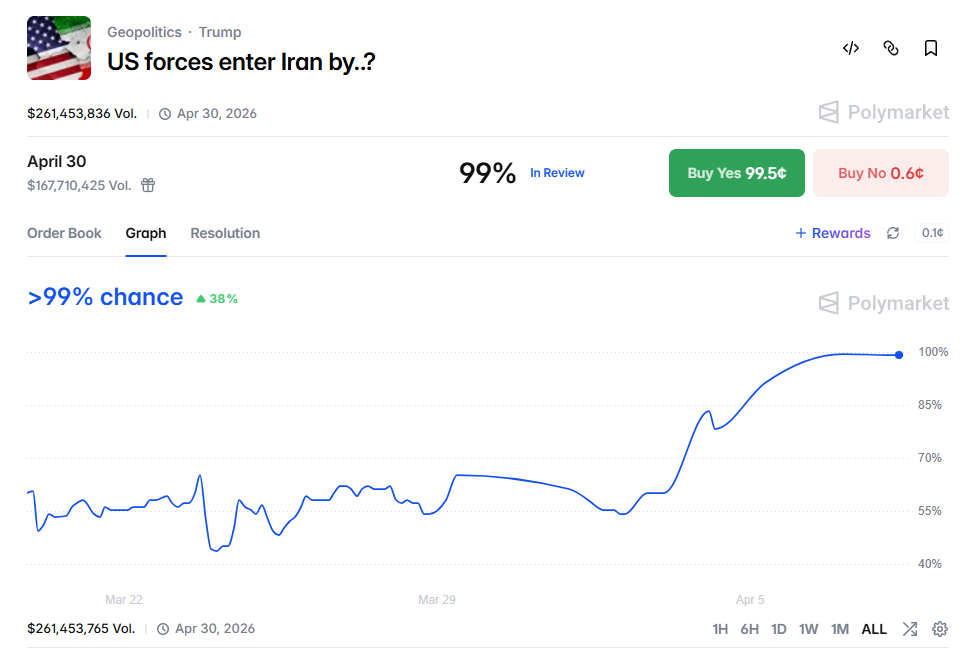
According to the settlement rules, active US military personnel (including special operations forces) entering Iranian land territory before the specified date counts as an invasion. Downed pilots do not count as invasion, but the special forces sent by the US military did indeed enter Iranian territory to rescue the pilot. Therefore, the special forces entering Iran for the rescue mission met the criteria for a Yes判定 on the US invasion of Iran.
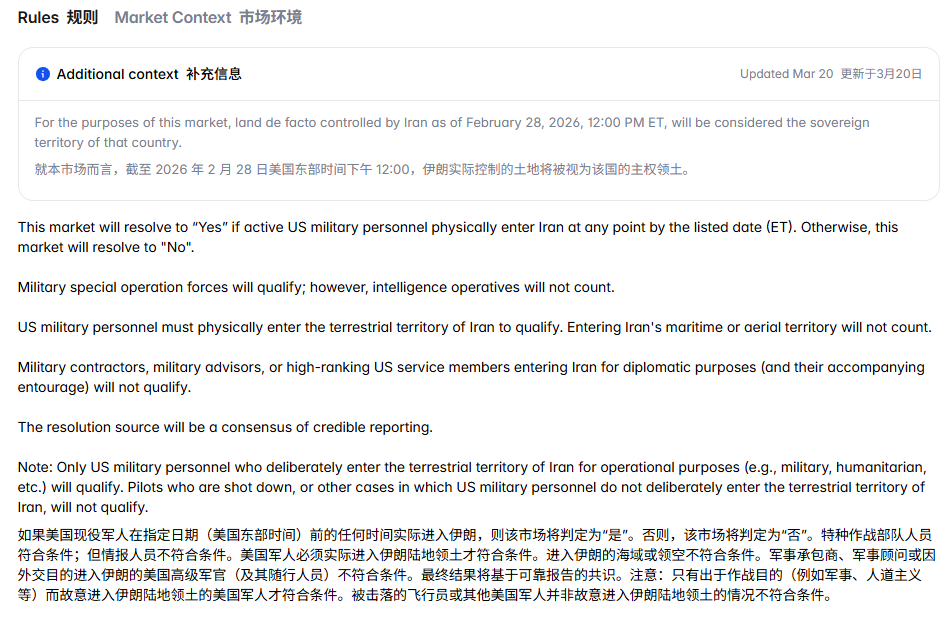
Polymarket's判定 of the "pilot rescue" event as a US invasion of Iran has sparked strong community controversy.

Those supporting "counts as entry" (Yes side) argue that this operation符合 the definition of "entry" in the rules. The US special forces deliberately entered Iranian territory to execute a mission, and the rules explicitly state "special operation forces will qualify", also covering "for operational purposes (including humanitarian)". Objectively, this is the first confirmed ground infiltration by US forces in the current conflict context; US personnel did set foot on Iranian soil, so it should be considered "entry".

Those opposing "counts as entry" (No side) believe this definition is an overextension. The action was essentially a short-term, limited-scale humanitarian rescue, not a combat invasion (invasion), nor did it have an intent to occupy,不符合 the public's common-sense understanding of "US forces entering Iran". Furthermore, the rules explicitly exclude "pilots who are shot down... will not qualify", and this operation was precisely centered around a downed pilot, possessing a "forced entry" nature, logically falling under a similar exception. Referencing past cases (e.g., similar regional actions not deemed invasions), rescue operations should not be equated with military entry;判定 it as Yes might encourage marginal interpretations of the rules, weakening the market's seriousness and consistency. The Chinese community also普遍 believes "entering Iran" should refer more to large-scale ground or amphibious warfare, not a short-term "rescue and leave" operation.

Predict.fun: Polymarket Issuing Stablecoin Judged as Token Launch

On the evening of April 6th, Polymarket官方 announced on X a comprehensive exchange upgrade:

  • Rebuilding the trading engine, upgrading smart contracts;
  • Launching a new native collateral token, Polymarket USD (1:1 pegged to USDC, intended to replace USDC.e and reduce bridging risks).

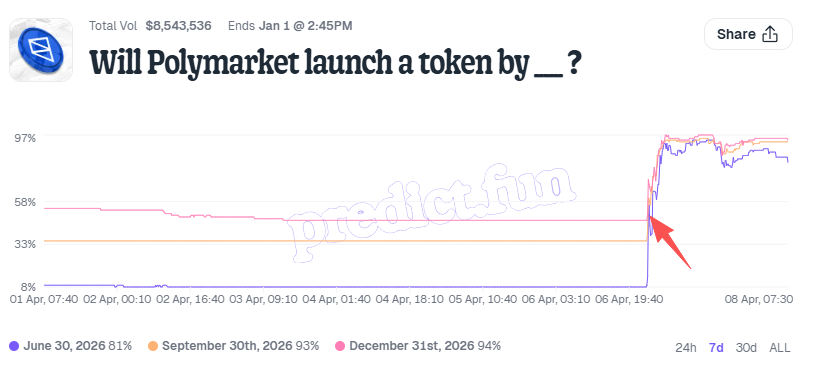
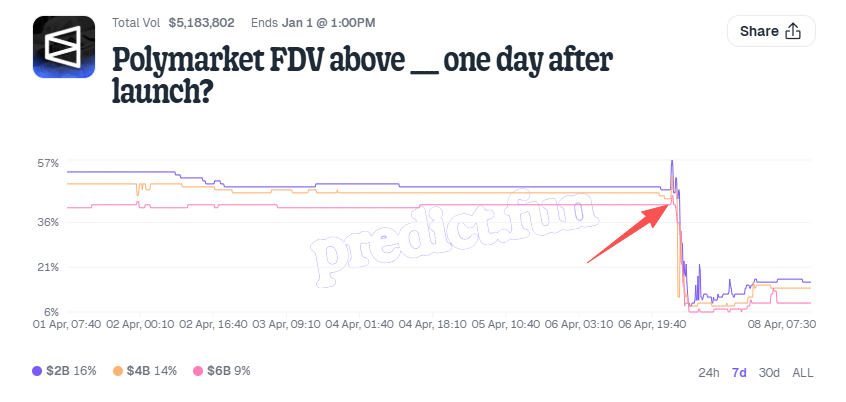
The second point, mentioning the launch of the native collateral token Polymarket USD, directly affected the probability of two related prediction events on the Predict.fun platform: one关于 token launch; the other about post-launch market cap:

1. When will Polymarket launch a token? (Will Polymarket launch a token by ___?)
2. Polymarket's FDV one day after launch (Polymarket FDV above ___ one day after launch?);
According to the settlement rules document, it clearly states that "Any fungible token issued by Polymarket counts as a 'token launch' for this event", and stablecoins are certainly no exception. Therefore, the Polymarket stablecoin meets the criteria for a Yes判定.
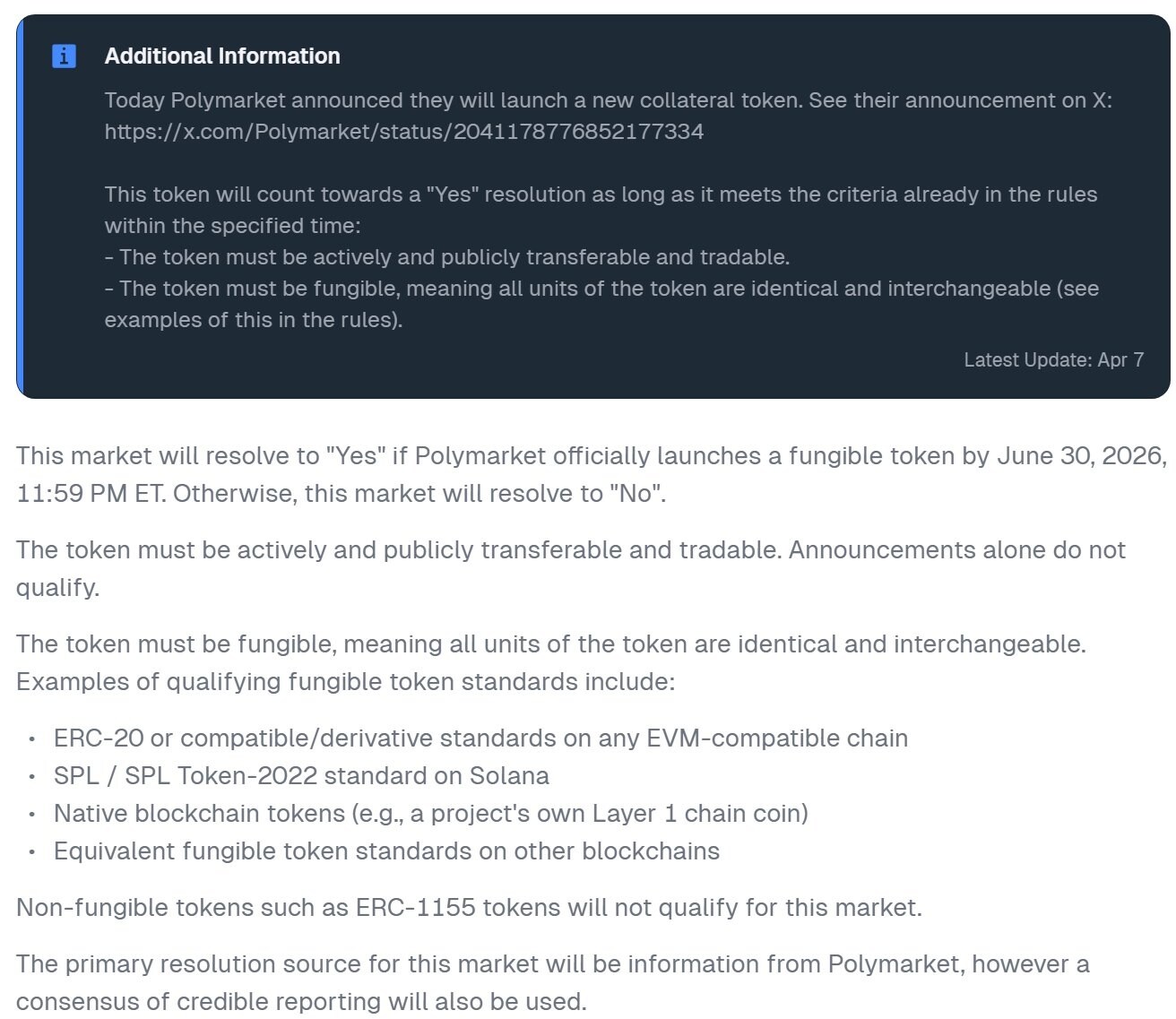
Relevant settlement rule说明

The community debated this.

Supporters argue that, literally from the rules, "issuing a token" is not limited to必须是 a "governance token" but is a general term for all tokens. Under this premise, Polymarket USD, as a fungible token (ERC20/SPL, etc.) issued by Polymarket,本质上符合 the definition of a "token launch". Additionally, the subsequent official clarification was more a reiteration of the existing rules rather than a临时 modification, so it has some legitimacy in terms of compliance.

However, skeptics do not accept this explanation. On one hand, they believe including stablecoins in the "token launch" category is an overinterpretation of the rules, a typical play on words; on the other hand, even if stablecoins are acknowledged as "token launches", the core of this prediction market is "Polymarket FDV", not "Polymarket USD FDV". Stablecoins serve more as collateral or settlement tools; their market cap structure is fundamentally different from that of a project's main token (e.g., a POLY governance token), and therefore should not be directly equated or substitute for the project's overall valuation logic.

Which Side Are You On?

Looking at the整体 picture, controversial events in prediction markets ultimately revolve around a core question: are you betting on "reality" or are you betting on "rules". Often, these two do not completely overlap.

For those of us participating in prediction markets, understanding the rules themselves might be more important than judging the direction of the event. How the information source is defined, whether there are exception clauses, whether there is room for interpretation—these details can directly determine win or loss at critical moments.

Precisely because of this, some high-probability events that look like "sure bets" are not without risk; they might instead be potential "lose-everything bets". Many reversals happen precisely in these overlooked details. Rather than betting blindly, taking an extra look at the rules is more useful than complaining after losing money.


Preguntas relacionadas

QWhat is the core issue discussed in the article regarding prediction markets?

AThe core issue is the discrepancy between user expectations based on real-world understanding and the actual settlement outcomes determined by platform rules, leading to debates about rule design, fairness, and platform credibility.

QWhy did the rescue operation for the downed US pilot in Iran trigger a 'Yes' settlement on Polymarket's 'US forces enter Iran' event?

ABecause the settlement rules defined 'entry' as active, deliberate incursion by US forces (including special operations) for operational purposes, and the rescue mission involved special forces entering Iranian territory, qualifying as 'invasion' under the platform's criteria.

QWhat was the opposition's argument against the 'Yes' outcome in the Polymarket Iran event?

AThey argued that the rescue was a short-term humanitarian operation, not an invasion or occupation, and should be considered an exception similar to excluded cases like shot-down pilots, as it didn't align with common understanding of 'US forces entering Iran'.

QHow did Predict.fun justify settling 'Will Polymarket launch a token?' as 'Yes' after the stablecoin announcement?

AThe rules specified that any fungible token issued by Polymarket counted as 'launching a token,' and Polymarket USD, being a fungible token, met this definition despite being a stablecoin rather than a governance token.

QWhat key advice does the article offer to participants in prediction markets to avoid losses?

AParticipants should prioritize understanding the specific rules—including definitions, exceptions, and interpretive nuances—over merely predicting real-world outcomes, as rule details ultimately determine settlement and can turn high-probability bets into losses.

Lecturas Relacionadas

OpenAI Post-Training Engineer Weng Jiayi Proposes a New Paradigm Hypothesis for Agentic AI

OpenAI engineer Weng Jiayi's "Heuristic Learning" experiments propose a new paradigm for Agentic AI, suggesting that intelligent agents can improve not just by training neural networks, but also by autonomously writing and refining code based on environmental feedback. In the experiment, a coding agent (powered by Codex) was tasked with developing and maintaining a programmatic strategy for the Atari game Breakout. Starting from a basic prompt, the agent iteratively wrote code, ran the game, analyzed logs and video replays to identify failures, and then modified the code. Through this engineering loop of "code-run-debug-update," it evolved a pure Python heuristic strategy that achieved a perfect score of 864 in Breakout and performed competitively with deep reinforcement learning (RL) algorithms in MuJoCo control tasks like Ant and HalfCheetah. This approach, termed Heuristic Learning (HL), contrasts with Deep RL. In HL, experience is captured in readable, modifiable code, tests, logs, and configurations—a software system—rather than being encoded solely into opaque neural network weights. This offers potential advantages in explainability, auditability for safety-critical applications, easier integration of regression tests to combat catastrophic forgetting, and more efficient sample use in early learning stages, as demonstrated in broader tests on 57 Atari games. However, the blog acknowledges clear limitations. Programmatic strategies struggle with tasks requiring long-horizon planning or complex perception (e.g., Montezuma's Revenge), areas where neural networks excel. The future vision is a hybrid architecture: specialized neural networks for fast perception (System 1), HL systems for rules, safety, and local recovery (also System 1), and LLM agents providing high-level feedback and learning from the HL system's data (System 2). The core proposition is that in the era of capable coding agents, a significant portion of an AI's learned experience could be maintained as an auditable, evolving software system.

marsbitHace 25 min(s)

OpenAI Post-Training Engineer Weng Jiayi Proposes a New Paradigm Hypothesis for Agentic AI

marsbitHace 25 min(s)

Your Claude Will Dream Tonight, Don't Disturb It

This article explores the recent phenomenon of AI companies increasingly using anthropomorphic language—like "thinking," "memory," "hallucination," and now "dreaming"—to describe machine learning processes. Focusing on Anthropic's newly announced "Dreaming" feature for its Claude Agent platform, the piece explains that this function is essentially an automated, offline batch processing of an agent's operational logs. It analyzes past task sessions to identify patterns, optimize future actions, and consolidate learnings into a persistent memory system, akin to a form of reinforcement learning and self-correction. The article draws parallels to similar features in other AI agent systems like Hermes Agent and OpenClaw, which also implement mechanisms for reviewing historical data, extracting reusable "skills," and strengthening long-term memory. It notes a key difference from human dreaming: these AI "dreams" still consume computational resources and user tokens. Further context is provided by discussing the technical challenges of managing AI "memory" or context, highlighting the computational expense of large context windows and innovations like Subquadratic's new model claiming drastically longer contexts. The core critique argues that this strategic use of human-centric vocabulary does more than market products; it subtly reshapes user perception. By framing algorithms with terms associated with consciousness, companies blur the line between tool and autonomous entity. This linguistic shift can influence user expectations, tolerance for errors, and even perceptions of responsibility when systems fail, potentially diverting scrutiny from the companies and engineers behind the technology. The article concludes by speculating that terms like "daydreaming" for predictive task simulation might be next, continuing this trend of embedding the idea of an "inner life" into computational processes.

marsbitHace 27 min(s)

Your Claude Will Dream Tonight, Don't Disturb It

marsbitHace 27 min(s)

Trading

Spot
Futuros
活动图片




