Prediction Markets Plunge into Major Controversy Again: Are You Trading Facts or Rules?

Odaily星球日报Publicado a 2026-04-08Actualizado a 2026-04-08

Resumen

The prediction market sector, particularly in Web3, is facing significant controversy over the interpretation of event outcomes versus predefined rules. Two recent high-profile cases highlight this tension. On Polymarket, a market asking "Will US forces enter Iran by a certain date?" was settled as "Yes" after US special operations troops entered Iranian territory to rescue a downed pilot. While the rules explicitly qualified such operational entries—including humanitarian missions—as valid, many users argued that a limited, rescue-focused operation should not be considered an "invasion," contradicting common understanding. On Predict.fun, a market asking if Polymarket would "launch a token" was triggered when the platform introduced a native stablecoin, Polymarket USD, pegged 1:1 to USDC. The rules defined "token" broadly as any fungible asset, but critics argued that issuing a stablecoin—a collateralized utility token—should not count as a "token launch," which is typically associated with governance or equity tokens. This raised questions about whether the outcome reflected market expectations about valuation (FDV) or merely technical rule compliance. The core issue is whether participants are betting on real-world events or narrowly defined rules. These cases show that even high-probability markets can become "lose-everything" scenarios if rule nuances are overlooked. Understanding the rules—including definitions, exceptions, and interpretation boundaries—is crucial, a...

Original | Odaily Planet Daily (@OdailyChina)

Author | Asher (@Asher_ 0210)

Prediction markets are arguably the hottest topic in Web3 right now.

Trading on predictions surrounding macroeconomic events, the crypto industry, and even entertainment topics continues to heat up, with discussion fervor and participation numbers constantly rising. However, as the market develops rapidly, some discordant voices have gradually emerged—some events, upon settlement, deviate from user expectations based on common sense or "real-world understanding," sparking controversies about rule design, fairness, and even platform credibility.

Recently, two highly controversial events occurred in quick succession within prediction markets. Below, Odaily Planet Daily will summarize and discuss them.

Polymarket: US Rescue of Downed Pilot in Iran Judged as US Invasion of Iran

On April 3rd, a US F-15E Strike Eagle fighter jet was shot down by Iranian air defense systems in southwestern Iran. The two crew members (one pilot, one Weapon Systems Officer/WSO) ejected; one was quickly rescued, while the other was missing for several days, hiding in the Iranian mountains.

  • The US military subsequently launched a Search and Rescue (SAR) operation involving armed aircraft, helicopters, etc., ultimately rescuing the second, severely injured crew member (Trump personally announced "WE GOT HIM").
  • The rescue operation involved US forces entering Iranian territory (mountain search and rescue, possible ground or low-altitude operations), which drew attention given the current sensitive geopolitical conflict backdrop.

Since the US military entering Iranian territory could, in a way, be considered a US invasion of Iran, it directly affected the prediction event on the Polymarket platform regarding when US forces would enter Iran (US forces enter Iran by?).
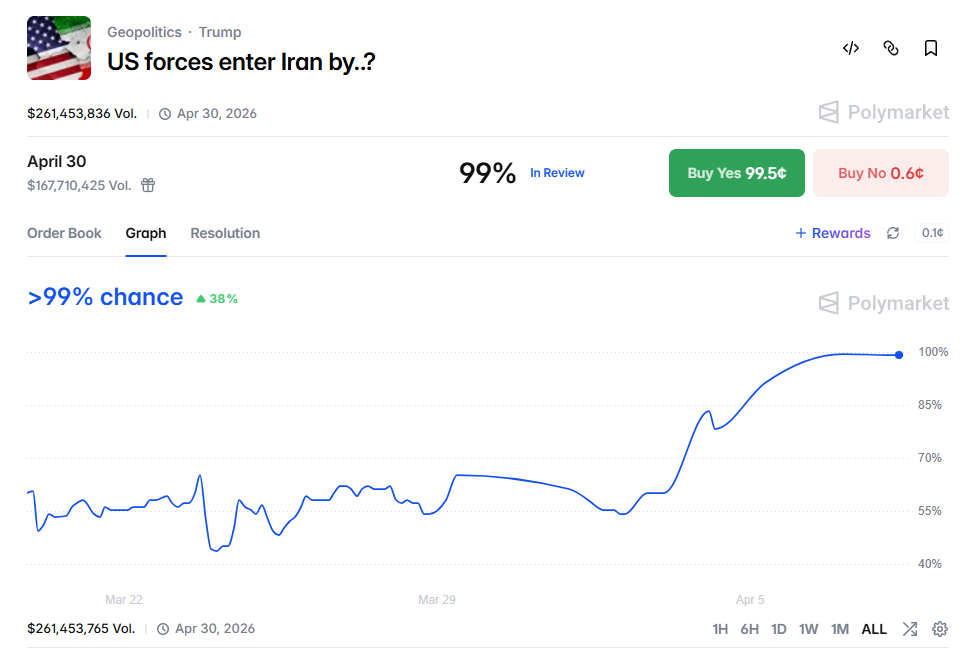
According to the settlement rules, active US military personnel (including special operations forces) entering Iranian land territory before the specified date counts as an invasion. Downed pilots do not count as invasion, but the special forces sent by the US military did indeed enter Iranian territory to rescue the pilot. Therefore, the special forces entering Iran for the rescue mission met the criteria for a Yes判定 on the US invasion of Iran.
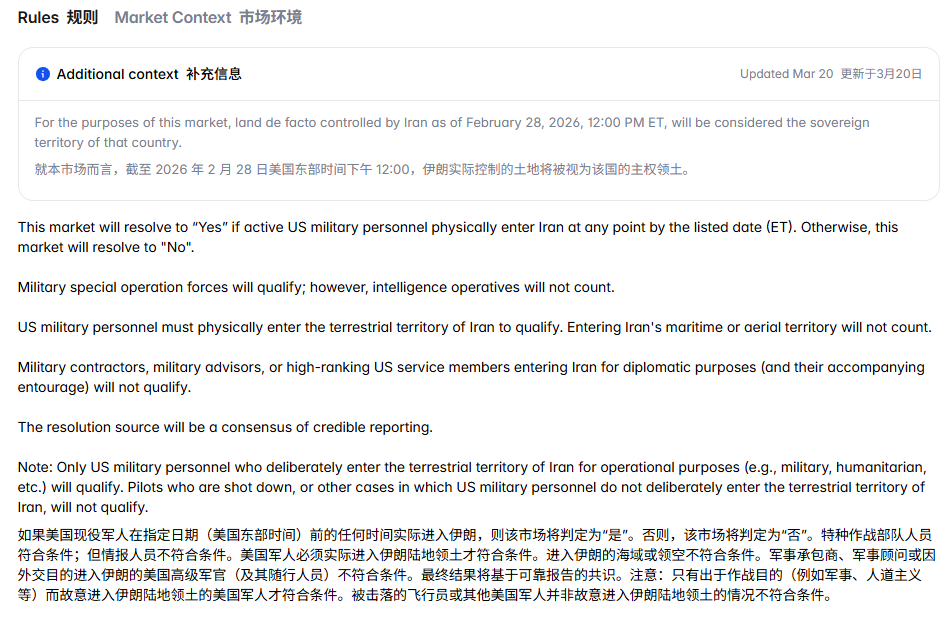
Polymarket's判定 of the "pilot rescue" event as a US invasion of Iran has sparked strong community controversy.

Those supporting "counts as entry" (Yes side) argue that this operation符合 the definition of "entry" in the rules. The US special forces deliberately entered Iranian territory to execute a mission, and the rules explicitly state "special operation forces will qualify", also covering "for operational purposes (including humanitarian)". Objectively, this is the first confirmed ground infiltration by US forces in the current conflict context; US personnel did set foot on Iranian soil, so it should be considered "entry".

Those opposing "counts as entry" (No side) believe this definition is an overextension. The action was essentially a short-term, limited-scale humanitarian rescue, not a combat invasion (invasion), nor did it have an intent to occupy,不符合 the public's common-sense understanding of "US forces entering Iran". Furthermore, the rules explicitly exclude "pilots who are shot down... will not qualify", and this operation was precisely centered around a downed pilot, possessing a "forced entry" nature, logically falling under a similar exception. Referencing past cases (e.g., similar regional actions not deemed invasions), rescue operations should not be equated with military entry;判定 it as Yes might encourage marginal interpretations of the rules, weakening the market's seriousness and consistency. The Chinese community also普遍 believes "entering Iran" should refer more to large-scale ground or amphibious warfare, not a short-term "rescue and leave" operation.

Predict.fun: Polymarket Issuing Stablecoin Judged as Token Launch

On the evening of April 6th, Polymarket官方 announced on X a comprehensive exchange upgrade:

  • Rebuilding the trading engine, upgrading smart contracts;
  • Launching a new native collateral token, Polymarket USD (1:1 pegged to USDC, intended to replace USDC.e and reduce bridging risks).

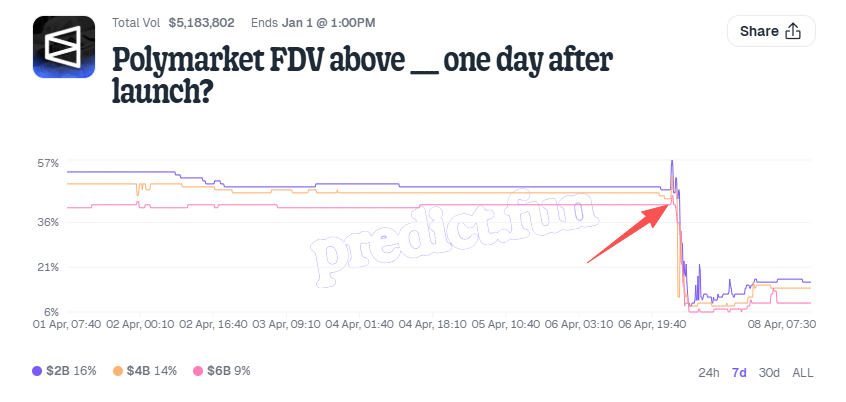
The second point, mentioning the launch of the native collateral token Polymarket USD, directly affected the probability of two related prediction events on the Predict.fun platform: one关于 token launch; the other about post-launch market cap:

1. When will Polymarket launch a token? (Will Polymarket launch a token by ___?)
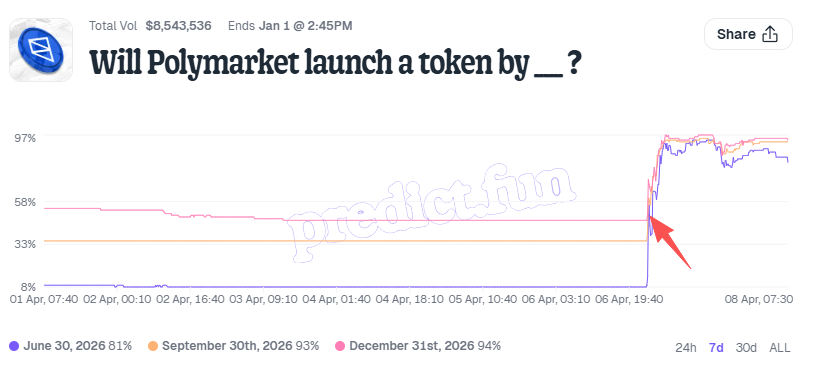
2. Polymarket's FDV one day after launch (Polymarket FDV above ___ one day after launch?);
According to the settlement rules document, it clearly states that "Any fungible token issued by Polymarket counts as a 'token launch' for this event", and stablecoins are certainly no exception. Therefore, the Polymarket stablecoin meets the criteria for a Yes判定.
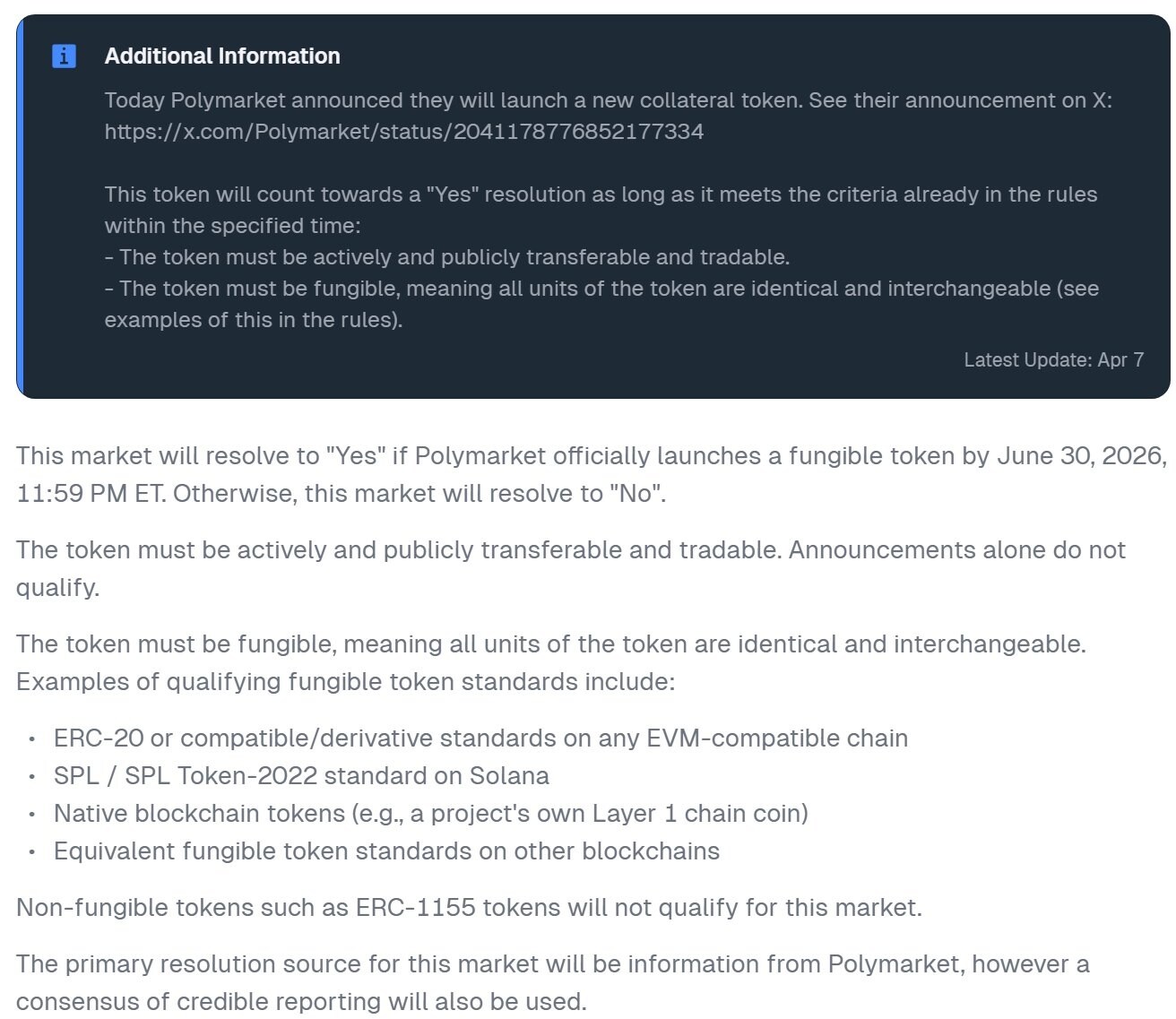
Relevant settlement rule说明

The community debated this.

Supporters argue that, literally from the rules, "issuing a token" is not limited to必须是 a "governance token" but is a general term for all tokens. Under this premise, Polymarket USD, as a fungible token (ERC20/SPL, etc.) issued by Polymarket,本质上符合 the definition of a "token launch". Additionally, the subsequent official clarification was more a reiteration of the existing rules rather than a临时 modification, so it has some legitimacy in terms of compliance.

However, skeptics do not accept this explanation. On one hand, they believe including stablecoins in the "token launch" category is an overinterpretation of the rules, a typical play on words; on the other hand, even if stablecoins are acknowledged as "token launches", the core of this prediction market is "Polymarket FDV", not "Polymarket USD FDV". Stablecoins serve more as collateral or settlement tools; their market cap structure is fundamentally different from that of a project's main token (e.g., a POLY governance token), and therefore should not be directly equated or substitute for the project's overall valuation logic.

Which Side Are You On?

Looking at the整体 picture, controversial events in prediction markets ultimately revolve around a core question: are you betting on "reality" or are you betting on "rules". Often, these two do not completely overlap.

For those of us participating in prediction markets, understanding the rules themselves might be more important than judging the direction of the event. How the information source is defined, whether there are exception clauses, whether there is room for interpretation—these details can directly determine win or loss at critical moments.

Precisely because of this, some high-probability events that look like "sure bets" are not without risk; they might instead be potential "lose-everything bets". Many reversals happen precisely in these overlooked details. Rather than betting blindly, taking an extra look at the rules is more useful than complaining after losing money.

Preguntas relacionadas

QWhat is the core issue discussed in the article regarding prediction markets?

AThe core issue is the discrepancy between user expectations based on real-world understanding and the actual settlement outcomes determined by platform rules, leading to debates about rule design, fairness, and platform credibility.

QWhy did the rescue operation for the downed US pilot in Iran trigger a 'Yes' settlement on Polymarket's 'US forces enter Iran' event?

ABecause the settlement rules defined 'entry' as active, deliberate incursion by US forces (including special operations) for operational purposes, and the rescue mission involved special forces entering Iranian territory, qualifying as 'invasion' under the platform's criteria.

QWhat was the opposition's argument against the 'Yes' outcome in the Polymarket Iran event?

AThey argued that the rescue was a short-term humanitarian operation, not an invasion or occupation, and should be considered an exception similar to excluded cases like shot-down pilots, as it didn't align with common understanding of 'US forces entering Iran'.

QHow did Predict.fun justify settling 'Will Polymarket launch a token?' as 'Yes' after the stablecoin announcement?

AThe rules specified that any fungible token issued by Polymarket counted as 'launching a token,' and Polymarket USD, being a fungible token, met this definition despite being a stablecoin rather than a governance token.

QWhat key advice does the article offer to participants in prediction markets to avoid losses?

AParticipants should prioritize understanding the specific rules—including definitions, exceptions, and interpretive nuances—over merely predicting real-world outcomes, as rule details ultimately determine settlement and can turn high-probability bets into losses.

Lecturas Relacionadas

On the Eve of Circle's Earnings Report, Wall Street Shows Major Divergence in CRCL Valuation

On the eve of Circle (CRCL) releasing its quarterly earnings report, Wall Street analysts are deeply divided over the company's valuation. Morgan Stanley downgraded Circle from "Equal Weight" to "Underweight," slashing its price target from $106 to $38. Analyst James Faucette argues the market overestimates the growth potential of Circle's core USDC stablecoin, noting its circulation hasn't increased since Q3 2025 and new use cases beyond remittances and card spending are limited. He warns that slowing USDC growth could pressure the crucial "reserve income" and shift revenue toward lower-margin transaction fees. In stark contrast, TD Cowen initiated coverage with a "Buy" rating and an $82 price target. Analyst Bryan Bergin believes the market underestimates Circle's potential to evolve from a stablecoin issuer into a broader digital financial infrastructure platform. He forecasts a ~31% annual growth rate for USDC through 2030 and expects faster growth in fee-based revenue from services like payments, RWA tokenization, and its Arc network. A key external factor adding uncertainty is the stalled progress of the CLARITY Act in the US Senate, whose delay could dampen institutional adoption expectations for stablecoins. The core disagreement lies in whether Circle's future hinges on USDC circulation growth or a successful platform-based transformation. The upcoming earnings report is keenly awaited for insights into reserve income trends and the progress of newer business verticals.

marsbitHace 29 min(s)

On the Eve of Circle's Earnings Report, Wall Street Shows Major Divergence in CRCL Valuation

marsbitHace 29 min(s)

Hong Kong Stock Market in July: Super IPOs Coexist with Wave of Breakings, Hard Tech Still the Main Theme

The Hong Kong IPO market in July presented a "two-tiered" scenario characterized by both a mega-IPO and a significant wave of new stock listings falling below their issue price ("breaking issue"). The highlight was Zhongji Innolight's (stock code: 03308.HK) listing on July 30, which raised approximately HK$53.41 billion. This marked the largest IPO on the Hong Kong exchange in nearly seven years since Alibaba's secondary listing. A prominent trend was the continued dominance of A+H listings, with companies like Luxshare (02475.HK) and others contributing significantly to the total monthly fundraising of around HK$116 billion. In stark contrast, the market saw a sharp rise in "broken issues." Out of 17 new listings for the month, 7 broke issue on their debut, with the rate climbing to 47% by month-end. Factors contributing to this included an intense concentration of listings (15 in one week), profit-taking by investors, and a market reassessment of valuations, particularly for companies with unclear commercial prospects. Despite the sell-off, hard tech remained the core theme, accounting for over 70% of July's listings. Key sectors were semiconductors and AI/autonomous driving. However, market enthusiasm became highly selective, with extreme over-subscription for certain niche players while others were heavily sold off. This signals a shift from speculative fervor towards a more value-driven assessment. Looking ahead, recent listing reforms by the Hong Kong Exchanges are expected to attract more tech firms. With a large pipeline of over 350 companies awaiting listing, including potential large offerings like SHEIN, the market is poised for continued activity. Analysts view July's correction not as a downturn but as a healthy valuation reset, emphasizing the need for investors to carefully discern company fundamentals.

marsbitHace 31 min(s)

Hong Kong Stock Market in July: Super IPOs Coexist with Wave of Breakings, Hard Tech Still the Main Theme

marsbitHace 31 min(s)

Wall Street Shows Sharp Divergence in CRCL Valuation on the Eve of Circle's Earnings Report

On the eve of its earnings report on August 5th, significant divergence emerged on Wall Street regarding the valuation of Circle (CRCL). Morgan Stanley downgraded Circle from "Equal Weight" to "Underweight," slashing its target price from $106 to $38. Analyst James Faucette argues that the market has overestimated the growth potential of USDC, noting stagnant circulation since Q3 2025 and a lack of major new use cases beyond remittances and card spending. He warns that slower USDC growth could pressure Circle's core "reserve income" and shift its revenue mix toward lower-margin transaction fees, making current valuations excessive. In contrast, TD Cowen initiated coverage with a "Buy" rating and an $82 target price. Analyst Bryan Bergin believes the market underestimates Circle's potential to evolve from a stablecoin issuer into a broader digital financial infrastructure platform. He focuses on future services like payments, asset management, RWA tokenization, and blockchain infrastructure, forecasting a ~31% CAGR for USDC circulation through 2030 and faster growth in fee-based revenues. A key external variable is the delayed progress of the CLARITY Act, whose uncertainty may pressure market sentiment by slowing regulatory clarity for stablecoins. Ultimately, the split centers on whether Circle's value hinges on USDC growth or its platform transformation. The upcoming earnings report will be scrutinized for details on reserve income, payment services, and RWA initiatives.

Odaily星球日报Hace 34 min(s)

Wall Street Shows Sharp Divergence in CRCL Valuation on the Eve of Circle's Earnings Report

Odaily星球日报Hace 34 min(s)

July Security Report: Total Losses Approximately $97 Million, Cross-Chain Bridge Attacks Concentrated with Over $35 Million

In July 2026, the cryptocurrency sector suffered total losses of approximately $97 million, with hacker attacks and contract vulnerabilities accounting for about $94 million. A significant trend was the shift in attack vectors from smart contract code to off-chain infrastructure, signature key leaks, and governance manipulation. Major incidents included: * **Ostium ($23.75M loss):** An attacker gained access to its off-chain price oracle signing system, manipulated BTC prices, and drained funds. * **AFX Trade Bridge ($24.15M loss):** The private validator key for its cross-chain bridge was compromised, allowing unauthorized withdrawals. * **BonkDAO ($20M loss):** An attacker acquired enough tokens to pass a malicious governance proposal and drain the treasury, exploiting low voting thresholds. * **Bonzo Lend ($9.05M loss):** A third-party oracle provider's signature verification was exploited to inject manipulated token prices. * **Verus Bridge ($7.55M loss):** A repeat attack exploiting the same unpatched bridge vulnerability. * **B2 Network ($3.86M loss):** An attacker seized the upgrade authority for a staking contract. Cross-chain bridges remained a prime target, with concentrated attacks causing over $35 million in losses. Phishing scams resulted in roughly $3 million in losses, employing sophisticated methods like fake mobile apps and physical counterfeit letters targeting Ledger users. Key takeaways are the acceleration of attacks on off-chain infrastructure, the persistent vulnerability of cross-chain bridges, and the rising prominence of governance-layer exploits. Recommendations include enhancing off-chain key management with multi-sig security, implementing stricter governance controls, and increasing user vigilance against phishing.

marsbitHace 1 hora(s)

July Security Report: Total Losses Approximately $97 Million, Cross-Chain Bridge Attacks Concentrated with Over $35 Million

marsbitHace 1 hora(s)

Trading

Spot
活动图片