Prediction Market Giants Clash as Competition Between Kalshi and Polymarket Heats Up

marsbitPublicado a 2026-04-02Actualizado a 2026-04-02

Resumen

The competition between US-based prediction market platforms Kalshi and Polymarket has intensified, with both companies exchanging sharp public criticisms. Kalshi, which is regulated by the CFTC, launched an ad campaign in Washington, D.C., with slogans such as "We don’t do death markets," directly targeting Polymarket’s offshore operations and its controversial contracts related to military conflicts and sensitive events. Kalshi accused Polymarket of being "irresponsible, dangerous, and non-compliant," while Polymarket responded by calling for fact-based discussions and emphasizing its commitment to market integrity. The dispute highlights fundamental differences in their regulatory approaches and comes amid growing scrutiny over insider trading and ethical concerns in the prediction market industry, which has seen combined weekly volumes nearing $6 billion.

Written by: Yash Roy, Bloomberg

Compiled by: Saoirse, Foresight News
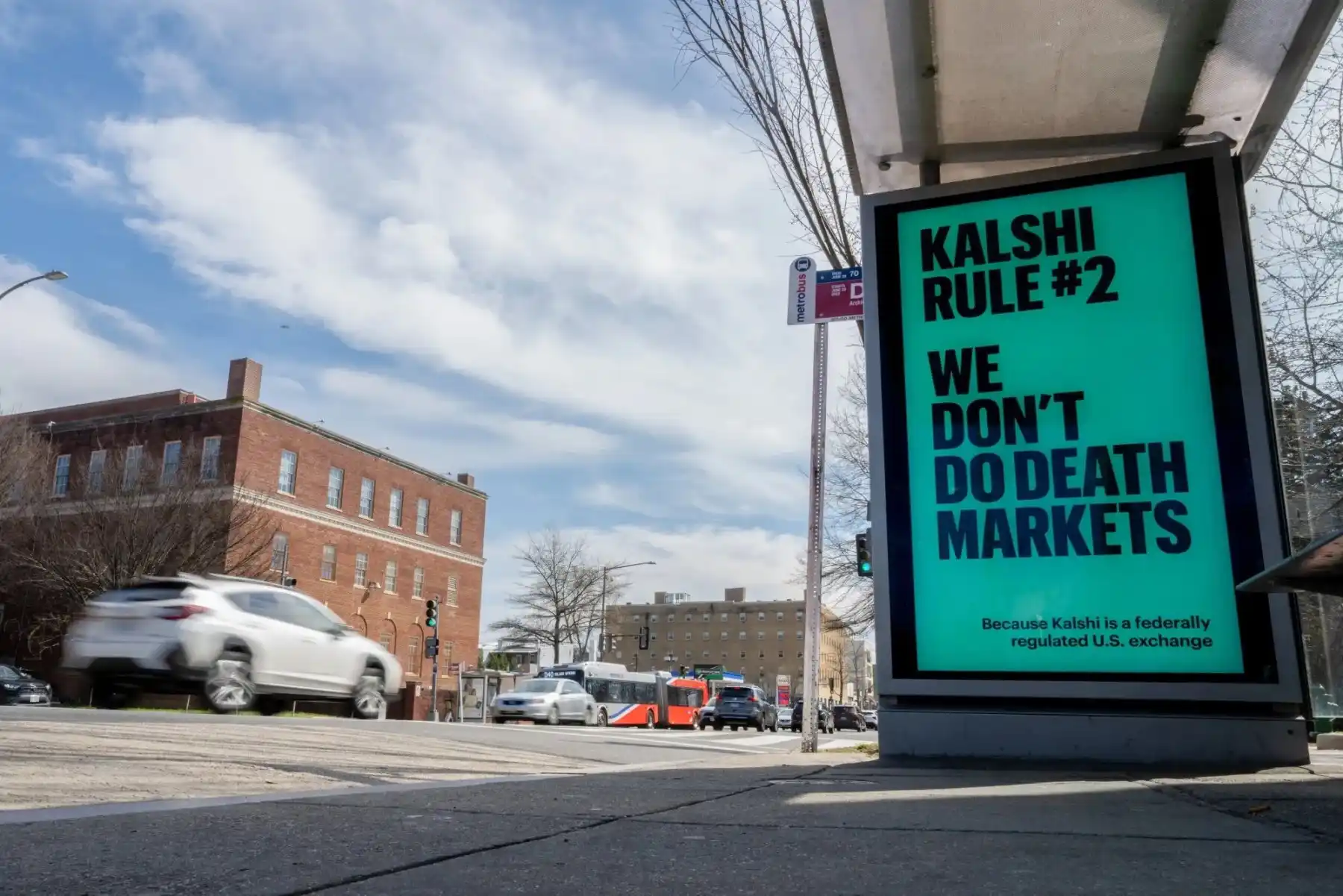
This is an advertisement placed by the American prediction market platform Kalshi at a Washington bus stop in March. With the slogan 'We Don't Do Death Markets,' it emphasizes its own federally regulated compliance to attack its competitor Polymarket's unregulated overseas operations and sensitive contracts related to military conflicts. Photographer: Daniel Hoyle / Bloomberg

As competition in the prediction market industry intensifies and this emerging field faces strict regulatory scrutiny in Washington, Kalshi and Polymarket are exchanging heavy accusations in a fierce confrontation.

The two platforms have frequently clashed before, but recent conflicts have escalated completely — Kalshi launched a highly targeted advertising campaign, and its employees have publicly criticized Polymarket, with the rhetoric from both sides becoming increasingly heated.

Benjamin Freeman, who is responsible for political and election markets at Kalshi, posted on social media on Monday, stating: 'Polymarket's irresponsible, dangerous, and allegedly违规的行为 (non-compliant behavior) is threatening the survival of legitimate prediction markets in the United States.'

This accusation quickly sparked a fierce war of words between the two companies.

Polymarket responded in a statement: 'We welcome competition but believe discussions should be based on facts. Misleading the public only harms the entire industry and its participants.'

Kalshi spokesperson Elisabeth Diana directly retorted: 'It's laughable to hear this from a company whose vast majority of trading volume is on an unregulated overseas platform, with rules that even allow for 'death markets'.'

(Note: Death Markets is a general term in the prediction market industry for trading contracts that directly/indirectly bet on events related to death, military conflicts, assassinations, etc., also known as 'assassination markets.')

This internal strife erupts at a critical time when Polymarket and Kalshi are vying for the leading position in the rapidly growing prediction market industry. This industry provides Americans with a new way to bet on various events, from sports games to election outcomes. According to data compiled by a user on Dune Analytics, the two startups have recently set new records in weekly trading volume, with their combined nominal trading volume recently approaching $6 billion.

Prediction Market Trading Volume Reaches Billions
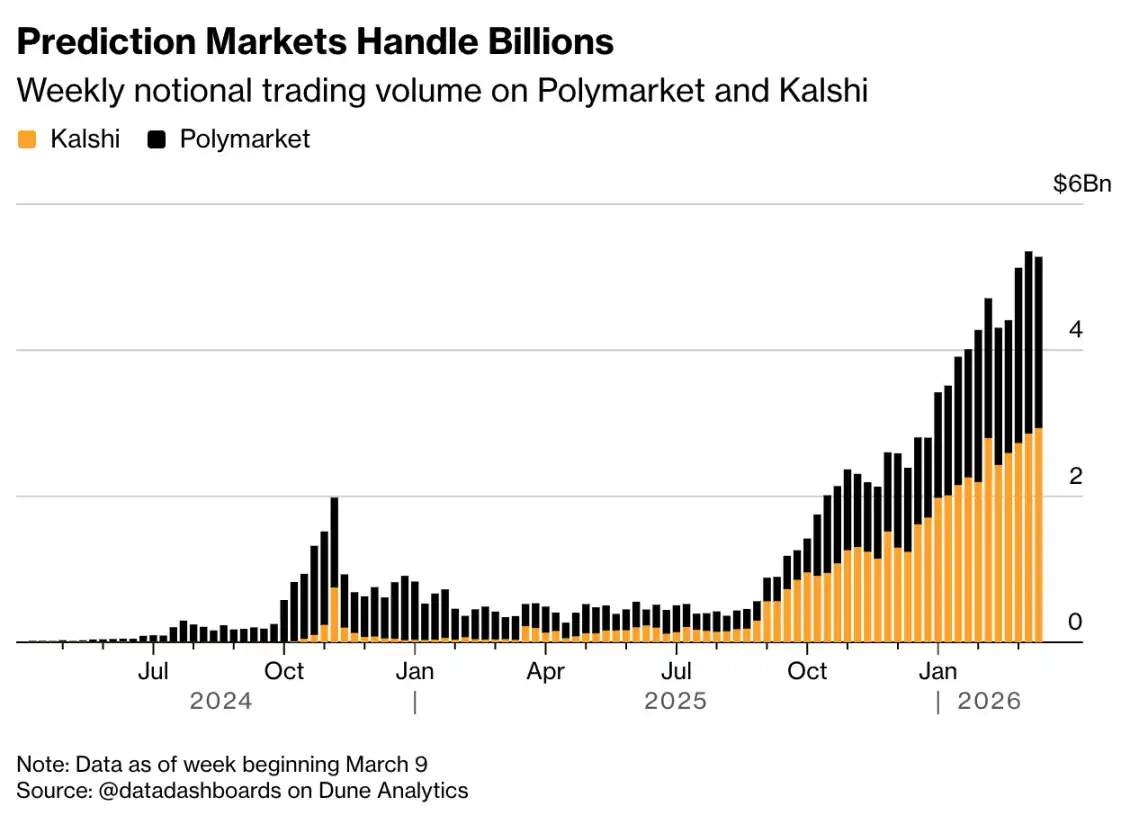
Weekly nominal trading volume of Polymarket and Kalshi. Note: Data is for the week ending March 9th. Source: @datadashboards on Dune Analytics

The core of the dispute lies in the fundamental differences in the establishment models and operating rules of the trading platforms. The Kalshi platform is headquartered in the United States and is regulated by the U.S. Commodity Futures Trading Commission (CFTC); Polymarket's main trading platform is based overseas.

Polymarket leverages its overseas operational advantage to list contracts related to military conflicts, including those involving Iran. Kalshi directly states that such products are both unethical and illegal.

One of Kalshi's advertisements bluntly states: 'We Don't Do Death Markets.'

Earlier this week, this set of marketing ads from Kalshi, in the form of a 'platform rules list,' began appearing at bus stops and subway stations in Washington.

One of them reads: 'Rule 1: We ban insider trading because Kalshi is a federally regulated U.S. exchange.' In the eyes of industry observers, the subtext of this statement is obvious: Polymarket's main platform is not under the jurisdiction of U.S. regulators.
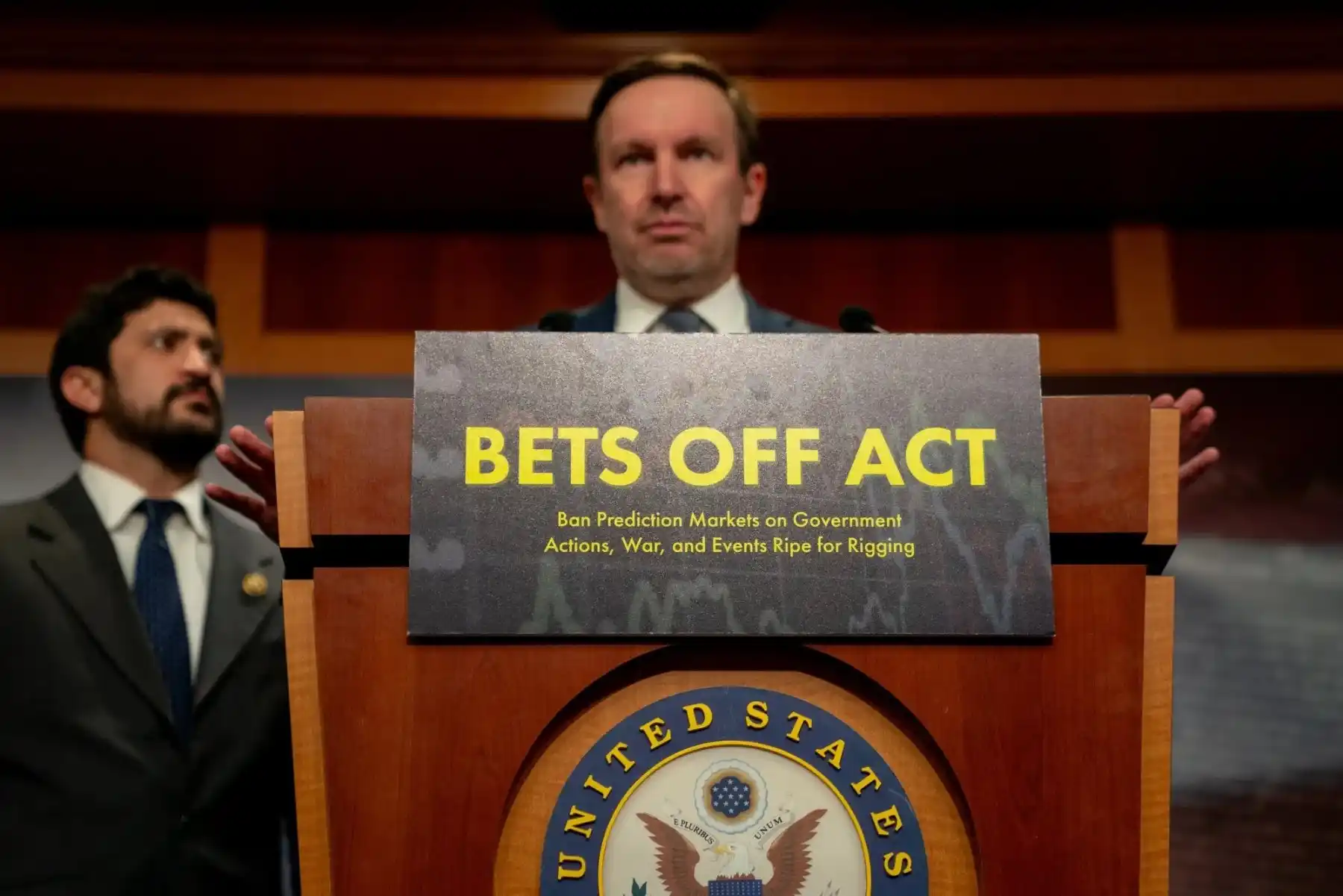
'BETS OFF Act' signage, Representative Greg Casar and Senator Chris Murphy speak at a press conference regarding the 'Betting on Events with Security and Federal Functions Off-Limits (BETS OFF) Act'. Photographer: Stephanie Reynolds / Bloomberg

Following allegations that insider information was used to improperly bet on U.S. military actions in Iran and Venezuela, Congress has turned its focus to the issue of insider trading in prediction markets. In response, Kalshi has taken a tougher stance, imposing fines, suspending trading, and other penalties on users it deems to have violated rules; Polymarket has been relatively permissive, though with increased regulatory attention, the platform recently announced its own insider trading rules.

Kalshi spokesperson Diana said: 'We want to make these significant differences clear. Many people in the market currently conflate Kalshi and Polymarket and confuse the different paths we have taken regarding regulatory compliance.'

In addition to its overseas main platform, Polymarket also has a U.S.-regulated platform, which is still in the testing phase. The company stated in a declaration that both platforms enforce 'the same strict market integrity standards, including prohibitions on insider trading and market manipulation, active monitoring of trading, and ongoing communication and cooperation with regulators and law enforcement agencies.'

A trade on the Polymarket website regarding whether the Houthis will attack Israeli territory. Photographer: Gabby Jones / Bloomberg

Just a few months ago, Kalshi co-founder Luana Lopes Lara was still trying to ease tensions between the two rivals. In a social media post last October, she expressed hope that the industry could move beyond 'destructive infighting' and develop together.

Now, that vision seems largely shattered.

The conflict became even more difficult to reconcile after Kalshi advisor and former U.S. Commodity Futures Trading Commissioner Brian Quintenz joined the fray. In response to reports that prosecutors are investigating insider trading, Brian Quintenz publicly hinted on social media this week that the investigation should focus on Polymarket. When contacted by Bloomberg News, he declined to comment further.


Preguntas relacionadas

QWhat is the main point of contention between Kalshi and Polymarket?

AThe core dispute revolves around their operational models and regulatory compliance. Kalshi, a US-based platform regulated by the CFTC, criticizes Polymarket for its primarily offshore, unregulated main platform and for offering controversial 'death market' contracts related to military conflicts.

QWhat specific advertising campaign did Kalshi launch against Polymarket?

AKalshi launched a targeted ad campaign in Washington, D.C., bus and metro stations. One ad stated, 'We don't do death markets,' emphasizing its federal regulation and taking a direct shot at Polymarket's offshore operations and sensitive contracts.

QHow did Polymarket respond to the allegations from Kalshi?

APolymarket responded with a statement saying, 'We welcome competition, but believe discussions should be based on facts,' and argued that misleading the public harms the entire industry and its participants. They also stated that both their offshore and US-regulated platforms maintain the same strict market integrity standards.

QWhat recent legislative focus is mentioned in the article that impacts prediction markets?

AThe article mentions that Congress has turned its focus to the issue of insider trading in prediction markets, particularly following allegations that people used inside information to bet on U.S. military actions in Iran and Venezuela. This has led to the proposed 'BETS OFF Act'.

QWhat was the reported combined recent trading volume for Kalshi and Polymarket?

AAccording to user-compiled data on Dune Analytics, the two startups recently set new weekly trading volume records, with their combined nominal trading volume approaching $6 billion.

Lecturas Relacionadas

380,000 Apps Exposed, 2,000+ Apps Leaked Secrets: AI Programming Turns 'Intranet' into Public Internet

Israeli cybersecurity firm RedAccess uncovered a severe data exposure trend linked to "vibe coding" or AI-powered software development tools. Their research found approximately 38,000 publicly accessible web applications built with platforms like Lovable, Base44, Netlify, and Replit. Of these, an estimated 2,000 apps exposed sensitive corporate and personal data, including medical records, financial information, internal strategic documents, and customer chat logs. In some cases, access even granted administrative privileges. The core issue stems from default privacy settings that make applications public by default, combined with a lack of built-in security controls (like authentication) in the AI-generated code. This allows employees without security expertise—"citizen developers"—to easily create and deploy applications that bypass standard corporate security reviews. The exposed apps, often indexed by search engines, are trivially discoverable. While some platform providers (Replit, Lovable, Wix/Base44) argue that security configuration is the user's responsibility and question the validity of some findings, security researchers confirm the widespread reality of such exposures. This pattern, also noted in prior studies, highlights a critical security gap as AI democratizes app creation, potentially leading to massive, unintentional data leaks.

marsbitHace 9 min(s)

380,000 Apps Exposed, 2,000+ Apps Leaked Secrets: AI Programming Turns 'Intranet' into Public Internet

marsbitHace 9 min(s)

Attracting Global Capital, Asia's New 'Super Cycle' Is Unfolding

Investors are turning to Asia as the next frontier for global equity growth, with a new "super cycle" unfolding across the region. Driven by the AI revolution, Asian markets, particularly South Korea, have seen significant rallies. According to Morgan Stanley analysis, the underlying drivers of Asia's industrial cycle are shifting from traditional sectors like real estate and manufacturing to massive investments in AI infrastructure, energy security and transition, and supply chain resilience. Fixed asset investment in Asia is projected to grow from around $11 trillion in 2025 to $16 trillion by 2030, with a 7% annual growth rate from 2026-2030. The AI wave is a primary catalyst, driving immense capital expenditure for chips, servers, data centers, and power systems. Asia is central to this hardware supply chain. In China, AI investment is focused on building a full-system domestic capability, with the local AI chip market potentially reaching $86 billion by 2030. Beyond AI, China's export story is expanding from EVs and batteries to robotics. The country already captures about half of new global industrial robot demand and over 90% of humanoid robot shipments. This growth phase mirrors the early stages of China's EV export boom. Simultaneously, energy security investments, spurred by AI's massive power needs, are rising, with China benefiting from its leadership in solar, batteries, and EVs. Regional defense spending is also increasing structurally, supporting demand for advanced manufacturing. The main beneficiaries are China, South Korea, and Japan, positioned in core supply chain areas. However, risks remain, including potential overcapacity, profit margin pressures from competition, persistent technological restrictions, geopolitical friction, and workforce displacement due to AI-driven automation. Market volatility is also expected to increase as investor expectations diverge on the realization of these capital investment and export themes.

marsbitHace 9 min(s)

Attracting Global Capital, Asia's New 'Super Cycle' Is Unfolding

marsbitHace 9 min(s)

Funding Weekly Report | 14 Public Funding Events, Kalshi Completes $10B New Funding Round at $220B Valuation Led by Coatue Management

Weekly Funding Roundup: 14 Deals and $10.49B+ in Total Funding, Led by Kalshi's $1B Round Last week (5.4-5.10) saw 14 notable funding events in the global blockchain ecosystem, raising over $10.49 billion in total. Key highlights include Kalshi, a prediction market platform, securing a $1 billion round led by Coatue Management, reaching a $22 billion valuation. The platform now boasts ~2 million MAUs and $178B in annualized trading volume. In DeFi, regulated on-chain reinsurer OnRe raised $5 million in Series A funding, and Bitcoin-backed credit protocol Saturn Credit completed a $2 million seed round. For Infrastructure & Tools, OpenTrade raised $17 million to expand its stablecoin yield infrastructure, and RWA platform Balcony secured $12.7 million to deploy its property settlement service in the US. Centralized Finance saw one deal: AI-driven trading platform Stockcoin.ai completed a seed round led by Amber Group. In the prediction market sector alongside Kalshi, AI-powered platform Elastics raised $2 million. Other notable deals include SC Ventures' strategic investment in crypto market maker GSR and Centrifuge securing a "seven-figure" investment from Coinbase to become a core RWA partner for Base. On the investor side, Haun Ventures raised a new $1 billion fund targeting crypto and AI, and Multi Investment raised ~$616 million to focus on blockchain and Web3 investments.

marsbitHace 1 hora(s)

Funding Weekly Report | 14 Public Funding Events, Kalshi Completes $10B New Funding Round at $220B Valuation Led by Coatue Management

marsbitHace 1 hora(s)

Trading

Spot
Futuros
活动图片