Prediction Market Competition Heats Up, Hyperliquid Enters the Fray with 'Outcomes'

marsbitPublicado a 2026-02-03Actualizado a 2026-02-03

Resumen

Hyperliquid, a leading crypto derivatives exchange, has announced the test launch of "Outcomes," a new prediction market feature, causing its native token HYPE to surge over 10%. Unlike traditional prediction markets, Outcomes is designed with three core mechanisms: full collateralization (eliminating liquidation risk), non-linear settlement (enabling complex strategies similar to options), and native integration with Hyperliquid’s chain and margin system. This move positions Hyperliquid against established players like Polymarket (focused on social sentiment), Kalshi (compliant markets), and Coinbase (consumer-facing products). Hyperliquid aims to integrate prediction markets directly into its financial ecosystem, allowing users to combine derivatives and prediction positions within a unified margin account. With a highly efficient core team of 11 members generating over $1 billion in annualized revenue per person, Hyperliquid is expanding rapidly. While some analysts note that even capturing all of Polymarket’s volume would only add ~5% to Hyperliquid’s revenue, the platform’s current $7 billion valuation is considered undervalued compared to Polymarket’s $10 billion valuation. Outcomes is seen as a key step in building a comprehensive on-chain Wall Street, though it remains in testnet with no mainnet release date announced.

Original Author: Seed.eth, Bitpush News

Hyperliquid, firmly holding the top spot in the crypto derivatives track, is now attempting to extend its reach into another trillion-dollar market on the brink of explosion: the prediction market.

Today, Hyperliquid officially announced the testing of a new feature called 'Outcomes'. This news directly ignited excitement in the secondary market, with its native token HYPE recording a gain of over 10% within 24 hours, breaking through the $30 mark.
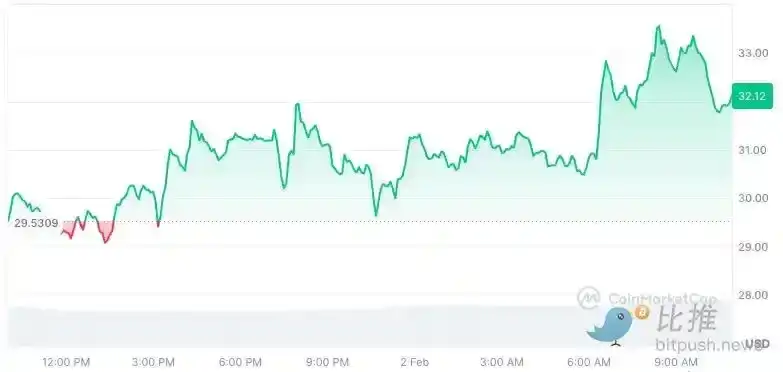
At a time when Polymarket dominates on-chain traffic and Kalshi, in partnership with Coinbase, captures the compliant market, Hyperliquid's entry is far from simple 'bandwagoning'. Instead, it leverages the absolute advantage of its native underlying performance to redefine the rules of the game.

What is Outcomes
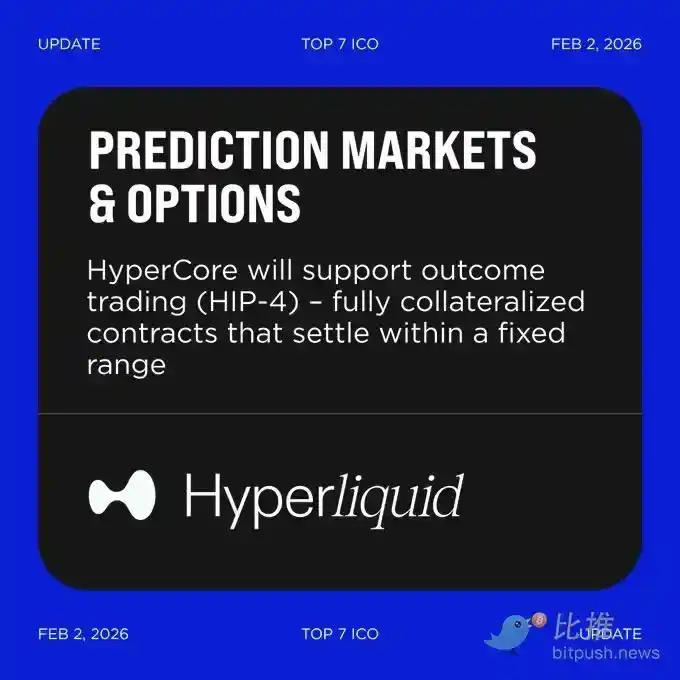
According to the official HIP-4 proposal, Outcomes (Result Contracts) are not a simple betting interface. Their design hinges on the following three core logics:

1. Full Collateralization, No Liquidation Risk

Unlike leveraged perpetual contracts, Outcomes adhere to the principle of 'you can only do as much as your money allows'. It uses full collateralization and settles within a fixed range. This means that no matter how the market fluctuates, as long as the settlement date hasn't arrived, a trader's position will not face forced liquidation, fundamentally removing the risk of being liquidated.

2. Non-linear Settlement, Greater Strategic Space

Outcomes introduces a non-linear settlement mechanism. For traders, this is equivalent to gaining a flexibility close to that of options. You can use it to build more complex hedging instruments, no longer limited to simple binary 'yes' or 'no' games, thereby opening up greater space for risk management and strategic combinations.

3. Native Integration, Liquidity Connectivity

Outcomes will be deeply integrated into HyperCore, Hyperliquid's underlying chain, and priced in its native stablecoin USDH. More importantly, it will share cross-margin with the platform's existing spot and perpetual contracts. This means users can seamlessly connect multiple trading strategies within a single margin account, truly achieving interoperability and reuse of liquidity.

Multi-Party Fragmentation: Who is the Final Form of the Prediction Market?

The current prediction market is at its '1995 browser war' moment, forming four distinct business paths:
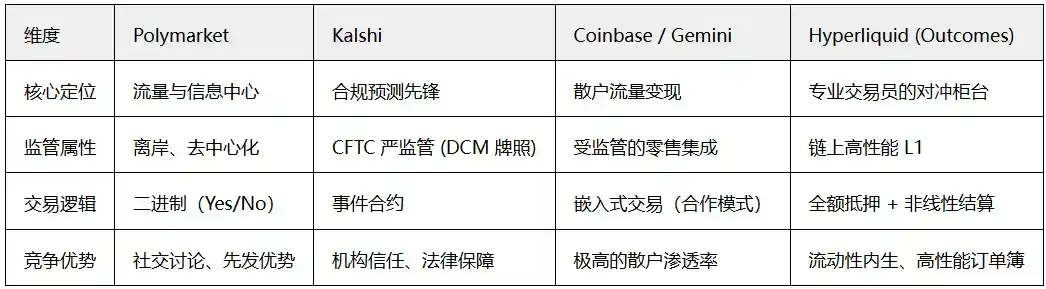
  • Polymarket sells 'opinions'; it's a barometer of social trends.
  • Kalshi sells 'compliance'; it attracts US domestic capital seeking to avoid legal risks.
  • Coinbase is about 'dimensionality reduction attack', turning the prediction market into a mass consumer product through an in-app feature.
  • Hyperliquid's logic is the most hardcore: it doesn't require you to click Yes or No on a webpage; it wants you to buy an Outcomes contract hedging 'non-farm payroll data exceeding expectations' while shorting BTC.

Right now, the community is most focused on the synergistic effect between HIP-3 (Permissionless Listing) and HIP-4 (Outcomes).

Under this architecture, Hyperliquid's evolution path is clear: first, official deployment of 'Canonical Markets' based on objective data sources, such as interest rates and macroeconomic indicators; followed by enabling permissionless deployment.
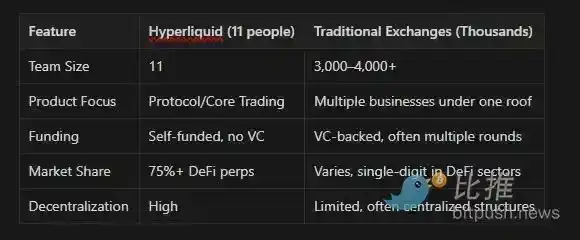
Behind this strategy is Hyperliquid's legendary team advantage. It's hard to imagine that this behemoth, with annualized revenue exceeding $1.1 billion and trading volume rivaling top-tier CEXs, is supported by a core team of only about 11 people. This 'special forces' team, composed of Harvard, MIT elites, and top quantitative hedge fund professionals, has created an astonishing efficiency of over $100 million in annualized revenue per capita. Precisely because the team is extremely lean with short decision-making paths, Hyperliquid can iterate rapidly.

A senior DeFi observer commented: 'Coinbase's entry validates the business model, but it is still centralized. Hyperliquid's Outcomes is challenging a proposition: the endgame of prediction markets does not lie in social media, but in financialization. When trading prediction outcomes becomes as smooth as buying and selling stocks, and can share margin with futures, the imagination space for on-chain finance truly opens up.'

Is HYPE Severely Undervalued?

As the crypto options market matures, the Open Interest (OI) in Hyperliquid's HIP-3 market has surged to $1 billion, and the platform's 24-hour trading volume has skyrocketed to $4.8 billion, hitting a new all-time high.
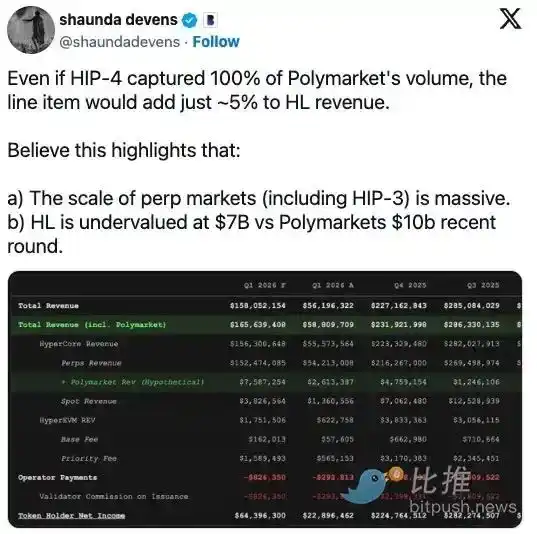
Regarding this move, Blockworks researcher Shaunda Devens believes it further supports Hyperliquid's valuation upside.

Devens pointed out that even if HIP-4 captured 100% of Polymarket's trading volume, its contribution to Hyperliquid's revenue would only be about 5%.

This data seems surprising at first glance, but the underlying logic is: the perpetual contracts market (including the long-tail assets brought by HIP-3) is extremely large. Devens believes that Hyperliquid's current valuation of approximately $7 billion is clearly in a state of significant undervaluation compared to Polymarket's latest round valuation of $10 billion (based on 2025 funding data). The launch of Outcomes is primarily about supplementing a key piece of its full-category financial matrix.

Despite the high market sentiment, it is important to note that Outcomes is currently still in the testnet phase, and a specific timeline for the mainnet launch has not been announced yet. However, with the explosion of the HyperEVM ecosystem, future mainstream service providers like Kalshi or Crypto.com could, in theory, migrate to run on the Hyperliquid chain using the HIP-4 protocol.

In summary, the prediction market is ushering in its best era. In the US, thanks to the advancement of regulatory clarity, the cooperation between Kalshi and Coinbase has already made prediction markets available in all 50 states; similarly strong growth momentum is also seen in the EU and Asia. For Hyperliquid, Outcomes is not a simple 'gambling game'; it is an indispensable piece of the puzzle in building the 'on-chain Wall Street'.

Original link

Preguntas relacionadas

QWhat is Hyperliquid's new feature called and what market is it targeting?

AHyperliquid's new feature is called 'Outcomes', and it is targeting the prediction market.

QWhat are the three core design principles of Hyperliquid's Outcomes feature?

AThe three core design principles are: 1. Full collateralization with no liquidation risk. 2. Non-linear settlement for greater strategic flexibility. 3. Native integration on HyperCore, sharing cross-margin with existing spot and perpetual contracts.

QHow did the announcement of Outcomes affect the price of the HYPE token?

AThe announcement caused the HYPE token to surge over 10% in 24 hours, pushing its price above $30.

QAccording to the article, how does Hyperliquid's approach to the prediction market differ from competitors like Polymarket and Kalshi?

AHyperliquid's approach is not a simple gambling interface; it leverages its native chain's performance to create a financialized product that integrates seamlessly with other derivatives, allowing for complex hedging strategies. This contrasts with Polymarket, which focuses on social sentiment, and Kalshi, which focuses on regulatory compliance.

QWhat was a key observation from Blockworks researcher Shaunda Devens regarding Hyperliquid's valuation after the Outcomes announcement?

AShaunda Devens observed that Hyperliquid's ~$7 billion valuation is significantly undervalued compared to Polymarket's latest $10 billion valuation, even if Outcomes captured 100% of Polymarket's volume, as the perpetuals market is vastly larger and is Hyperliquid's primary revenue driver.

Lecturas Relacionadas

Has the 'Digital Gold' Narrative for BTC Failed?

**Title: Has the "Digital Gold" Narrative for Bitcoin Failed?** The article argues that Bitcoin's "digital gold" narrative remains valid despite a recent sharp price decline (from a peak near $126k in Oct 2025 to briefly under $61k in Feb 2026). It presents a long-term investment framework based on three core points: **1. Viewing Bitcoin as an Asset:** Bitcoin is presented as a superior potential store of value compared to gold. Key arguments are its absolute scarcity (21 million cap), superior portability, and transparent auditability via its public ledger. While acknowledging its current use in early, volatile stages (~3-4% global adoption), the author draws parallels to the early, disruptive phases of the internet and e-commerce. **2. Understanding the Recent Downturn:** The current ~50% correction is framed as a predictable, consensus-driven cycle following its post-halving peak (the 2024 halving preceded the Oct 2025 high). A crucial factor is a historic "changing of hands": the influx of new institutional buyers via ETFs allowed early, low-cost holders (miners, OG believers) to take profits. The author notes that while severe, Bitcoin's historical drawdowns (e.g., 93% in 2011, 77% in 2021-22) have been progressively smaller, suggesting maturing holder structure and decreasing volatility over time. **3. The Long-Term Perspective:** The long-term thesis hinges on Bitcoin capturing a portion of gold's market value. With Bitcoin's market cap at ~$1.4 trillion (at $70k) versus gold's ~$20 trillion, significant upside potential exists if the "digital gold" narrative is partially realized. However, the author strongly cautions that short-term risks remain, the bottom is unpredictable, and high volatility is inherent. The real risk is not Bitcoin failing but poor personal position management (over-leverage, wrong capital) and a lack of deep understanding, which can force investors out during severe downturns. The conclusion uses Amazon's 95% crash post-2000 dot-com bubble and subsequent 42x recovery as an analogy. The ultimate question is not if Bitcoin's price will rise, but if an investor's strategy and conviction can withstand the volatility to see the long-term play out. The recent divergence (gold up, Bitcoin down) is posed not as a narrative failure, but as potential evidence of this ongoing, painful transition from a speculative asset to a mainstream allocation.

marsbitHace 9 hora(s)

Has the 'Digital Gold' Narrative for BTC Failed?

marsbitHace 9 hora(s)

Has BTC's 'Digital Gold' Narrative Failed?

The article discusses Bitcoin's "digital gold" narrative, its recent price drop, and long-term outlook through the perspective of "Jason". It argues the narrative is not a failure but that Bitcoin represents a superior, new asset class due to its fixed supply (21 million), portability, and auditability. The piece compares its current ~3-4% global adoption rate to early internet/e-commerce, suggesting significant growth potential. Regarding the 2025-2026 price decline (from ~$126k to briefly under $61k), the author views it as a predictable, consensus-driven sell-off within Bitcoin's ~4-year cycle post-halving, exacerbated by a major "handover" from early, low-cost holders to new institutional buyers via ETFs. A key observation is that historical peak-to-trough drawdowns have lessened over time (e.g., 93% in 2011 to ~50% in 2026), indicating maturing volatility as holder structure changes. For the long term, the author uses a simple framework: Bitcoin's total market cap (~$1.4T at $70k) is only about 7% of gold's (~$20T). Even capturing 30-50% of gold's value would imply substantial upside. However, the article strongly cautions against viewing this as investment advice, emphasizing extreme volatility and the critical importance of risk management, position sizing, and deep fundamental understanding to survive severe drawdowns. It concludes by drawing a parallel to Amazon's 95% crash in 2000 and subsequent 42x recovery, stressing that the key is surviving market cycles to realize long-term potential.

链捕手Hace 10 hora(s)

Has BTC's 'Digital Gold' Narrative Failed?

链捕手Hace 10 hora(s)

From Code to Cognition: A Ten-Thousand-Word Guide to the Evolution of the Robot Brain

"From Code to Cognition: The Evolution of Robot Brains" The journey of robotic intelligence has shifted dramatically from manually coded systems to AI-driven brains. For decades, robots relied on layered software stacks—perception, state estimation, planning, control—each handcrafted. While predictable, they lacked adaptability. The 2010s saw deep learning revolutionize perception (e.g., object detection) and control (via reinforcement learning), but learned skills remained narrow. The arrival of Large Language Models (LLMs) marked a turning point. LLMs acted as high-level planners, interpreting natural language instructions and generating sequences of actions for traditional robotic systems to execute. However, true integration came with Visual-Language-Action (VLA) models, which fused vision, language, and motion prediction into a single network. Pioneered by models like RT-2 and open-source projects like OpenVLA, VLAs enable robots to reason and act directly from visual input and commands. The most advanced humanoid robots now employ a "dual-brain" architecture: a slow-thinking, large VLA (System 2) for reasoning and planning, and a fast-reacting, small network (System 1) for high-frequency motion control, sometimes with an even lower-level System 0 for balance. This split balances cognition with the physics of real-time movement. Computation is split between onboard hardware (e.g., NVIDIA Jetson) for safety-critical control loops and cloud/edge servers for non-critical tasks like learning and interfaces. A crucial driver is the open-source ecosystem—models like GR00T and OpenVLA allow startups to build upon pre-trained brains and fine-tune them with their own data, accelerating development. Despite progress, current systems struggle with recovery from errors, sample inefficiency, and long-horizon tasks. This has spurred the rise of **World Models**—neural networks that predict the consequences of actions. By simulating possible futures before acting (like NVIDIA Cosmos or Meta V-JEPA), robots can plan, recover, and generalize better. This represents the next frontier: shifting intelligence from learned reactions to an internal model of physics and cause-and-effect. The field is rapidly evolving. While not yet at its "ChatGPT moment," the convergence of cheaper hardware, scalable simulation, and world models points toward robots that are increasingly capable, adaptive, and useful. The question is shifting from "what can robots do?" to "what *should* they do?"

marsbitHace 10 hora(s)

From Code to Cognition: A Ten-Thousand-Word Guide to the Evolution of the Robot Brain

marsbitHace 10 hora(s)

Trading

Spot
Futuros
活动图片