Powell's Reappointment Probability Soars to 98%, Is Trump's 'Firing Order' Just Empty Talk?

Odaily星球日报Publicado a 2026-04-17Actualizado a 2026-04-17

Resumen

Powell's likelihood of remaining as Fed Chair surges to 98%, as Trump's threat to fire him appears increasingly unenforceable. The key issue is the Senate confirmation of Trump's nominee, Kevin Warsh, scheduled for a hearing on April 21. Opposition from Republican Senator Thom Tillis, who insists on delaying the vote until a Justice Department investigation into Powell (regarding Fed building renovation costs) is concluded, threatens to stall the process. With limited Senate working days before Powell's term ends on May 15, Warsh’s confirmation is unlikely to proceed in time. If no successor is confirmed, Powell will continue as interim Chair, a scenario supported by precedent and the Federal Reserve Act. Trump has threatened to fire Powell if he doesn’t step down, but legal authority to do so is weak—dismissal requires “for cause” justification, not policy disagreements. The ongoing investigation has so far yielded no evidence of wrongdoing by Powell, making a court challenge likely to fail. Market participants, however, may prefer Warsh, who is perceived as more open to rate cuts and crypto-friendly policies.

Original | Odaily Planet Daily (@OdailyChina)

Author | Golem (@web3_golem)
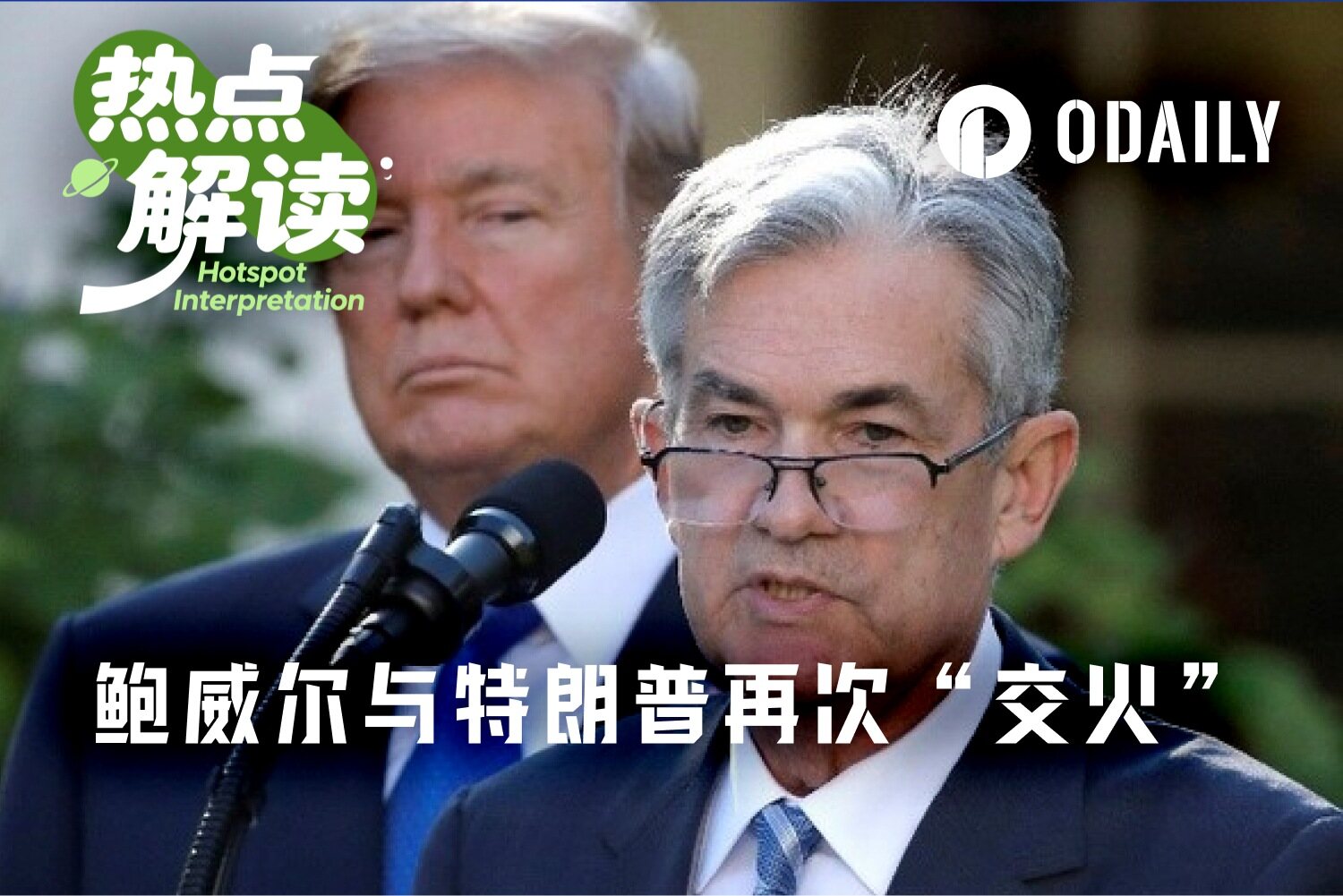
Trump is now truly facing both internal and external troubles: externally entangled in an ongoing struggle with Iran, and internally engaged in an intensifying "palace intrigue" with Federal Reserve Chairman Jerome Powell.

The two have long been at odds. Powell has repeatedly failed to follow Trump's wishes for interest rate cuts, and Trump has repeatedly stated his intention to fire Powell. Originally, if Trump could just endure a little longer, this problem would resolve itself: Powell's term as Fed Chair expires on May 15, 2026. Although he could remain on the Board of Governors until 2028, as long as Trump's favored Kevin Warsh took over, the new chair would hold the power, and an era of compliant rate cuts seemed imminent.

However, an unexpected twist has occurred. Monitoring by Odaily Seer Channel shows that the probability of Powell stepping down as Fed Chair after his term expires has dropped to 2% on Polymarket, indicating that Powell is very likely to continue serving as interim Fed Chair after May 15.

As early as March 19, Powell stated that if his successor is not confirmed before his term ends (May 15), he will continue to serve as Fed Chair. He further indicated that he would not leave the Fed Board of Governors as long as the Justice Department's investigation into him remains ongoing (Odaily Note: This investigation concerns whether Powell lied to Congress about the Fed's $2.5 billion building renovation project).

Therefore, whether Trump can get rid of Powell depends crucially on whether the Senate approves Kevin Warsh as the successor. Although prediction markets have priced in the outcome, the real answer will not be revealed until April 21 (next Tuesday).

Key Juncture: Whether Warsh's Fed Nomination Can Secure Senate Confirmation on April 21

Kevin Warsh is Trump's nominee for the next Fed Chair, but his eventual appointment is subject to review by the US Senate, which has the power to reject the nomination. Warsh will first appear at a hearing before the Senate Banking Committee on April 21, and the market is concerned that Warsh might not even pass the committee's confirmation.

The central figure obstructing Warsh's appointment is Thom Tillis, a Republican from North Carolina and a member of the Banking Committee. His reason is that the Justice Department's investigation into Powell is not yet concluded; he has publicly stated that he will block Warsh nomination from proceeding to a full Senate vote until the Justice Department ends its investigation. Thom Tillis has this influence because, although Republicans hold a 13-11 majority on the Senate Banking Committee, if Thom Tillis votes against it, Warsh's nomination could stall.

The Justice Department's investigation into Powell dates back to July 2025, when Trump visited the Fed building renovation site and publicly questioned its budget合理性. Consequently, in January 2026, the Justice Department formally launched an investigation into Powell regarding the cost of the Fed building renovation. This investigation was originally a political maneuver by Trump aimed at tarnishing Powell's public image and increasing pressure on the Fed.

Perhaps Trump didn't anticipate the backlash. However, Trump also does not intend to terminate the investigation into Powell to clear the path for Warsh's appointment. In an April 15 interview with Fox Business, he stated that while Thom Tillis's opposition would delay Warsh's confirmation, he did not plan to end the investigation, bluntly asking, "Don't you think we need to find out what happened there?"

Stepping back, even without this investigative hurdle, Warsh might struggle to secure the 51 Senate votes needed for confirmation. Under the current geopolitical and economic conditions, Warsh is likely to face questions about Fed independence and interest rate policy during his hearing. If energy and commodity bottlenecks persist due to war, the Fed's focus should be on whether to raise rates, not cut them.

This forces Warsh to choose his stance: either consistently support Trump, which would lower his confirmation chances, or defend the Fed's current wait-and-see stance, thereby angering the President.

Regardless of Warsh's choice, the window is narrow: The hearing is scheduled for April 21, meaning the Senate has only 24 days left before Powell's term ends to confirm Warsh's nomination and hold a vote; of these 24 days, the Senate is only scheduled to be in session for 13 days.

The Trump-Powell Stalemate

Therefore, based on this analysis, if Warsh encounters obstacles at the April 21 hearing, Powell is highly likely to continue serving as interim Fed Chair after his term expires on May 15, continuing to oppose Trump.

There is precedent for an incumbent chair continuing to lead the Fed as "interim chair" due to the successor's confirmation process being incomplete. For example, during President Clinton's administration, then-Fed Chair Alan Greenspan continued to lead the Fed for over three months as interim chair after his term expired while his successor's confirmation was pending; Powell himself served as interim chair for about three months in 2022 while awaiting Senate confirmation for his second term.

This mechanism also has a basis in US law. The Federal Reserve Act, the law governing the Fed, states that members of the Board of Governors shall continue to serve until their successors are appointed.

Faced with this situation, Trump is not willing to sit idly by. In his April 15 Fox Business interview, he stated that if Powell does not step down on time, he will fire him, and also will not abandon the investigation into him.

However, this might also be just an empty threat. Because Trump has not revealed what strategy he would use to fire Powell. Some conservatives believe Trump has the right to appoint one of his own nominated Fed governors—for example, Mester, Bowman, or Waller—to act in Warsh's stead before his confirmation, rather than having Powell do so, citing a memo drafted during the Carter administration which suggests the President can designate an acting chair if his nominee is not confirmed in time.

But the Fed's attitude towards this memo is unknown. Furthermore, this memo ultimately cannot serve as legal basis, so Trump appointing someone other than Powell as interim chair basically lacks legal foundation.

If Trump tries to fire Powell through normal procedures, the success rate is also low. US law states that Trump does not need Congressional confirmation to fire Powell, but he also cannot fire him directly without reason; it must be "for cause," meaning there must be legal grounds, not simply policy disagreements. Whether the reason for dismissal is justified would ultimately be decided by the courts.

Under the current circumstances, the only justifiable reason Trump has for firing Powell would be if Powell lied or was corrupt regarding the Fed's $2.5 billion building renovation project. But according to a March 25 report by The Washington Post, a senior aide to US Justice Department official Jeannie Rhee admitted during a closed-door hearing this month that the Justice Department, in its criminal investigation into Fed Chair Powell regarding the renovation costs, has not found evidence of any wrongdoing.

In other words, the investigation into Powell has not made substantial progress. Therefore, if Trump were to actually fire Powell, the latter would certainly appeal and challenge the dismissal, and with insufficient evidence, the court ruling would most likely side with Powell.

However, for capital market investors, a delay in Warsh's appointment and Powell retaining control of the Fed for several more months is not necessarily good news. Compared to Powell, who consistently preaches "patience," the market clearly prefers Warsh, who, upon taking office, might signal more rate cuts. Additionally, Warsh's own demonstrated crypto-friendly stance could more easily bring new imagination space to the crypto market.


Preguntas relacionadas

QWhat is the probability of Jerome Powell remaining as Fed Chair after May 15th, according to the prediction market?

AAccording to the Polymarket, the probability of Jerome Powell remaining as Fed Chair after his term expires has surged to 98%.

QWho is the key Republican senator potentially blocking Kevin Warsh's confirmation, and what is his reason?

AThe key Republican senator is Thom Tillis. His reason for potentially blocking the nomination is that he will not allow the nomination to proceed to a full Senate vote until the Justice Department's investigation into Jerome Powell is concluded.

QWhat is the legal basis that could allow Jerome Powell to stay on as 'interim Chair' after his term expires?

AThe legal basis is the Federal Reserve Act, which states that a member of the Board of Governors may continue to serve until a successor is appointed and confirmed.

QWhat reason would President Trump need to legally fire Jerome Powell, and does he currently have sufficient evidence for it?

APresident Trump would need to fire Jerome Powell 'for cause,' meaning a legal reason such as proven misconduct, not just policy disagreements. The article states that the Justice Department's investigation has not yet found evidence of any wrongdoing, so sufficient evidence currently does not appear to exist.

QWhy might the market prefer Kevin Warsh over Jerome Powell as Fed Chair, according to the article?

AThe market might prefer Kevin Warsh because he is perceived as being more likely to signal interest rate cuts, and he has shown a crypto-friendly stance which could bring new imagination space to the crypto market.

Lecturas Relacionadas

Apple Also Has to Pay Rent Now

Apple Pays Rent Too: The Two-Way Flow of "Traffic Tax" and "AI Capability Rent" Between Tech Giants For over two decades, Google has paid Apple an estimated $20 billion annually to remain the default search engine on Safari, a "traffic tax" for a critical user entry point. However, in 2026, the direction of this cash flow partially reversed. Apple agreed to pay Google roughly $1 billion per year to license its Gemini AI models, as Apple's own models reportedly struggled with complex tasks. This creates a unique dynamic: Apple acts as the "landlord" in the established search ecosystem, collecting rent from Google for access. Simultaneously, in the emerging AI arena, Apple becomes the "tenant," paying Google for access to cutting-edge AI capabilities it cannot currently match internally. While Apple claims its new models are "distilled" from Gemini outputs and contain "not a drop" of Google's original code, core dependencies remain. Its knowledge base is refined using Gemini's outputs, and its most powerful cloud model runs on Google's infrastructure. Apple has structured the deal as non-exclusive, allowing it to theoretically switch AI suppliers—a hedge against over-reliance. The future hinges on whether advanced AI models become a commodity (cheap and abundant) or remain a concentrated, scarce resource (expensive and controlled by few). Apple is betting on the former, leveraging its massive device ecosystem to be a powerful, choosy customer. If the latter proves true, its bargaining power could erode. This power dynamic is extending to developers. Apple, Google, and WeChat are all pushing for apps to expose their core functions as standardized "actions" or "intents" that their respective AI assistants (Siri, Gemini, WeChat AI) can directly call. The new scarce resource is no longer just app store visibility, but "being selected by the AI." The currency of "rent" has changed from a 30% revenue share to ceding control over how users interact with an app's functions.

marsbitHace 1 hora(s)

Apple Also Has to Pay Rent Now

marsbitHace 1 hora(s)

Missed the SpaceX IPO? WEEX's "First Trade Protection" Lets You Experience US Stock Trading Risk-Free.

With the excitement around SpaceX's recent public listing reigniting interest in the US stock market, Chinese investors face significant challenges accessing compliant and convenient trading channels following regulatory actions against major online brokers. This article explores the available options, highlighting their risks and limitations. Traditional paths for US stock investments remain problematic. Qualified Domestic Institutional Investor (QDII) and Listed Open-Ended Fund (LOF) products, while compliant, suffer from high fees, significant purchase premiums, and a very limited selection of assets. Small, unregulated offshore brokers pose substantial risks, including potential insolvency. While secure, VIP accounts at banks in Hong Kong or Singapore require high minimum deposits (often 1-2 million RMB) and in-person visits, placing them out of reach for most retail investors. The article positions cryptocurrency exchanges, specifically their TradFi (traditional finance on-chain) offerings, as a compelling alternative. Platforms like WEEX are noted for providing access to a wide range of US stocks and ETFs, including SpaceX (SPCXON), through tokenized assets. This method offers advantages such as a single account for both crypto and traditional assets, USDT-based settlement avoiding fiat complexities, flexible leverage, and robust risk management. To attract users, WEEX is promoting a "First Trade Guarantee" campaign. Running from June 15 to July 8 (UTC+8), it features a $30,000 prize pool. Users who trade $500 worth of US stock contracts can qualify for a guarantee on their first eligible trade: 100% loss coverage up to $30 or a 20% bonus on profits up to $30. The campaign is presented as a low-risk opportunity for both crypto natives and traditional investors to experience US stock trading.

marsbitHace 1 hora(s)

Missed the SpaceX IPO? WEEX's "First Trade Protection" Lets You Experience US Stock Trading Risk-Free.

marsbitHace 1 hora(s)

How Difficult is Chip Making? A Division Error Costs 475 Million Dollars

How Hard Is It to Make a Chip? A Division Error Cost $475 Million Chip expert Shi Kan, a researcher at the Chinese Academy of Sciences and a popular tech creator, explains the immense challenges of chip development. Chips are foundational to modern technology, but their creation is extraordinarily difficult. The journey from sand to a functional chip involves complex design and manufacturing, but a critical bottleneck is verification—ensuring the design works flawlessly before costly production. A single, undetected bug can have catastrophic consequences, as illustrated by the infamous 1994 Intel Pentium FDIV bug. A flaw in the floating-point division unit forced a recall costing $475 million. Unlike software, chips cannot be easily patched after manufacture, making "first-time success" paramount. However, industry surveys show only 24% of chip projects achieve this; over three-quarters require at least one costly re-spin due to design flaws. Verification has thus become the dominant phase, consuming up to 70% of the design cycle. The core challenge is a "verification impossible triangle" between high performance, good debuggability, and low cost. Exhaustively verifying a modern CPU core could take 15,000 years with software simulation, or 30 years with advanced hardware emulation—timeframes utterly impractical for development. Despite being essential, verification is often seen as unglamorous "dirty work," receiving less academic attention than fields like AI. Shi and his team are tackling this by developing an agile verification research framework called ENCORE, based on FPGA technology, to improve verification efficiency and debug capability. Beyond research, Shi engages in public science communication through long-form video content, aiming to demystify chip technology, AI, and computer science. He argues for the value of pursuing "hard and long-term" endeavors, whether in the meticulous world of chip verification or in creating substantive educational content, believing such sustained effort is likely the right path forward.

marsbitHace 1 hora(s)

How Difficult is Chip Making? A Division Error Costs 475 Million Dollars

marsbitHace 1 hora(s)

Trading

Spot
Futuros

Artículos destacados

Cómo comprar ORDER

¡Bienvenido a HTX.com! Hemos hecho que comprar Orderly (ORDER) sea simple y conveniente. Sigue nuestra guía paso a paso para iniciar tu viaje de criptos.Paso 1: crea tu cuenta HTXUtiliza tu correo electrónico o número de teléfono para registrarte y obtener una cuenta gratuita en HTX. Experimenta un proceso de registro sin complicaciones y desbloquea todas las funciones.Obtener mi cuentaPaso 2: ve a Comprar cripto y elige tu método de pagoTarjeta de crédito/débito: usa tu Visa o Mastercard para comprar Orderly (ORDER) al instante.Saldo: utiliza fondos del saldo de tu cuenta HTX para tradear sin problemas.Terceros: hemos agregado métodos de pago populares como Google Pay y Apple Pay para mejorar la comodidad.P2P: tradear directamente con otros usuarios en HTX.Over-the-Counter (OTC): ofrecemos servicios personalizados y tipos de cambio competitivos para los traders.Paso 3: guarda tu Orderly (ORDER)Después de comprar tu Orderly (ORDER), guárdalo en tu cuenta HTX. Alternativamente, puedes enviarlo a otro lugar mediante transferencia blockchain o utilizarlo para tradear otras criptomonedas.Paso 4: tradear Orderly (ORDER)Tradear fácilmente con Orderly (ORDER) en HTX's mercado spot. Simplemente accede a tu cuenta, selecciona tu par de trading, ejecuta tus trades y monitorea en tiempo real. Ofrecemos una experiencia fácil de usar tanto para principiantes como para traders experimentados.

233 Vistas totalesPublicado en 2024.12.10Actualizado en 2026.06.02

Cómo comprar ORDER

Discusiones

Bienvenido a la comunidad de HTX. Aquí puedes mantenerte informado sobre los últimos desarrollos de la plataforma y acceder a análisis profesionales del mercado. A continuación se presentan las opiniones de los usuarios sobre el precio de ORDER (ORDER).

活动图片











