Post a Tweet for $5 Million? The Price Tag for a President's Endorsement of a Meme Coin Exposed

比推Publicado a 2026-03-17Actualizado a 2026-03-17

Resumen

Argentine President Javier Milei is accused of accepting a $5 million bribe to promote the meme token LIBRA on his X (formerly Twitter) account, according to a report by local media El Destape. The allegation is based on evidence recovered from the phone of a crypto lobbyist, Mauricio Novelli, who represented KIP Protocol, the entity behind LIBRA. The scandal erupted after Milei posted a tweet on February 15, 2025, endorsing LIBRA as a project aimed at supporting Argentine entrepreneurs. The token's market cap surged to $4.56 billion within 30 minutes, but it collapsed after insiders executed a "rug pull," cashing out over $100 million. Milei later deleted the tweet, claiming he was misled and that the post was intended to support private enterprise. Investigators uncovered a purported agreement between Milei and Hayden Davis, the alleged mastermind behind the scheme. The deal involved a $5 million payment—$1.5 million upfront, another $1.5 million after Milei publicly endorsed Davis as an advisor, and a final $2 million for a blockchain consulting contract. Phone records also showed frequent communication between Novelli and Milei’s office around the time of the tweet. Despite initial investigations by anti-corruption offices and Congress, no conclusive action was taken. The report suggests Milei was aware of the token’s speculative nature but proceeded for financial gain. Davis defended the scheme in an interview, arguing that meme token trading is a “casino” where such ...

Author: Eric, Foresight News

Original Title: How Much Does It Cost for a President to Endorse a Meme Coin? Milei: $5 Million


On March 17, Beijing time, Argentine local media El Destape broke an exclusive bombshell: information recovered from the phone of a cryptocurrency lobbyist in Argentina revealed that Argentine President Milei posted a tweet promoting LIBRA a year ago because he accepted a $5 million bribe, and the mastermind was none other than Hayden Davis, as previously speculated by the outside world.

Opposition lawmakers in Argentina who pushed for the investigation called this an "explosive scandal" and demanded further investigation. However, as of the time of writing, neither Milei nor the presidential office has responded.

Promoting Meme Coin Backfires, Blames "Political Struggle"

On February 15, 2025, Argentine President Milei promoted a Meme token named LIBRA on X, with the caption "Free Argentina is growing!!! This private project will be committed to promoting Argentina's economic growth and providing funding for Argentine small businesses and startup projects. The world wants to invest in Argentina."
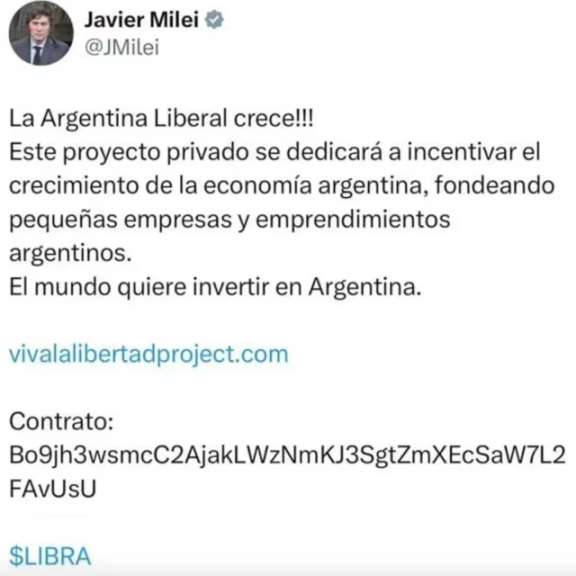
At that time, the hype around the Meme tokens of the US Trump couple had not yet subsided, and the new "presidential concept coin" once again ignited market enthusiasm. The FDV of the LIBRA token soared to a maximum of $4.56 billion within 30 minutes of its launch.

This project, which claimed it would invest token proceeds in Argentine entrepreneurs and education, saw a large number of rat warehouses withdraw liquidity and sell tokens after Milei helped the token price take off, successfully cashing out over $100 million and leaving within an hour or two. At noon Beijing time that day, Milei deleted the tweet and stated that his previous action was merely to support private enterprises and was not related to them, and that after understanding the situation, he decided not to spread the message further.

After the tweet was deleted, the price of LIBRA headed straight to zero without looking back. The entire event started in the early morning Beijing time and was over before the afternoon even arrived.

Even someone as abstract as Trump only dared to issue Meme coins before taking office, but Milei publicly helped promote a Rug project while in office. This kind of "not even pretending" blatant corruption was met with indiscriminate criticism. As the torrent of verbal and written attacks fell, Milei was forced to respond, but these responses seemed more like excuses.

The Argentine presidential office first stated that Milei met with Mauricio Novelli, the representative of KIP Protocol (the entity behind LIBRA) in Argentina, in October 2024. At that time, this representative said that a project named Viva la Libertad would be launched in the future to provide financing support for Argentine private enterprises. Milei's retweet after KIP Protocol launched the LIBRA token was merely to support Argentine entrepreneurs, and he himself was not aware of the details.

In other words, Milei believed LIBRA was a project to help Argentine entrepreneurs, and the retweet was well-intentioned.

Later, Milei himself stated again on a television program that his actions were in good faith, hoping to support any project that could improve the financing situation for technology entrepreneurs, but he was "deceived" because he did not understand the project's situation. Furthermore, Milei shamelessly stated that the vast majority of the deceived investors were Americans and Chinese, and he had not wronged his own citizens.

Finally, Milei even stated that the smear campaign against him was politically motivated and vowed to pursue the matter.

This flimsy explanation was obviously unconvincing: Why would a national president promote a private company without investigation?

Took the Money, But Didn't Fully Deliver

After this national-level scandal occurred, both the Argentine Anti-Corruption Office and Congress launched investigations. The Anti-Corruption Office believed that Milei's action was personal and did not violate public ethics regulations; the congressional investigation committee accused Milei of providing "key cooperation" in the LIBRA incident and recommended that Congress assess whether it constituted misconduct.

However, these investigation results did not reveal details, and the outside world was unclear about what exactly happened.

El Destape's爆料 revealed a key piece of evidence, shedding light on the gray transaction between LIBRA's issuer and the president.

According to the report, investigators recovered an agreement between H (confirmed to be Hayden Davis) and Milei from the phone of Mauricio Novelli, who was referred to by the Argentine presidential office as the "representative of KIP Protocol in Argentina" but was actually a cryptocurrency lobbyist.
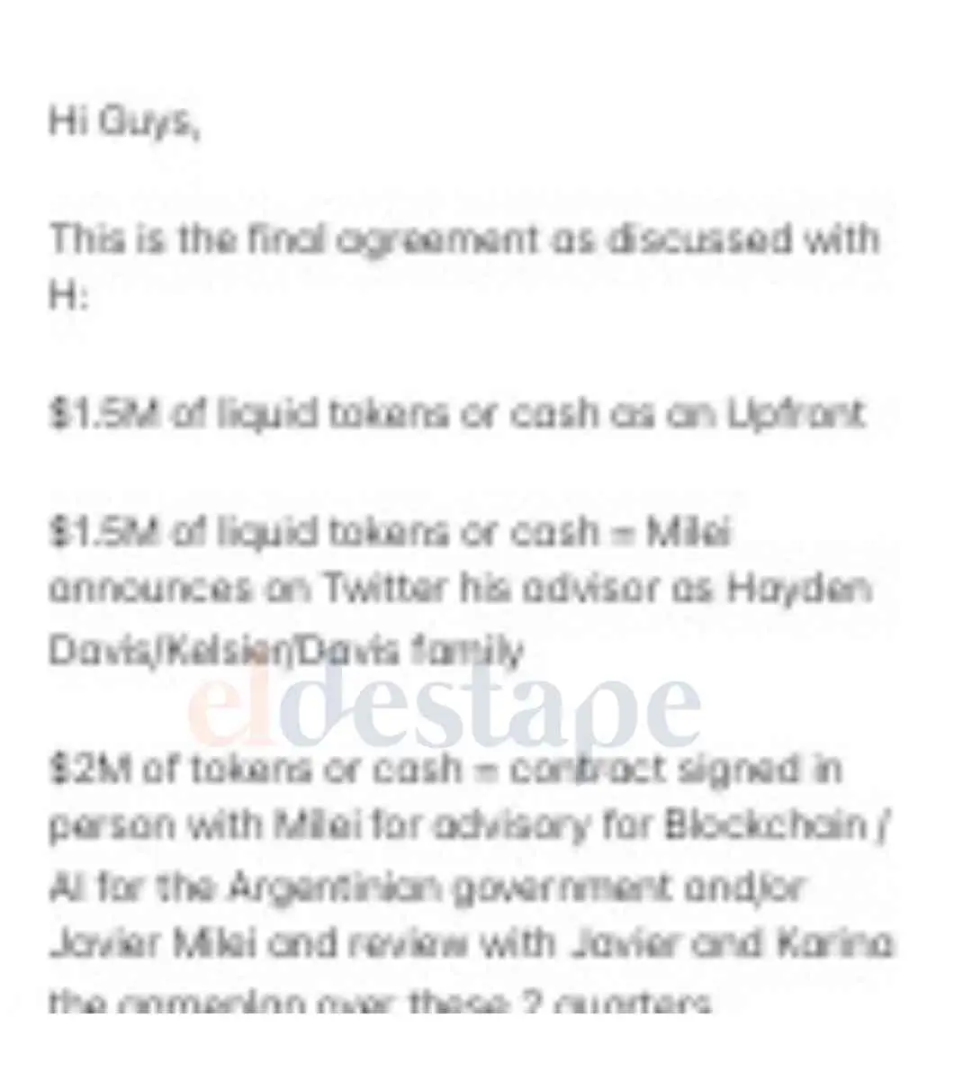
The agreement content shows that Hayden Davis would first pay Milei $1.5 million in liquid tokens or cash as an advance payment. After Milei announced on X that Hayden Davis/Kelsier/Davis family were his advisors, another $1.5 million in liquid tokens or cash would be paid. As for the final $2 million, it required Milei to sign a blockchain/artificial intelligence consulting contract.

The creation date of this file was just three days before Milei posted the promotional LIBRA tweet, and the file came from an expert report by the Argentine General Directorate of Technical Support for Criminal Investigations, but it only appeared in a folder of an attachment.

The secrets found on the phone were far more than just this file; they even included materials related to Milei teaching a cryptocurrency course at a school, which also proved that Milei's claim a year ago that he did not understand cryptocurrency was a pure lie.

In addition, the investigation report also exposed密集的通话记录 (dense call records) between Mauricio Novelli and Milei, as well as Milei's sister (who serves as Secretary General of the Argentine Presidential Office) from a few minutes before to a few hours after Milei promoted the token. Although there was no specific call content, the timing吻合 (coincidence)恰好证明 (just proves) that LIBRA was a premeditated financial scam organized with the involvement of the president.

Judging from Milei's tweet, the cooperation between the two parties may have only reached the first step. Before the tweet announcing that Hayden Davis was his advisor could be sent, the LIBRA incident spiraled out of control, forcing Milei to quickly clarify and distance himself. No wonder Hayden Davis said in an interview with crypto blogger Coffeezilla that Milei was originally supposed to post more interactive tweets, but for some reason the cooperation suddenly stopped.

Bottomless "Open Robbery"

In fact, after the LIBRA incident, some people inferred through on-chain information that Hayden Davis and his Kelsier Ventures were the masterminds behind the incident, and also uncovered that the token MELANIA launched by Trump's wife was also manipulated by him.

El Destape reported that on January 30, 2025, Hayden Davis met with Milei and Milei's sister at the Argentine presidential palace and signed a contract with Milei, making Davis an advisor to the Argentine government in the blockchain field. This contract was also found on Novelli's phone but was concealed by prosecutor Eduardo Taiano and not made known to the relevant parties.

After this agreement was reached, a bank account associated with Davis transferred $1 million to an account with an unconfirmed owner.

So far, we roughly know the whole story:

In October 2024, Mauricio Novelli introduced KIP Protocol (actually controlled by Hayden Davis) to Argentine President Milei, claiming that a project named Viva la Libertad would be launched to provide financing support for Argentine private enterprises, thereby getting closer to Milei.

At the end of January 2025, Hayden Davis, through the introduction of Mauricio Novelli, contacted Argentine President Milei and successfully became the blockchain advisor to the Argentine government. Afterwards, Hayden Davis, through Mauricio Novelli, reached an agreement with Milei: Hayden Davis would pay Milei a total of $5 million in exchange for Milei promoting the Viva la Libertad project and its issued LIBRA token on his personal X account.

Between October 2024 and the end of January 2025, Hayden Davis and Milei may have had more or less contact through Mauricio Novelli and discussed how to promote LIBRA. Milei was probably well aware that this was a pure scam project using cryptocurrency, but the reason he agreed was probably, as Hayden Davis said in an interview, their series of plans would not let this token quickly "rug pull.

But unexpectedly, after Milei posted the tweet, the rat warehouses couldn't wait to cash out over $100 million, quickly triggering a large amount of critical public opinion. Seeing the situation turning bad, Milei chose to cut losses rather than continue the cooperation. As public opinion further发酵 (fermented), the originally win-win situation turned into Milei being left alone in the lurch, while Hayden Davis cashed out and left.

The most terrifying thing about this incident is that Hayden Davis never considered it fraud. In an interview with Coffeezilla, he stated, "In the meme market, this is not illegal. This is what happens in every trade. These are the rules here. People know this, agree to this, and make money from this. If you're going to blame this, I think, for the vast majority of retail traders betting on meme tokens, especially those who get in early, this is the rules of the game in this market. This is not the capital market; this is a casino."

The development process of the industry is never afraid of speculators participating. What it fears is that speculators truly believe the industry is simply a casino for speculation.

This perhaps explains some of the chaos in the Web3 industry in the past two or three years: when schemers don't think they are scheming, they naturally lose all bottom lines. Eventually, projects no longer compare in the simple sense of good or bad, but only in who has the more clever means of "robbing."


Twitter:https://twitter.com/BitpushNewsCN

Bitpush TG Discussion Group:https://t.me/BitPushCommunity

Bitpush TG Subscription: https://t.me/bitpush

Original link:https://www.bitpush.news/articles/7620466

Criptos en tendencia

Preguntas relacionadas

QWhat was the alleged bribe amount that Argentine President Javier Milei received to promote the LIBRA meme coin on Twitter?

AArgentine President Javier Milei allegedly received a bribe of $5 million to promote the LIBRA meme coin on Twitter.

QWho was identified as the mastermind behind the LIBRA meme coin promotion scandal involving President Milei?

AHayden Davis was identified as the mastermind behind the LIBRA meme coin promotion scandal involving President Milei.

QWhat was the fully diluted valuation (FDV) of the LIBRA token shortly after its promotion by President Milei?

AThe fully diluted valuation (FDV) of the LIBRA token surged to a peak of $4.56 billion within 30 minutes after its promotion by President Milei.

QHow did President Milei respond to the backlash after promoting the LIBRA meme coin?

APresident Milei deleted the promotional tweet, claimed he was deceived and acted in good faith to support Argentine entrepreneurs, and alleged that the criticism was politically motivated.

QWhat evidence was recovered from the phone of cryptocurrency lobbyist Mauricio Novelli that implicated President Milei?

AEvidence recovered from Mauricio Novelli's phone included a agreement detailing a $5 million payment plan to President Milei for promoting the LIBRA token, documents related to Milei's cryptocurrency lectures, and records of密集的通话记录 between Novelli, Milei, and his sister around the time of the promotion.

Lecturas Relacionadas

Analysis of the Latest Portfolio Adjustment by the "Top Player" in the U.S. Stock Market: $9 Billion Short on NVIDIA, Shifting Focus to Power and Memory Sectors

AI investor Leopold Aschenbrenner has made a significant portfolio shift, taking a $9 billion nominal short position against top AI infrastructure stocks like NVIDIA, ASML, and Oracle. Simultaneously, he is redirecting capital towards what he sees as the next critical bottlenecks in the AI boom: power, memory, and data center networking, alongside private investments in AI model companies like Anthropic. This move is interpreted not as a call that the AI bubble has burst, but as a rotation within the infrastructure stack. The analysis highlights NVIDIA's recent $25 billion bond issuance as a potential signal, questioning why a cash-rich company would seek external debt despite high profits and increased dividends/buybacks. The core investment thesis is that the initial, crowded "picks and shovels" trade in semiconductors is maturing. The next wave of capital is expected to flow into the physical and logistical constraints of AI expansion: electricity supply, memory chip capacity, data center construction, and enabling technologies like optical networking (fiber) for high-bandwidth communication, where copper remains crucial for short distances. Aschenbrenner's substantial (approx. 20% of fund) private stake in Anthropic is noted as a key part of his strategy—investing directly in the "mine" (AI models) rather than just the "shovels." The discussion concludes that while certain segments may be overvalued, the overarching AI infrastructure demand driven by real product usage remains robust. The most promising long-term investments are seen in essential, non-sexy infrastructure—particularly energy and power companies—whose demand is viewed as a global constant irrespective of AI's cyclicality.

marsbitHace 5 min(s)

Analysis of the Latest Portfolio Adjustment by the "Top Player" in the U.S. Stock Market: $9 Billion Short on NVIDIA, Shifting Focus to Power and Memory Sectors

marsbitHace 5 min(s)

BIT Research: Liquidity is Disappearing, Will Bitcoin Replay the Bottoming Pattern of 2022?

The crypto market is currently in an adjustment phase driven by policy expectations and liquidity shifts. Despite a brief rebound fueled by geopolitical easing and SpaceX's strong IPO performance, unexpectedly hawkish signals from new Fed Chair Kevin Warsh have removed anticipated easing support. Concurrently, stablecoin liquidity is shrinking, with insufficient new capital inflows, pushing the market into a typically quiet summer period. Pricing lacks catalysts for a sustained rally. Daily trading volume has significantly contracted, stablecoin growth has slowed markedly, and the supportive effect of Strategy's (formerly MicroStrategy) STRC preferred stock-financed Bitcoin purchases is fading. Amid policy uncertainty, seasonal weakness, and liquidity contraction, Bitcoin faces near-term downward pressure. Warsh's hawkish pivot and refusal to provide a clear policy outlook have increased risk premiums, historically unfavorable for Bitcoin. Technically, the trend remains bearish below $73,700, with $62,446 as critical support. A break below could accelerate declines, though a prolonged consolidation phase, similar to 2022's bottoming process, is possible. Liquidity is a core constraint. Current daily volume is around $500 billion, roughly 25% of the peak during the July-Oct 2025 rally. The 12-month growth rates for USDT and USDC have fallen to ~20%, with 6-month growth near zero, indicating weak new inflows. Bitcoin ETF and Strategy-driven inflows have also weakened, with a 30-day rolling net outflow. With inflation at 4.2% above the Fed's target, combined hawkish policy, seasonal factors, and liquidity shortages challenge Bitcoin's ability to hold above $60,000. However, this adjustment phase may be forming a cyclical low this summer, potentially setting the stage for the next bull cycle.

marsbitHace 33 min(s)

BIT Research: Liquidity is Disappearing, Will Bitcoin Replay the Bottoming Pattern of 2022?

marsbitHace 33 min(s)

Who Makes the Best Use of Claude Code? The Answer Might Not Be Programmers

Claude Code Usage Report Summary (Based on ~400k sessions) Core Finding: In agentic programming with Claude Code, a clear division of labor has emerged: humans primarily decide *what* to build (planning decisions), while Claude decides *how* to build it (execution decisions). Key Insights: 1. **Effectiveness is not limited to programmers.** In code-generation tasks, success rates for users in non-technical fields (law, finance, management, research) are nearing those of software engineers. What matters most is the user's domain expertise and understanding of the problem to be solved. 2. **Domain expertise drives success and efficiency.** Sessions where users exhibited "expert" proficiency in the task's domain saw verified success rates double compared to "novice" sessions. Experts also delegated more work per instruction, with Claude executing more actions and producing more output. 3. **AI is amplifying, not replacing, domain knowledge.** Claude Code lowers the *implementation* barrier, not the *judgment* barrier. The value of knowing the "what" and "why" is increasing relative to just knowing the "how" to code. 4. **Usage is evolving.** Over a 7-month period (Oct '25 - Apr '26), the share of sessions for debugging halved, while use for software operations, data analysis, and non-code writing roughly doubled. The estimated economic value of typical tasks increased by ~25%. Conclusion: The data suggests coding agents are making programming background less critical for completing technical tasks. However, they reward and amplify deep domain understanding. The ability to successfully direct an AI agent stems more from mastery of a specific field than from coding skill itself. The primary gains come from being competent in a domain; deep specialization adds only marginal additional advantage. This may signal a shift where software creation becomes integrated into various professions.

marsbitHace 1 hora(s)

Who Makes the Best Use of Claude Code? The Answer Might Not Be Programmers

marsbitHace 1 hora(s)

Trading

Spot
Futuros

Artículos destacados

Qué es MEME 2.0

Memecoin 2.0: El Ascenso de $MEME 2.0 en el Mundo de las Criptomonedas Introducción En el panorama siempre cambiante de las criptomonedas, ha surgido un nuevo contendiente. Memecoin 2.0, simbolizada como $MEME 2.0, lleva el concepto de las monedas meme a un emocionante nuevo nivel. Como un subproducto del Memecoin original, este proyecto ha capturado la atención de la comunidad cripto al cambiar el enfoque de los incentivos financieros típicos a una experiencia comprometida y entretenida. Operando en la blockchain de Ethereum, Memecoin 2.0 redefine audazmente la participación de la comunidad en la esfera cripto. ¿Qué es Memecoin 2.0, $MEME 2.0? En su núcleo, Memecoin 2.0 es un proyecto de criptomoneda que prioriza el espíritu comunitario y la diversión asociada con la cultura meme. A diferencia de las criptomonedas convencionales, que se concentran en casos de uso prácticos y beneficios tangibles, Memecoin 2.0 se distingue al abrazar el lado más liviano de la moneda digital. El proyecto existe sin promesas de utilidad, un mapa estructurado o retornos financieros, enfocándose en cambio en fomentar una comunidad vibrante centrada en memes y en el disfrute compartido. Al hacerlo, aprovecha la creciente tendencia de la cultura meme en el espacio en línea, convirtiéndose en un jugador único en el mundo de los activos digitales. Creador de Memecoin 2.0, $MEME 2.0 A pesar de la extensa investigación sobre los orígenes de Memecoin 2.0, la identidad explícita de su creador sigue siendo desconocida. Esta anonimidad no es inusual en la comunidad cripto, donde muchos proyectos son liderados por individuos o grupos que prefieren permanecer en las sombras. La falta de información disponible públicamente sobre el creador podría verse como un movimiento estratégico, poniendo el foco en la participación comunitaria en lugar de la notoriedad individual dentro del espacio. Inversores de Memecoin 2.0, $MEME 2.0 La información sobre los inversores o el respaldo financiero de Memecoin 2.0 es escasa. Esta ausencia de detalles puede sugerir que el proyecto es autofinanciado o que su enfoque en la comunidad en lugar de las estructuras de inversión tradicionales ha atraído a un tipo diferente de apoyo. Dado que el mundo de las monedas meme generalmente involucra una participación más de base en lugar de inversión institucional, este enfoque está alineado con la ética de los proyectos impulsados por la comunidad. ¿Cómo Funciona Memecoin 2.0, $MEME 2.0? Memecoin 2.0 opera completamente en la blockchain de Ethereum, capitalizando sus robustas características de seguridad y escalabilidad. Al aprovechar las fortalezas de Ethereum, Memecoin 2.0 puede ofrecer un entorno seguro para las interacciones de los usuarios, asegurando que las transacciones sean tanto eficientes como rentables. Uno de los atributos únicos de Memecoin 2.0 radica en su estructura impulsada por la comunidad. El valor y la popularidad del token $MEME 2.0 derivan de la participación activa de sus usuarios, en vez de de una utilidad inherente. Este diseño refuerza el enfoque del proyecto en el aspecto de entretenimiento de las criptomonedas, lo que implica que la risa y la participación comunitaria son las verdaderas monedas que impulsan su éxito. Además, el proyecto encaja dentro del ecosistema más amplio de las monedas meme, donde el valor de cada moneda meme oscila basado en la cultura, tendencias y la participación de la comunidad, en lugar de principios económicos tradicionales. Cronología de Memecoin 2.0, $MEME 2.0 Para entender mejor la evolución y los hitos de Memecoin 2.0, aquí hay una cronología que destaca eventos significativos en su historia: 2024: Se reconoce la creación de Memecoin 2.0 como una ramificación del Memecoin original, estableciéndose dentro del contexto próspero de las monedas meme mientras opera en la blockchain de Ethereum. 13 de julio de 2024: Memecoin 2.0 se posiciona oficialmente como una moneda meme centrada en la comunidad en la red de Ethereum, enfatizando su enfoque centrado en el entretenimiento que invita a los usuarios a participar y crecer. Puntos Clave Sobre Memecoin 2.0, $MEME 2.0 Varios rasgos críticos definen a Memecoin 2.0: Enfoque Centrado en la Comunidad: La misión principal de Memecoin 2.0 es crear una experiencia comunitaria divertida y atractiva, capitalizando en el disfrute colectivo derivado de la cultura memética. Construido sobre Ethereum: Operar en la blockchain de Ethereum proporciona al proyecto una infraestructura esencial que garantiza seguridad y escalabilidad. Falta de Utilidad o Hoja de Ruta: En un notable desvío de las criptomonedas tradicionales, Memecoin 2.0 no promete características utilitarias ni retornos financieros, reafirmando su compromiso con la participación comunitaria y el compromiso social. Enfoque en la Cultura Memética: Al abrazar los aspectos humorísticos y culturales del fenómeno meme, Memecoin 2.0 proporciona una plataforma para que los usuarios interactúen con cripto tanto fuera de línea como en línea. Contexto Adicional: La Importancia de las Monedas Meme Las monedas meme han surgido como una clase distinta de criptomonedas, a menudo impulsadas por el humor y un enfoque desenfadado para el comercio. Estas monedas generalmente carecen de una utilidad significativa o hojas de ruta de desarrollo, atrayendo a los usuarios con la promesa de diversión, interacción comunitaria y relevancia cultural. En el panorama del ecosistema cripto más amplio, las monedas meme reviven la importancia de la participación comunitaria, revirtiendo enfoques únicamente motivados por el lucro. Proyectos como Memecoin 2.0 inauguran una era donde el entretenimiento puede armonizar con las aspiraciones financieras, convirtiendo la blockchain en un parque de diversiones para la creatividad y la interacción social. Conclusión Memecoin 2.0, o $MEME 2.0, encarna una nueva ola de criptomonedas que prioriza la participación comunitaria sobre estructuras financieras rígidas. Con un enfoque en el humor y la interacción social, capitaliza sobre la fascinación que rodea la cultura meme. Al operar en la blockchain de Ethereum, Memecoin 2.0 aprovecha las capacidades de la tecnología mientras se mantiene firme en su compromiso con el valor de entretenimiento de la moneda digital. A medida que el espacio alrededor de las criptomonedas continúa evolucionando, Memecoin 2.0 sirve como un testimonio de la noción de que el futuro de los activos digitales podría depender, en gran medida, de experiencias compartidas, risas y sólidas conexiones comunitarias. En el mundo impredecible de las criptomonedas, quizás la alegría pueda ser tan valiosa como la ganancia financiera tradicional.

102 Vistas totalesPublicado en 2024.04.04Actualizado en 2024.12.03

Qué es MEME 2.0

Cómo comprar MEME

¡Bienvenido a HTX.com! Hemos hecho que comprar Memeland (MEME) sea simple y conveniente. Sigue nuestra guía paso a paso para iniciar tu viaje de criptos.Paso 1: crea tu cuenta HTXUtiliza tu correo electrónico o número de teléfono para registrarte y obtener una cuenta gratuita en HTX. Experimenta un proceso de registro sin complicaciones y desbloquea todas las funciones.Obtener mi cuentaPaso 2: ve a Comprar cripto y elige tu método de pagoTarjeta de crédito/débito: usa tu Visa o Mastercard para comprar Memeland (MEME) al instante.Saldo: utiliza fondos del saldo de tu cuenta HTX para tradear sin problemas.Terceros: hemos agregado métodos de pago populares como Google Pay y Apple Pay para mejorar la comodidad.P2P: tradear directamente con otros usuarios en HTX.Over-the-Counter (OTC): ofrecemos servicios personalizados y tipos de cambio competitivos para los traders.Paso 3: guarda tu Memeland (MEME)Después de comprar tu Memeland (MEME), guárdalo en tu cuenta HTX. Alternativamente, puedes enviarlo a otro lugar mediante transferencia blockchain o utilizarlo para tradear otras criptomonedas.Paso 4: tradear Memeland (MEME)Tradear fácilmente con Memeland (MEME) en HTX's mercado spot. Simplemente accede a tu cuenta, selecciona tu par de trading, ejecuta tus trades y monitorea en tiempo real. Ofrecemos una experiencia fácil de usar tanto para principiantes como para traders experimentados.

221 Vistas totalesPublicado en 2024.12.12Actualizado en 2026.06.02

Cómo comprar MEME

Discusiones

Bienvenido a la comunidad de HTX. Aquí puedes mantenerte informado sobre los últimos desarrollos de la plataforma y acceder a análisis profesionales del mercado. A continuación se presentan las opiniones de los usuarios sobre el precio de MEME (MEME).

活动图片