POLY's Appearance Hints Are Getting Denser, How Far Away Is the Polymarket Airdrop?

Odaily星球日报Publicado a 2026-05-19Actualizado a 2026-05-19

Resumen

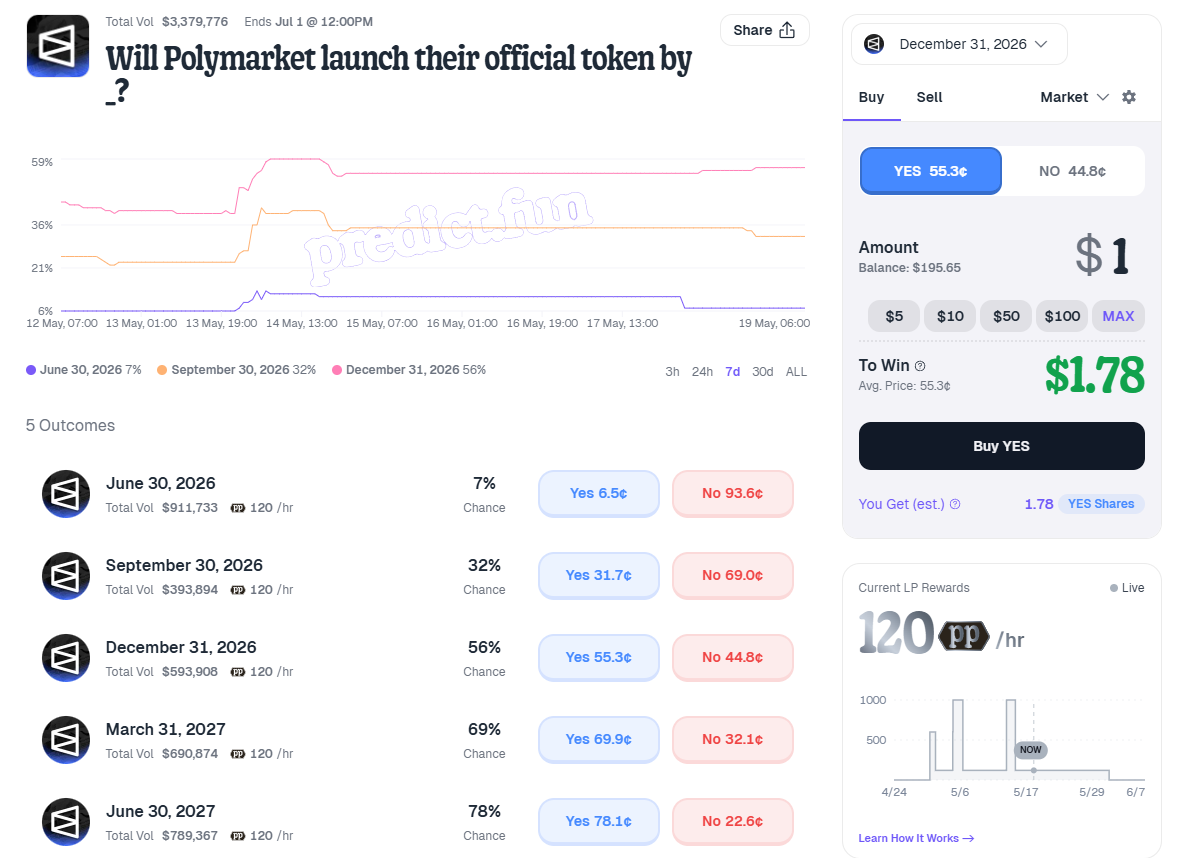
**POLY Debut Hints Grow More Frequent: How Far is the Polymarket Airdrop?** Recent continuous hints from Polymarket team members regarding the POLY token have sparked widespread analysis within airdrop communities about its launch timeline and potential scale. According to predict.fun data, the probability of "Polymarket launching its official token before year-end 2025" currently stands at 56%. Hints about POLY began in October 2024. CEO Shayne Coplan's social media post mentioning $POLY alongside major cryptocurrencies first fueled speculation. This was followed by Growth Lead William LeGate discussing "prospective airdrop farmers," and CMO Matthew Modabber explicitly confirming that "Polymarket will have a token, and there will be an airdrop." The momentum continued into 2025. In April, major crypto data platforms CoinGecko and CoinMarketCap created placeholder pages for POLY, further solidifying expectations. May saw discussions shift towards token utility and airdrop criteria. A team member's "Soon" reply to a question about staking POLY for fee reductions, and a leaked internal screenshot showing an "Airdrop" tab, significantly increased anticipation. LeGate also outlined potential airdrop qualifiers, mentioning badges for employees, high-volume/high-profit traders, and ecosystem builders. He suggested that linking a Polymarket account to X (Twitter), sharing trades and market insights, and actively engaging with the community might constitute part of the eligibilit...

Original | Odaily Planet Daily (@OdailyChina)

Author | Asher (@Asher_0210)

Recently, due to continuous hints from Polymarket's official team members regarding POLY token-related content, major airdrop farming communities have analyzed the timing and scale of a potential POLY airdrop from various angles. According to data from predict.fun, the probability of the event "Polymarket will launch its official token before the end of this year" is currently reported at 56%; there is even a 7% probability that "Polymarket will launch its official token before Q2 this year."
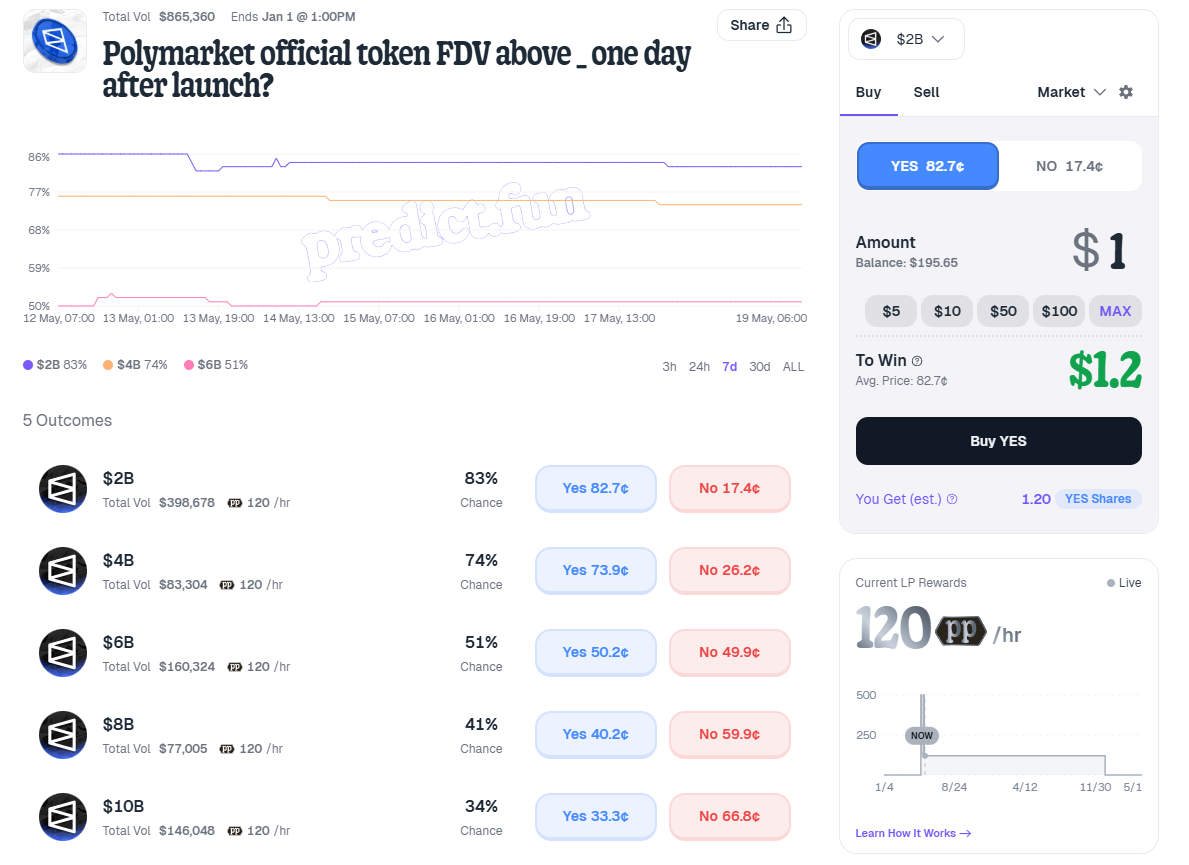
Furthermore, regarding market cap, the probability of the event "Polymarket's FDV exceeds $6 billion one day after launch" is currently reported at 51%; there is a 34% probability that "Polymarket's FDV exceeds $10 billion one day after launch."
Timeline of Polymarket's Official Token Hinting

October 2025: Initial Hints and Official Confirmation of the POLY Token

Signals from the Polymarket official team about the POLY token can be traced back to October last year.

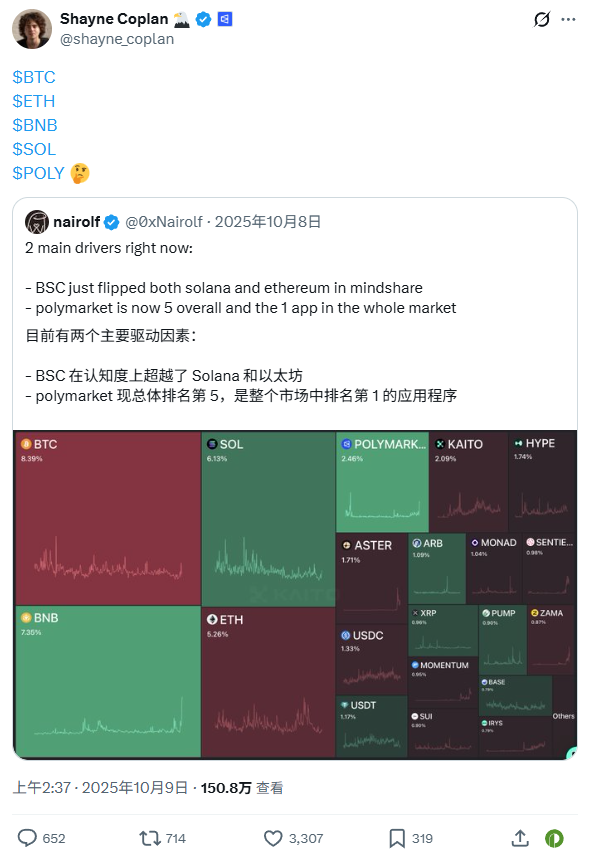
On October 8, 2025, Polymarket CEO Shayne Coplan posted on platform X, listing POLY alongside BTC, ETH, BNB, SOL, sparking community speculation about a Polymarket token launch. Although this was not an official token announcement, for the market, the founder personally writing $POLY was sensitive enough. After that, community discussion about a Polymarket token launch began to noticeably heat up.
Subsequently, the airdrop expectation was further brought into public discussion by official team members. On October 23, 2025, Polymarket Growth Lead William LeGate mentioned "prospective airdrop farmers" in a podcast or related discussion. While not an official rules clarification, this acknowledged the existence of user behavior and expectations surrounding a potential Polymarket airdrop in the market.

What further solidified the POLY token expectation was on October 24, 2025. Polymarket CMO Matthew Modabber explicitly stated in a podcast, "Polymarket will have a token, and there will be an airdrop." This statement became a key turning point for Polymarket's token expectation, shifting from community speculation to official confirmation.

After entering November, the focus of official discussions began to shift from whether there would be an airdrop to what kind of behavior would NOT qualify for an airdrop. On November 11, 2025, William LeGate explicitly stated in response to Sybil farming, "I can tell you for sure that these Sybil accounts will not get airdrop allocations. They are wasting their time."

April This Year: Major Price Tracking Platforms Launch POLY Preview Pages

Entering April this year, the POLY token expectation extended to major crypto price-tracking websites.

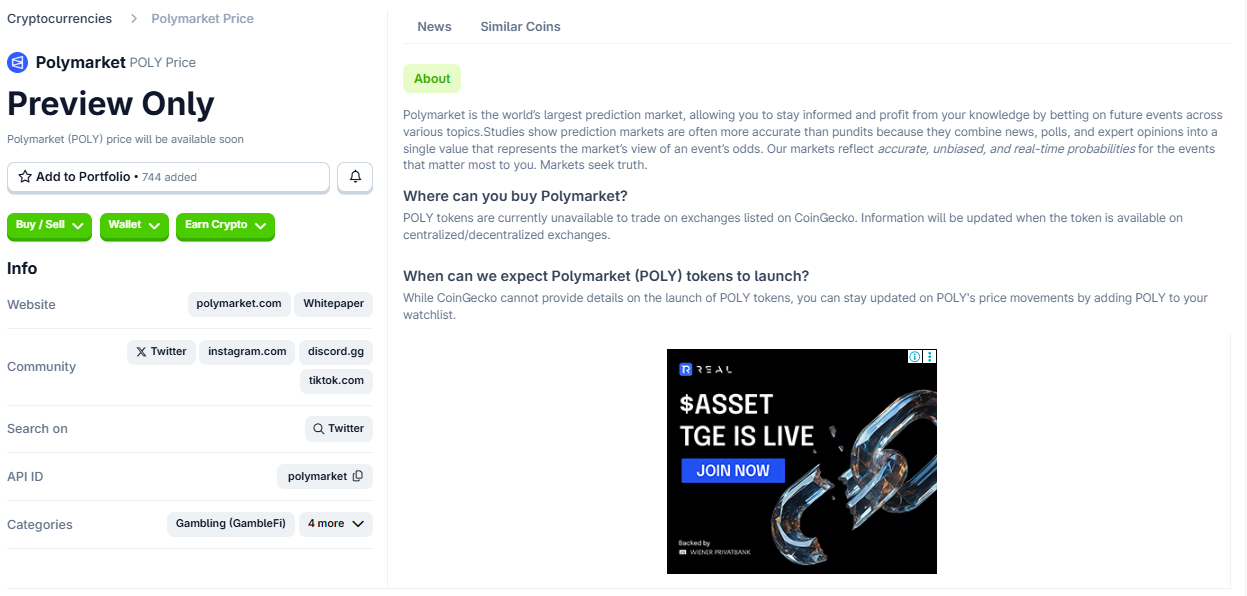
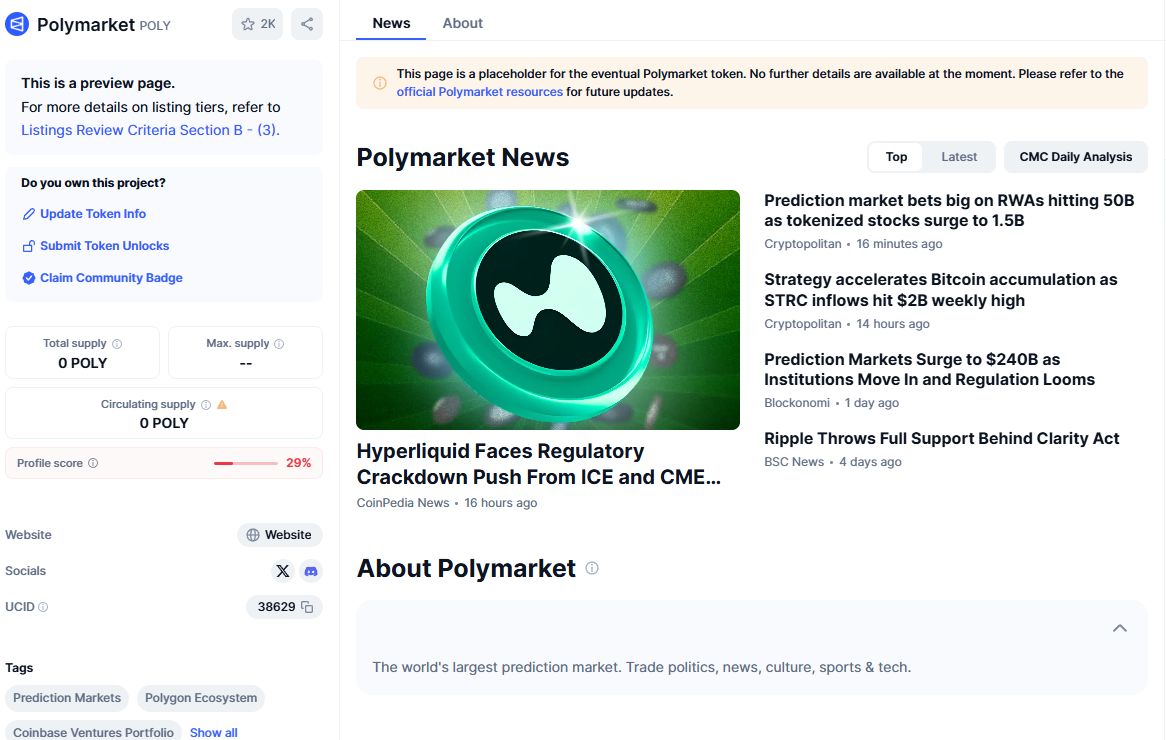
Currently, preview pages for Polymarket (POLY) have appeared on both CoinGecko and CoinMarketCap. While these pages do not equate to the formal token launch and do not represent an announced TGE date by Polymarket, the fact that external price-tracking platforms are reserving space for $POLY further reinforces the community's expectation for a Polymarket token launch.
May This Year: POLY Token Moves from Airdrop Expectation to Product Hinting

After entering May, discussions about the POLY token have progressed further towards specific functionalities and airdrop eligibility.

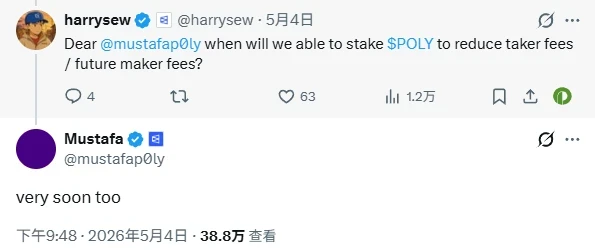
On the evening of May 4, Polymarket official team member Mustafa responded to a question about the POLY token during a community interaction. A user asked when it would be possible to stake POLY to reduce taker fees or potentially future maker fees. Mustafa replied: "Soon." The community quickly interpreted this official response as an indication that Polymarket is preparing for the token's launch.
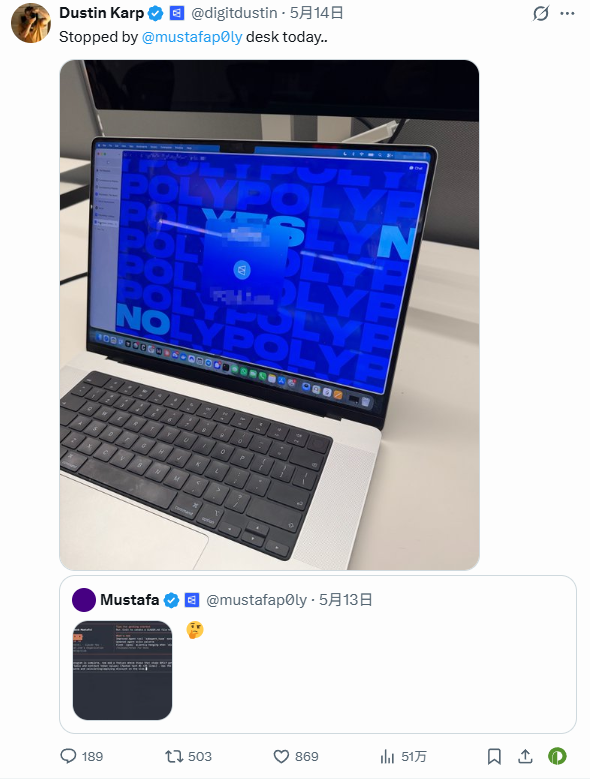
On May 13, more clues around the POLY token emerged. Polymarket Product Lead Dustin Karp posted a photo of a workstation, saying he passed by Mustafa's desk. The photo appeared to show an internal page related to the POLY token airdrop. Upon zooming in, the community spotted an "Airdrop" label, further increasing expectations for the POLY token airdrop.
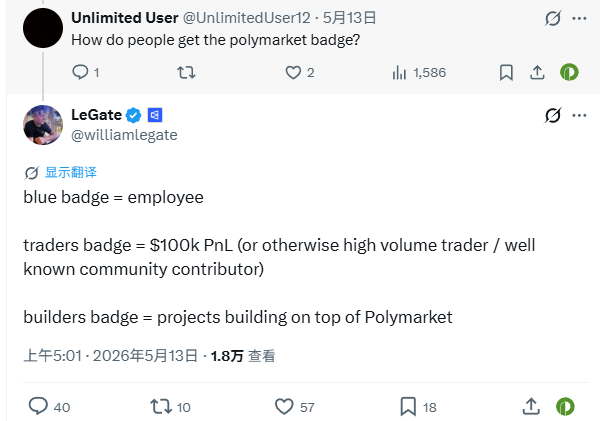
Subsequently, Polymarket Growth Lead LeGate also responded in a community discussion regarding official badges. LeGate replied that blue badges represent Polymarket employees; Traders badges are mainly for traders with cumulative profits reaching $100,000, or other high-volume users (in other tweet replies he mentioned transaction volume exceeding $10 million, adding that if users are active traders on Polymarket, profit amounts and transaction volumes could be slightly adjusted), and notable community contributors; Builders badges are for projects developing and building based on the Polymarket ecosystem.
Badges may not be the sole criterion for receiving an airdrop. The community inquired whether X content contributions would be rewarded with POLY tokens. LeGate replied that connecting an X account to a Polymarket account is only one-third of the conditions. Additionally, users should perhaps also put their Polymarket profile link in their X bio, actively share their trades, profit records, and market views on X, and engage with the community.
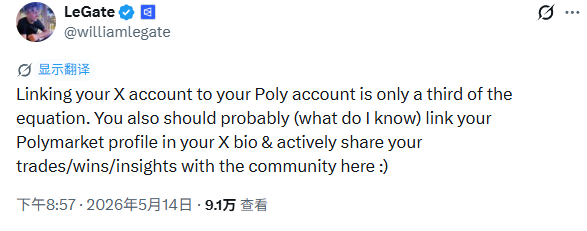
Although this reply did not explicitly confirm whether "jaw farming" (creating content for potential airdrops) would actually yield an airdrop, major communities are relatively optimistic and are actively posting Polymarket-related content on X to vie for potential token airdrops.

Personal Strategy

For me, having been deeply involved in prediction markets throughout the first half of this year, I still lean towards Polymarket not launching its token before the World Cup.

The reason is simple: Polymarket's more important task right now might not be launching a token immediately, but first refining the trading experience and infrastructure. Whether it's the continuous optimization of the V2 version or even changing chains, the essence is to prepare for high-traffic, high-frequency trading scenarios like the World Cup. For Polymarket, if the platform experience is unstable during the World Cup, launching a token beforehand might not effectively capture new users and trading volume.

Therefore, recent trading has primarily been hedging: placing orders for points on predict.fun, and then hedging the acquired positions on Polymarket. At the same time, I participate in various events on Polymarket with the goal of making profits. Additionally, I will bind my personal X account information on Polymarket and post Polymarket-related content on X, hoping that future token launches might allocate a portion of airdrops to "jaw-farming users."


Preguntas relacionadas

QWhat are the key pieces of evidence from Polymarket officials that have fueled speculation about a POLY token airdrop?

AThe evidence includes: CEO Shayne Coplan mentioning $POLY alongside major cryptocurrencies in Oct 2025; CMO Matthew Modabber explicitly confirming 'Polymarket will have a token, and there will be an airdrop' in late Oct 2025; Growth Lead William LeGate discussing 'prospective airdrop farmers'; internal screenshots from May 2026 showing 'Airdrop' labels; and LeGate outlining potential airdrop criteria like linking X accounts and active community participation.

QAccording to the prediction market data in the article, what is the perceived likelihood and potential valuation of a POLY token launch?

AAccording to predict.fun data: There is a 56% probability that Polymarket will launch its official token before the end of the year. There is a 34% probability that its Fully Diluted Valuation (FDV) will exceed $10 billion one day after launch, and a 51% probability it will exceed $6 billion.

QWhat specific user behaviors does the article suggest might *not* qualify for a potential POLY airdrop, based on official hints?

ABased on comments from Growth Lead William LeGate, Sybil farming (creating fake accounts to farm airdrops) will not qualify for an airdrop allocation. He stated such accounts are 'just wasting their time.'

QWhat are the three types of official badges mentioned by Polymarket's team, and what do they represent?

AThe three badge types are: 1) Blue Badge: Represents Polymarket employees. 2) Traders Badge: For users with cumulative profits of $100,000+, very high trading volume (hinted at over $10 million), or notable community contributors. 3) Builders Badge: For projects building on or developing within the Polymarket ecosystem.

QWhat is the author's personal prediction regarding the timing of the POLY token launch, and what is their reasoning?

AThe author predicts Polymarket will NOT launch the token before the FIFA World Cup. The reasoning is that Polymarket's priority is likely perfecting the trading experience and infrastructure (like V2 optimizations) to handle the high traffic and transaction volume expected during the World Cup. A stable platform is seen as more critical than an immediate token launch to capitalize on that event.

Lecturas Relacionadas

Ten-Thousand-Word Analysis: From $10 to $290, MRVL Wins the Entire AI Era by 'Not Making GPUs'

Marvell Technology's stock price surged from under $10 in 2016 to a record $290 in June 2026, fueled not by making GPUs, but by dominating AI infrastructure connectivity. This analysis argues the market misvalues MRVL as merely a smaller Broadcom in custom AI chips, overlooking its true, unique position. Marvell's core strength lies in enabling high-speed data flow for AI clusters through three interconnected businesses. First, it holds a commanding ~70% market share in high-speed optical DSPs (essential for data center light modules), a deep-moat business with accelerating growth. Second, its custom AI chip design business serves hyperscalers like AWS, Microsoft, and Google, with a significant revenue pipeline despite lower margins. Third, stable cash flows come from Ethernet switch chips and enterprise storage controllers. Together, they form a full-stack "AI data movement" platform. CEO Matt Murphy's transformative leadership since 2016, involving strategic divestments, key acquisitions (like Inphi for optical DSPs), and securing long-term agreements with major cloud providers, repositioned the company. A pivotal $2 billion strategic investment from NVIDIA in 2026 underscored Marvell's critical role in the AI ecosystem, particularly through collaborations like NVLink Fusion. While Marvell faces risks—including client concentration (losing the Amazon Trainium3 design), lower-margin business mix, competitive threats, insider selling, and complex supply chains—its fundamentals remain strong. The optical interconnect moat is widening with the acquisition of Celestial AI (photonics fabric), and financial metrics show accelerating revenue growth and operating leverage. With a PEG ratio suggesting undervaluation relative to its growth, the thesis is that the market undervalues Marvell's monopolistic position in AI "plumbing" while overemphasizing its competitive custom chip segment. The story transcends investing, symbolizing how in any complex system—from the internet to AI—the value of "connection" ultimately surpasses that of individual "nodes."

marsbitHace 15 min(s)

Ten-Thousand-Word Analysis: From $10 to $290, MRVL Wins the Entire AI Era by 'Not Making GPUs'

marsbitHace 15 min(s)

AI Relay Stations Spark Heated Debate on Zhihu: Behind Cheap Tokens, What Are Users Really Worried About?

A discussion on Zhihu about "AI relay stations" shifted the niche developer topic of "cheap tokens" into broader user awareness. Users moved beyond simply questioning the legitimacy of these services to focus on practical concerns: Where do cheap tokens truly come from? Is the model being accessed the real one? Can relay stations see prompts, code, and API keys? For occasional users, are the risks worth it? The core debate centered less on price and more on trust. A primary worry is model authenticity—the risk of "model swapping," where users paying for a premium model might be routed to a cheaper one, creating an information asymmetry. Others argued that cost comparisons matter; while cheaper than official pay-as-you-go APIs, relay stations may not be the lowest-cost option versus subscriptions, domestic models, or free tiers, making user needs assessment crucial. Speculation about token sources ranged from legitimate bulk discounts to gray-area methods like account sharing or exploiting regional pricing. This opacity makes risk assessment difficult for users. Data security emerged as a critical concern, especially for enterprise use. When processing sensitive information like code, contracts, or client data, the inability to verify a relay station's data handling, retention, or access policies poses significant compliance and confidentiality risks. The evolving consensus suggests relay stations can be used cautiously for low-sensitivity, disposable tasks (e.g., summarizing public info, simple translation). However, they should not be the default for sensitive, professional, or production workflows involving proprietary data, Agents, or automated systems. Recommendations include avoiding large prepayments, not relying on a single service, using test prompts to monitor quality, anonymizing data where possible, and keeping official channels as backups. Ultimately, the discussion framed tokens not just as a billing unit but as a measure of real cost encompassing price, model integrity, data security, and service stability. The popularity of relay stations highlights user demand for affordable access, but the debate underscores a key trade-off: the savings from cheap tokens may come at the price of trust, transparency, and control over one's data and AI experience.

marsbitHace 45 min(s)

AI Relay Stations Spark Heated Debate on Zhihu: Behind Cheap Tokens, What Are Users Really Worried About?

marsbitHace 45 min(s)

In-Depth Research Report on TradFi: The Convergence Wave of Crypto and Traditional Finance

In 2026, the crypto industry is undergoing a profound infrastructure-level transformation—TradFi assets are migrating on-chain at an unprecedented pace. According to CoinGecko's Q1 2026 report, the total value locked (TVL) of tokenized real-world assets (RWA) has surpassed $31 billion, a nearly 4x increase from $7.8 billion at the beginning of 2025, with the sector’s aggregate market capitalization reaching $19.3 billion. Among these, the market cap of tokenized stocks surged from $2 million to $486 million, with Q1 spot trading volume reaching $15.1 billion—a single quarter already surpassing the entire second half of 2025. RWA perpetual contract Q1 trading volume reached a staggering $524.8 billion, far exceeding the $313 billion for all of 2025. Meanwhile, BlackRock's BUIDL fund has reached $2.3 billion in scale and has filed for two new tokenized funds, signaling that the world's largest asset manager's tokenization strategy is evolving from pilot to product suite expansion. HTX, as a core participant in the crypto exchange sector, officially launched TradFi perpetual futures products including NVDA, AAPL, MSFT, META, and SPY in 2026, enabling crypto users to gain 24/7 trading access to core U.S. equities. Boston Consulting Group predicts that global tokenized asset scale could reach $16 trillion by 2030, while McKinsey offers a conservative estimate of approximately $2 trillion. The on-chain migration of TradFi assets is no longer a "future narrative" but a structural transformation unfolding in real time, as crypto exchanges evolve from single crypto asset trading platforms toward "multi-asset-class trading infrastructure."

HTX LearnHace 47 min(s)

In-Depth Research Report on TradFi: The Convergence Wave of Crypto and Traditional Finance

HTX LearnHace 47 min(s)

Trading

Spot
Futuros
活动图片




