Polymarket Rushes to Launch Token with Revenue Data? Sports Market Opens for Fees, Aiming to Become Web3's New "Money Printing Machine"

marsbitPublicado a 2026-02-18Actualizado a 2026-02-18

Resumen

Polymarket, a leading prediction market platform, has begun charging taker fees on sports markets starting February 18, 2026, beginning with NCAA basketball and Serie A. This follows its recent introduction of fees on its 15-minute crypto markets, which already generate over $1.08 million in weekly revenue. With sports accounting for 39% of platform activity and having significantly larger average trade sizes than crypto markets, this move is expected to substantially boost revenue. Conservative estimates project annualized revenue could exceed $200 million after full rollout. The fee model is dynamically designed, charging up to 0.44% for market orders (takers) when event outcomes are most uncertain (50% probability), while limit order makers receive a 25% rebate. This strategy aims to maintain liquidity and competitive low costs compared to traditional sportsbooks. The platform, valued at up to $116 billion in secondary markets, is also preparing for a potential mid-2026 token launch ($POLY trademark filed), with a highly anticipated airdrop. While it faces competition and regulatory scrutiny, its deep liquidity, low fees, and data partnership with NYSE parent ICE (a major investor) form a strong moat for its new revenue "money machine."

Author: Frank, PANews

On February 18, 2026, Polymarket announced that starting from this day, the platform would begin piloting the collection of market order fees in the sports market. The first wave of events covered includes U.S. college basketball (NCAA) and Serie A (Italian football league), with plans to gradually extend to all sports events in the future.

Previously, relying solely on fees from its 15-minute cryptocurrency up/down markets, Polymarket's recent weekly revenue had already surpassed $1.08 million. According to on-chain data, the sports market accounts for nearly 40% of the platform's total trading activity. If converted to annual revenue, fees from the crypto market alone could contribute approximately $56 million in annualized income. Therefore, when the larger share of the sports market also begins charging fees, Polymarket might become the biggest money printer in the crypto space.

PANews conducted an in-depth analysis of Polymarket's fee mechanism, revenue model, competitor benchmarking, and token airdrop expectations.

From "Zero Revenue" to Millions Weekly: The $9 Billion Giant Starts Eagerly Making Money

For a long time, Polymarket operated with almost "zero revenue," as the vast majority of markets did not impose any trading fees. This free strategy brought it astonishing growth: total trading volume for the full year 2025 reached $21.5 billion, accounting for nearly half of the global prediction market volume ($44 billion); the single-month trading volume in January 2026 even hit a record high of over $12 billion.

However, with the upcoming token listing this year, the zero-revenue model clearly could not match its valuation. Its valuation had already reached $9 billion in the latest funding round. In October 2025, Intercontinental Exchange (ICE), the parent company of the New York Stock Exchange, injected a massive $2 billion into Polymarket. According to data from PM Insights, as of January 19, 2026, the implied valuation of Polymarket equity in the secondary market had climbed to $11.6 billion, a nearly 29% increase from the previous funding round. There are reports that the valuation in subsequent funding rounds could reach $12 billion to $15 billion. Such a high valuation requires matching revenue to support it.

The turning point came in January 2026; it was evident that Polymarket had become eager since the start of the year.

In January, Polymarket formally introduced a "Taker Fee" for its high-frequency trading product, the 15-minute cryptocurrency up/down markets, with a maximum rate of 3%. The data showed immediate results: in early February 2026, weekly fee revenue broke through $1.08 million, with the 15-minute up/down markets alone contributing $787,000 in a certain week in January, accounting for 28.4% of the total platform's prediction market fee revenue ($2.7 million) during the same period. To date, Polymarket has generated over $4.7 million in fees, ranking among the top in revenue charts.

The Ingenious Design Behind 0.45%: A Fee Model Not Just for Profit

The fee introduced by Polymarket for the sports market is a carefully designed dynamic fee model.

According to Polymarket's official documentation and community analysis, the sports market fee is only charged on market orders (Taker). Limit orders (Maker) are not only free but also receive a 25% rebate from the Taker fees. Similar to the crypto market fee model, the rate is not a fixed value but fluctuates with changes in event probability:
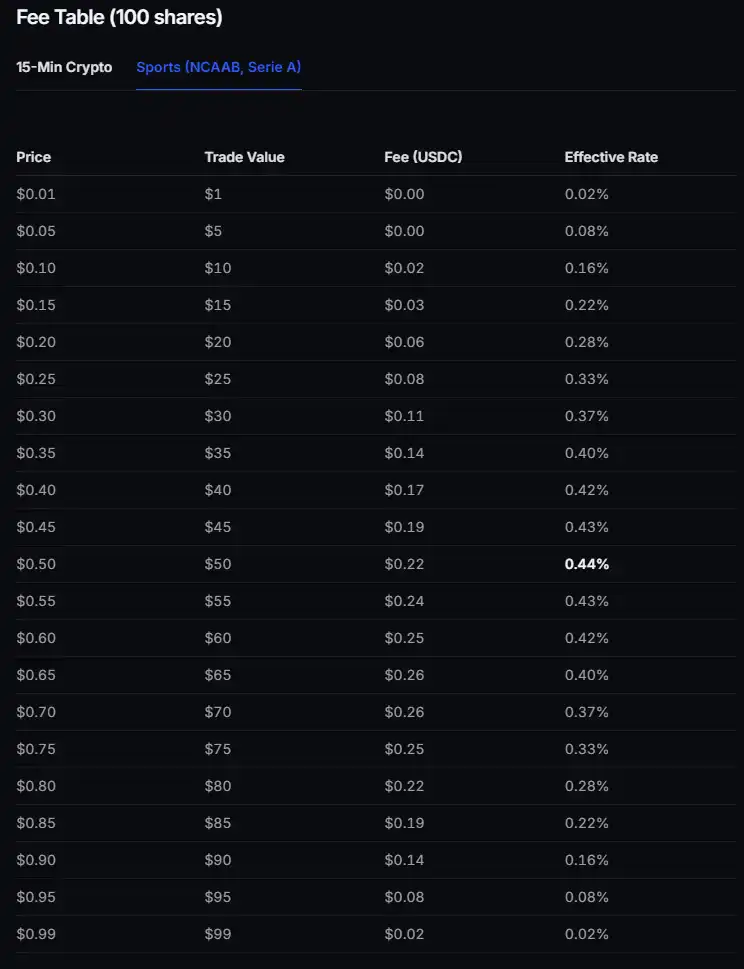
Simply put, the more uncertain the market, the higher the fee, peaking at 0.44% at a 50% probability, and dropping to only 0.13%-0.16% at probabilities of 10% or 90%.

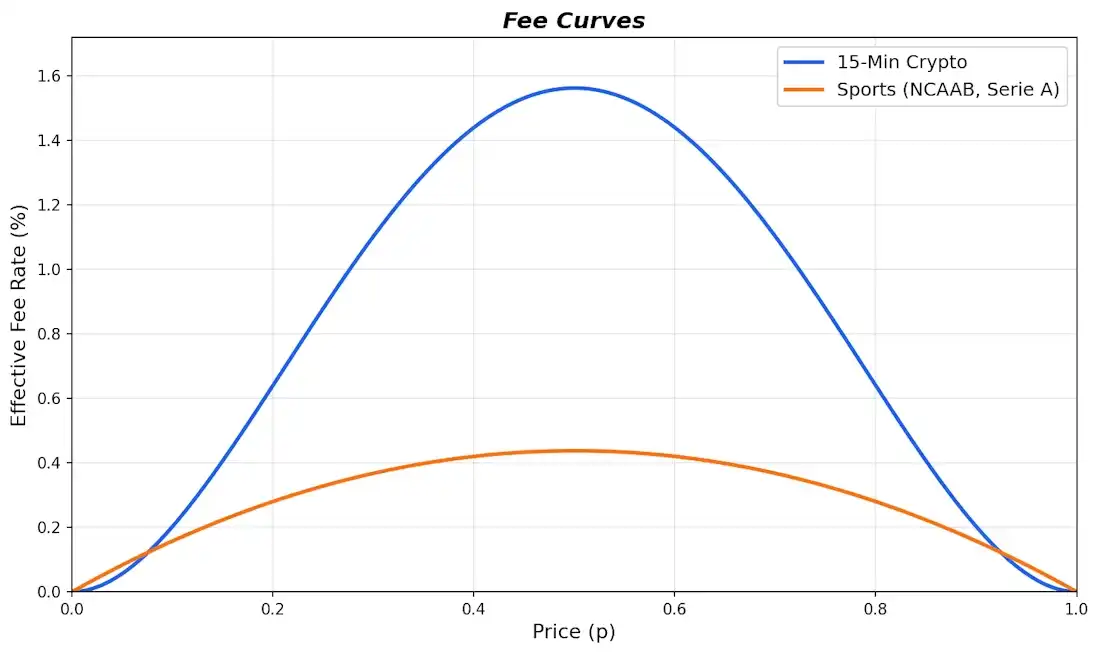
However, by standard, the sports market fee rate is significantly lower than that of the crypto market. Nevertheless, this does not diminish the revenue potential of the sports market.
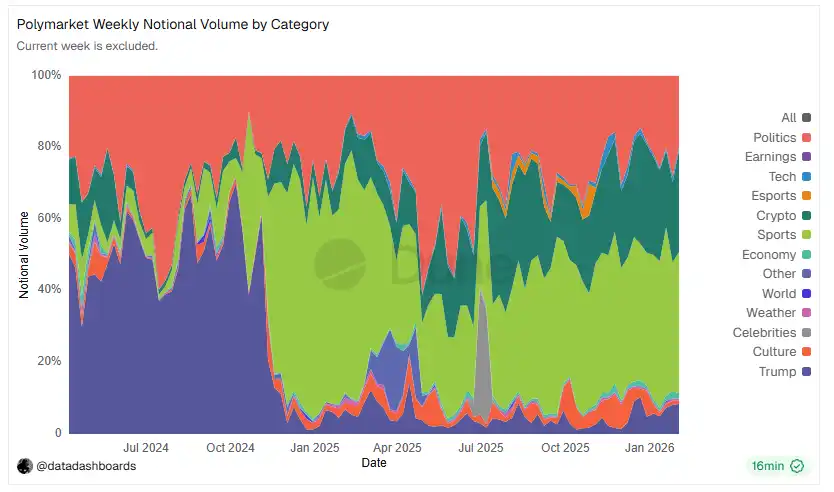
Data shows that sports markets currently account for 39% of Polymarket's total trading activity, surpassing political (20%) and crypto (28%) categories. More crucially, according to previous PANews analysis data, the average trading volume of short-term sports markets on Polymarket ($1.32 million) is 30 times that of short-term crypto markets ($44,000). This means that if fees are fully rolled out in the sports market, revenue will experience massive growth.
Taking the 2026 Super Bowl as an example, Polymarket's total trading volume in related markets reached approximately $795 million, covering various sub-markets such as game outcome, player performance, and halftime show predictions. The total weekly prediction market volume was once driven by sports events to break $6.3 billion.

Based on existing data, PANews constructed three profit forecast scenarios (assuming an average effective fee rate of 0.25% for sports markets, considering probability distribution and free limit orders):
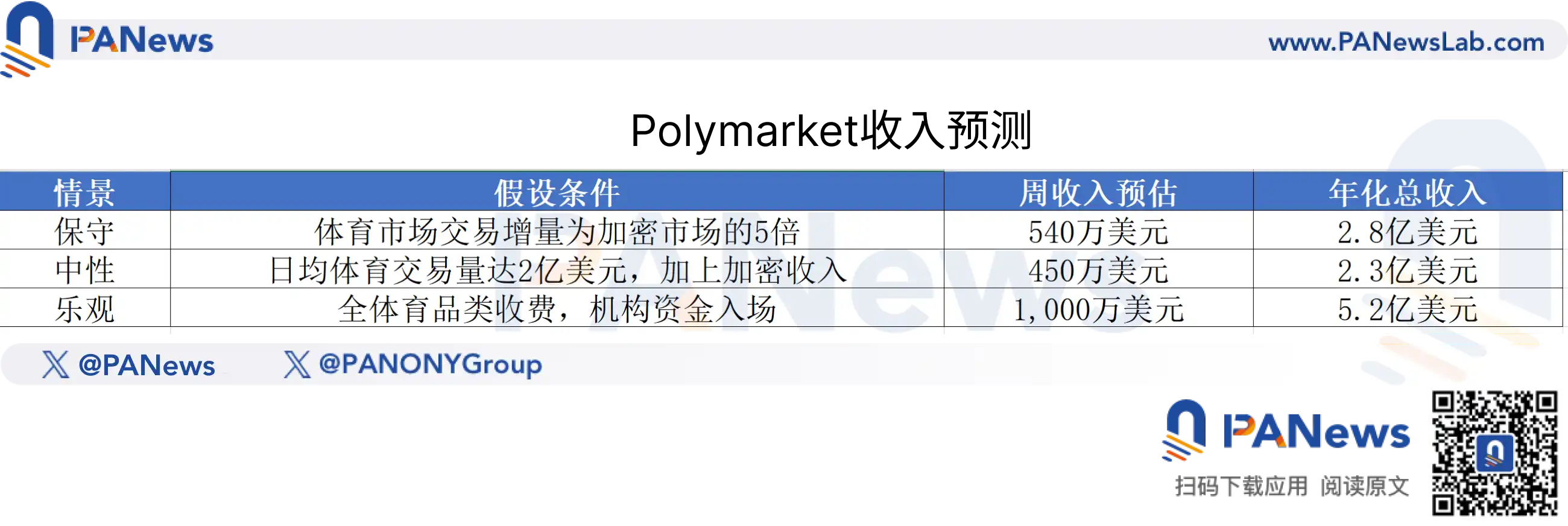
Even under the most conservative estimate, Polymarket's annualized revenue after full fee implementation would exceed $200 million, enough to place it among the highest-revenue protocols in the Web3 space.

While surpassing Tether's treasury interest income or Ethereum mainnet gas fees might be unrealistic, at the application layer, Polymarket has the full potential to compete for the title of "most profitable dApp." Especially considering its user retention rate is as high as 85%, far exceeding that of general DeFi protocols, this high stickiness implies higher quality revenue.

POLY Token and Airdrop: A "Wealth Feast" Worth Billions?

Polymarket's high valuation and massive user base make its token airdrop one of the most anticipated events of 2026.

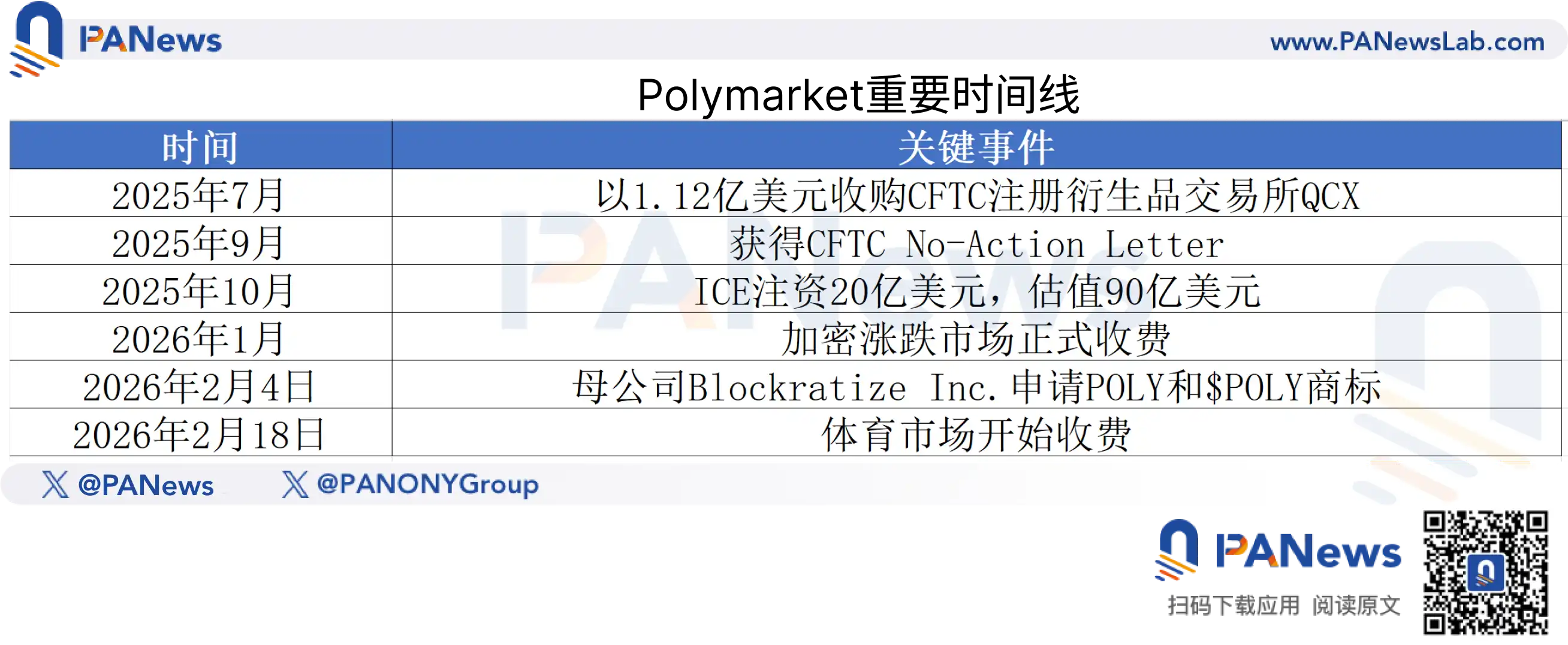
Polymarket's Chief Marketing Officer, Matthew Modabber, has clearly stated: "There will be a token, there will be an airdrop." Market predictions indicate a 62%-70% probability that Polymarket will issue its token before December 31, 2026. Considering the progress of restarting U.S. operations, the Token Generation Event (TGE) is likely to be completed around mid-2026.

On February 4, 2026, its parent company, Blockratize Inc., applied for the trademarks "POLY" and "$POLY," which is also considered by the industry as a significant milestone for TGE. According to general practices in the crypto industry, it typically takes 3-6 months from trademark registration to TGE.
Airdrop Scale May Surpass Hyperliquid; The Era of Volume Farming is Over

Referring to recent airdrop ratios of top projects (Arbitrum, Jupiter, Hyperliquid), the community allocation usually ranges between 5%-15% of the total supply. PANews calculated based on different valuation assumptions:
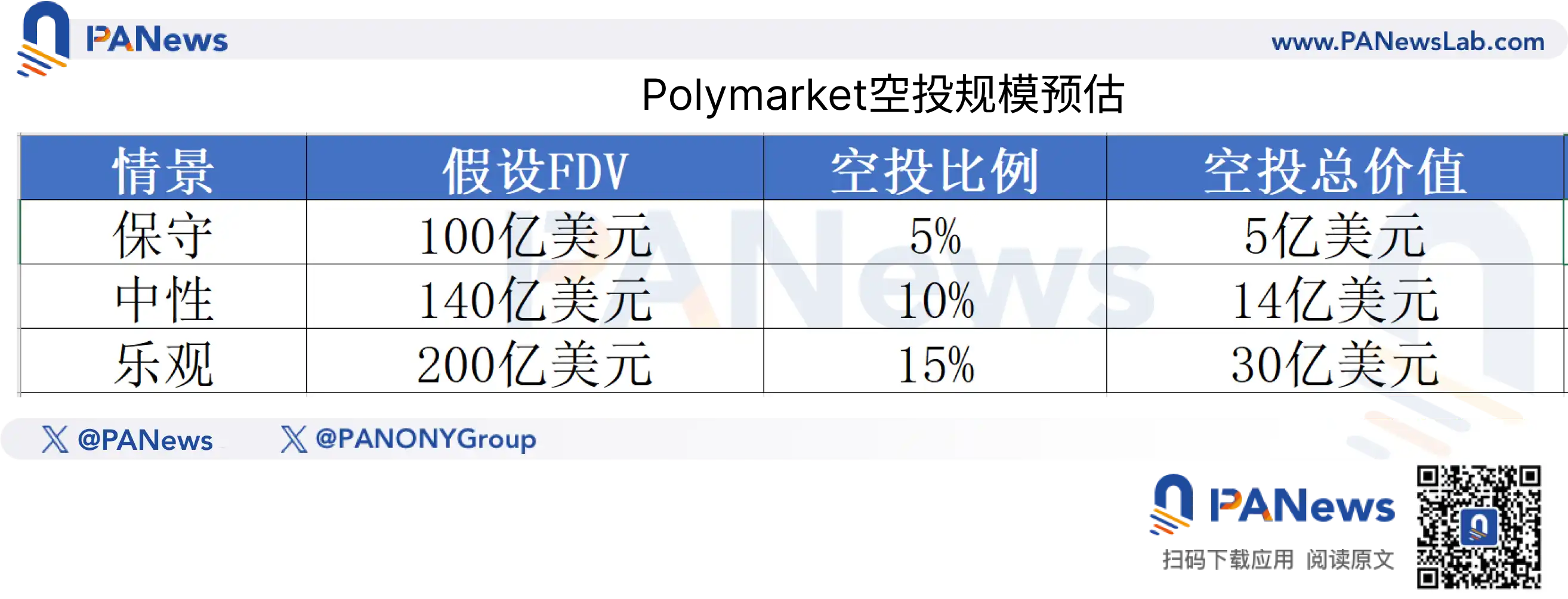
If the total airdrop is $1.4 billion, and assuming there are 500,000 eligible active addresses, the average airdrop value per account could be around $2,800. However, according to the "Pareto principle," top users might reap rewards ranging from hundreds of thousands to even millions of dollars, so ordinary retail users need to manage their expectations reasonably.

It is worth noting that, simultaneously with the fee launch, Polymarket introduced a 4% annualized holding reward, with hourly snapshots and daily distributions. This mechanism reveals the project's clear preference: the duration funds are held is far more important than trading frequency.

Moat and Concerns: Where are the Risks for This "Money Printer"?

Charging fees means users incur additional costs. So, what gives Polymarket the confidence to sustain this?

A triple moat is clearly visible: First, the platform possesses unmatched liquidity depth in the prediction market space, which is crucial for large-volume traders. Second, compared to the 5%-10% rake in traditional betting and Kalshi's 1%-3.5%, the peak fee rate of 0.45% still holds an overwhelming cost advantage. Third, ICE's involvement not only brought capital but also data distribution capabilities. ICE plans to integrate Polymarket's real-time prediction data for its global institutional clients, constituting a "second growth curve" beyond trading fees.

However, risks should not be overlooked:

Short-term trading volume fluctuations: Polymarket's monthly trading volume once dropped from a peak of $1.026 billion in November 2025 to $543 million in December 2025. Will fee introduction exacerbate this trend? However, considering the positive effects of increased order book depth and reduced spreads after introducing the Maker Rebate, long-term trading volume might actually increase.

Competitive landscape: Kalshi holds a first-mover advantage in the U.S. compliant market (2025 revenue approximately $260 million). Hyperliquid is attempting to enter the prediction market赛道 through "Outcome Trading" (FDV approx. $16 billion). Predict.fun attracts users with DeFi yield叠加.

Regulatory uncertainty: Although it has obtained a No-Action Letter from the CFTC and acquired the compliant exchange QCX, changes in the U.S. regulatory environment remain the sword of Damocles hanging over the prediction market.

Postscript

From free to fee-based, from crypto up/down markets to global sports events, Polymarket is undergoing a meticulously planned business model upgrade. It already earns millions weekly just from the crypto market, and the sports market—this behemoth accounting for nearly 40% of the platform's volume with liquidity 30 times that of crypto—has only just begun charging. Polymarket's story provides a model worth pondering: a platform's true value might not lie in how much money it is making at the moment, but in its proven ability to charge fees whenever it decides to. When the cake is big enough and the moat deep enough, opening the fee floodgates is only a matter of time.

And for this money printer that's warming up, February 18th was just the start button being pressed.


Preguntas relacionadas

QWhat is the main reason Polymarket is introducing fees for sports markets, and when did this initiative begin?

APolymarket is introducing fees for sports markets to generate revenue that matches its high valuation, which reached $90 billion in recent funding. This initiative began on February 18, 2026, starting with NCAA basketball and Serie A leagues, with plans to expand to all sports events.

QHow does Polymarket's dynamic fee model for sports markets work, and what is the peak fee rate?

APolymarket's dynamic fee model charges only market orders (Taker), while limit orders (Maker) are free and receive a 25% rebate from Taker fees. The fee rate fluctuates based on event probability, peaking at 0.44% when the probability is 50%, and decreasing to 0.13%-0.16% at probabilities of 10% or 90%.

QWhat is the estimated annual revenue for Polymarket if sports markets are fully monetized, according to PANews' analysis?

AAccording to PANews' analysis, if sports markets are fully monetized, Polymarket's annualized revenue is estimated to exceed $200 million, based on a conservative scenario with an average effective fee rate of 0.25% for sports markets.

QWhat are the key factors contributing to Polymarket's competitive advantages or 'moat' in the prediction market space?

APolymarket's competitive advantages include unmatched liquidity depth in prediction markets, a cost advantage with peak fees of 0.45% compared to traditional betting (5%-10%) or competitors like Kalshi (1%-3.5%), and data distribution capabilities through its partnership with ICE, which plans to integrate Polymarket's real-time prediction data for institutional clients.

QWhat is the expected timeline for Polymarket's token generation event (TGE), and what evidence supports this prediction?

AThe token generation event (TGE) for Polymarket is expected around mid-2026, supported by the high probability (62%-70%) of a token launch by December 31, 2026, and the trademark application for 'POLY' and '$POLY' by its parent company Blockratize Inc. on February 4, 2026, which typically precedes a TGE by 3-6 months in the crypto industry.

Lecturas Relacionadas

a16z Partner: Being in the Flow of Capital Is the True Moat

A16z Partner: Standing in the Cash Flow is the True Moat Historically, many of the strongest companies built their moats by positioning themselves within "cash flows"—facilitating value creation and transfer in a network and taking a cut. The more value flows, the larger they grow. Crypto is the first modern technology natively built for this. With open ledgers, programmable settlement, and stablecoins enabling internet-speed global value transfer, it allows startups to inherit network effects from day one. Well-designed tokens align users, developers, and the protocol towards network growth, distributing value to contributors. This model isn't new (e.g., railroads, Visa, Google, AWS) but Crypto democratizes it. It lets entrepreneurs target areas with high inefficiency and profit extraction—like traditional finance's payments, custody, FX, and settlement—to compress costs, increase speed, and redistribute value by standing in the new flow. The opportunity extends beyond finance to emerging markets like GPU/compute, AI training data, energy, and space, where new, programmable infrastructure can be built without legacy constraints. Key questions for founders: Are you already in the cash flow? Does your revenue scale 10x with network activity? Where is profit extraction highest relative to value created in your market? The strategy is clear: compress the old cost structure, position yourself in the new value stream, and let the network compound.

marsbitHace 19 min(s)

a16z Partner: Being in the Flow of Capital Is the True Moat

marsbitHace 19 min(s)

Capturing 15 Top-Tier Zero-Day Vulnerabilities: A Consensus Protocol Debug Agent Framework Built by 0G Lab in Collaboration with Teams from NUS, PKU, and BUPT

"Agents Capture 15 Critical Zero-Day Bugs: 0G Lab's Multi-Agent Framework Automates Debugging in Consensus Protocols" Distributed consensus protocols are notoriously difficult to debug due to complex, intertwined states. A novel framework, Agora, developed by 0G Labs with researchers from NUS, Peking University, and Beijing University of Posts and Telecommunications, tackles this by fusing deep domain expertise with a collaborative multi-agent LLM architecture. Agora moves beyond the limitations of single LLMs and traditional testing like fuzzing. It employs three specialized agents: an Orchestrator for global state, a Strategy agent for generating attack scenarios using distributed systems knowledge, and a TestGen agent that creates executable tests. A core innovation is its efficient "Succinct Memory & Communication" mechanism and a dynamic test harness. This allows the system to translate abstract hypotheses into concrete tests across languages like Go and Rust, run them, capture failures, and refine the approach in a closed loop—all with minimal token overhead. In rigorous evaluations on production-level protocols including Raft, EPaxos, and components from etcd and Sui, Agora discovered 15 previously unknown deep logic bugs (e.g., execution divergence, liveness violations). In stark contrast, powerful standalone LLMs like GPT-5.2 and Claude 4.5 found zero such bugs. Agora achieved this with a high precision of 73.9% and at an average cost of only about $40 per bug found. The framework demonstrates high generalizability. Its decoupled design allows the "Multi-Agent + Hypothesis-Driven Testing" paradigm to be applied to other complex domains like database concurrency control, OS kernels, and Web3 smart contract auditing. By enabling efficient, automated detection of deep logic flaws, Agora points the way for AI-powered security in critical infrastructure, aligning with the growing trends of agentic systems and automated quality control.

marsbitHace 22 min(s)

Capturing 15 Top-Tier Zero-Day Vulnerabilities: A Consensus Protocol Debug Agent Framework Built by 0G Lab in Collaboration with Teams from NUS, PKU, and BUPT

marsbitHace 22 min(s)

a16z crypto Partner: Cash Flow Is the True Moat

Title: a16z Crypto Partner: Capital Flow is the True Moat In business history, enduringly successful enterprises often share a core logic: capturing value by facilitating its creation and transfer within an ecosystem, taking a share of the proceeds. The scale of value flowing through the ecosystem directly correlates with the company's growth. Cryptography is the first modern technology natively suited to this commercial logic. Startups that don't leverage this framework in product design and business model construction miss significant opportunities. Stablecoins enable internet-speed, 24/7 global settlement of value with end-to-end programmability. With open underlying channels for capital flow and transparent unit economics, every circulating dollar globally represents potential flow in this arena. Blockchain is inherently a network business model. All transactions are recorded on a shared ledger, and each new participant strengthens this foundational system for future developers. More users and applications increase the network's value for all. Crypto entrepreneurs start with built-in network effects, unlike traditional businesses that spend years building them on legacy infrastructure. Network tokens amplify this advantage. A well-designed token system aligns users, developers, service providers, and validators around a common goal—network growth—while distributing rewards based on contribution. All proceeds flow back to ecosystem participants, creating a virtuous cycle of value circulation. This is not a new logic; the crypto industry simply makes it easier for startups to implement and scale. Historic giants like railroads, Standard Oil, AT&T, and modern leaders like Google and AWS succeeded by positioning themselves at critical junctures of value flow. In finance, Visa processed $15.7 trillion in payments (net revenue: $35.9B), and top market makers like Jane Street thrive by being in the path of order flow, benefiting from volume. Combining capital flow with network effects creates one of business's most robust models. As Jeff Bezos noted, "Your margin is my opportunity." This is acutely true in traditional finance, where sectors like payments, custody, and settlements extract significant fees (e.g., 2-3% for card networks, 6-9% for cross-border transfers). These profits represent opportunities for disruption by reducing costs and increasing efficiency, as proven by Stripe and Square in payments. Crypto founders can build the next-generation infrastructure: programmable, instant, global, and inherently embedded in capital flow paths. Opportunities extend beyond finance to markets like compute/GPU trading, AI training data, energy, robotics, and critical minerals—areas poised for massive global value movement that existing channels cannot handle. These are blue oceans for new, programmable infrastructure centered on capital flow, free from entrenched platforms and intermediaries. Founders should ask: Is your business at the heart of a value flow? Does your revenue scale 10x with ecosystem transaction growth? Where are the highest margins relative to value created in your target market? The answers point to the opportunity: cut existing costs, enter new value flow arenas, and grow through network effects.

Foresight NewsHace 23 min(s)

a16z crypto Partner: Cash Flow Is the True Moat

Foresight NewsHace 23 min(s)

Unveiling the 'White-haired Stock God' Serenity: A Spiritual Remedy for Anxious Retail Investors

The article details the rise of Serenity, dubbed the "White-Haired Stock God," whose social media posts have recently caused significant volatility in China's A-share market. Previously gaining fame in international retail investor communities, Serenity is known for his "Chokepoint Investment" strategy targeting small monopolies in the AI supply chain, reportedly achieving returns over 3612% this year. His influence stems from his background as a former AI research scientist, detailed analysis, and a massive following on X, where his subscriber count has surpassed Elon Musk's. In early June, Serenity's Chinese-language posts mentioning A-shares like LeaderDrive (Lide Xiebo), Easun, and Innolight triggered immediate 20% surges in their stock prices. He later clarified that some recommendations were crowdsourced from followers and claimed he did not hold positions in these stocks, stating his actions were "just for fun" to offer a foreign perspective on Chinese markets. This activity drew scrutiny from Chinese financial media, which warned of potential "pump-and-dump" schemes and legal risks. While anonymous, clues suggest Serenity is likely a Chinese-speaking individual living in Japan. He maintains his anonymity due to past harassment but enjoys substantial monthly income from his paid subscriptions. The article posits that Serenity embodies the market's current appetite for a charismatic, successful figure during the AI bull run, serving as an "outward projection" of bullish sentiment. It concludes by noting the cyclical nature of such market icons, warning that the same crowds that elevate them often seek scapegoats when trends reverse.

Odaily星球日报Hace 28 min(s)

Unveiling the 'White-haired Stock God' Serenity: A Spiritual Remedy for Anxious Retail Investors

Odaily星球日报Hace 28 min(s)

Unveiling the 'White-Haired Stock God' Serenity: The Mental Elixir for Anxious Retail Investors

The anonymous stock influencer known as "White-Haired Stock God" Serenity has ignited a frenzy in the A-share market. From June 5-9, Serenity's posts on platform X mentioning A-shares like LeaderDrive, Easun, and Innolight triggered sharp price surges, with some stocks hitting 20% daily limits. Serenity, who claims a 3612% personal return this year, gained fame internationally using a "chokepoint investment" strategy focused on small, monopolistic AI supply chain companies. With over 810k X followers, his influence rivals top analysts. His recent foray into Chinese stocks, which he claims is "for fun" to offer a "foreign perspective," has drawn scrutiny. While Serenity denies holding positions in these A-shares and states his posts are not recommendations, his actions have caused significant market volatility. He monetizes through a $1/month subscription, earning an estimated $54k monthly. Facing accusations of market manipulation, he maintains he promotes "information democracy." Community analysis suggests Serenity is likely an English-speaking Chinese national living in Japan, based on his posting patterns and shared personal details. He maintains anonymity due to past harassment. Ultimately, Serenity is seen by many as a manifestation of the current AI bull market's euphoria—a mysterious, seemingly successful figure who fulfills the market's desire for a "stock god," though such personas often face intense scrutiny when market sentiment shifts.

marsbitHace 29 min(s)

Unveiling the 'White-Haired Stock God' Serenity: The Mental Elixir for Anxious Retail Investors

marsbitHace 29 min(s)

Trading

Spot
Futuros

Artículos destacados

Cómo comprar F

¡Bienvenido a HTX.com! Hemos hecho que comprar Synfutures (F) sea simple y conveniente. Sigue nuestra guía paso a paso para iniciar tu viaje de criptos.Paso 1: crea tu cuenta HTXUtiliza tu correo electrónico o número de teléfono para registrarte y obtener una cuenta gratuita en HTX. Experimenta un proceso de registro sin complicaciones y desbloquea todas las funciones.Obtener mi cuentaPaso 2: ve a Comprar cripto y elige tu método de pagoTarjeta de crédito/débito: usa tu Visa o Mastercard para comprar Synfutures (F) al instante.Saldo: utiliza fondos del saldo de tu cuenta HTX para tradear sin problemas.Terceros: hemos agregado métodos de pago populares como Google Pay y Apple Pay para mejorar la comodidad.P2P: tradear directamente con otros usuarios en HTX.Over-the-Counter (OTC): ofrecemos servicios personalizados y tipos de cambio competitivos para los traders.Paso 3: guarda tu Synfutures (F)Después de comprar tu Synfutures (F), guárdalo en tu cuenta HTX. Alternativamente, puedes enviarlo a otro lugar mediante transferencia blockchain o utilizarlo para tradear otras criptomonedas.Paso 4: tradear Synfutures (F)Tradear fácilmente con Synfutures (F) en HTX's mercado spot. Simplemente accede a tu cuenta, selecciona tu par de trading, ejecuta tus trades y monitorea en tiempo real. Ofrecemos una experiencia fácil de usar tanto para principiantes como para traders experimentados.

211 Vistas totalesPublicado en 2024.12.21Actualizado en 2026.06.02

Cómo comprar F

Discusiones

Bienvenido a la comunidad de HTX. Aquí puedes mantenerte informado sobre los últimos desarrollos de la plataforma y acceder a análisis profesionales del mercado. A continuación se presentan las opiniones de los usuarios sobre el precio de F (F).

活动图片












