Polymarket bets surge on Lighter airdrop as Hyperliquid lists LIT

cointelegraphPublicado a 2025-12-23Actualizado a 2025-12-23

Resumen

Lighter, a perpetual decentralized exchange (perp DEX) and rival to Hyperliquid, is generating significant airdrop speculation. A core contributor announced the platform is finalizing its token generation event (TGE), including removing Sybil and wash-trading points from its Season 2 rewards program. Hype intensified when Hyperliquid listed the yet-to-launch LIT token. Lighter opened an airdrop allocation form, allowing users to direct tokens to additional wallets, with submissions accepted until Friday. The transfer of 250 million LIT tokens (25% of supply) further fueled expectations. On prediction market Polymarket, the odds of an airdrop occurring by December 31st have surged to 86%, with $9.5 million in betting volume. Lighter recently raised $68 million in a round led by Founders Fund and Ribbit Capital.

Lighter, a perpetual decentralized exchange (perp DEX) and a major rival to Hyperliquid, is fueling airdrop speculation as Polymarket traders bet on a token launch before year’s end.

Sebas, also known as Babastianj, a core contributor to the Lighter DEX, announced on the project’s Discord channel Monday that the platform is finalizing key processes ahead of the highly anticipated token generation event (TGE).

“We’re in the final stretch of Season 2 and are running data science to remove Sybil, self-trading, and wash-trading points,” he said, adding that all slashed and removed points are planned to be redistributed to the community.

The announcement has fueled growing optimism over Lighter’s airdrop, further amplified with Hyperliquid’s listing of the yet-to-launch Lighter token against USDC (USDC) on Monday.

Lighter’s airdrop allocation form open until Friday

Lighter launched an airdrop allocation form on Sunday, allowing users to direct their tokens to up to four additional wallets.

The optional form lets users allocate different token amounts to each wallet, with submissions accepted through Friday.

“If you do not submit this form and are eligible, the airdrop will be sent to your main Lighter account,” Sebas said on Discord.
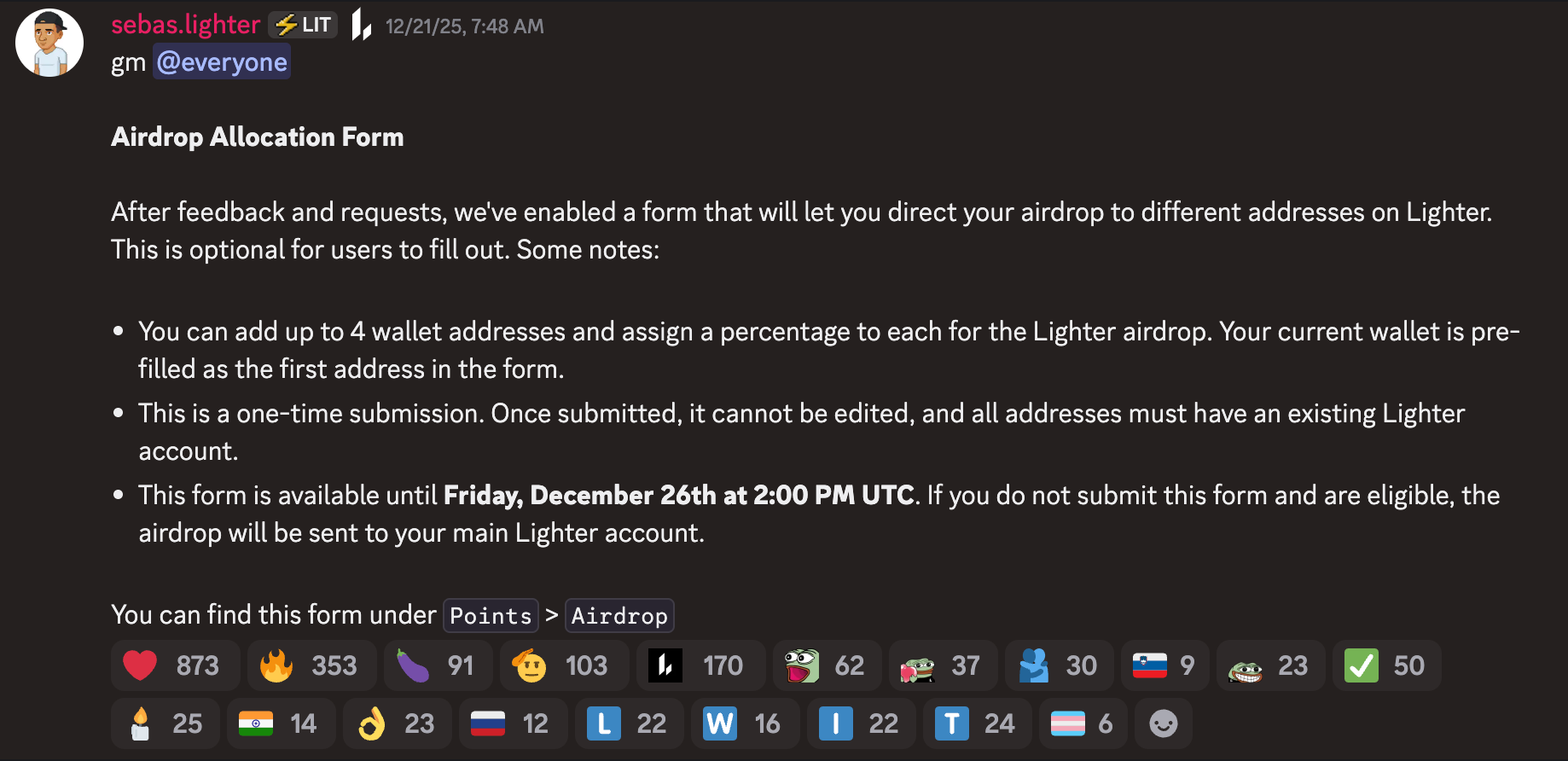
Source: Discord

Lighter transferred 250 million LIT tokens — representing 25% of the total supply — on Friday, sparking community speculation that the move signaled an upcoming user airdrop ahead of the TGE, expected by Dec. 31.
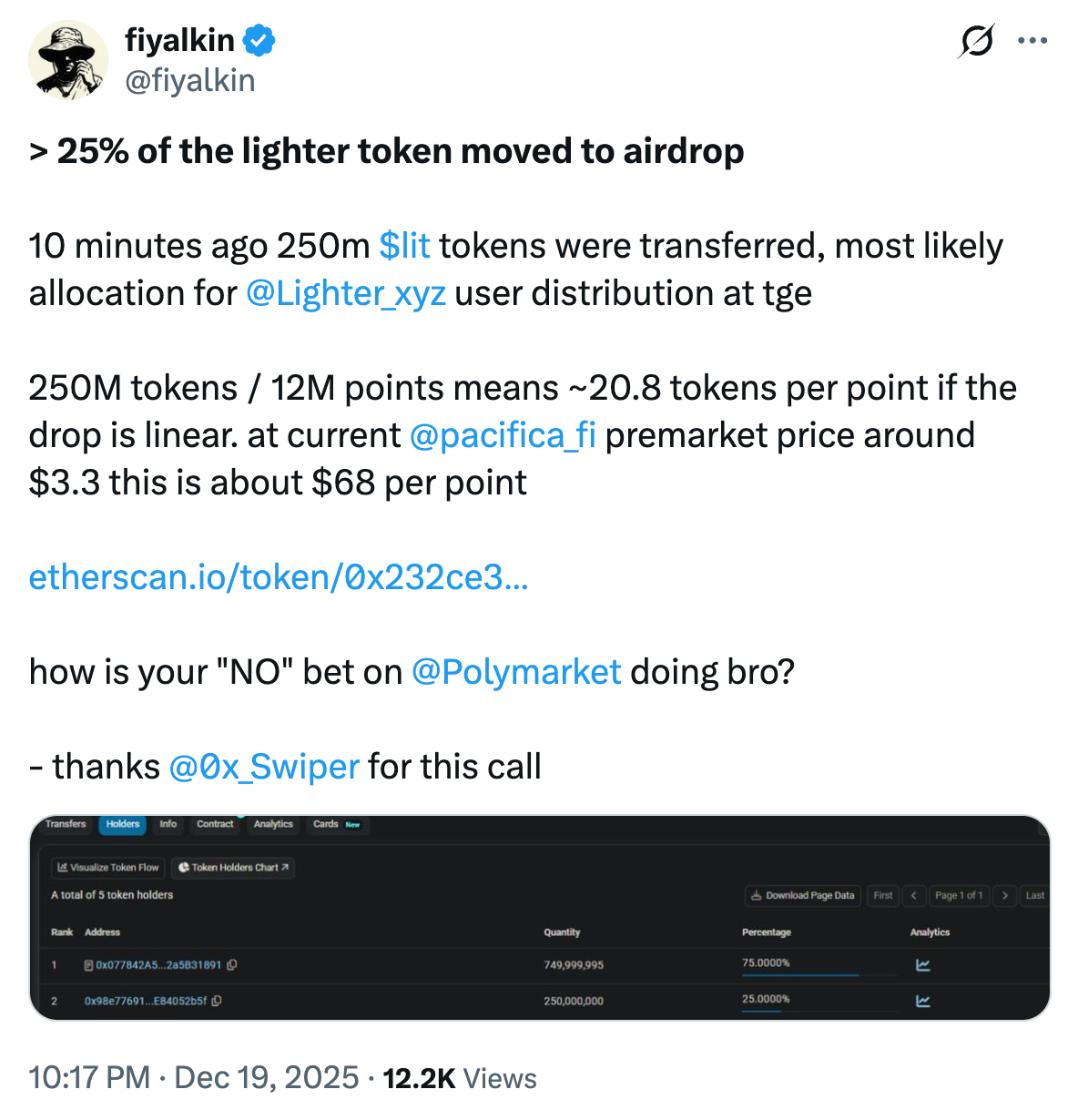
Source: Fiyalkin

According to Lighter, its Season 1 points program ended with the final private beta distribution on Sept. 30, while Season 2 points are distributed every Friday.

Related: Hyperliquid says ex-employee responsible for HYPE token shorting

The points are earned by running organic trading strategies via user interface and application programming interface.

Polymarket odds on Lighter airdrop at 86%

Amid rising community anticipation, the odds that Lighter’s airdrop will occur before the end of the year have been climbing on the prediction market Polymarket, with $9.5 million in volume backing bets that it will take place by Dec. 31.

At least 86% of traders have positioned their predictions on a “yes” scenario.

Onchain analyst Andrew 10 GWEI previously suggested that the airdrop would happen by the end of December, using an alleged insider bet proof on Polymarket.
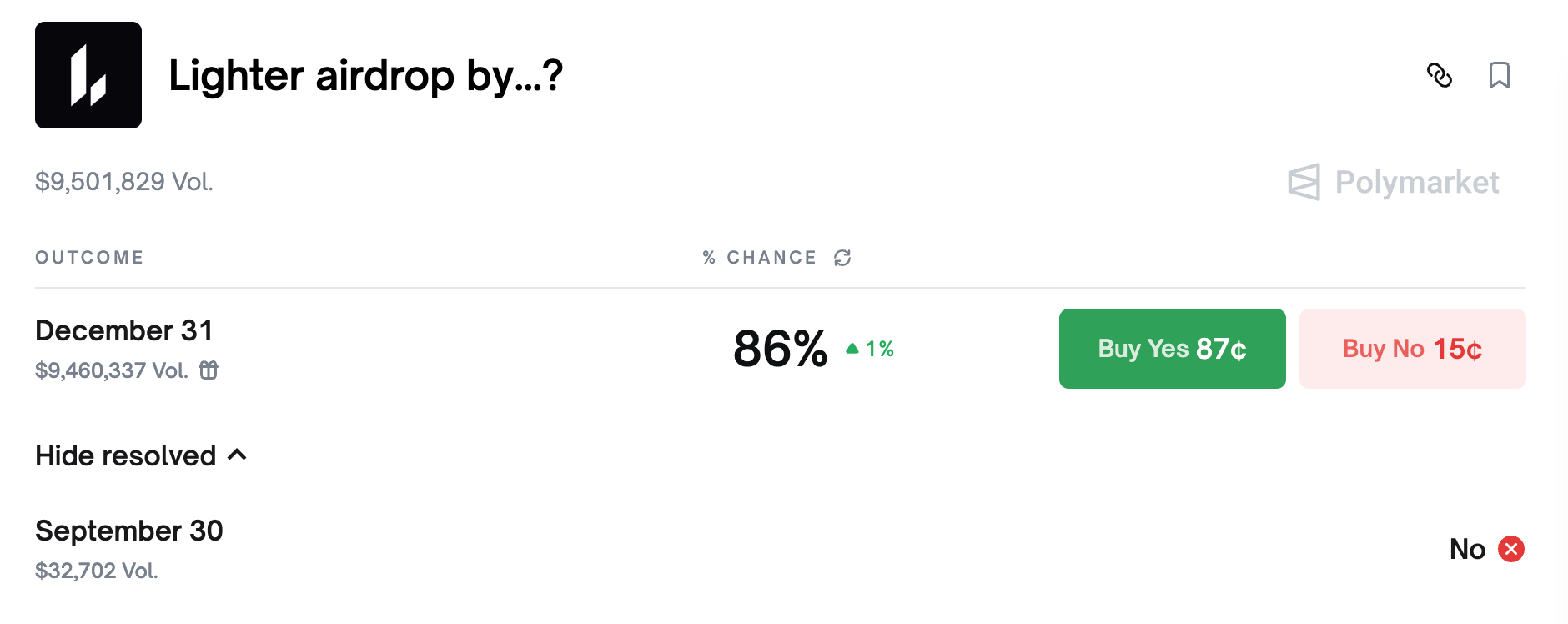
Source: Polymarket

The news follows Lighter’s $68 million fundraising round announced in November, led by Peter Thiel’s Founders Fund and fintech investor Ribbit Capital, shortly after the platform launched its public mainnet in October.

Related: Coinbase opens Solana DEX access as CeFi and DeFi converge

Founded in 2022 by tech entrepreneur Vladimir Novakovski, Lighter has emerged as a key competitor in the perpetual decentralized exchange market, ranking as the second-largest perp DEX after Hyperliquid at the time of publication, according to DefiLlama data.

In mid-December, major US cryptocurrency exchange Coinbase added Lighter to its listing roadmap, signaling a potential future listing of the token, which has yet to be generated.

Preguntas relacionadas

QWhat is the current probability on Polymarket that Lighter's airdrop will occur before the end of the year?

AThe current probability on Polymarket is 86%, with $9.5 million in volume backing bets that the airdrop will take place by December 31st.

QWhat action did Hyperliquid take that amplified the speculation around Lighter's token?

AHyperliquid listed the yet-to-launch Lighter token (LIT) against USDC on Monday, which amplified the growing optimism over the airdrop.

QWhat is the purpose of the airdrop allocation form that Lighter launched, and until when is it open?

AThe optional airdrop allocation form allows eligible users to direct their tokens to up to four additional wallets, with different amounts for each. Submissions are accepted through Friday.

QWhat percentage of the total LIT token supply was transferred recently, and what did this action spark in the community?

ALighter transferred 250 million LIT tokens, representing 25% of the total supply. This sparked community speculation that it signaled an upcoming user airdrop ahead of the Token Generation Event (TGE).

QWho led Lighter's recent $68 million fundraising round?

AThe $68 million fundraising round was led by Peter Thiel's Founders Fund and fintech investor Ribbit Capital.

Lecturas Relacionadas

Bitcoin's 'Rally Ends,' Officially Entering the Later Stage of a Bear Market?

Bitcoin prices declined 13% this week, reversing the recent rebound and signaling a likely transition into the later stages of a bear market. Key on-chain metrics deteriorated, with the short-term holder cost basis falling below the Realized Price—a pattern last seen in early 2022, characteristic of bear market maturity. The rally to ~$82k proved to be a bear market bounce, as evidenced by the 90-day realized profit/loss ratio failing to sustain above the bullish threshold of 2. Daily realized losses surged to $1.35B, including significant selling from long-term holders who accumulated near cycle tops, indicating ongoing supply redistribution. Price was rejected almost precisely at the aggregate US spot ETF cost basis of ~$83k, turning that level into resistance and leaving the average ETF investor underwater again. Spot market selling pressure intensified, with the 7-day volume delta turning significantly negative to its weakest level since February. While a major long liquidation event cleared over $400M in leverage, spot demand has not yet stepped in to absorb the resulting supply. Options markets continue pricing in higher future volatility (elevated volatility risk premium) and maintain a skew toward put options, reflecting persistent demand for downside protection, though not yet panic. Overall, market structure remains fragile. Sustained recovery likely requires a reclaim of the ETF cost basis, a shift back to positive spot demand, and a slowdown in realized loss-taking. Until then, the market risks further downside or extended consolidation within the broader bear trend.

Foresight NewsHace 33 min(s)

Bitcoin's 'Rally Ends,' Officially Entering the Later Stage of a Bear Market?

Foresight NewsHace 33 min(s)

How Risky is the "Death Spiral" of MSTR and STRC?

Summary: This article explores the perceived "death spiral" risk between MicroStrategy (MSTR), its Bitcoin holdings, and its perpetual preferred stock (STRC), drawing comparisons to the LUNA-UST collapse. While both systems feature price anchors, high yields for holders, and potential feedback loops, their core mechanisms differ fundamentally. The MSTR-STRC structure relies on continuous financing to sustain its high dividend payouts, primarily through stock ATM offerings. A negative feedback cycle could occur: falling MSTR stock price makes raising equity capital harder, increasing pressure to sell Bitcoin, which undermines STRC confidence and further depresses MSTR. However, unlike LUNA-UST's automated, direct linkage, the MSTR-STRC loop is weaker and has brakes: STRC dividends can be deferred or rates lowered, and STRC holders have a $100/share liquidation preference in bankruptcy, providing a price floor. The company's sustainability hinges on its ability to continue financing. Its current ~$900 million USD reserves cover only about 6.3 months of its ~$1.71 billion annual interest/dividend burden. The next six months are critical, aligning with both the potential bottom in Bitcoin's four-year cycle and the depletion timeline of its reserves. While a LUNA-style catastrophic collapse is deemed highly unlikely due to structural differences, the key question is whether MicroStrategy can navigate this period through healthy deleveraging to restart its capital engine.

Foresight NewsHace 52 min(s)

How Risky is the "Death Spiral" of MSTR and STRC?

Foresight NewsHace 52 min(s)

How Much Debt Does Strategy Really Have? Is There a Risk of Implosion?

MicroStrategy's Debt Risk: A Turning Point in the "Never Sell" Strategy As of June 3, 2026, MicroStrategy holds 843,706 bitcoins (valued at ~$53.1B) but faces significant financial obligations. Its capital structure includes $6.75B in convertible notes and $15.48B in perpetual preferred stock (led by the $8.5B STRC series), creating an annual payout burden of ~$1.71B. With software revenue at only ~$500M, interest and dividend obligations far exceed operating income. A critical shift occurred in late May 2026 when the company sold 32 bitcoins for ~$2.5M to cover dividends, breaking CEO Michael Saylor's long-standing "never sell" pledge. This symbolic move triggered a sharp decline in both Bitcoin's price and MSTR stock, reflecting market fears about cash flow sustainability. The core of the strain is the STRC perpetual preferred stock, designed as a "permanent loan" with no maturity date but requiring high monthly dividends (currently 11.5%). Its business model relies on a three-part cycle: issuing new STRC shares, using proceeds to buy more Bitcoin and fund a USD reserve, and using that reserve to pay dividends. This cycle depends on continuous investor demand for STRC and Bitcoin's price appreciation. Analysis shows Bitcoin needs to appreciate at least 2.3% annually to cover the $1.71B in yearly obligations at current holdings. With Bitcoin price down ~22% from March 2026 highs, this pressure has intensified. The company's $900M USD reserve can only cover about 7 months of payments if STRC issuance stalls. Key risks are not immediate bankruptcy or forced Bitcoin liquidation (as BTC is not collateral), but rather: 1) The erosion of MSTR's premium to its Bitcoin holdings (mNAV), which would cripple its ability to raise cheap capital; 2) A vicious cycle where stagnant Bitcoin prices reduce STRC demand, draining the USD reserve and forcing BTC sales, further depressing prices. The period from February 2027 to September 2028 is a crucial test, with over $5.9B in convertible notes facing put options or maturity. In essence, MicroStrategy has evolved from a simple Bitcoin holder into a complex financial entity acting like a "private Bitcoin bank," leveraging its BTC holdings to create layered financial products. Its survival depends on maintaining Bitcoin's price trend, its stock premium, and market appetite for its preferred shares. The recent token sale marks not a betrayal of its Bitcoin thesis, but an admission that the leveraged strategy must eventually be paid for.

marsbitHace 1 hora(s)

How Much Debt Does Strategy Really Have? Is There a Risk of Implosion?

marsbitHace 1 hora(s)

Trading

Spot
Futuros
活动图片