Polymarket 2025: In-Depth Report on Six Profit Models, Starting from 95 Million On-Chain Transactions

marsbitPublicado a 2025-12-29Actualizado a 2025-12-29

Resumen

This report analyzes six proven profit strategies on Polymarket, a decentralized prediction market with over 95 million transactions and $21.5 billion in nominal volume in 2025. Based on an analysis of 86 million on-chain transactions, the strategies are: 1. **Information Arbitrage**: Exemplified by a French trader who made $85M on the 2024 US election by conducting unique "neighbor effect" polls, exploiting systematic market pricing errors. 2. **Cross-Platform Arbitrage**: Earning risk-free profits by capitalizing on price discrepancies for the same event across different prediction markets (e.g., Polymarket vs. Kalshi), netting over $40M collectively. 3. **High-Probability "Bonding"**: Consistently buying high-probability outcomes (e.g., >95% certainty) for steady, short-term returns, with potential yields exceeding 1800% annualized. 4. **Liquidity Providing (LP)**: Acting as a market maker to earn spreads and rewards, though returns have diminished post-2024 election due to increased competition and lower rewards. 5. **Domain Specialization**: Achieving high win rates (e.g., 96%) by developing deep expertise in a niche area (e.g., sports, specific event mentions), making infrequent but high-conviction bets. 6. **Speed Trading**: Using automated systems and low-latency tech to profit from brief information advantages, a strategy increasingly dominated by institutional players. The analysis concludes that successful traders systematically identify market inefficienci...

Original Author: Lin Wanwan's Cat (X: @linwanwan823)

On the night of the 2024 U.S. election, a French trader netted $85 million on Polymarket.

This figure surpassed the annual performance of the vast majority of hedge funds.

Polymarket, a decentralized prediction market that has processed over $9 billion in trading volume and attracted 314,000 active traders, is redefining the boundaries of "voting with money."

But first, we must be honest: prediction markets are a zero-sum game.

Only 0.51% of Polymarket wallets have achieved profits exceeding $1,000.

So, what did the winners do right?

I recently wrote a series of strategies and attempted to systematically analyze over 86 million on-chain transactions,

(Data is based on academic research from IMDEA Networks Institute, covering complete on-chain records of over 86 million transactions and 17,218 market conditions from April 1, 2024, to April 1, 2025.

According to Dune Analytics data, Polymarket processed over 95 million transactions in 2025, with a nominal trading volume exceeding $21.5 billion, though there is some double-counting.)

dissecting the position logic and entry/exit timing of top traders,

and summarizing six proven profitable strategies: from the French whale's "neighbor poll" information arbitrage to a high-probability bond strategy with 1800% annualized returns; from cross-platform spread capture to a niche specialization approach with a 96% win rate.

Our retrospective analysis reveals that the common trait of top traders is not "predictive ability,"

but three things:

systematically capturing market mispricing,近乎偏执的严格风险管理, and the patience to build a碾压级 information advantage in a single领域.

If you've read this far, I suspect that sooner or later in 2026, you will try it yourself.

Of course, this is not a guide on "how to gamble,"

but rather aims to provide a systematic strategic framework and replicable methodological reference for prediction market participants, especially beginners.

Keywords: Prediction Markets; Polymarket; Trading Strategies; Arbitrage; Risk Management; Blockchain

I will cover this in five parts. If you only want to see the strategies, jump directly to Part Three.

I. Research Background

II. Evaluation Dimensions and Criteria

III. Six Core Strategies for 2025

IV. Position Management and Strategy

V. Conclusion

I. Research Background

In October 2025, ICE, the parent company of the NYSE, wrote a $2 billion check to Polymarket, valuing it at $9 billion.

A month later, Polymarket acquired a CFTC-licensed exchange, officially returning to the U.S. The "gray area project" expelled by regulators three years prior had become a darling of traditional finance.

The turning point was the 2024 election.

When all mainstream polls were saying "too close to call," Polymarket's odds steadily pointed to Trump. $3.7 billion in bets ultimately predicted the result earlier and more accurately than professional polling agencies. Academia began re-examining an old question: Does forcing people to "put their money where their mouth is" truly elicit more honest judgments?

The first thirty years of the internet created three types of infrastructure: search engines tell you "what happened," social media tells you "what others think," and algorithmic recommendations tell you "what you might want to see." But one piece was always missing: a place that could reliably answer "what will happen next."

Polymarket is filling this gap and has become crypto's first truly breakout application, targeting the rigid demand for "information pricing."

When media outlets start checking odds before writing news, when investors start consulting the market for decisions, when political teams start monitoring Polymarket instead of polls.

It is evolving from gambling toward a form of "pricing consensus."

A market that makes Wall Street pay, regulators relent, and polls sweat is worth serious study.

II. Research Methods and Evaluation Criteria

2.1 Data Sources

This study uses multiple data sources for cross-validation:

(1) Polymarket official leaderboard data;

(2) Polymarket Analytics third-party analysis platform (updated every 5 minutes);

(3) PolyTrack trader tracking tool;

(4) Dune Analytics on-chain data dashboard;

(5) Chainalysis blockchain analysis reports.

Data covers the complete on-chain records of over 86 million transactions and 17,218 market conditions from April 2024 to December 2025.

2.2 Evaluation Dimensions and Weights

Strategy evaluation uses a multi-dimensional comprehensive assessment system, including:

Absolute Profitability (Weight 30%):

Core metric is cumulative profit and loss (PnL),统计策略产生的总利润金额. Data shows that wallets with PnL exceeding $1,000 account for only 0.51% of the total, and whale accounts with trading volume over $50,000 account for only 1.74%.

Risk-Adjusted Returns (Weight 25%):

Calculating metrics like Return on Investment (ROI) and Sharpe Ratio. Excellent traders typically maintain a 60-70% win rate while controlling single-position risk exposure to 20-40% of total capital.

Strategy Replicability (Weight 20%):

Assessing the systematic and rule-based nature of the strategy. Profits purely reliant on insider information or luck are excluded.

Sustainability and Stability (Weight 15%):

Examining the strategy's consistency across different market cycles, excluding "one-hit wonder" gambling-style gains.

Scalability (Weight 10%):

Analyzing the strategy's applicability at larger capital scales, considering liquidity constraints and market impact costs.

2.3 Exclusion Criteria

The following situations are excluded from the best strategy评选:

(1) Suspected market manipulation, such as the UMA token governance attack in March 2025, where a whale holding 5 million UMA tokens (25% voting power) manipulated the settlement of a market worth $7 million;

(2) Gambling-style trades with single positions exceeding 40-50% of capital;

(3) Unverifiable or non-replicable "black box" strategies;

(4) Insider trading relying on non-public information.

III. Review of the Six Core Profit Strategies for 2025

1. Information Arbitrage Strategy: When a Frenchman Understood the Election Better Than All U.S. Polling Agencies

In the early hours of November 5, 2024, when CNN and Fox News anchors were still cautiously saying "the race is tight,"

an anonymous account, Fredi9999, was already showing an unrealized gain of over $50 million.

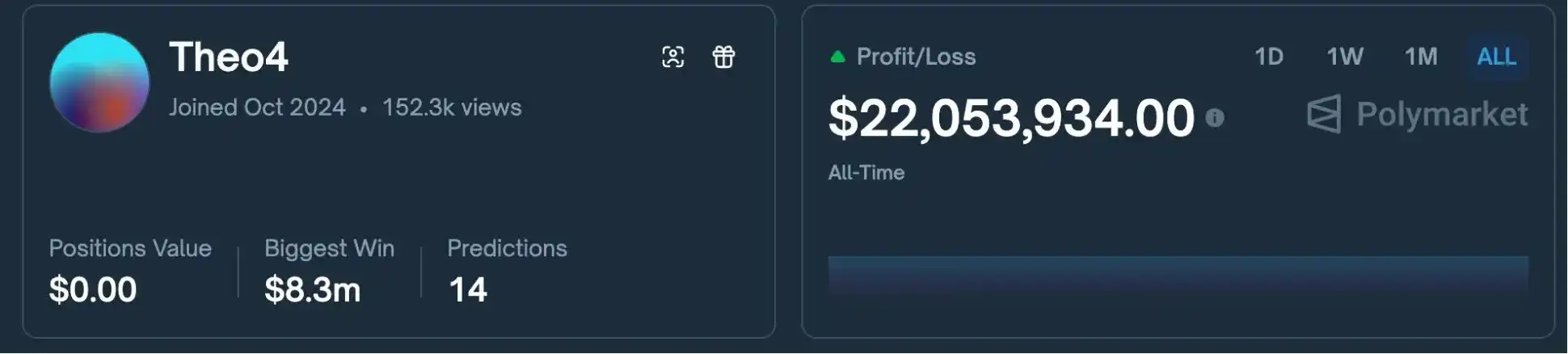
A few hours later, Trump declared victory. This account, along with its 10 associated wallets, ultimately harvested $85 million in profits.

The person behind the account was Théo, a French trader who had previously worked on Wall Street.

When all mainstream polls showed Harris and Trump neck and neck,

he did something seemingly crazy: sold almost all his liquid assets, raised $80 million, and went all-in on Trump winning.

Théo didn't ask voters "who are you voting for," but commissioned YouGov to conduct a special poll in the swing states of Pennsylvania, Michigan, and Wisconsin, asking: "Who do you think your neighbor will vote for?"

The logic of this "neighbor effect" poll was simple: some people are ashamed to admit they support Trump, but they don't mind saying their neighbor does.

The results were "stunningly in favor of Trump." The moment he got the data, Théo went from a 30% position to All-in.

This case reveals the essence of information arbitrage: not knowing more than others, but asking the right questions. Théo spent less than $100,000 on the poll for an $85 million return.

This might be the highest ROI market research in human history. He currently ranks first in total profits on Polymarket.
Replicability Assessment: The barrier to information arbitrage is extremely high, requiring original research methodology, large capital, and the psychological fortitude to stick to your judgment when "everyone says you're wrong." But its core idea—finding systematic biases in market pricing—applies to any contentious prediction market.

2. Cross-Platform Arbitrage Strategy: The Art of "Picking Up Money" Between Two Markets

If information arbitrage is an "intellectual game," cross-platform arbitrage is "manual labor": tedious, mechanical, but almost risk-free.

Its principle is simple enough for a child to understand: the same event sells for $45 in Store A and $48 in Store B. You buy both sides to hedge, profiting from the差价 regardless of the outcome.

From April 2024 to April 2025, academic research recorded a number: arbitrageurs extracted over $40 million in "risk-free profits" from Polymarket. The top three wallets alone made $4.2 million.

A real案例: On a certain day in 2025, for the question "Will Bitcoin break $95,000 within one hour?", the YES price was $0.45 on Polymarket, while the NO price for the same event on competitor Kalshi was $0.48.

A smart trader bought both sides simultaneously for a total cost of $0.93. Whether Bitcoin rose or not, he would get back $1, a 7.5% risk-free return, realized in one hour.

But there is a "critical detail": the definition of the "same event" may differ between platforms.

During the 2024 U.S. government shutdown event, a group of arbitrageurs found that Polymarket resolved "shutdown occurred" (YES), while Kalshi resolved "shutdown did not occur" (NO).

Their supposedly guaranteed hedged positions lost money on both sides.

Reason? Polymarket's settlement standard was "OPM announces shutdown," while Kalshi required "actual shutdown lasting over 24 hours."

Arbitrage isn't just picking up money blindly. Behind every cent of price difference lies the detail of settlement rules.

Replicability Assessment: This is the lowest barrier to entry among the six strategies. All you need is accounts on multiple platforms, some starting capital, and the patience to compare spreads. There are even open-source arbitrage bot codes on GitHub. However, as institutional capital floods in, the arbitrage window is visibly narrowing.

3. High-Probability Bond Strategy: Turning "Almost Certain" into a Business with 1800% Annualized Returns

Most people come to Polymarket for the thrill: betting on dark horses, predicting upsets.

But the real "smart money" does the exact opposite: they专门 buy things that are "already in the bag."

Data shows that over 90% of large orders exceeding $10,000 on Polymarket occur at prices above $0.95. What are these "whales" doing? They are "Bonding," buying almost certain events like bonds.

An example: Three days before the December 2025 Fed meeting, the YES contract for "a 25 basis point rate cut" was at $0.95. Economic data was clear, Fed officials' speeches heavily hinted—no room for surprise. You spend $0.95 to buy, get back $1 upon settlement three days later, a 5.2% return in 72 hours.

5% doesn't sound like much? Do the math: if you can find two such opportunities per week, that's 52 weeks × 2 times × 5% = 520% simple return per year. Considering compounding, annualized returns easily exceed 1800%. And the risk you take is接近 zero.

Some traders, using this strategy, make only a few trades per week and earn over $150,000 annually.

Of course, "almost certain" is not "absolutely certain."

The biggest enemy of the bond strategy is the black swan, those 0.01% probability surprises. One mistake can wipe out the profits of dozens of successes. So the core skill of top bond players is not finding opportunities, but identifying "false certainty": things that look like sure bets but hide risks.

Replicability Assessment: This is the most suitable strategy for beginners. It requires no deep research, no speed advantage, just patience and discipline. But its profit ceiling is also the lowest. When your capital reaches a certain size, there simply aren't enough 95%+ opportunities in the market for you to "harvest."

4. Liquidity Provider (LP) Strategy: Just Earning "Toll Fees"? Not That Simple

Why does the casino always win? Because it doesn't bet against you; it just takes a cut.

On Polymarket, some people choose to "be the casino" rather than "be the gambler"—they are Liquidity Providers (LPs).

The LP's job: place both buy and sell orders on the order book, earning the spread in between. For example, you place a buy order at $0.49 and a sell order at $0.51. No matter who trades, you earn the $0.02 difference. You don't care about the event outcome, only if someone trades.

Polymarket sees new markets every day. New markets are characterized by: poor liquidity, wide spreads, many retail traders. For LPs, this is heaven. Data shows that providing liquidity in new markets can yield annualized equivalent returns of 80%-200%.

A trader named @defiance_cr was interviewed by Polymarket官方, detailing how he built an automated market-making system. At its peak, this system generated $700-800 in profit daily.

He started with $10,000 capital, initially earning about $200 per day. As the system optimized and capital grew, profits increased to $700-800 daily. The core was utilizing Polymarket's liquidity reward program, where placing orders on both sides of the market could yield nearly 3x the rewards.
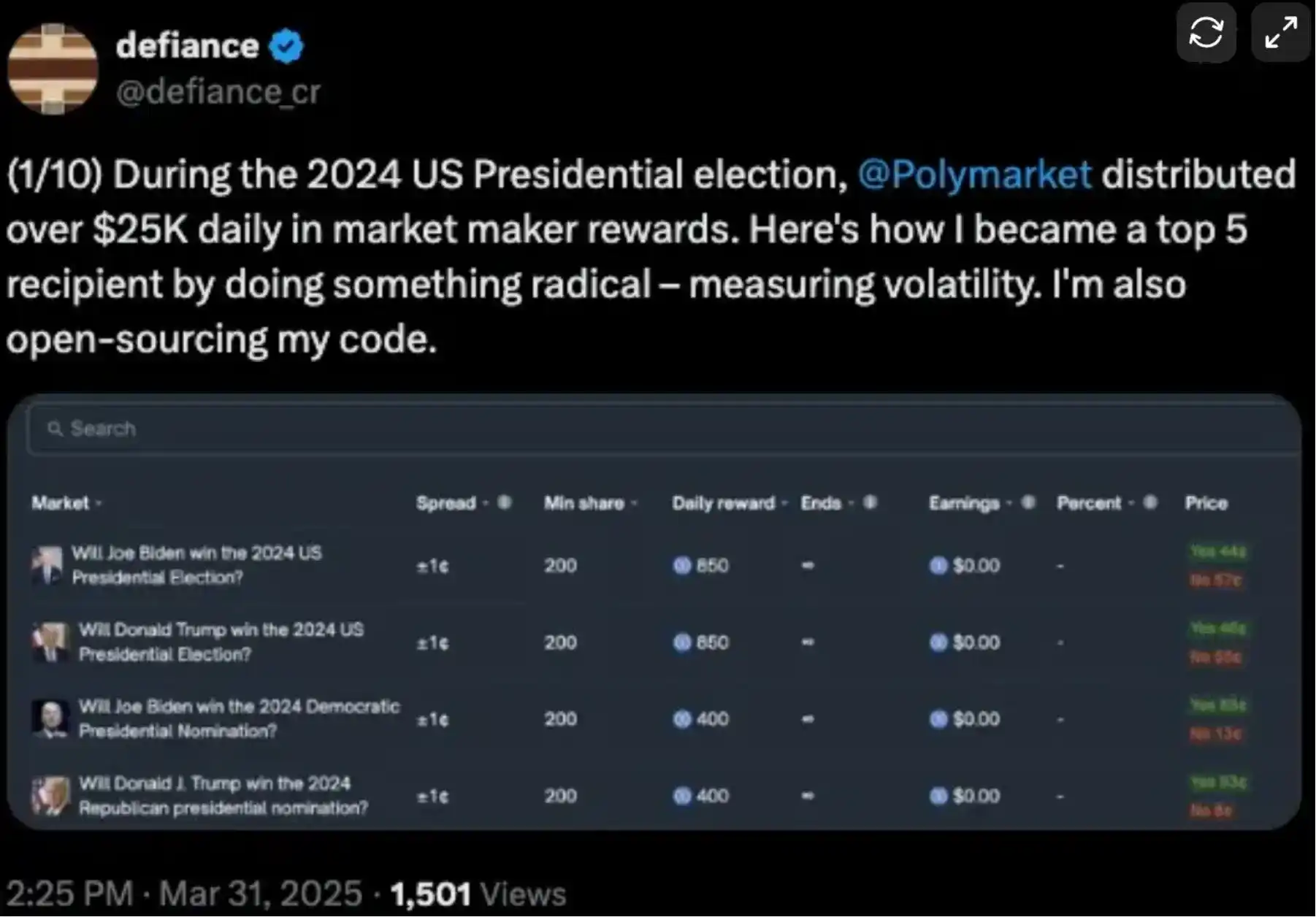
His system consisted of two core modules: a data collection module pulling historical prices from the Polymarket API, calculating volatility indicators, estimating expected returns per $100 invested, and sorting by risk-adjusted returns; a trade execution module automatically placing orders based on preset parameters—narrow spreads for liquid markets, wide spreads for volatile markets.

But after the election, Polymarket's liquidity rewards significantly decreased.

The LP strategy remained viable in late 2025, but with lower returns and increased competition. The cost of high-frequency trading infrastructure is higher than an average employee's salary. High-end VPS infrastructure needs to be hosted near Polymarket's servers. Quant algorithms are optimized for fast execution.

So don't envy "those traders making $200,000 a month确实存在. They are the top 0.5%."

This combination of "market making + prediction" is the standard for high-level players.

Replicability Assessment: The LP strategy requires a deep understanding of market microstructure, including order book dynamics, spread management, inventory risk control, etc. It's not as mechanical as arbitrage, nor does it require unique insight like information arbitrage, but sits between, requiring skill, but skill that can be learned.

5. Niche Specialization Strategy: The 10,000-Hour Rule in Prediction Markets

An interesting phenomenon on the Polymarket leaderboard: the most profitable people are almost all "specialists." They are not generalists who know a little about everything, but experts with a碾压级 advantage in a narrow field.

Look at some real cases:

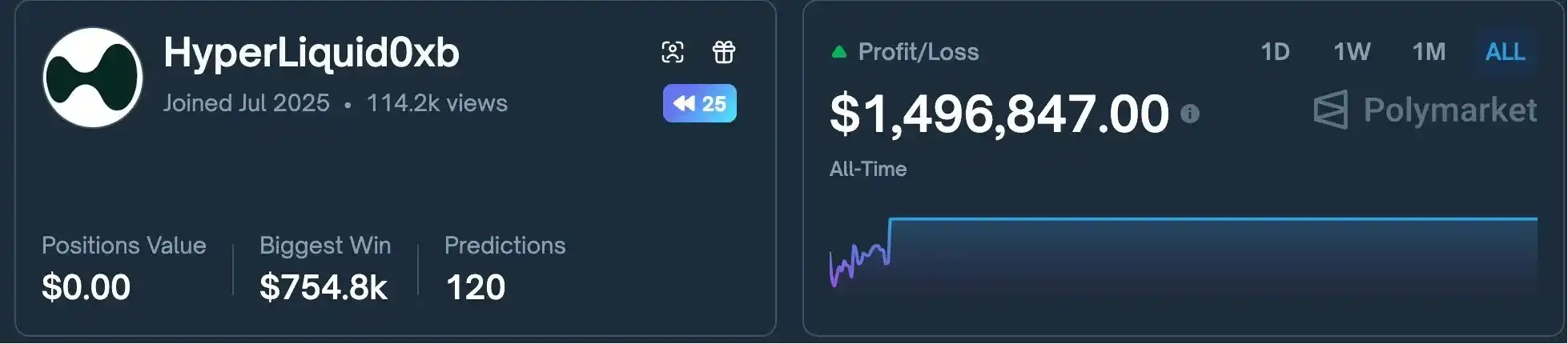
Sports Market Dominator HyperLiquid0xb: Total profits over $1.4 million, single largest gain of $755,000 from predicting a baseball game. His familiarity with MLB data rivals that of professional analysts, allowing him to quickly adjust judgments mid-game based on pitcher rotations, weather changes.
Mention Market Wizard Axios: Maintains a terrifying 96% win rate in markets like "Will Trump say 'crypto' in his speech?". His method is simple but extremely time-consuming: analyze all past public speeches of the target person,统计 the frequency and context of specific words, build a prediction model. While others are "gambling," he is "calculating."
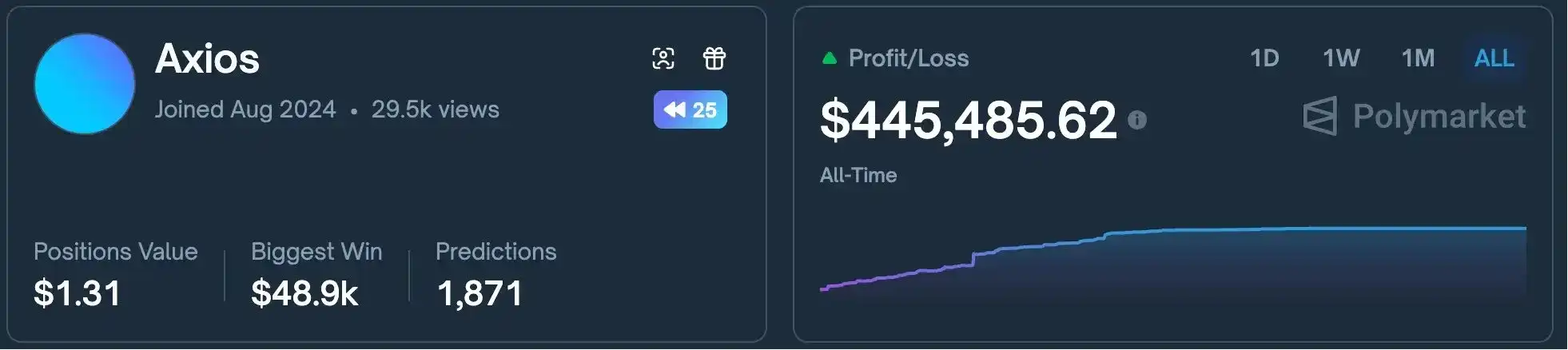
These cases share a common point: expert traders may only engage in 10-30 trades per year, but each has extremely high confidence and profit potential.

So specialization is more profitable than breadth.

Of course, I also saw a sports expert, SeriouslySirius, lose $440,000 on a single World Series bet, followed by losses in a series of events.
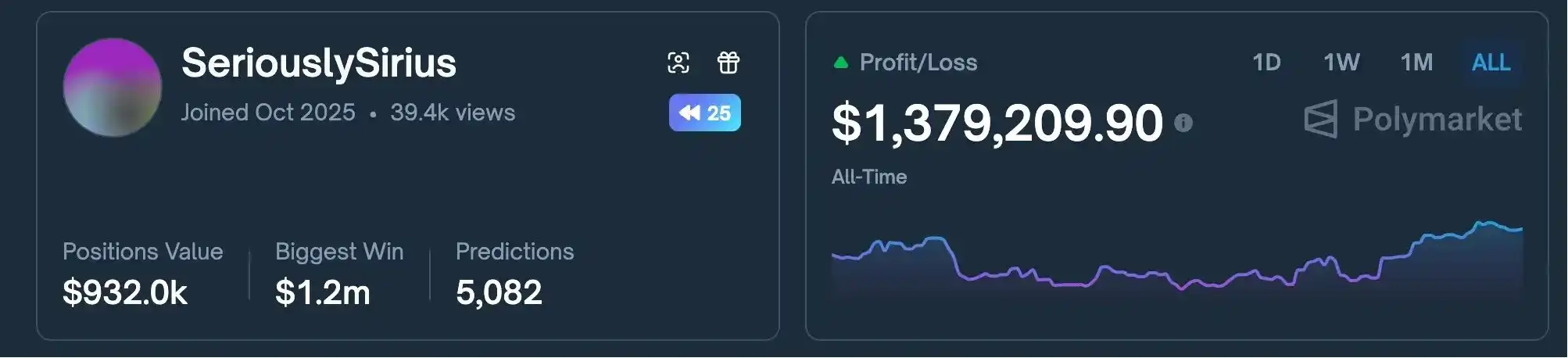
If you are only "somewhat knowledgeable," you are giving money to the experts. Of course,所谓的“懂”, is also another form of gambling.

Replicability Assessment: This is the strategy requiring the most time investment, but also the one with the highest barriers. Once you build an information advantage in a field, it's hard to replicate.建议 choosing an area where you already have knowledge or professional experience.

6. Speed Trading Strategy: Beating the World to the Punch

One Wednesday afternoon in 2024 at 2 PM, Fed Chair Powell began speaking. Within 8 seconds of him saying "we will adjust policy at the appropriate time," the price of the "Fed December rate cut" contract on Polymarket jumped from $0.65 to $0.78.

What happened in those 8 seconds? A small group of "speed traders," monitoring the live feed with preset triggers, placed their orders before the average person could even "understand" what Powell said.

Trading legend GCR once said the core of speed trading is "reaction." It exploits the time window between information generation and its digestion by the market, usually only a few seconds to minutes.

This strategy is particularly effective in "Mention markets." For example, "Will Biden mention China in his speech today?" If you can know the answer 30 seconds faster than others (by monitoring the White House live stream instead of waiting for news alerts), you can build a position before the price moves.

Some quant teams have industrialized this strategy. According to on-chain data analysis, between 2024-2025, top algorithmic traders executed over 10,200 speed trades, generating累计 $4.2 million in profits. Their tools include: low-latency API access, real-time news monitoring systems, preset decision rule scripts, and capital distributed across multiple platforms.

But speed trading is becoming increasingly difficult. As more institutional capital enters, the arbitrage window has compressed from "minutes" to "seconds," making it almost impossible for retail to participate. It's an arms race, and散户 tools are far inferior to institutions.

Replicability Assessment: Unless you have a technical background and time to invest in developing a trading system, it's not recommended. The alpha in speed trading is disappearing fast, leaving little room for retail. If you must try, start practicing in low-competition niche markets (like local elections, niche sports).

IV. Risk Management and Strategy Portfolio

4.1 Position Management Principles

Successful traders generally follow these position management principles:

Hold 5-12 uncorrelated positions simultaneously; Mix short-term (days) and long-term (weeks/months) holdings;

Keep 20-40% of capital as reserve for new opportunities;

Single trade risk exposure not exceeding 5-10% of total capital.

Over-diversification (30+ positions) dilutes returns, while over-concentration (1-2 positions) is too risky.

The optimal number of positions is usually between 6-10.

4.2 Strategy Portfolio Suggestions

Strategy allocation suggestions based on risk appetite are as follows.

  • Conservative Investors: 70% Bond Strategy + 20% Liquidity Providing + 10% Copy Trading.
  • Balanced Investors: 40% Niche Specialization + 30% Arbitrage + 20% Bonds + 10% Event-Driven.
  • Aggressive Investors: 50% Information Arbitrage + 30% Niche Specialization + 20% Speed Trading.

Regardless of the combination, avoid allocating over 40% of capital to a single event or a group of highly correlated events.

V. Conclusion

2025 was a pivotal year for Polymarket's transition from fringe experiment to mainstream finance.

The six盈利 strategies reviewed here—information arbitrage, cross-platform arbitrage, high-probability bonds, liquidity providing, niche specialization, and speed trading—represent proven sources of alpha in prediction markets.

In 2026, prediction markets will face fiercer competition and higher专业化门槛.

It is recommended that newcomers focus on: (1) Choosing a vertical field where they can build an information advantage; (2) Starting with small-scale bond strategies to accumulate experience; (3) Using tools like PolyTrack to跟踪和学习头部交易者的模式; (4) Maintaining close attention to regulatory changes and platform rule updates.

The essence of prediction markets is a "truth discovery mechanism powered by monetary votes."

In this market, the true edge comes not from luck, but from better information, more rigorous analysis, and more rational risk management. May this review provide you with a systematic map for navigating this new world.

References

[1] Chainalysis. "Polymarket Whale Analysis Report." November 2024.

[2] The Free Press. "How a French Whale Made $85 Million off Trump's Win." November 2024.

[3] Polymarket Analytics. "Trader Leaderboard and Performance Metrics." December 2025.

[4] PolyTrack. "Best Polymarket Traders to Follow 2025." November 2025.

[5] Dune Analytics. "Prediction Market Volume and Open Interest Data." September 2025.

[6] Wall Street Journal. "The French Trader Who Bet Big on Trump." November 2024.

[7] Bloomberg. "Trump Whale's Polymarket Haul Boosted to $85 Million." November 2024.

[8] CBS News 60 Minutes. "How a French 'whale' made over $80 million on Polymarket." December 2025.

Original Article Link

Preguntas relacionadas

QWhat are the six core profit strategies identified in the Polymarket 2025 report?

AThe six core profit strategies are: 1. Information Arbitrage, 2. Cross-Platform Arbitrage, 3. High-Probability Bond Strategy, 4. Liquidity Providing, 5. Domain Specialization, and 6. Speed Trading.

QWhat was the key insight behind the French trader Théo's successful $85 million information arbitrage bet on the 2024 U.S. election?

AThéo's key insight came from a unique poll he commissioned that asked voters in swing states 'Who do you think your neighbor will vote for?' instead of who they would vote for themselves. This 'neighbor effect' poll revealed a significant, hidden bias towards Trump that mainstream polls missed.

QWhat is the main risk associated with the seemingly low-risk Cross-Platform Arbitrage strategy?

AThe main risk is that different platforms may have subtly different definitions or settlement criteria for what constitutes the 'same event'. A trader's hedged position can lose money on both sides if one platform resolves to YES and another to NO based on these differing rules.

QAccording to the report, what is the common characteristic of the most profitable traders, beyond prediction skill?

AThe most profitable traders systematically identify market pricing errors, practice extremely strict and近乎偏执 (paranoid) risk management, and patiently build a crushing information advantage in a single, specialized domain.

QWhat recommendation does the report give to new entrants for building experience in 2026?

AThe report recommends that new entrants should: 1. Focus on a vertical domain where they can build an information advantage, 2. Start by accumulating experience with small-scale Bond strategies, 3. Use tools like PolyTrack to learn from the patterns of top traders, and 4. Maintain close attention to regulatory changes and platform rule updates.

Lecturas Relacionadas

Trading

Spot
Futuros

Artículos destacados

Qué es $S$

Entendiendo SPERO: Una Visión General Completa Introducción a SPERO A medida que el panorama de la innovación continúa evolucionando, la aparición de tecnologías web3 y proyectos de criptomonedas juega un papel fundamental en la configuración del futuro digital. Un proyecto que ha atraído la atención en este campo dinámico es SPERO, denotado como SPERO,$$s$. Este artículo tiene como objetivo reunir y presentar información detallada sobre SPERO, para ayudar a entusiastas e inversores a comprender sus fundamentos, objetivos e innovaciones dentro de los dominios web3 y cripto. ¿Qué es SPERO,$$s$? SPERO,$$s$ es un proyecto único dentro del espacio cripto que busca aprovechar los principios de descentralización y tecnología blockchain para crear un ecosistema que promueva la participación, la utilidad y la inclusión financiera. El proyecto está diseñado para facilitar interacciones de igual a igual de nuevas maneras, proporcionando a los usuarios soluciones y servicios financieros innovadores. En su esencia, SPERO,$$s$ tiene como objetivo empoderar a los individuos al proporcionar herramientas y plataformas que mejoren la experiencia del usuario en el espacio de las criptomonedas. Esto incluye habilitar métodos de transacción más flexibles, fomentar iniciativas impulsadas por la comunidad y crear caminos para oportunidades financieras a través de aplicaciones descentralizadas (dApps). La visión subyacente de SPERO,$$s$ gira en torno a la inclusividad, buscando cerrar brechas dentro de las finanzas tradicionales mientras aprovecha los beneficios de la tecnología blockchain. ¿Quién es el Creador de SPERO,$$s$? La identidad del creador de SPERO,$$s$ sigue siendo algo oscura, ya que hay recursos públicos limitados que proporcionan información de fondo detallada sobre su(s) fundador(es). Esta falta de transparencia puede derivarse del compromiso del proyecto con la descentralización, una ética que muchos proyectos web3 comparten, priorizando las contribuciones colectivas sobre el reconocimiento individual. Al centrar las discusiones en torno a la comunidad y sus objetivos colectivos, SPERO,$$s$ encarna la esencia del empoderamiento sin señalar a individuos específicos. Como tal, comprender la ética y la misión de SPERO sigue siendo más importante que identificar a un creador singular. ¿Quiénes son los Inversores de SPERO,$$s$? SPERO,$$s$ cuenta con el apoyo de una diversa gama de inversores que van desde capitalistas de riesgo hasta inversores ángeles dedicados a fomentar la innovación en el sector cripto. El enfoque de estos inversores generalmente se alinea con la misión de SPERO, priorizando proyectos que prometen avances tecnológicos sociales, inclusión financiera y gobernanza descentralizada. Estas fundaciones de inversores suelen estar interesadas en proyectos que no solo ofrecen productos innovadores, sino que también contribuyen positivamente a la comunidad blockchain y sus ecosistemas. El respaldo de estos inversores refuerza a SPERO,$$s$ como un contendiente notable en el dominio de proyectos cripto que evoluciona rápidamente. ¿Cómo Funciona SPERO,$$s$? SPERO,$$s$ emplea un marco multifacético que lo distingue de los proyectos de criptomonedas convencionales. Aquí hay algunas de las características clave que subrayan su singularidad e innovación: Gobernanza Descentralizada: SPERO,$$s$ integra modelos de gobernanza descentralizada, empoderando a los usuarios para participar activamente en los procesos de toma de decisiones sobre el futuro del proyecto. Este enfoque fomenta un sentido de propiedad y responsabilidad entre los miembros de la comunidad. Utilidad del Token: SPERO,$$s$ utiliza su propio token de criptomoneda, diseñado para servir diversas funciones dentro del ecosistema. Estos tokens permiten transacciones, recompensas y la facilitación de servicios ofrecidos en la plataforma, mejorando la participación y la utilidad general. Arquitectura en Capas: La arquitectura técnica de SPERO,$$s$ apoya la modularidad y escalabilidad, permitiendo la integración fluida de características y aplicaciones adicionales a medida que el proyecto evoluciona. Esta adaptabilidad es fundamental para mantener la relevancia en el cambiante paisaje cripto. Participación de la Comunidad: El proyecto enfatiza iniciativas impulsadas por la comunidad, empleando mecanismos que incentivan la colaboración y la retroalimentación. Al nutrir una comunidad sólida, SPERO,$$s$ puede abordar mejor las necesidades de los usuarios y adaptarse a las tendencias del mercado. Enfoque en la Inclusión: Al ofrecer tarifas de transacción bajas e interfaces amigables para el usuario, SPERO,$$s$ busca atraer a una base de usuarios diversa, incluyendo a individuos que anteriormente pueden no haber participado en el espacio cripto. Este compromiso con la inclusión se alinea con su misión general de empoderamiento a través de la accesibilidad. Cronología de SPERO,$$s$ Entender la historia de un proyecto proporciona información crucial sobre su trayectoria de desarrollo y hitos. A continuación se presenta una cronología sugerida que mapea eventos significativos en la evolución de SPERO,$$s$: Fase de Conceptualización e Ideación: Las ideas iniciales que forman la base de SPERO,$$s$ fueron concebidas, alineándose estrechamente con los principios de descentralización y enfoque comunitario dentro de la industria blockchain. Lanzamiento del Whitepaper del Proyecto: Tras la fase conceptual, se lanzó un whitepaper completo que detalla la visión, los objetivos y la infraestructura tecnológica de SPERO,$$s$ para generar interés y retroalimentación de la comunidad. Construcción de Comunidad y Primeras Interacciones: Se realizaron esfuerzos de divulgación activa para construir una comunidad de primeros adoptantes y posibles inversores, facilitando discusiones en torno a los objetivos del proyecto y obteniendo apoyo. Evento de Generación de Tokens: SPERO,$$s$ llevó a cabo un evento de generación de tokens (TGE) para distribuir sus tokens nativos a los primeros seguidores y establecer liquidez inicial dentro del ecosistema. Lanzamiento de la dApp Inicial: La primera aplicación descentralizada (dApp) asociada con SPERO,$$s$ se puso en marcha, permitiendo a los usuarios interactuar con las funcionalidades centrales de la plataforma. Desarrollo Continuo y Alianzas: Actualizaciones y mejoras continuas a las ofertas del proyecto, incluyendo alianzas estratégicas con otros actores en el espacio blockchain, han moldeado a SPERO,$$s$ en un jugador competitivo y en evolución en el mercado cripto. Conclusión SPERO,$$s$ se erige como un testimonio del potencial de web3 y las criptomonedas para revolucionar los sistemas financieros y empoderar a los individuos. Con un compromiso con la gobernanza descentralizada, la participación comunitaria y funcionalidades diseñadas de manera innovadora, allana el camino hacia un paisaje financiero más inclusivo. Como con cualquier inversión en el espacio cripto que evoluciona rápidamente, se anima a los posibles inversores y usuarios a investigar a fondo y participar de manera reflexiva con los desarrollos en curso dentro de SPERO,$$s$. El proyecto muestra el espíritu innovador de la industria cripto, invitando a una mayor exploración de sus innumerables posibilidades. Mientras el viaje de SPERO,$$s$ aún se desarrolla, sus principios fundamentales pueden, de hecho, influir en el futuro de cómo interactuamos con la tecnología, las finanzas y entre nosotros en ecosistemas digitales interconectados.

72 Vistas totalesPublicado en 2024.12.17Actualizado en 2024.12.17

Qué es $S$

Qué es AGENT S

Agent S: El Futuro de la Interacción Autónoma en Web3 Introducción En el paisaje en constante evolución de Web3 y las criptomonedas, las innovaciones están redefiniendo constantemente cómo los individuos interactúan con las plataformas digitales. Uno de estos proyectos pioneros, Agent S, promete revolucionar la interacción humano-computadora a través de su marco agente abierto. Al allanar el camino para interacciones autónomas, Agent S busca simplificar tareas complejas, ofreciendo aplicaciones transformadoras en inteligencia artificial (IA). Esta exploración detallada profundizará en las complejidades del proyecto, sus características únicas y las implicaciones para el dominio de las criptomonedas. ¿Qué es Agent S? Agent S se presenta como un marco agente abierto innovador, diseñado específicamente para abordar tres desafíos fundamentales en la automatización de tareas informáticas: Adquisición de Conocimiento Específico del Dominio: El marco aprende inteligentemente de diversas fuentes de conocimiento externas y experiencias internas. Este enfoque dual le permite construir un rico repositorio de conocimiento específico del dominio, mejorando su rendimiento en la ejecución de tareas. Planificación a Largo Plazo de Tareas: Agent S emplea planificación jerárquica aumentada por la experiencia, un enfoque estratégico que facilita la descomposición y ejecución eficiente de tareas complejas. Esta característica mejora significativamente su capacidad para gestionar múltiples subtareas de manera eficiente y efectiva. Manejo de Interfaces Dinámicas y No Uniformes: El proyecto introduce la Interfaz Agente-Computadora (ACI), una solución innovadora que mejora la interacción entre agentes y usuarios. Utilizando Modelos de Lenguaje Multimodal de Gran Escala (MLLMs), Agent S puede navegar y manipular diversas interfaces gráficas de usuario sin problemas. A través de estas características pioneras, Agent S proporciona un marco robusto que aborda las complejidades involucradas en la automatización de la interacción humana con las máquinas, preparando el terreno para una multitud de aplicaciones en IA y más allá. ¿Quién es el Creador de Agent S? Si bien el concepto de Agent S es fundamentalmente innovador, la información específica sobre su creador sigue siendo elusiva. El creador es actualmente desconocido, lo que resalta ya sea la etapa incipiente del proyecto o la elección estratégica de mantener a los miembros fundadores en el anonimato. Independientemente de la anonimidad, el enfoque sigue siendo en las capacidades y el potencial del marco. ¿Quiénes son los Inversores de Agent S? Dado que Agent S es relativamente nuevo en el ecosistema criptográfico, la información detallada sobre sus inversores y patrocinadores financieros no está documentada explícitamente. La falta de información disponible públicamente sobre las bases de inversión u organizaciones que apoyan el proyecto plantea preguntas sobre su estructura de financiamiento y hoja de ruta de desarrollo. Comprender el respaldo es crucial para evaluar la sostenibilidad del proyecto y su posible impacto en el mercado. ¿Cómo Funciona Agent S? En el núcleo de Agent S se encuentra una tecnología de vanguardia que le permite funcionar de manera efectiva en diversos entornos. Su modelo operativo se basa en varias características clave: Interacción Humano-Computadora Similar a la Humana: El marco ofrece planificación avanzada de IA, esforzándose por hacer que las interacciones con las computadoras sean más intuitivas. Al imitar el comportamiento humano en la ejecución de tareas, promete elevar las experiencias de los usuarios. Memoria Narrativa: Empleada para aprovechar experiencias de alto nivel, Agent S utiliza memoria narrativa para hacer un seguimiento de las historias de tareas, mejorando así sus procesos de toma de decisiones. Memoria Episódica: Esta característica proporciona a los usuarios una guía paso a paso, permitiendo que el marco ofrezca apoyo contextual a medida que se desarrollan las tareas. Soporte para OpenACI: Con la capacidad de ejecutarse localmente, Agent S permite a los usuarios mantener el control sobre sus interacciones y flujos de trabajo, alineándose con la ética descentralizada de Web3. Fácil Integración con APIs Externas: Su versatilidad y compatibilidad con varias plataformas de IA aseguran que Agent S pueda encajar sin problemas en ecosistemas tecnológicos existentes, convirtiéndolo en una opción atractiva para desarrolladores y organizaciones. Estas funcionalidades contribuyen colectivamente a la posición única de Agent S dentro del espacio cripto, ya que automatiza tareas complejas y de múltiples pasos con una intervención humana mínima. A medida que el proyecto evoluciona, sus posibles aplicaciones en Web3 podrían redefinir cómo se desarrollan las interacciones digitales. Cronología de Agent S El desarrollo y los hitos de Agent S pueden encapsularse en una cronología que resalta sus eventos significativos: 27 de septiembre de 2024: El concepto de Agent S fue lanzado en un documento de investigación integral titulado “Un Marco Agente Abierto que Usa Computadoras Como un Humano”, mostrando las bases del proyecto. 10 de octubre de 2024: El documento de investigación fue puesto a disposición del público en arXiv, ofreciendo una exploración profunda del marco y su evaluación de rendimiento basada en el benchmark OSWorld. 12 de octubre de 2024: Se lanzó una presentación en video, proporcionando una visión visual de las capacidades y características de Agent S, involucrando aún más a posibles usuarios e inversores. Estos marcadores en la cronología no solo ilustran el progreso de Agent S, sino que también indican su compromiso con la transparencia y la participación comunitaria. Puntos Clave Sobre Agent S A medida que el marco Agent S continúa evolucionando, varios atributos clave destacan, subrayando su naturaleza innovadora y potencial: Marco Innovador: Diseñado para proporcionar un uso intuitivo de las computadoras similar a la interacción humana, Agent S aporta un enfoque novedoso a la automatización de tareas. Interacción Autónoma: La capacidad de interactuar de manera autónoma con las computadoras a través de GUI significa un salto hacia soluciones informáticas más inteligentes y eficientes. Automatización de Tareas Complejas: Con su metodología robusta, puede automatizar tareas complejas y de múltiples pasos, haciendo que los procesos sean más rápidos y menos propensos a errores. Mejora Continua: Los mecanismos de aprendizaje permiten a Agent S mejorar a partir de experiencias pasadas, mejorando continuamente su rendimiento y eficacia. Versatilidad: Su adaptabilidad en diferentes entornos operativos como OSWorld y WindowsAgentArena asegura que pueda servir a una amplia gama de aplicaciones. A medida que Agent S se posiciona en el paisaje de Web3 y criptomonedas, su potencial para mejorar las capacidades de interacción y automatizar procesos significa un avance significativo en las tecnologías de IA. A través de su marco innovador, Agent S ejemplifica el futuro de las interacciones digitales, prometiendo una experiencia más fluida y eficiente para los usuarios en diversas industrias. Conclusión Agent S representa un audaz avance en la unión de la IA y Web3, con la capacidad de redefinir cómo interactuamos con la tecnología. Aunque aún se encuentra en sus primeras etapas, las posibilidades para su aplicación son vastas y atractivas. A través de su marco integral que aborda desafíos críticos, Agent S busca llevar las interacciones autónomas al primer plano de la experiencia digital. A medida que nos adentramos más en los reinos de las criptomonedas y la descentralización, proyectos como Agent S sin duda desempeñarán un papel crucial en la configuración del futuro de la tecnología y la colaboración humano-computadora.

363 Vistas totalesPublicado en 2025.01.14Actualizado en 2025.01.14

Qué es AGENT S

Cómo comprar S

¡Bienvenido a HTX.com! Hemos hecho que comprar Sonic (S) sea simple y conveniente. Sigue nuestra guía paso a paso para iniciar tu viaje de criptos.Paso 1: crea tu cuenta HTXUtiliza tu correo electrónico o número de teléfono para registrarte y obtener una cuenta gratuita en HTX. Experimenta un proceso de registro sin complicaciones y desbloquea todas las funciones.Obtener mi cuentaPaso 2: ve a Comprar cripto y elige tu método de pagoTarjeta de crédito/débito: usa tu Visa o Mastercard para comprar Sonic (S) al instante.Saldo: utiliza fondos del saldo de tu cuenta HTX para tradear sin problemas.Terceros: hemos agregado métodos de pago populares como Google Pay y Apple Pay para mejorar la comodidad.P2P: tradear directamente con otros usuarios en HTX.Over-the-Counter (OTC): ofrecemos servicios personalizados y tipos de cambio competitivos para los traders.Paso 3: guarda tu Sonic (S)Después de comprar tu Sonic (S), guárdalo en tu cuenta HTX. Alternativamente, puedes enviarlo a otro lugar mediante transferencia blockchain o utilizarlo para tradear otras criptomonedas.Paso 4: tradear Sonic (S)Tradear fácilmente con Sonic (S) en HTX's mercado spot. Simplemente accede a tu cuenta, selecciona tu par de trading, ejecuta tus trades y monitorea en tiempo real. Ofrecemos una experiencia fácil de usar tanto para principiantes como para traders experimentados.

744 Vistas totalesPublicado en 2025.01.15Actualizado en 2025.03.21

Cómo comprar S

Discusiones

Bienvenido a la comunidad de HTX. Aquí puedes mantenerte informado sobre los últimos desarrollos de la plataforma y acceder a análisis profesionales del mercado. A continuación se presentan las opiniones de los usuarios sobre el precio de S (S).

活动图片














