Polkadot jumps 11% after channel breakout – Can DOT breach $1.686?

ambcryptoPublicado a 2026-03-16Actualizado a 2026-03-16

Resumen

Polkadot (DOT) surged over 11% in 24 hours, accompanied by a 78% increase in trading volume, signaling renewed buyer interest. The price broke out of a prolonged descending channel, reaching toward the $1.686 resistance level—a key barrier that could determine the next directional move. Technical indicators strengthened, with the RSI climbing to 57.51, indicating bullish momentum. Market data revealed aggressive buy-dominant order flow and strong accumulation pressure in spot markets. Additionally, top Binance traders showed a long-biased stance, with 61.66% holding long positions. A sustained break above $1.686 could open a path toward the $2.000 resistance zone.

Polkadot has surged over 11% in 24 hours as trading volume jumped nearly 78%, signaling renewed market activity as buyers returned aggressively to the DOT market.

Rising participation has accompanied the move toward the $1.59 region, suggesting that traders have stepped back into the market after weeks of subdued activity.

Increased liquidity has strengthened short-term price dynamics while expanding volatility across spot markets.

As a result, Polkadot [DOT] traded closer to an important resistance barrier that could influence the next directional move.

Descending channel breakout reshapes DOT structure

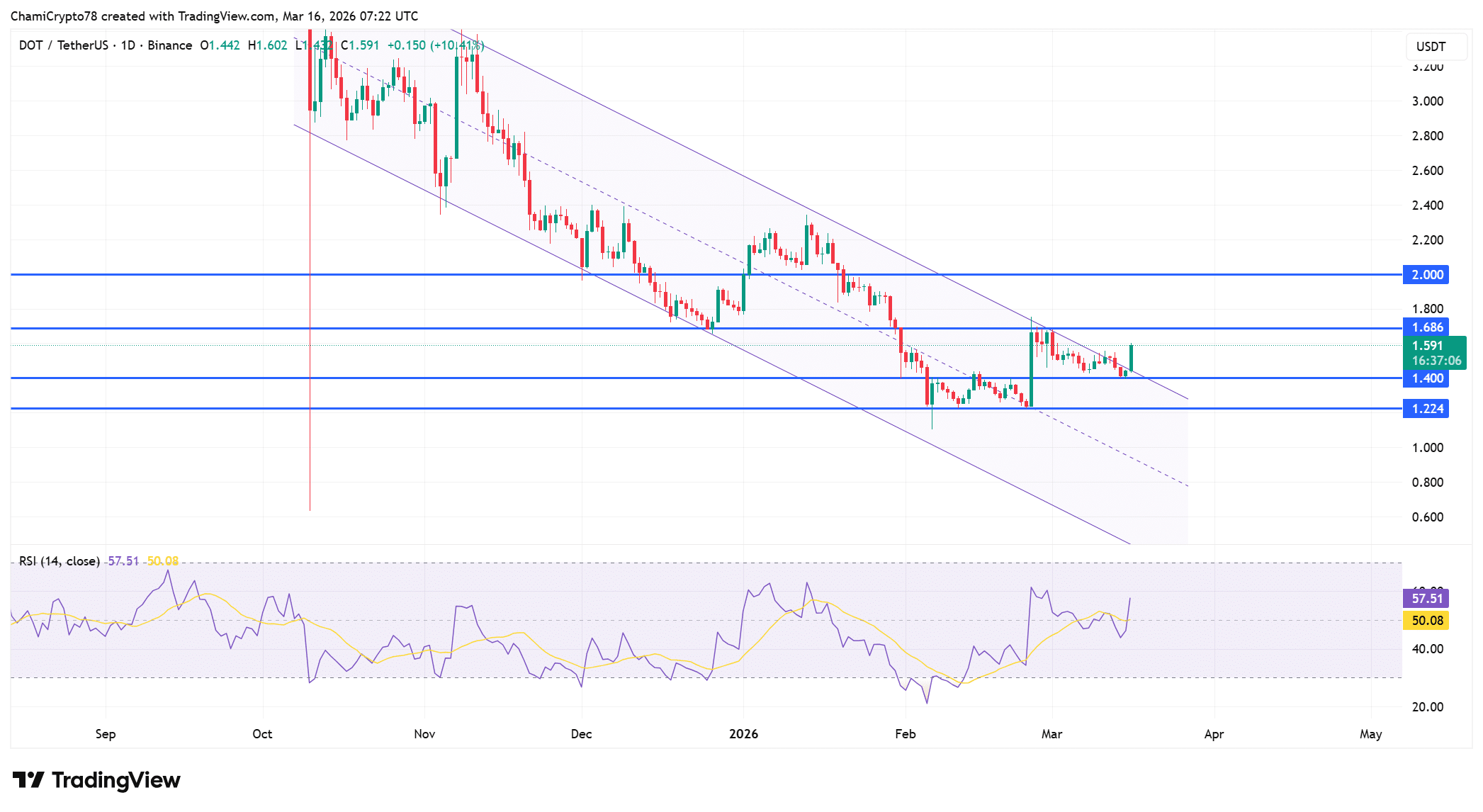
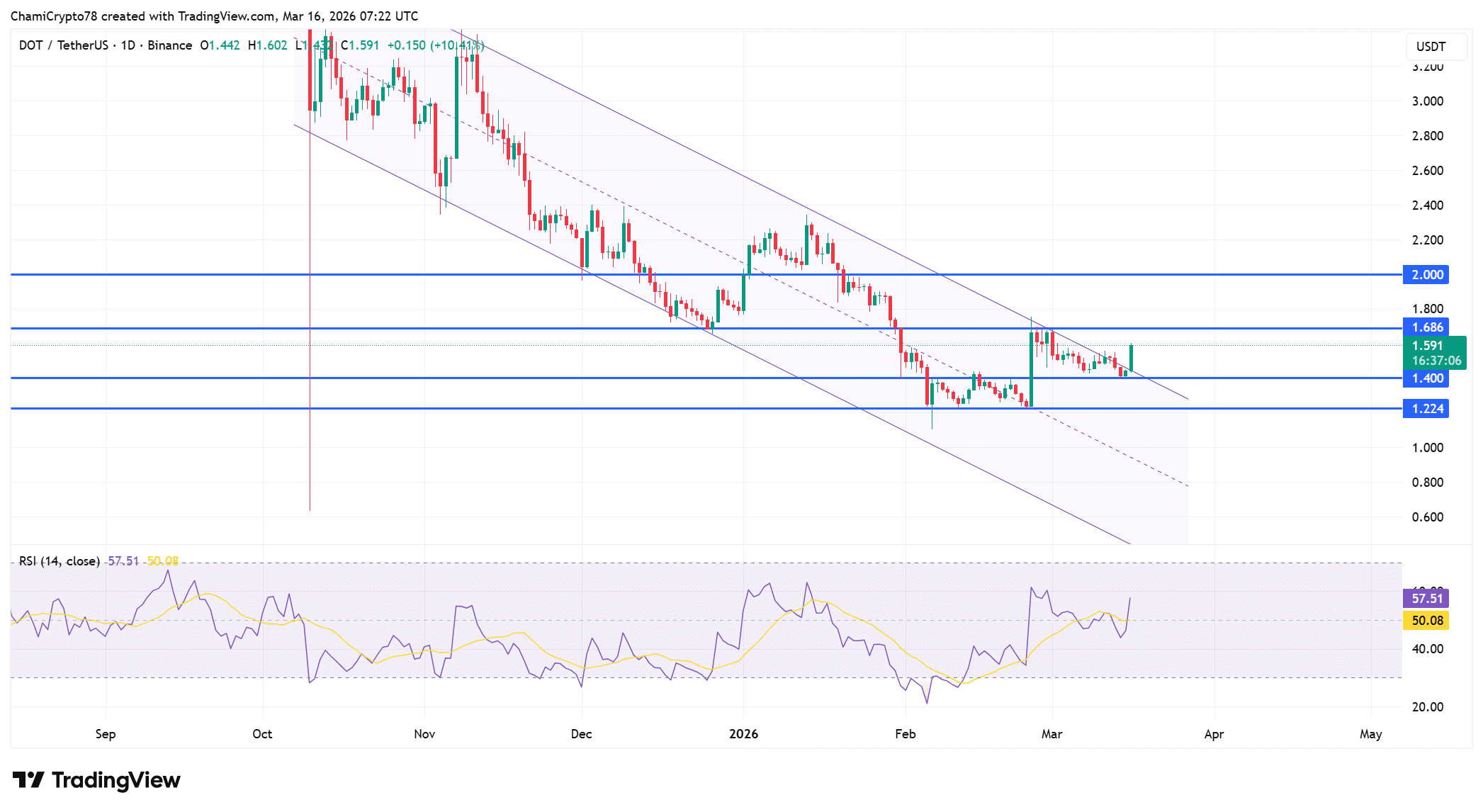
Price action reflected a notable structural shift after DOT had broken above a prolonged descending channel.

The breakout has followed the sharp rally that pushed the price toward the $1.686 resistance zone, placing the asset near a technical inflection point.

Earlier price compression inside the channel had restricted recovery attempts for months.

However, the recent surge has lifted the price above that declining boundary, signaling that bearish control has weakened considerably.

Technical indicators now reflect strengthening buyer activity as the RSI has climbed to 57.51, clearly above the 50 neutral threshold.

This shift suggests that demand has strengthened steadily following earlier weakness during the prolonged downtrend.

As buyers regained control of short-term price swings, the indicator has gradually advanced into bullish territory.

Meanwhile, DOT continued trading near $1.591, which places it between the $1.400 support level and the $1.686 resistance barrier.

Buyers have defended the lower zone repeatedly during recent sessions.

As a result, the breakout structure now attracts attention because a sustained push above $1.686 could open the path toward the $2.000 resistance region.
Source: TradingView

Buy-dominant order flow strengthens DOT demand

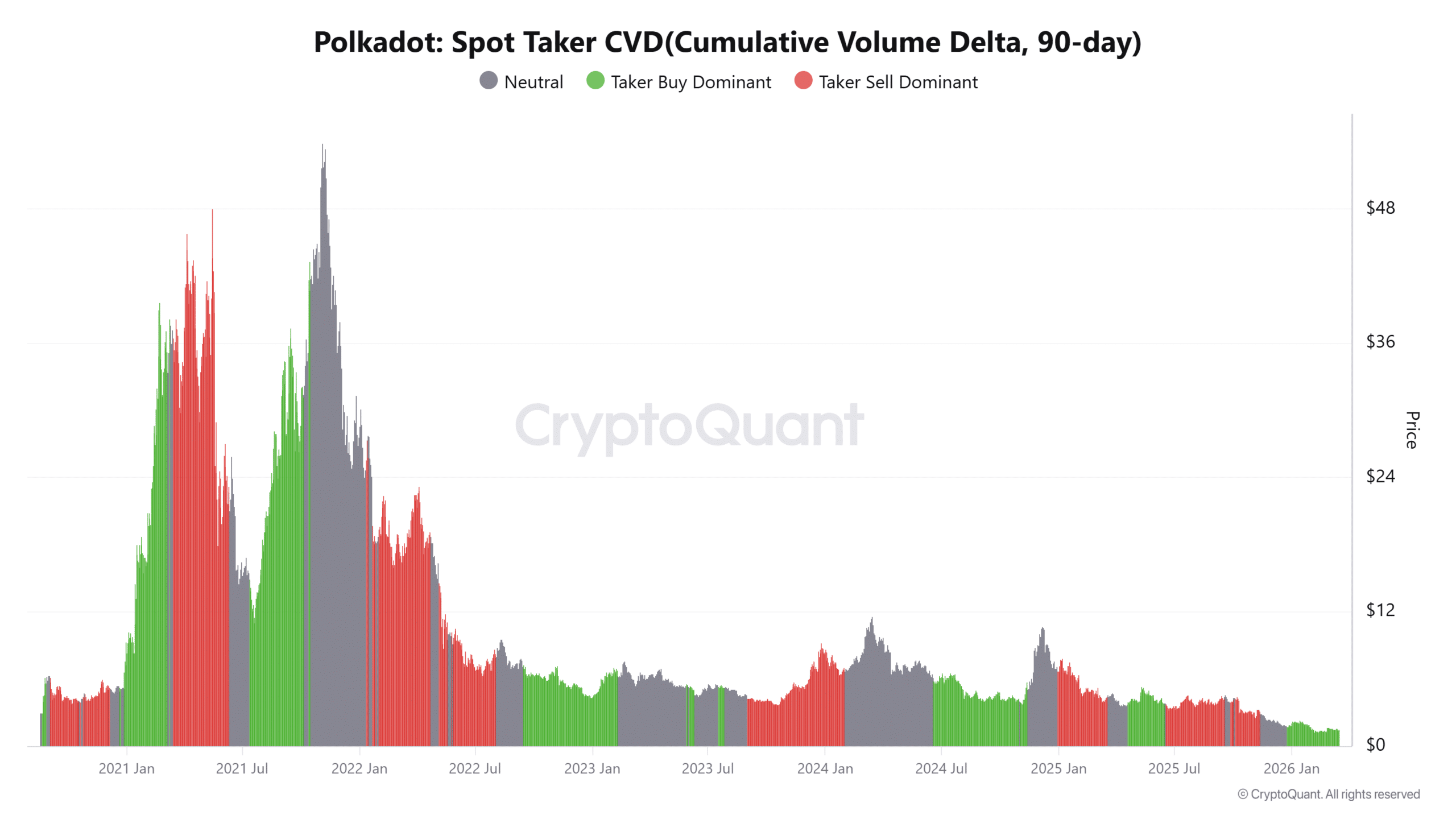
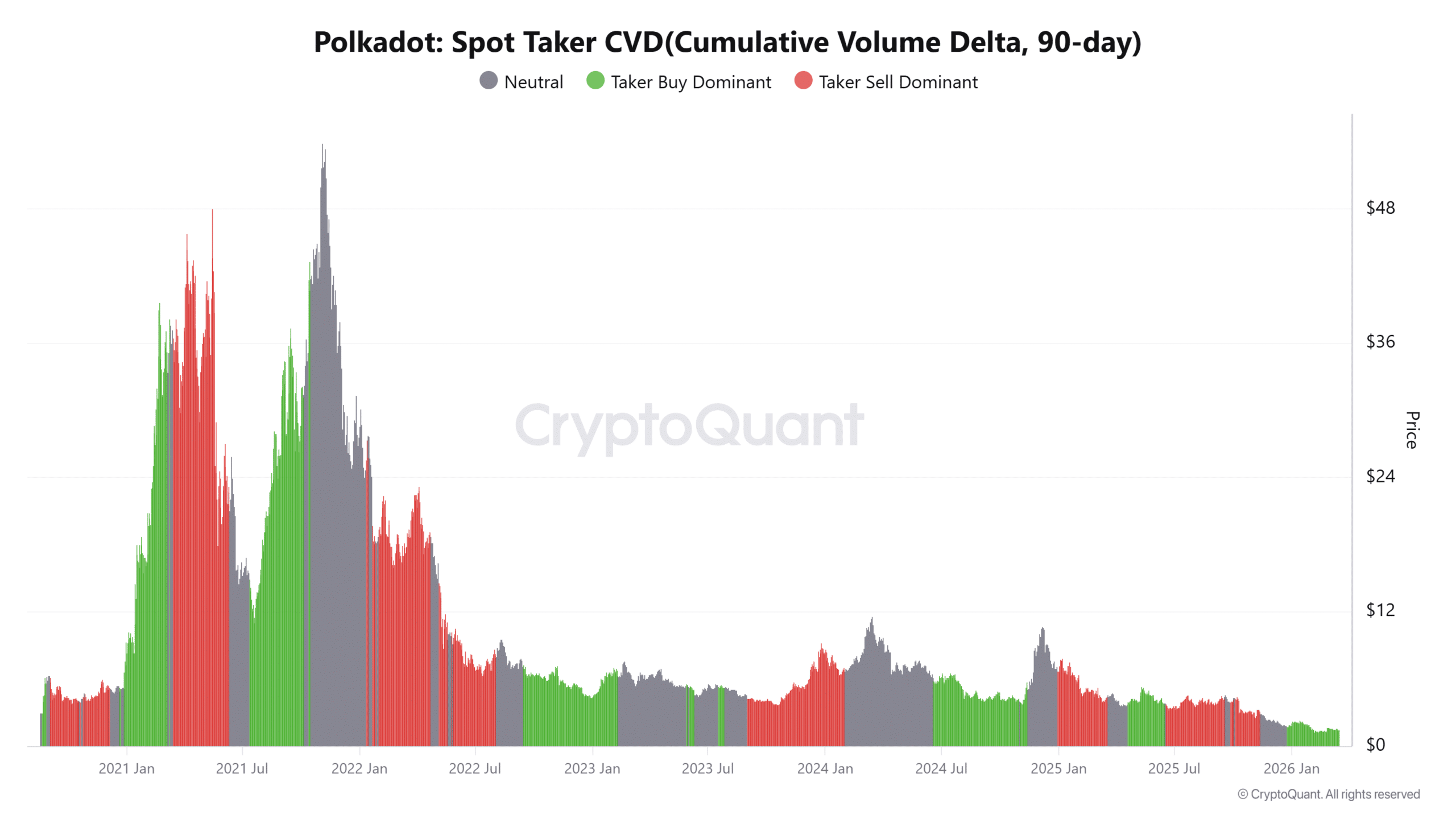
Market activity across spot exchanges now reflects strong buyer aggression as Spot Taker CVD has shifted into buy-dominant territory.

This metric tracks the cumulative difference between aggressive buy orders and sell orders, providing insight into trader conviction.

Recent readings suggest that market participants have increasingly executed buy orders at market prices rather than waiting for passive liquidity.

Such behavior often reflects stronger directional conviction among traders. In DOT’s case, this buyer-led order flow has emerged alongside rising trading activity and the recent price breakout.

As aggressive demand continues driving transactions, traders increasingly interpret the data as a signal that accumulation pressure has strengthened across spot markets.
Source: CryptoQuant

Top Binance traders lean heavily long on DOT

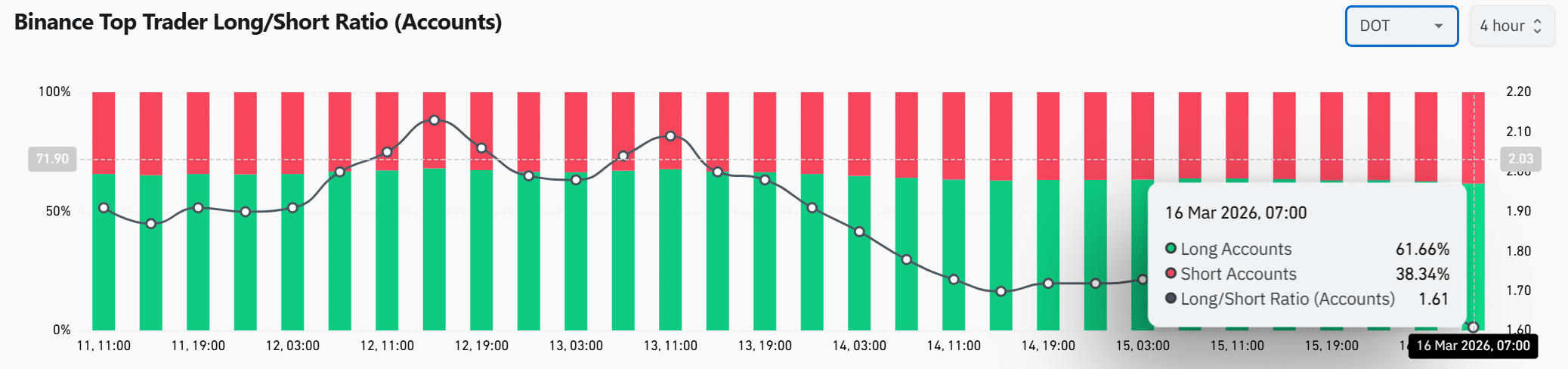
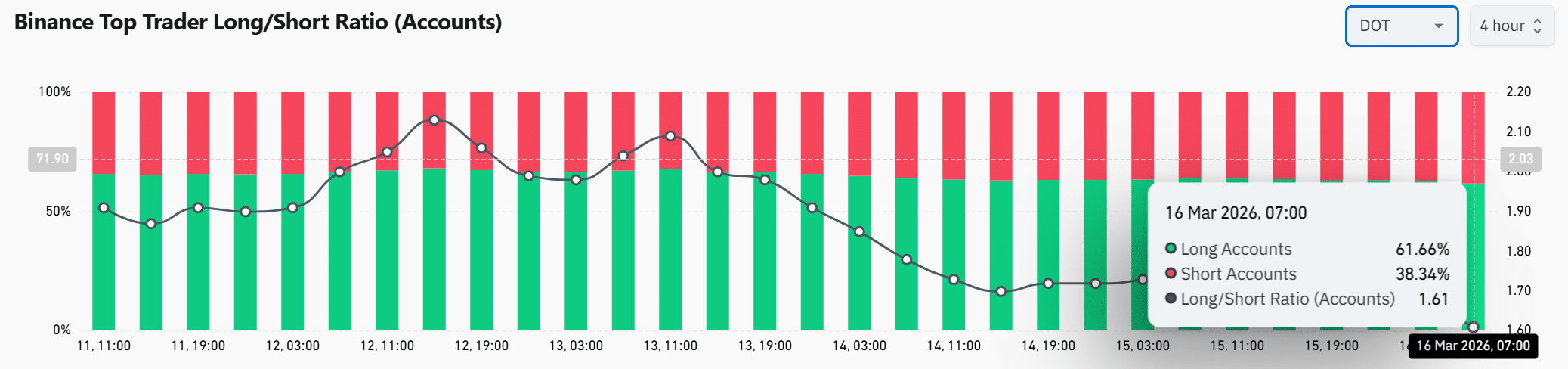
Data from CoinGlass on Binance Top Trader Long/Short Ratio showed that 61.66% of accounts held long positions at press time, while 38.34% maintain short exposure, resulting in a long/short ratio of 1.61.

This distribution indicates that experienced traders have largely positioned themselves for further upside.

Earlier sessions showed fluctuating positioning among top traders. However, recent readings show that long exposure has remained dominant while price attempted recovery.

This alignment between derivatives positioning and strengthening spot demand often signals growing conviction among market participants as they anticipate continued upside pressure.
Source: CoinGlass

Polkadot has strengthened significantly as the price surged above its descending channel while buyers expanded trading activity and aggressive order flow.

Technical indicators and derivatives positioning now support improving sentiment. However, the $1.686 resistance remains the next critical barrier.

A decisive break above that level could drive DOT toward the $2.000 zone as buyer conviction continues strengthening across the market.


Final Summary

  • Polkadot [DOT] jumped over 11% in 24 hours, with trading volume rising nearly 78%.
  • DOT broke above a prolonged descending channel, indicating weakening bearish control after months of price compression.


Preguntas relacionadas

QWhat was the percentage increase in Polkadot's price and trading volume over 24 hours?

APolkadot's price surged over 11% and its trading volume jumped nearly 78% in 24 hours.

QWhat key resistance level is DOT approaching after the breakout?

ADOT is approaching the key resistance level at $1.686 after the breakout.

QWhat does the RSI value of 57.51 indicate about the market sentiment for DOT?

AThe RSI value of 57.51, which is above the 50 neutral threshold, indicates strengthening buyer activity and a shift into bullish territory.

QWhat does the Spot Taker CVD metric reveal about current market behavior?

AThe Spot Taker CVD metric has shifted into buy-dominant territory, indicating that traders are aggressively executing buy orders at market prices, reflecting stronger directional conviction.

QWhat is the long/short ratio for top Binance traders regarding DOT, and what does it suggest?

AThe long/short ratio for top Binance traders is 1.61, with 61.66% holding long positions, indicating that experienced traders are largely positioned for further upside price movement.

Lecturas Relacionadas

a16z: AI's 'Amnesia', Can Continuous Learning Cure It?

The article "a16z: AI's 'Amnesia' – Can Continual Learning Cure It?" explores the limitations of current large language models (LLMs), which, like the protagonist in the film *Memento*, are trapped in a perpetual present—unable to form new memories after training. While methods like in-context learning (ICL), retrieval-augmented generation (RAG), and external scaffolding (e.g., chat history, prompts) provide temporary solutions, they fail to enable true internalization of new knowledge. The authors argue that compression—the core of learning during training—is halted at deployment, preventing models from generalizing, discovering novel solutions (e.g., mathematical proofs), or handling adversarial scenarios. The piece introduces *continual learning* as a critical research direction to address this, categorizing approaches into three paths: 1. **Context**: Scaling external memory via longer context windows, multi-agent systems, and smarter retrieval. 2. **Modules**: Using pluggable adapters or external memory layers for specialization without full retraining. 3. **Weights**: Enabling parameter updates through sparse training, test-time training, meta-learning, distillation, and reinforcement learning from feedback. Challenges include catastrophic forgetting, safety risks, and auditability, but overcoming these could unlock models that learn iteratively from experience. The conclusion emphasizes that while context-based methods are effective, true breakthroughs require models to compress new information into weights post-deployment, moving from mere retrieval to genuine learning.

marsbitHace 54 min(s)

a16z: AI's 'Amnesia', Can Continuous Learning Cure It?

marsbitHace 54 min(s)

Can a Hair Dryer Earn $34,000? Deciphering the Reflexivity Paradox in Prediction Markets

An individual manipulated a weather sensor at Paris Charles de Gaulle Airport with a portable heat source, causing a Polymarket weather market to settle at 22°C and earning $34,000. This incident highlights a fundamental issue in prediction markets: when a market aims to reflect reality, it also incentivizes participants to influence that reality. Prediction markets operate on two layers: platform rules (what outcome counts as a win) and data sources (what actually happened). While most focus on rules, the real vulnerability lies in the data source. If reality is recorded through a specific source, influencing that source directly affects market settlement. The article categorizes markets by their vulnerability: 1. **Single-point physical data sources** (e.g., weather stations): Easily manipulated through physical interference. 2. **Insider information markets** (e.g., MrBeast video details): Insiders like team members use non-public information to trade. Kalshi fined a剪辑师 $20,000 for insider trading. 3. **Actor-manipulated markets** (e.g., Andrew Tate’s tweet counts): The subject of the market can control the outcome. Evidence suggests Tate’sociated accounts coordinated to profit. 4. **Individual-action markets** (e.g., WNBA disruptions): A single person can execute an event to profit from their pre-placed bets. Kalshi and Polymarket handle these issues differently. Kalshi enforces strict KYC, publicly penalizes insider trading, and reports to regulators. Polymarket, with its anonymous wallet-based system, has historically been more permissive, arguing that insider information improves market accuracy. However, it cooperated with authorities in the "Van Dyke case," where a user traded on classified government information. The core paradox is reflexivity: prediction markets are designed to discover truth, but their financial incentives can distort reality. The more valuable a prediction becomes, the more likely participants are to influence the event itself. The market ceases to be a mirror of reality and instead shapes it.

marsbitHace 1 hora(s)

Can a Hair Dryer Earn $34,000? Deciphering the Reflexivity Paradox in Prediction Markets

marsbitHace 1 hora(s)

Trading

Spot
Futuros

Artículos destacados

Cómo comprar DOT

¡Bienvenido a HTX.com! Hemos hecho que comprar Polkadot (DOT) sea simple y conveniente. Sigue nuestra guía paso a paso para iniciar tu viaje de criptos.Paso 1: crea tu cuenta HTXUtiliza tu correo electrónico o número de teléfono para registrarte y obtener una cuenta gratuita en HTX. Experimenta un proceso de registro sin complicaciones y desbloquea todas las funciones.Obtener mi cuentaPaso 2: ve a Comprar cripto y elige tu método de pagoTarjeta de crédito/débito: usa tu Visa o Mastercard para comprar Polkadot (DOT) al instante.Saldo: utiliza fondos del saldo de tu cuenta HTX para tradear sin problemas.Terceros: hemos agregado métodos de pago populares como Google Pay y Apple Pay para mejorar la comodidad.P2P: tradear directamente con otros usuarios en HTX.Over-the-Counter (OTC): ofrecemos servicios personalizados y tipos de cambio competitivos para los traders.Paso 3: guarda tu Polkadot (DOT)Después de comprar tu Polkadot (DOT), guárdalo en tu cuenta HTX. Alternativamente, puedes enviarlo a otro lugar mediante transferencia blockchain o utilizarlo para tradear otras criptomonedas.Paso 4: tradear Polkadot (DOT)Tradear fácilmente con Polkadot (DOT) en HTX's mercado spot. Simplemente accede a tu cuenta, selecciona tu par de trading, ejecuta tus trades y monitorea en tiempo real. Ofrecemos una experiencia fácil de usar tanto para principiantes como para traders experimentados.

508 Vistas totalesPublicado en 2024.12.12Actualizado en 2025.03.21

Cómo comprar DOT

Discusiones

Bienvenido a la comunidad de HTX. Aquí puedes mantenerte informado sobre los últimos desarrollos de la plataforma y acceder a análisis profesionales del mercado. A continuación se presentan las opiniones de los usuarios sobre el precio de DOT (DOT).

活动图片












