Policy Pilot First: Central Bank Explores Direct 'Money Distribution', Digital Yuan Users Already Benefiting

比推Publicado a 2026-01-21Actualizado a 2026-01-21

Resumen

China's digital yuan (e-CNY) has entered a significant upgrade phase, transitioning from a non-interest-bearing digital cash (M0) to an interest-bearing asset classified as M1. As of January 1, 2026, users holding funds in verified tier 1-3 digital yuan wallets can earn interest at the current demand deposit rate of 0.05% per annum, paid quarterly. This move, a world-first for a central bank digital currency (CBDC), aims to boost user adoption by providing a tangible benefit for holding the digital currency, which had previously struggled to compete with established payment platforms like Alipay and WeChat Pay despite extensive pilot programs and government subsidies. A key structural change is the shift away from the 100% reserve requirement for commercial banks. Banks can now use a portion of the e-CNY deposits for lending and developing financial products, transforming the digital yuan from a cost center into a potential profit source and incentivizing them to promote it more actively. In contrast, non-bank payment institutions must still maintain 100% reserves. Beyond payments, the digital yuan is positioning itself as a programmable financial infrastructure. Its smart contract capability, though using a restricted Turing-complete design for security, enables complex applications like controlled fund disbursement for pre-paid services, family budgeting, and government subsidies. It also supports offline transactions via NFC. A major strategic focus is cross-border payme...

Author: Nancy, PANews

Original Title: While Wall Street Still Debates, Digital Yuan Already 'Distributes Money' to Users


Historically, in financial customer acquisition battles, 'distributing money to users' has always been the simplest and most effective weapon.

Over a decade ago, products like Yu'ebao used visible, calculable yields to pry open the cognitive boundaries of ordinary people towards financial products, also launching a frontal assault on traditional finance.

A similar game is playing out again across the ocean. These days, Wall Street elites and crypto-native giants are arguing fiercely over market structure bills related to stablecoin yields. One side attempts to defend the high walls of traditional finance through regulation, while the other tries to compete for the market with real money.

Shifting focus back to China, the digital yuan is undergoing a critical upgrade. As is well known, after several years of pilot programs, red envelope incentives, scenario promotions, and policy pushes have been deployed in turn, but the digital yuan has consistently struggled to become commonplace in every household.

As the digital yuan enters version 2.0 this year, it begins to possess interest-bearing capabilities, giving users, for the first time, an intuitive and practical reason to hold it: earning interest on holdings. Simultaneously, the digital yuan also transitions from being classified as M0 to M1, charting a longer-term path through smart contracts to become an underlying digital payment infrastructure.

Entering the Interest-Bearing Era, Upgrading to a 'Yield-Bearing Stablecoin'

If judged solely by scale, the progress of the digital yuan hasn't been slow.

After a decade of R&D exploration and pilot promotion, the digital yuan has reached a considerable size. As of the end of November 2025, it had cumulatively processed 3.48 billion transactions, with a transaction value of 167 trillion yuan; 230 million personal wallets and 18.84 million corporate wallets were opened, with pilot coverage extending to 26 regions across 17 provinces (autonomous regions, municipalities).

From infrastructure construction and technical verification to payment scenario implementation, the digital yuan has completed the phased goal of moving from usable to practical. This progress benefits both from the continuous improvement of underlying technology and strong policy-level promotion, creating usage opportunities for the digital yuan through methods like red envelope subsidies and consumption rebates.

But is the digital yuan truly common in daily life? The answer is unfortunately not optimistic.

Placed within the larger payment system, the contrast is particularly stark. In the third quarter of 2025 alone, Chinese non-bank payment institutions handled online payment business volume amounting to 85.28 trillion yuan, with 338.019 billion transactions. Not to mention, commercial payment networks formed by platforms like Alipay and WeChat Pay have long penetrated high-frequency scenarios such as daily necessities, clothing, housing, and transportation. Whether in terms of transaction scale, user stickiness, or fund settlement capacity, they far surpass what the digital yuan currently offers.

For most ordinary users and businesses, the digital yuan is just renminbi in a different guise; its essence remains funds sitting idle in an account, not earning interest. There is no difference from the user's perspective compared to balances in WeChat or Alipay wallets, so users naturally lack the motivation to change long-established usage habits.

This situation finally saw a turning point on January 1, 2026, when the digital yuan officially upgraded to a 'yield-bearing stablecoin'.

According to the latest policy, users can download the digital yuan App from official app stores and have funds in Tier 1, Tier 2, and Tier 3 real-name wallets accrue interest based on the listed demand deposit interest rate. The current annual interest rate is 0.05%, with interest settlement dates on March 20, June 20, September 20, and December 20 each year; it is important to note that anonymous wallets (Tier 4 wallets) opened solely with mobile number verification do not accrue interest for now.

This means users now have a channel for their short-term idle funds to appreciate, with automatic interest calculation and zero operational cost. Although this interest rate is not high, it provides a reason for users to retain funds and gives the digital yuan a competitive advantage compared to traditional financial products.

In the crypto world, stablecoin yield is not new, often achieved through DeFi, staking, or shadow interest rates. However, these mechanisms also come with challenges such as smart contract vulnerabilities, depegging risks, and regulatory uncertainty.

In contrast, the yield of the digital yuan is established within a safe and controllable framework under central bank supervision, ensuring fund stability and security. The digital yuan is included in the deposit insurance scope, enjoying the same safety guarantees as ordinary deposits, with coverage for compensation up to a limit of 500,000 yuan. This safety structure, backed by national credit, is fundamentally different from the crypto world's reliance on code and consensus mechanisms.

With this latest upgrade of the digital yuan, China has become the first economy globally to pay interest on a central bank digital currency.

Bidding Farewell to 100% Reserves, Banks Finally Have Motivation

Besides insufficient motivation on the user side, bank participation and incentive were also major challenges in promoting the digital yuan.

Initially, the digital yuan was positioned as M0 (digital cash). This design limited its application scenarios and could not generate yield for users. More importantly, it adopted a 100% reserve requirement system. This meant that commercial banks could not utilize the digital yuan deposited by users for fund utilization or lending; every unit of digital yuan received by banks had to be fully surrendered to the central bank and frozen in central bank accounts.

Consequently, banks not only failed to generate income from these funds but also bore significant operational costs for wallet opening, scenario expansion, anti-money laundering, customer service, etc. Therefore, banks lacked sufficient motivation to actively promote the digital yuan.

"The traditional account system has little room for innovation left. After the digital yuan is positioned as M1, it is becoming a piece of financial infrastructure, giving market institutions more space," according to a bank insider cited by Caixin Net.

The situation changed as the digital yuan gradually ascended to an M1 form.

In the new M1 model, the digital yuan balance in customers' real-name bank wallets becomes a liability of the commercial banks. Banks only need to deposit a portion of the funds with the central bank according to the statutory reserve requirement ratio; the remaining funds can be used for independently developing value-added services, such as launching exclusive wealth management products for digital yuan.

This institutional adjustment provides banks with more profit potential, incentivizing their active participation in building the digital yuan ecosystem. It also transforms banks from cost centers into profit centers, thereby enhancing their motivation to promote the digital yuan.

Currently, banks including Industrial and Commercial Bank of China (ICBC), Agricultural Bank of China (ABC), Bank of China (BOC), China Construction Bank (CCB), Bank of Communications, China Postal Savings Bank, and China Merchants Bank all provide digital wallet services.

It is important to note that non-bank payment institutions (such as Alipay and WeChat Pay) still need to maintain 100% reserves and cannot enjoy the relatively flexible fund operation space like banks.

Shedding the Payment Label, Smart Contracts Become New Financial Infrastructure

The digital yuan is gradually shedding its label as a 'payment substitute' and transforming towards a stickier digital financial infrastructure.

Unlike WeChat and Alipay, which are essentially payment tools storing traditional currency, the digital yuan is itself a form of money, used like electronic cash. Also, the digital yuan is not built on a blockchain but based on a newly designed account system. However, programmability based on smart contracts is its core competitive advantage, enabling it to be embedded into more complex performance and regulatory scenarios.
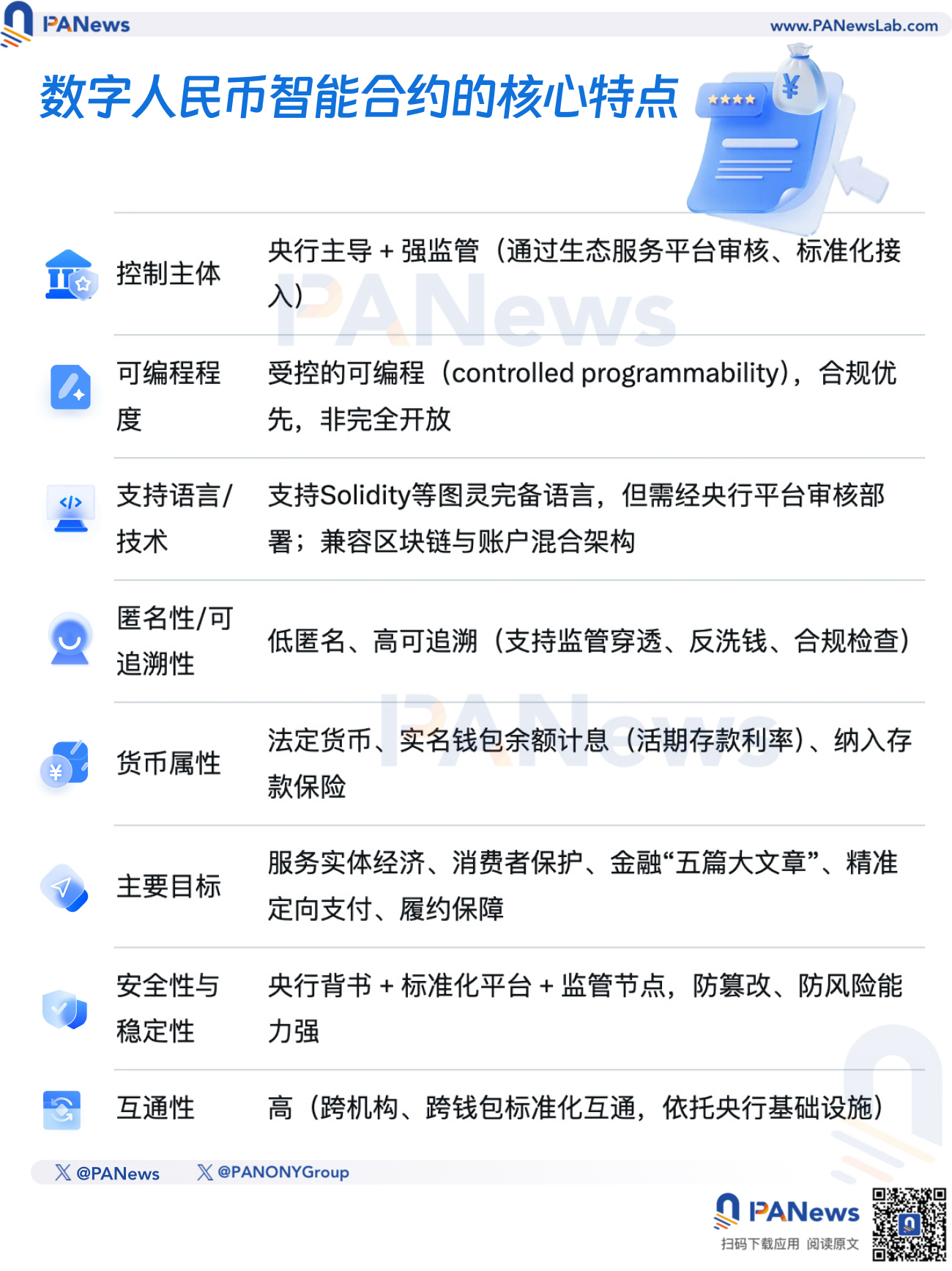
For example, in the pre-paid field, the digital yuan can achieve fund management modes like 'thawing in installments, paying per use'; in family and campus scenarios, parents can restrict children's accounts to specific consumption ranges; in government subsidy areas, the use of funds can also be precisely controlled.

In terms of technical implementation, according to disclosures by Caixin Net, the digital yuan adopts a restricted Turing-complete design, only supporting templated scripts permitted by the central bank. This design, while limiting certain functions, effectively ensures system security and controllability. Compared to the fully Turing-complete smart contracts of the crypto world, this design of the digital yuan avoids common risks like vulnerabilities, attacks, and governance failures in smart contracts. It is worth mentioning that the development of digital yuan smart contracts supports multiple programming languages, including fully Turing-complete languages compatible with Ethereum like Solidity. Therefore, development potential is not limited.

Furthermore, the digital yuan has demonstrated payment resilience. Its dual-offline payment function allows both payer and payee to complete transactions via手机NFC (Near Field Communication) in a no-network environment. This capability is irreplaceable in emergency scenarios and special environments. In contrast, in crypto systems, whether Bitcoin or stablecoin payments, they almost all rely on continuous internet connection to complete ledger synchronization and final settlement.
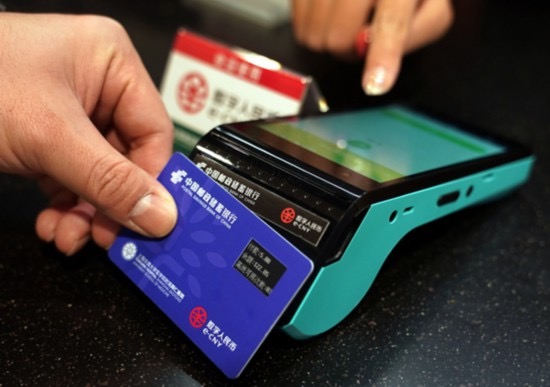
To bridge the 'digital divide' and adapt to the usage habits of different groups such as the elderly, students, and overseas visitors to China, the digital yuan also offers various forms of hard wallets, including IC cards, wearable devices (e.g., watches), SIM cards, and mobile terminals. This is fundamentally different from crypto hard wallets, which are primarily used for 'cold storage' of private keys as a defense against hacking attacks; digital yuan hard wallets focus more on the inclusivity of high-frequency payments. However, currently limited by the cost of deploying merchant acceptance terminals and the willingness to upgrade, the actual usage scope of digital yuan hard wallets remains limited, and their practical penetration effect still requires further observation.

Currently, the digital yuan is accelerating its evolution into a full-scenario currency. Its applications have broken through the retail sphere, forming replicable and promotable application models in areas like wholesale payments, public services, social governance, and even cross-border settlement, covering both online and offline scenarios. It is expected to further become an indispensable infrastructure in the digital economy.

Cross-border payment, in particular, is an important direction after its upgrade, supporting three-level transfers for countries, merchants, and individuals. As stablecoins rapidly penetrate the global cross-border payment field, the digital yuan is accelerating its 'going global' journey, becoming an important driving force for the internationalization of the renminbi. Through cross-border payments, the digital yuan can not only improve payment efficiency and reduce costs but also secure a place in the global payment system. For example, when overseas tourists consume in China, they don't need to exchange foreign currency; they can simply use the digital yuan App to scan a code and complete payment in their local currency at the real-time exchange rate. Currently, cross-border transfers conducted via mBridge have cumulatively exceeded $55 billion, with 95% settled using digital yuan.

In summary, for the digital yuan to truly complete the leap from a policy tool to a mass-market product, the real test may have just begun. But its path and potential are clearer than ever before.


Twitter:https://twitter.com/BitpushNewsCN

Bitpush TG Discussion Group:https://t.me/BitPushCommunity

Bitpush TG Subscription: https://t.me/bitpush

Original Link:https://www.bitpush.news/articles/7604656

Preguntas relacionadas

QWhat is the major upgrade that digital yuan (e-CNY) underwent on January 1, 2026, and how does it benefit users?

AThe major upgrade is that digital yuan transitioned to an 'interest-bearing stablecoin.' Users with verified (Class I, II, and III) wallets can now earn interest on their holdings at the current demand deposit rate of 0.05% per annum, paid quarterly. This provides users with a reason to hold digital yuan as their short-term idle funds can now generate yield automatically and with zero operational cost.

QHow did the initial M0 (digital cash) positioning of the digital yuan limit its adoption by commercial banks, and how has the shift to M1 changed this?

AInitially, as M0, the digital yuan operated on a 100% reserve system. This meant commercial banks had to deposit 100% of the digital yuan they received with the central bank, freezing those funds. Banks could not use them for lending or other profitable activities, making the system a cost center with little incentive for promotion. The shift to M1 reclassifies the funds in user wallets as a liability of the commercial banks. Now, banks only need to deposit a portion (the required reserve ratio) with the central bank and can use the remaining funds to develop profitable services, such as exclusive wealth management products, turning digital yuan into a potential profit center and incentivizing banks to promote it.

QWhat is a key technological advantage of the digital yuan's smart contracts compared to those in the crypto world, according to the article?

AA key technological advantage is its security and controllability. The digital yuan uses a 'restricted Turing-complete' design, which only supports templated scripts permitted by the central bank. This design, while still supporting languages like Solidity, effectively avoids common risks found in fully Turing-complete smart contracts in the crypto world, such as vulnerabilities, attacks, and governance failures, ensuring system safety and control.

QBesides retail payments, in which other significant area is the digital yuan expanding its application, and what is a specific example provided?

AThe digital yuan is expanding significantly into cross-border payments. A specific example is the mBridge project, through which cross-border transfers have cumulatively exceeded $55 billion, with 95% of these settlements conducted using the digital yuan. This facilitates more efficient and lower-cost international transactions and serves as a key driver for the internationalization of the renminbi.

QHow does the security backing for the digital yuan's value differ from that of crypto-based stablecoins?

AThe value of the digital yuan is backed by the full faith and credit of the Chinese state. It is included within the deposit insurance system, guaranteeing compensation of up to 500,000 yuan per account in case of bank failure. This state-backed security framework is fundamentally different from crypto stablecoins, which rely on code, algorithmic mechanisms, or collateral reserves that are subject to smart contract risks, de-pegging events, and regulatory uncertainty.

Lecturas Relacionadas

Trading

Spot
Futuros

Artículos destacados

Qué es $BANK

Banco AI: Un Paso Revolucionario en el Futuro de la Banca Introducción En una era marcada por avances rápidos en tecnología, Banco AI se sitúa en la intersección de la inteligencia artificial (IA) y los servicios bancarios. Este proyecto innovador busca redefinir el panorama financiero, mejorando la eficiencia operativa, las medidas de seguridad y las experiencias del cliente a través del poder de la IA. Al embarcarnos en esta exploración de Banco AI, profundizaremos en lo que implica el proyecto, sus dinámicas operativas, su contexto histórico y hitos significativos. ¿Qué es Banco AI? En su esencia, Banco AI representa una iniciativa transformadora destinada a integrar la inteligencia artificial en varias operaciones bancarias. Este proyecto aprovecha las capacidades de la IA para automatizar procesos, mejorar los protocolos de gestión de riesgos y mejorar la interacción con los clientes a través de servicios personalizados. Los objetivos principales de Banco AI incluyen: Automatización de Funciones Bancarias: Al aprovechar las tecnologías de IA, Banco AI tiene como objetivo automatizar tareas rutinarias, reduciendo la carga sobre los recursos humanos y mejorando la eficiencia. Mejora en la Gestión de Riesgos: El proyecto utiliza algoritmos de IA para predecir e identificar riesgos, fortaleciendo así las medidas de seguridad contra fraudes y otras amenazas. Personalización de Servicios Bancarios: Banco AI se centra en ofrecer productos y servicios financieros a medida al analizar datos y comportamientos de los clientes. Mejoramiento de la Experiencia del Cliente: La implementación de soluciones impulsadas por IA, como chatbots y asistentes virtuales, tiene como objetivo proporcionar a los usuarios interacciones más humanas, revolucionando la forma en que los clientes se relacionan con los bancos. Con estos objetivos, Banco AI se posiciona como un jugador crucial para hacer que la banca sea más eficiente, segura y centrada en el usuario. ¿Quién es el Creador de Banco AI? Los detalles sobre el creador de Banco AI siguen siendo desconocidos. Como tal, no se ha identificado a ninguna persona u organización específica en la información disponible. El anonimato que rodea el inicio del proyecto plantea preguntas, pero no resta valor a su ambiciosa visión y objetivos. ¿Quiénes Son los Inversores de Banco AI? Al igual que con el creador del proyecto, no se ha divulgado información específica sobre los inversores u organizaciones que apoyan a Banco AI. Sin esta información, es un desafío delinear el respaldo financiero y el apoyo institucional que podrían estar impulsando el proyecto hacia adelante. No obstante, la importancia de contar con una sólida base de inversión es fundamental para sostener el desarrollo en un campo tan innovador. ¿Cómo Funciona Banco AI? Banco AI opera en múltiples frentes innovadores, centrándose en factores únicos que lo diferencian de los marcos bancarios tradicionales. A continuación, se presentan las características operativas clave: Automatización: Al aplicar algoritmos de aprendizaje automático, Banco AI automatiza varios procesos manuales dentro de los bancos. Esto resulta en la reducción de costos operativos y permite que los trabajadores humanos redirijan sus esfuerzos hacia actividades más estratégicas. Gestión Avanzada de Riesgos: La integración de la IA en las prácticas de gestión de riesgos equipa a los bancos con herramientas para predecir con precisión amenazas potenciales como el fraude, garantizando que la información y los activos de los clientes permanezcan seguros. Recomendaciones Financieras Personalizadas: A través del aprendizaje continuo a partir de las interacciones con los clientes, los sistemas de IA desarrollan una comprensión matizada de las necesidades del usuario, lo que les permite ofrecer consejos adaptados sobre decisiones financieras. Interacciones Mejoradas con los Clientes: Al utilizar chatbots y asistentes virtuales impulsados por IA, Banco AI permite una experiencia más atractiva para el cliente, permitiendo a los usuarios resolver sus consultas rápidamente, reduciendo así los tiempos de espera y mejorando los niveles de satisfacción. En conjunto, estas características operativas posicionan a Banco AI como un pionero en el sector bancario, estableciendo nuevos parámetros para la entrega de servicios y la excelencia operativa. Línea de Tiempo de Banco AI Entender la trayectoria de Banco AI requiere mirar su contexto histórico. A continuación, se presenta una línea de tiempo que destaca hitos y desarrollos importantes: Inicios de 2010: La conceptualización de la integración de la IA en los servicios bancarios comenzó a ganar atención a medida que las instituciones bancarias reconocieron los posibles beneficios. 2018: Se produjo un aumento notable en la implementación de tecnologías de IA cuando los bancos comenzaron a utilizar herramientas de IA como chatbots para el servicio al cliente básico y sistemas de gestión de riesgos para mejorar la seguridad. 2023: La sofisticación de la IA continuó avanzando, con la introducción de IA generativa para tareas más complejas como el procesamiento de documentos y análisis de inversiones en tiempo real. Este año marcó un salto significativo en las capacidades que la tecnología de IA otorgó a los bancos. 2024-Estatus Actual: A partir de este año, Banco AI se encuentra en una trayectoria ascendente, con investigaciones y desarrollos en curso que pronto mejorarán las capacidades en las operaciones bancarias. La continua exploración de las aplicaciones de IA sugiere emocionantes desarrollos aún por venir. Puntos Clave Sobre Banco AI Integración de la IA en la Banca: Banco AI se centra en adoptar inteligencia artificial para optimizar los procesos bancarios y mejorar la experiencia del usuario. Enfoque en Automatización y Gestión de Riesgos: El proyecto enfatiza fuertemente estas áreas, con el objetivo de desplazar la carga de tareas rutinarias mientras mejora los marcos de seguridad a través de análisis predictivos. Soluciones Bancarias Personalizadas: Al aprovechar los datos de los clientes, Banco AI permite servicios bancarios adaptados a las necesidades individuales de los usuarios. Compromiso con el Desarrollo: Banco AI se mantiene comprometido con esfuerzos de investigación y desarrollo continuos, asegurando su adaptabilidad y relevancia continua a medida que la tecnología sigue evolucionando. Conclusión En resumen, Banco AI ejemplifica un paso crucial hacia adelante en la industria bancaria, aprovechando la inteligencia artificial para redefinir los paradigmas operativos, mejorar la seguridad y promover la satisfacción del cliente. A pesar de las lagunas en la información sobre el creador y los inversores, los objetivos claros y los mecanismos funcionales de Banco AI proporcionan una sólida base para su evolución continua. A medida que la tecnología de IA sigue avanzando y fusionándose con el sector bancario, Banco AI está bien posicionado para impactar significativamente el futuro de los servicios financieros, mejorando la forma en que entendemos e interactuamos con la banca.

143 Vistas totalesPublicado en 2024.04.06Actualizado en 2024.12.03

Qué es $BANK

Cómo comprar BANK

¡Bienvenido a HTX.com! Hemos hecho que comprar Lorenzo Protocol (BANK) sea simple y conveniente. Sigue nuestra guía paso a paso para iniciar tu viaje de criptos.Paso 1: crea tu cuenta HTXUtiliza tu correo electrónico o número de teléfono para registrarte y obtener una cuenta gratuita en HTX. Experimenta un proceso de registro sin complicaciones y desbloquea todas las funciones.Obtener mi cuentaPaso 2: ve a Comprar cripto y elige tu método de pagoTarjeta de crédito/débito: usa tu Visa o Mastercard para comprar Lorenzo Protocol (BANK) al instante.Saldo: utiliza fondos del saldo de tu cuenta HTX para tradear sin problemas.Terceros: hemos agregado métodos de pago populares como Google Pay y Apple Pay para mejorar la comodidad.P2P: tradear directamente con otros usuarios en HTX.Over-the-Counter (OTC): ofrecemos servicios personalizados y tipos de cambio competitivos para los traders.Paso 3: guarda tu Lorenzo Protocol (BANK)Después de comprar tu Lorenzo Protocol (BANK), guárdalo en tu cuenta HTX. Alternativamente, puedes enviarlo a otro lugar mediante transferencia blockchain o utilizarlo para tradear otras criptomonedas.Paso 4: tradear Lorenzo Protocol (BANK)Tradear fácilmente con Lorenzo Protocol (BANK) en HTX's mercado spot. Simplemente accede a tu cuenta, selecciona tu par de trading, ejecuta tus trades y monitorea en tiempo real. Ofrecemos una experiencia fácil de usar tanto para principiantes como para traders experimentados.

741 Vistas totalesPublicado en 2025.05.09Actualizado en 2025.05.09

Cómo comprar BANK

Discusiones

Bienvenido a la comunidad de HTX. Aquí puedes mantenerte informado sobre los últimos desarrollos de la plataforma y acceder a análisis profesionales del mercado. A continuación se presentan las opiniones de los usuarios sobre el precio de BANK (BANK).

活动图片