Plunging 10% Then Surging: Weekend Crude Oil Market Watch

marsbitPublicado a 2026-04-20Actualizado a 2026-04-20

Resumen

Following a 10% plunge, oil prices surged over the weekend as geopolitical tensions in the Strait of Hormuz escalated dramatically. The initial market optimism, driven by the strait’s brief reopening on Friday, quickly reversed on Saturday when Iran reinstated restrictions and fired on vessels, halting nearly all traffic. In response, oil contracts rose approximately 4.52%, while S&P futures fell nearly 0.8%. U.S. President Trump alternated between diplomatic gestures—sending an envoy for talks—and threats to destroy Iranian infrastructure if no deal was reached. Iran rejected further negotiations, fearing a U.S. attack before the midweek ceasefire deadline. This triggered another spike in oil, surpassing Saturday’s highs, and further pressured equity markets. Crypto-related stocks underperformed significantly. Market optimism is expected to be punished, and the week ahead hinges on whether Iran maintains its refusal to negotiate.

Friday's reopening of the critical Hormuz Strait waterway triggered widespread risk-on sentiment in the markets: U.S. stocks soared, crude oil prices plummeted, U.S. Treasury yields fell, as the belief spread that the worst was over and the disruption to global energy supplies had eased.

However, these moves may prove to be premature.

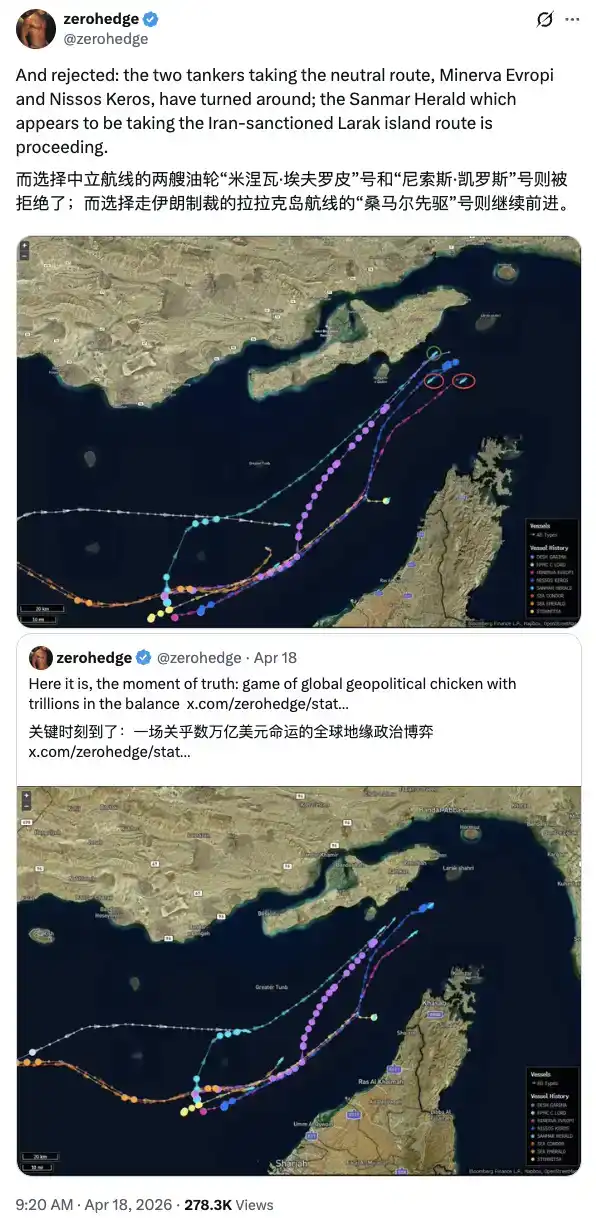
At 9:20 AM on the 18th (Saturday), reports broke that two oil tankers had been denied passage through the Strait of Hormuz. Trump immediately applied public pressure: if no deal was reached by Wednesday, the U.S. would continue blockading Iranian ports. At 16:00 that day, Iran announced the re-imposition of restrictions on the Strait and opened fire on vessels attempting to pass—two Indian ships turned back into the Persian Gulf after being shelled, bringing shipping traffic in the Strait to a near standstill.
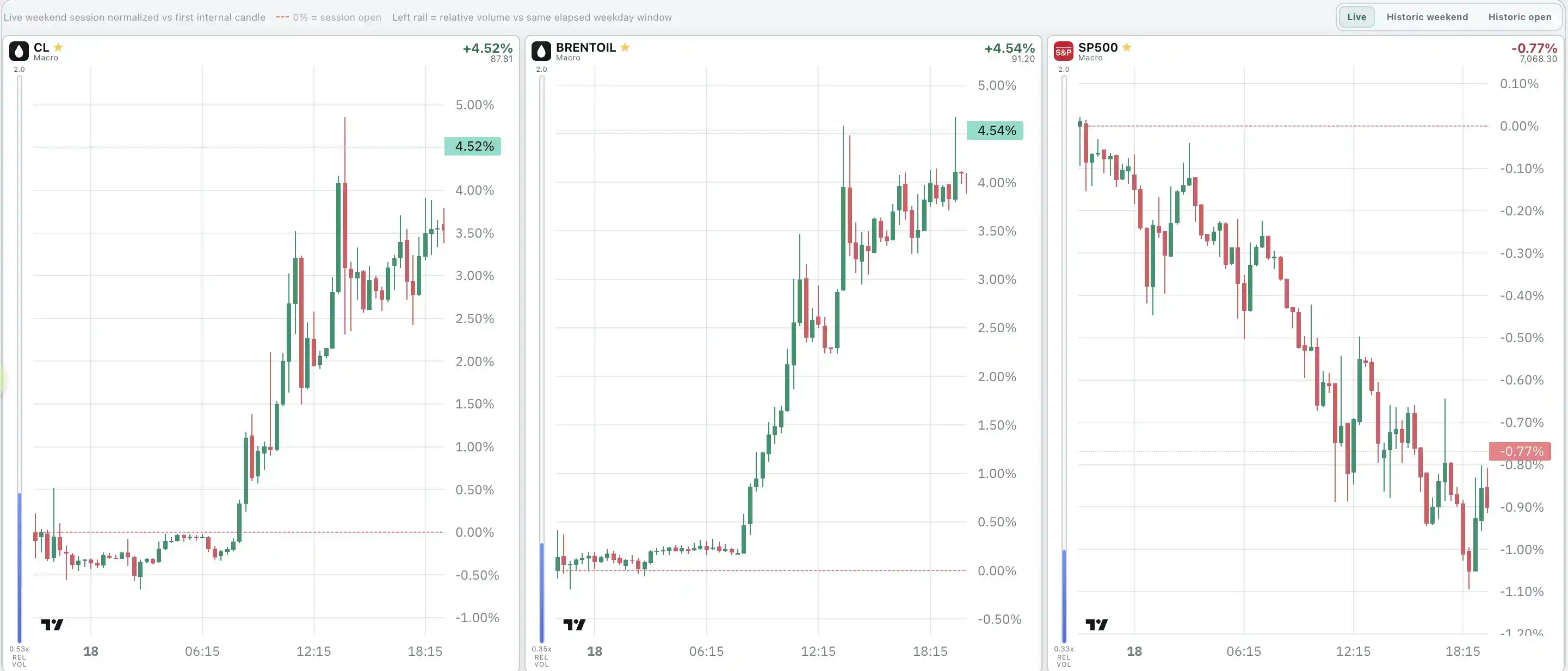
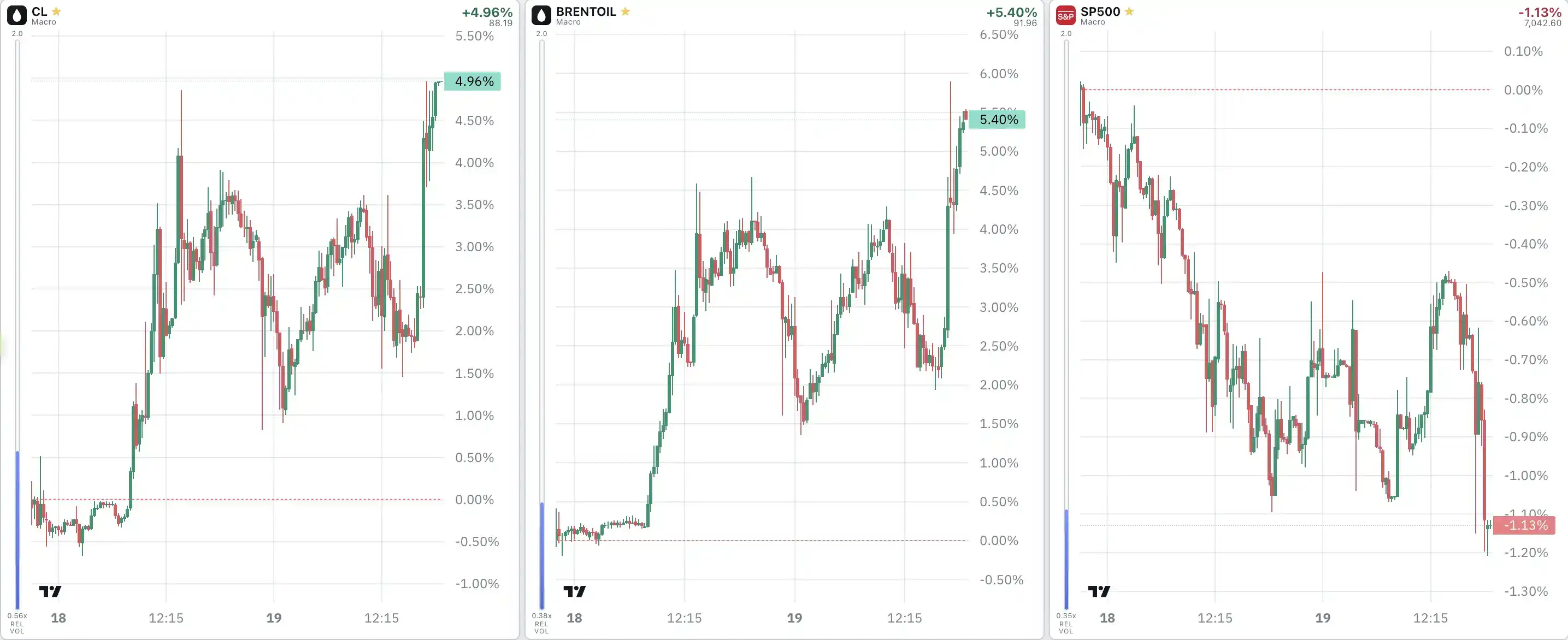
Traders reacted swiftly on TradeXYZ, with crude oil contracts gaining about 4.52% compared to the weekend closing price, and S&P index contracts falling nearly 0.8%.
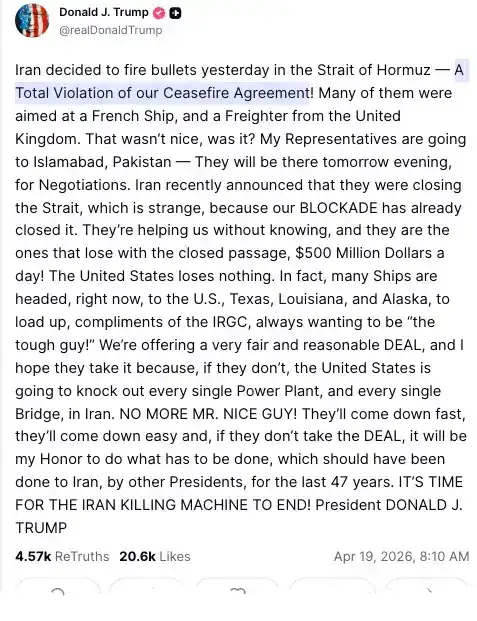
Trump then shifted his stance, revealing that envoy Steve Witkoff would travel to Pakistan for talks with the Iranian side on Tuesday, potentially extending the negotiation window until Wednesday.

He then turned around and posted on Truth Social, stating, "The deal we offered is very fair and reasonable, I hope they accept it, because if they don't, the U.S. will destroy every power plant and every bridge in Iran."
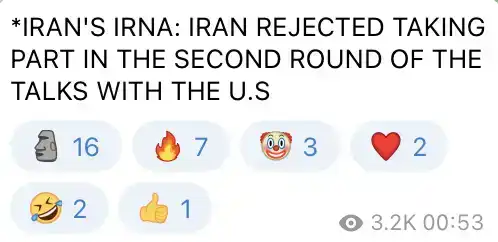
Iran was clearly not buying it. At 1:53 AM on the 20th, the Iranian side announced its refusal to participate in a second round of talks; according to Axios, Tehran's assessment was that the U.S. might launch an attack before the Tuesday night ceasefire expiration.
Driven by this news, crude oil surged again, clearing the highs from the 18th, while the S&P index correspondingly broke below the lows from the 18th.
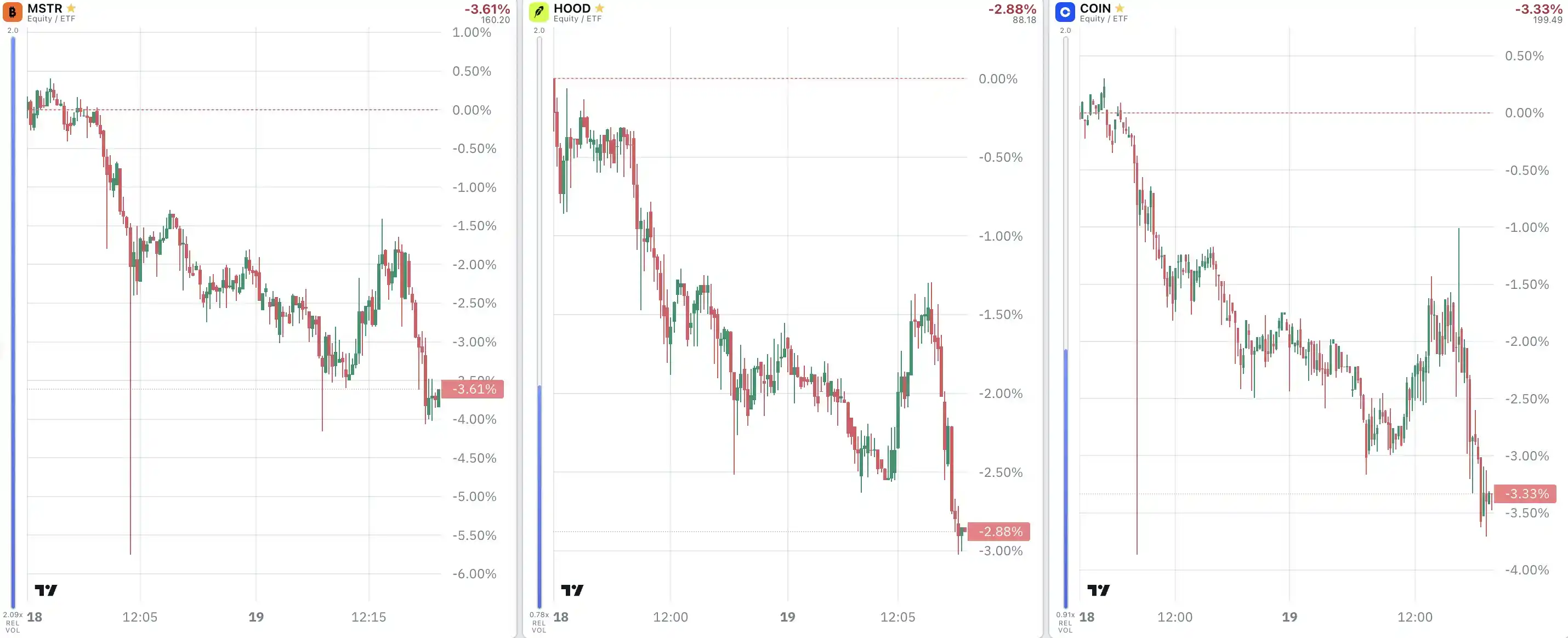
On the individual stock front, three crypto-related stocks significantly underperformed others.
Predictably, the spreading optimism in the market last week will be punished. This week's market movements will largely depend on whether Iran can maintain its no-negotiation stance.


Preguntas relacionadas

QWhat event initially caused the surge in risk appetite in the markets on Friday?

AThe reopening of the Strait of Hormuz shipping lane.

QWhat specific action did Iran take on Saturday that reversed the initial market optimism?

AIran re-imposed restrictions on the Strait of Hormuz and fired on vessels attempting to pass through, causing shipping to nearly halt.

QHow did crude oil futures react on TradeXYZ following the news of the Strait of Hormuz incident?

ACrude oil contracts rose by approximately 4.52% compared to the weekend's closing price.

QWhat was the content of Donald Trump's threat on Truth Social if Iran did not accept the U.S. deal?

AHe stated that if Iran did not accept the deal, the U.S. would 'destroy every power plant and every bridge in Iran.'

QWhat was the final event that caused crude oil to surge again and erase the previous day's highs?

AIran's announcement that it would refuse to participate in the second round of negotiations, fueled by reports that the U.S. might launch an attack before the ceasefire expired.

Lecturas Relacionadas

Standing in the Light: A Comprehensive Guide to the Optical Module and CPO Supply Chain

"Standing in the Light: Understanding the Optical Module and CPO Industry Chain" This article analyzes the critical role of optical communication technology, specifically optical modules and Co-Packaged Optics (CPO), as the "nervous system" for modern AI data centers. With exponential growth in AI computational demands (e.g., NVIDIA's Vera Rubin architecture), traditional electrical interconnects using copper cables face severe bottlenecks in bandwidth, power consumption, and signal integrity over distance. The core function of an optical module is to act as a "translator," converting electrical signals from chips into optical signals for transmission over fiber (and vice-versa). Key internal components include lasers, modulators, photodetectors, drivers, and DSP chips. The industry is currently transitioning from 800G to 1.6T modules. However, the future lies in CPO. This next-generation technology integrates the optical engine directly with the switch ASIC/XPU on the same package substrate, drastically reducing power consumption (by ~3.5x according to NVIDIA), overcoming bandwidth density limits, and minimizing signal attenuation compared to traditional pluggable modules. Key challenges for CPO include advanced packaging capacity (dominated by TSMC), thermal management, repairability, and standardization. The article details the broader technology landscape, including Near-Packaged Optics (NPO, a pragmatic intermediate step), Linear-drive Pluggable Optics (LPO), Optical I/O (OIO for chip-level integration), and Optical Circuit Switches (OCS). A comprehensive CPO industry chain is mapped, highlighting shifting power dynamics: * **Architecture Definers:** NVIDIA, Broadcom, and Marvell now hold greater influence. * **Advanced Packaging & Manufacturing:** TSMC is central; Fabrinet is a key EMS player. * **Lasers ("The Heart"):** A strategic bottleneck. EML lasers are led by Lumentum and Coherent (both receiving major NVIDIA investments). CW lasers, favored for CPO/silicon photonics, see strong Chinese players like Source Photonics and Sicoya. * **Silicon Photonics Chips:** The mainstream path for CPO engines, with key players like Broadcom, Intel, Marvell, and China's Accelink. * **Fiber Connectivity Components:** A major new, high-growth market created by CPO, including Fiber Array Units (FAU), Polarization-Maintaining Fiber (PMF), and MPO connectors. Companies like Tianfu Communication and US Conec are leaders. * **Fiber & Cable:** Experiencing a super-cycle (e.g., Corning, Yangtze Optical Fiber). * **PCB/Substrates:** Requiring advanced materials (e.g., Shengyi Tech). * **DSP & SerDes:** Functions are integrated into switch ASICs in the CPO era (e.g., Broadcom, Astera Labs). * **Optical Module Makers:** Transitioning from standalone module suppliers to providers of optical engines and NPO/LPO solutions while riding the current pluggable boom (e.g., Zhongji Innolight, Eoptolink). The investment timeline is segmented: Short-term (2026-2027) features the "last feast" for pluggable modules and CPO's initial rollout. Medium-term (2027-2029) will see CPO expand and NPO peak. Long-term (2029-2032+) involves CPO/OIO penetration into intra-rack scaling. In conclusion, optical interconnects are fundamental to AI infrastructure. The competitive landscape sees US firms leading in architecture and high-end chips, TSMC in advanced packaging, and Chinese firms holding strong positions in modules, connectivity components, CW lasers, and fiber/cable. The future belongs to companies that can navigate the technological shift from "selling shovels" (modules) to "building highways" (CPO/OIO infrastructure).

marsbitHace 9 min(s)

Standing in the Light: A Comprehensive Guide to the Optical Module and CPO Supply Chain

marsbitHace 9 min(s)

Trading

Spot
Futuros
活动图片




