PIPPIN falls hard after $0.90 peak – Can bulls take back control?

ambcryptoPublicado a 2026-03-24Actualizado a 2026-03-24

Resumen

PIPPIN's price experienced a sharp decline from its peak of $0.90, falling to around $0.0915, driven by aggressive selling pressure and long liquidations. Open Interest dropped by 40%, indicating a significant exit of speculative capital and a fragile market structure. However, the token has recently stabilized between $0.082 and $0.10, with RSI recovering from oversold levels and trading volume declining—suggesting seller exhaustion. A break above the $0.113 resistance could signal a short-term bullish reversal, potentially pushing the price toward $0.15.

Pippin’s [PIPPIN] price action reflects classic memecoin expansion followed by rapid unwinding, as momentum shifts from hype to distribution.

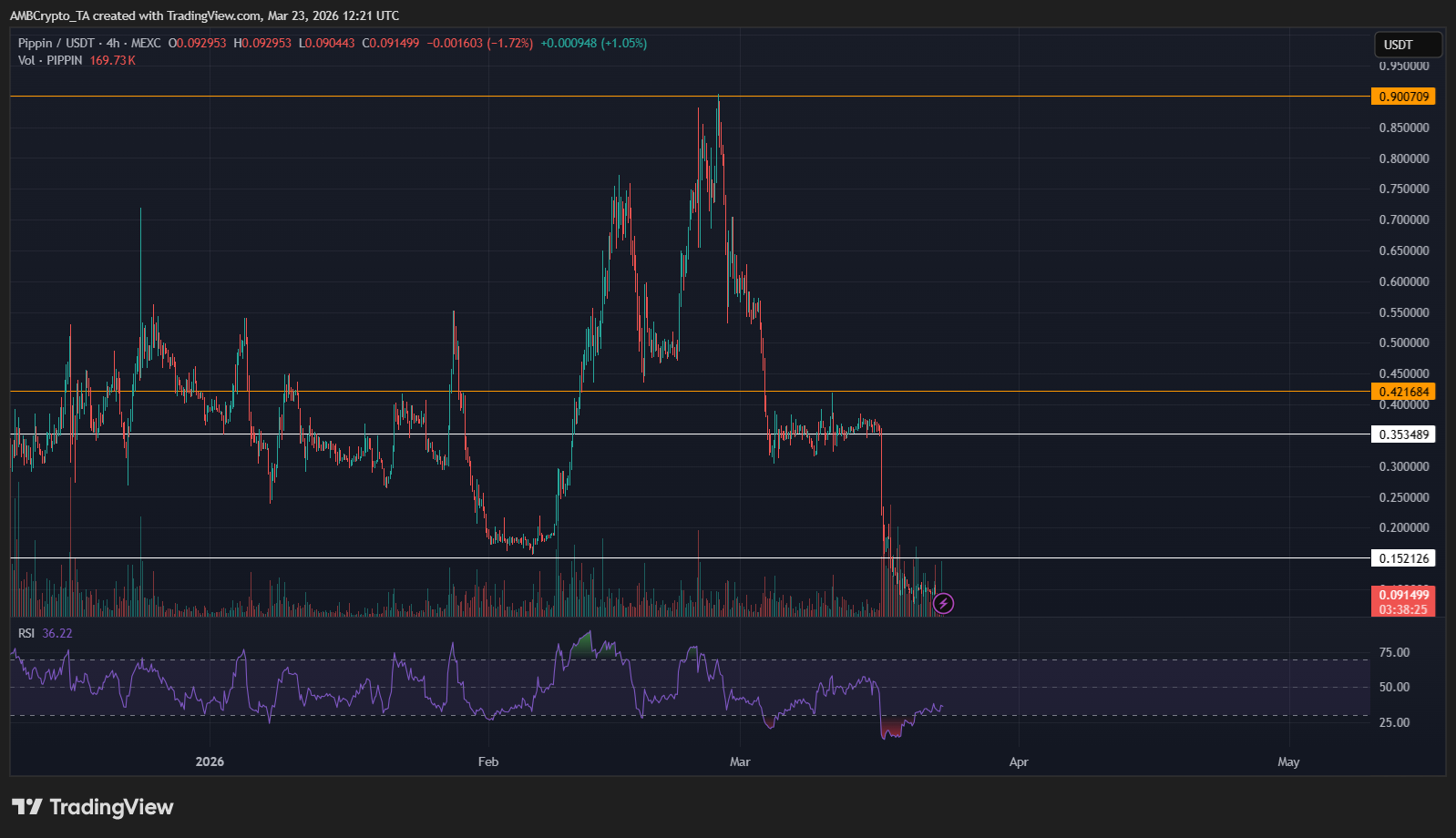
The rally from $0.20–$0.30 into the $0.90 peak shows aggressive speculative inflows, likely driven by social momentum and short-term positioning.

As the price approached $0.90, selling pressure intensified, leading to a sharp drop toward $0.15, which marked the first major profit-taking phase. This move weakened the structure, as buyers failed to sustain higher levels, allowing momentum to fade.
Source: TradingView

Price then consolidated briefly before breaking below $0.15, accelerating downside toward $0.0915, now acting as immediate support. RSI near 36 confirms bearish momentum, yet it is not fully oversold, which leaves room for further downside.

This decline reflects liquidity exit and fading demand, as speculative capital rotates out quickly. If $0.0915 fails, price may extend toward $0.05–$0.07, reinforcing a fragile, sentiment-driven structure.

Long liquidations accelerate as PIPPIN’s structure weakens

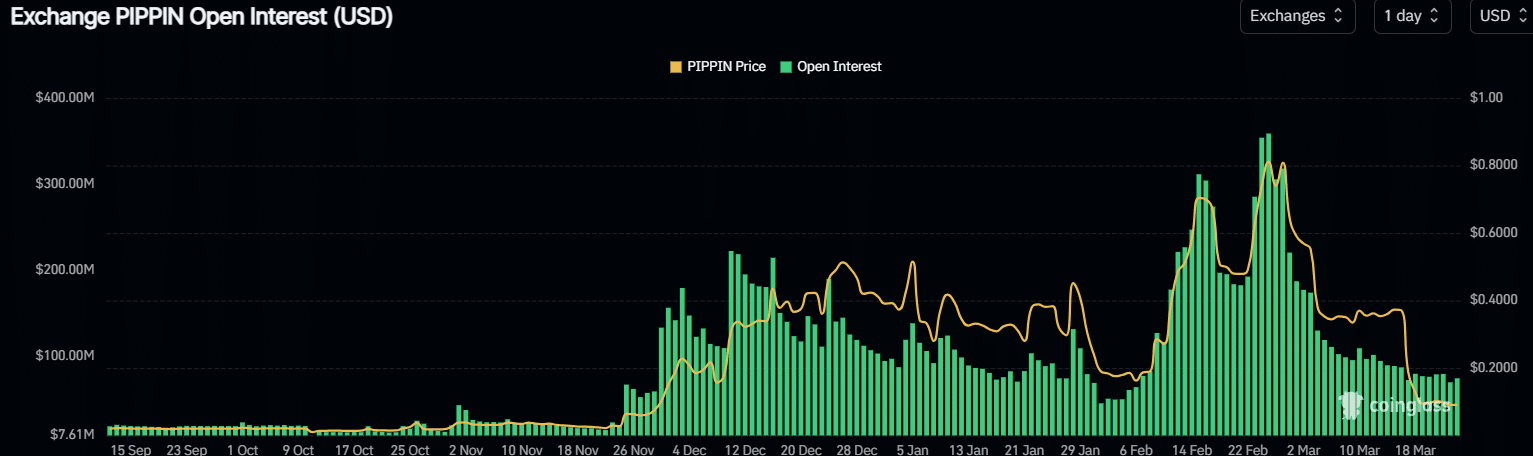
As price breaks below $0.15 and accelerates toward $0.0915, derivatives positioning confirms that the decline is driven by forced unwinding rather than fresh bearish bets.

Open Interest contracted to 74.14 million, dropping 12% in 24 hours and nearly 40% across major venues, which shows traders are closing positions instead of adding exposure.
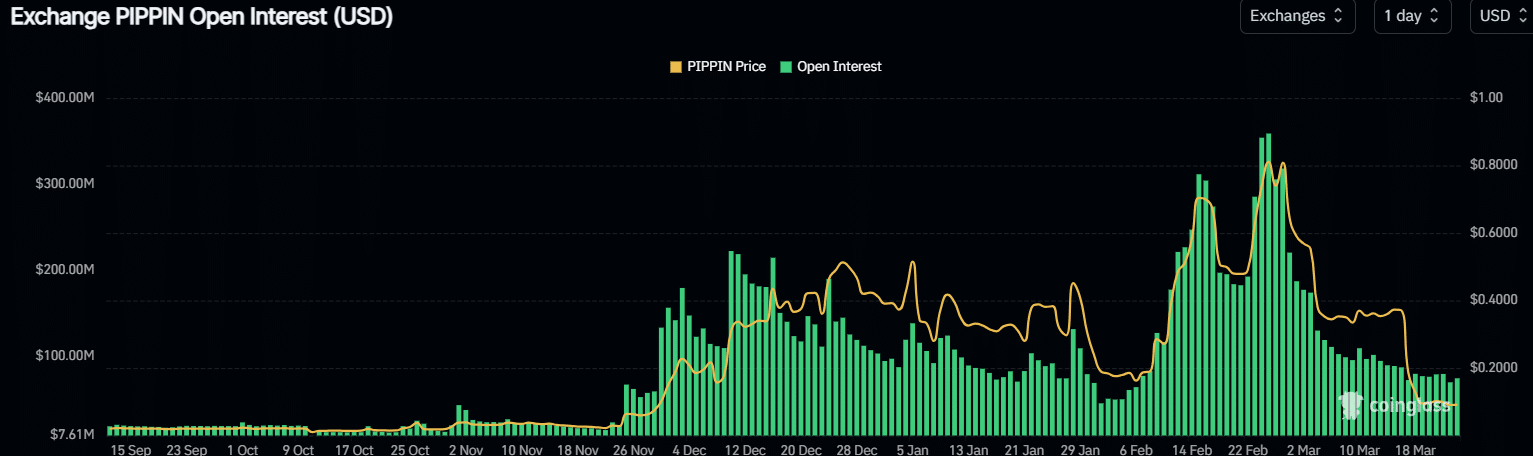
Source: CoinGlass

This shift reflects a long unwind phase, where overleveraged participants exit as losses mount, amplifying downside pressure. At the same time, Funding Rates remained positive near 0.05%, which revealed that some longs still held positions, expecting a rebound despite weakening structure.

As liquidations increased, long-side wipes dominated, contributing to cascading sell pressure and reinforcing the breakdown. This imbalance highlights a fragile market, where liquidity thins as participants retreat.

With conviction fading and capital exiting, the structure becomes hollow, meaning price lacks strong support. Until Open Interest stabilizes and funding normalizes, the market remains vulnerable to further downside or sharp volatility spikes.

Short-term strength builds as PIPPIN finds a floor

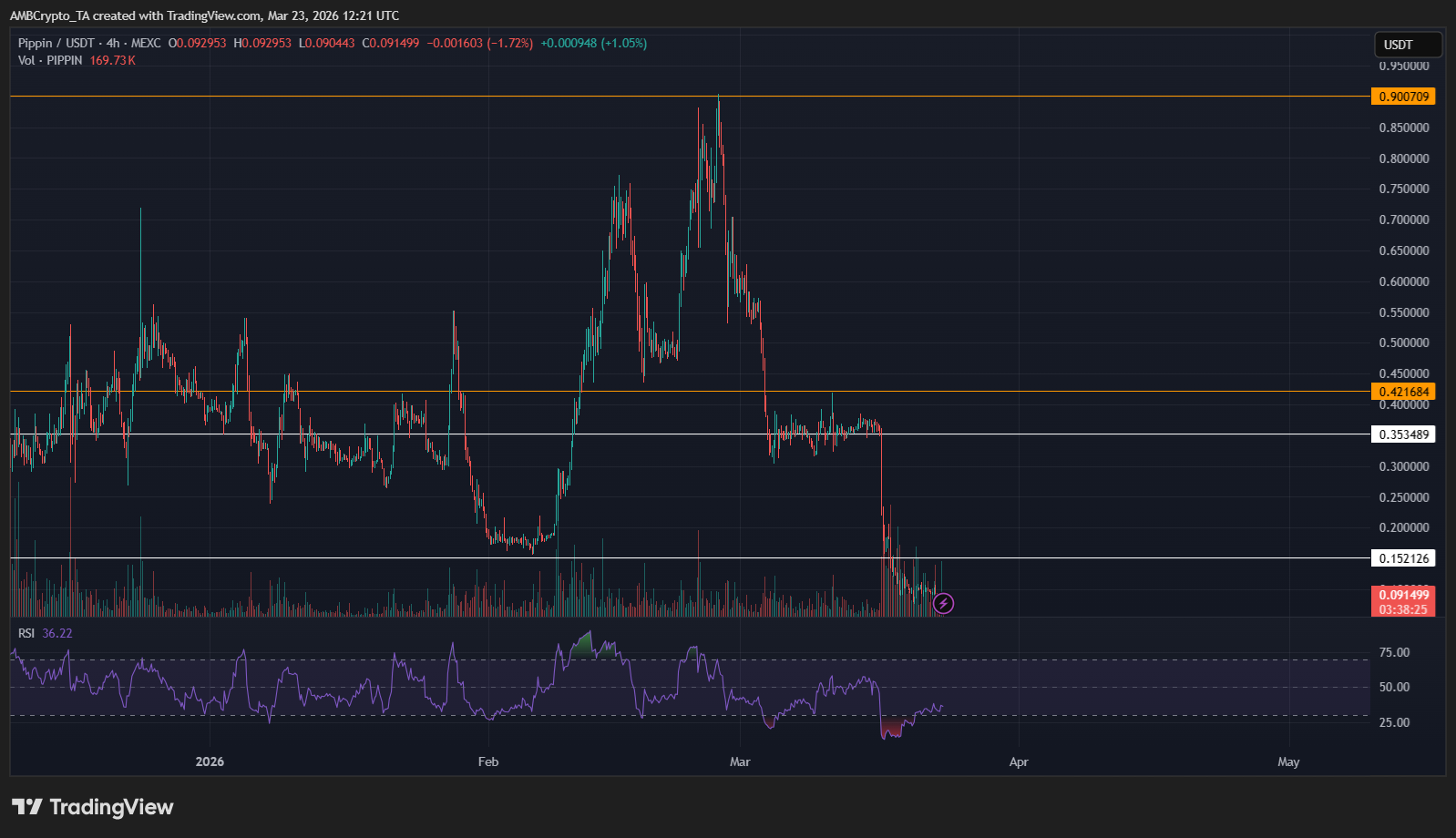
After the sharp breakdown, price began stabilizing between $0.082 and $0.10, forming a clear short-term floor. As lower lows disappeared, buyers gradually absorbed remaining sell pressure, shifting structure from decline to accumulation.

The RSI recovered from oversold levels below 20 to around 50.6, signaling improving momentum as buying strength starts matching selling pressure. This transition suggests that short-term control is slowly rotating back toward bulls.
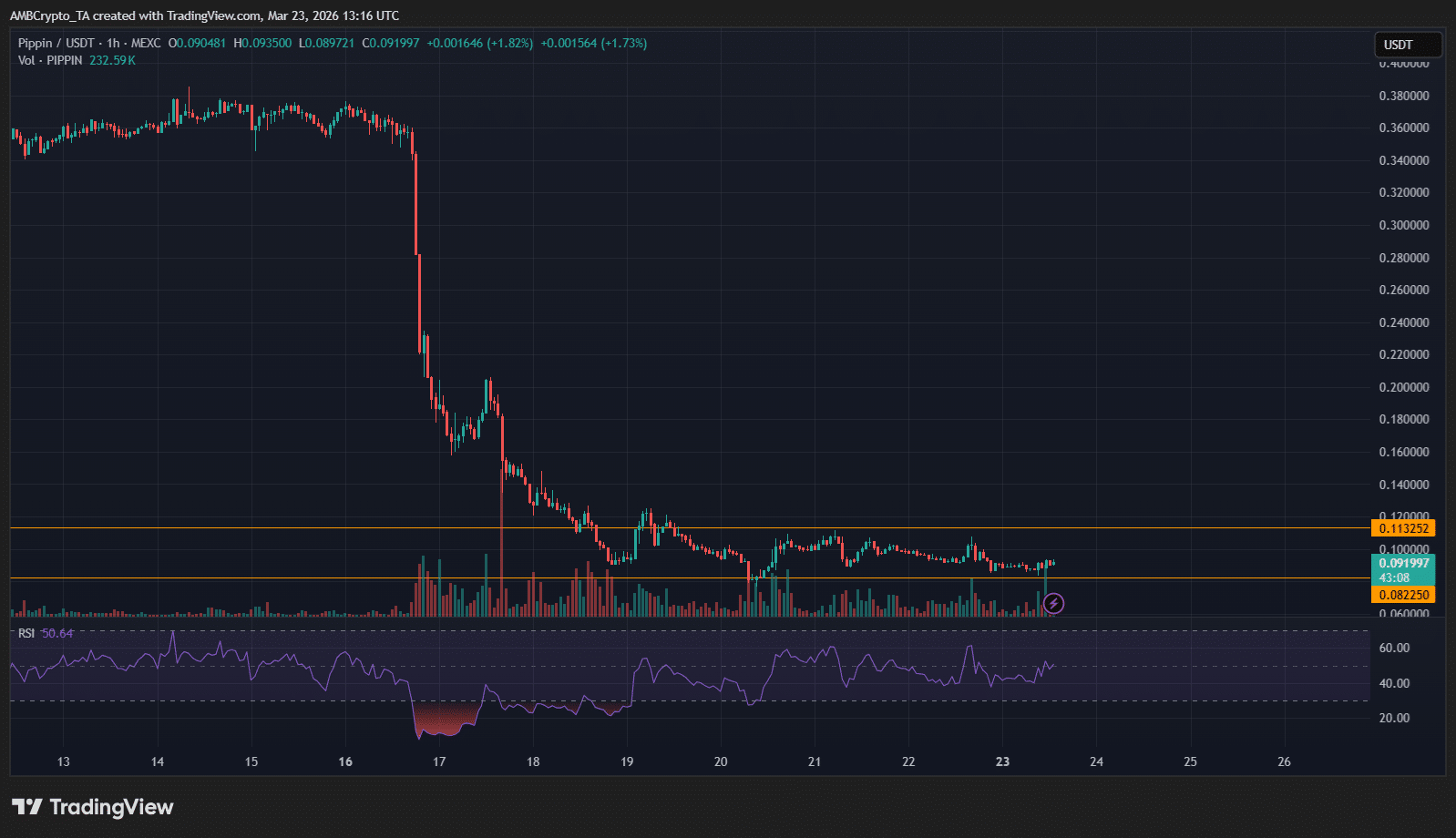
Source: TradingView

At the same time, volume declines noticeably compared to the crash on the 17th of March, indicating seller exhaustion as aggressive dumping fades. With fewer sellers, smaller buy orders can now influence price more effectively.

Price tightens below the $0.113 resistance, creating a compression range. If this level breaks, momentum could accelerate toward $0.15, confirming a short-term reversal structure.


Final Summary

  • PIPPIN’s collapse from $0.90 to $0.0915, driven by long liquidations and a 40% Open Interest drop signals liquidity exit and fragile structure.
  • PIPPIN stabilization between $0.082 and $0.10 with RSI recovery and declining volume suggests seller exhaustion, positioning for short-term rebound if $0.113 breaks.


Preguntas relacionadas

QWhat was the peak price of PIPPIN and what does its subsequent drop to $0.0915 indicate?

APIPPIN reached a peak price of $0.90. The subsequent sharp drop to $0.0915 indicates a classic memecoin pattern of rapid unwinding, driven by profit-taking, long liquidations, and a significant exit of speculative capital, revealing a fragile market structure.

QHow did Open Interest and Funding Rates change during PIPPIN's decline, and what does this suggest about market sentiment?

AOpen Interest contracted by 12% in 24 hours and nearly 40% across major venues, indicating traders were closing positions rather than adding new exposure. Despite this, Funding Rates remained slightly positive at 0.05%, suggesting some longs were still holding, hoping for a rebound, but the overall sentiment was weak with capital exiting.

QWhat key support level is PIPPIN currently testing, and what is the significance of a break below it?

APIPPIN is testing immediate support at $0.0915. A break below this level could lead to a further decline toward the $0.05–$0.07 range, reinforcing the fragile, sentiment-driven nature of its market structure.

QWhat signs suggest that PIPPIN might be forming a short-term bottom and a potential rebound?

ASigns of a short-term bottom include price stabilization between $0.082 and $0.10, the RSI recovering from oversold levels (20) to around 50.6, and a noticeable decline in trading volume indicating seller exhaustion. A break above the $0.113 resistance could confirm a short-term reversal.

QWhat was the primary driver behind the cascading sell pressure during PIPPIN's price crash?

AThe cascading sell pressure was primarily driven by long liquidations, where overleveraged participants were forced to exit their positions as losses mounted. This created a cycle of amplified downside pressure and contributed to the rapid breakdown in price.

Lecturas Relacionadas

Stuck Polymarket: The Real Test After Riding the Traffic Boom Has Arrived

Polymarket, a leading prediction market platform, is facing significant technical challenges as its growth outpaces its current infrastructure on Polygon. Users are experiencing laggy transactions, unresponsive orders, and delayed confirmations, severely impacting the trading experience. In response, DeFi Engineering VP Josh Stevens outlined a comprehensive engineering overhaul. The plan includes reducing on-chain data delays, fixing order cancellation issues, rebuilding the central limit order book (CLOB), improving website performance, and developing a unified SDK and API. A major revelation was the ongoing "chain migration," indicating a potential move away from Polygon. The core issue is that Polymarket has evolved from a simple prediction market into a high-frequency trading platform, making Polygon's limitations—such as block space, gas fees, and block time—a ceiling for further growth. The migration is not just a simple chain switch but a fundamental rebuild of its trading system to support more complex products like perpetual contracts (Perps). This announcement has sparked competition among chains like Solana, Sui, and Algorand, all vying to host Polymarket. For Polygon, losing this key application, which contributes significantly to its gas fee revenue, would be a major setback. The real test for Polymarket is no longer attracting users but proving it can provide a stable, reliable trading environment that retains them.

Odaily星球日报Hace 17 min(s)

Stuck Polymarket: The Real Test After Riding the Traffic Boom Has Arrived

Odaily星球日报Hace 17 min(s)

Lowering Expectations for BTC's Next Bull Market

The author, Alex Xu, explains his decision to significantly reduce his Bitcoin holdings (from full to ~30% of his portfolio) during the current bull cycle, citing a lowered long-term outlook for BTC's price appreciation in the next cycle. He outlines six key reasons for this reduced expectation: 1. **Diminished Growth Drivers:** The narrative of exponential user adoption has largely played out with institutional ETF adoption. The next major growth phase—adoption by sovereign national reserves or central banks—seems unlikely in the near future. 2. **Personal Opportunity Cost:** More attractive investment opportunities have emerged in other assets, such as undervalued companies. 3. **Industry-Wide Contraction:** The broader crypto industry is struggling, with most Web3 business models (SocialFi, GameFi, DePIN) failing. This overall萧条 (depression) reduces the fundamental demand and consensus for Bitcoin. 4. **Strain on Major Buyer:** MicroStrategy, a major corporate buyer of BTC, faces rising financing expenses for its debt, which could slow its purchasing rate and create significant marginal pressure on the market. 5. **Increased Competition from Gold:** The emergence of "tokenized gold" has closed the functional gap (portability, divisibility) between physical gold and Bitcoin, offering a strong competitor in the non-sovereign store-of-value space. 6. **Security Budget Concerns:** The block reward halving continues to exacerbate the long-standing issue of funding Bitcoin's network security, with new fee source explorations like Ordinals and L2s largely failing. The author's decision to hold a significant (though reduced) position reflects a cautious, not bearish, outlook. He remains open to increasing his exposure if the fundamental reasons for his skepticism change or if new positive catalysts emerge.

marsbitHace 56 min(s)

Lowering Expectations for BTC's Next Bull Market

marsbitHace 56 min(s)

Can Iran 'Control' the Strait of Hormuz?

Iran has announced a comprehensive plan to assert control over the strategic Strait of Hormuz, a critical global oil shipping chokepoint. The proposed measures include requiring all vessels to obtain Iranian permission for passage, imposing fees for security, environmental protection, and navigation management—preferably paid in Iranian rials—and absolutely banning Israeli ships. Vessels from countries deemed hostile by Iran’s top security bodies may also be barred. Analysts suggest Iran’s motives are multifaceted: increasing pressure on the U.S. and Israel by leveraging control over oil transit to influence global prices and inflation; creating a new revenue stream, potentially exceeding $7.7 billion annually, to counter Western sanctions and support postwar reconstruction; and using transit permissions as bargaining chips in future negotiations, notably with the U.S. However, the plan faces significant practical and diplomatic challenges. Enforcing comprehensive interception and fee collection in the busy waterway, patrolled by international military forces, would be difficult. The U.S. has already countering with a blockade of Iranian ports and threats to intercept any ship paying fees, potentially strangling Iran’s oil exports and fee revenue. Broad international opposition, led by European and Gulf states, and legal controversies further complicate implementation. The proposal may ultimately serve more as a negotiating tactic than a feasible policy, with its execution remaining highly uncertain.

marsbitHace 2 hora(s)

Can Iran 'Control' the Strait of Hormuz?

marsbitHace 2 hora(s)

Trading

Spot
Futuros

Artículos destacados

Cómo comprar PIPPIN

¡Bienvenido a HTX.com! Hemos hecho que comprar pippin (PIPPIN) sea simple y conveniente. Sigue nuestra guía paso a paso para iniciar tu viaje de criptos.Paso 1: crea tu cuenta HTXUtiliza tu correo electrónico o número de teléfono para registrarte y obtener una cuenta gratuita en HTX. Experimenta un proceso de registro sin complicaciones y desbloquea todas las funciones.Obtener mi cuentaPaso 2: ve a Comprar cripto y elige tu método de pagoTarjeta de crédito/débito: usa tu Visa o Mastercard para comprar pippin (PIPPIN) al instante.Saldo: utiliza fondos del saldo de tu cuenta HTX para tradear sin problemas.Terceros: hemos agregado métodos de pago populares como Google Pay y Apple Pay para mejorar la comodidad.P2P: tradear directamente con otros usuarios en HTX.Over-the-Counter (OTC): ofrecemos servicios personalizados y tipos de cambio competitivos para los traders.Paso 3: guarda tu pippin (PIPPIN)Después de comprar tu pippin (PIPPIN), guárdalo en tu cuenta HTX. Alternativamente, puedes enviarlo a otro lugar mediante transferencia blockchain o utilizarlo para tradear otras criptomonedas.Paso 4: tradear pippin (PIPPIN)Tradear fácilmente con pippin (PIPPIN) en HTX's mercado spot. Simplemente accede a tu cuenta, selecciona tu par de trading, ejecuta tus trades y monitorea en tiempo real. Ofrecemos una experiencia fácil de usar tanto para principiantes como para traders experimentados.

636 Vistas totalesPublicado en 2025.01.11Actualizado en 2025.03.21

Cómo comprar PIPPIN

Discusiones

Bienvenido a la comunidad de HTX. Aquí puedes mantenerte informado sobre los últimos desarrollos de la plataforma y acceder a análisis profesionales del mercado. A continuación se presentan las opiniones de los usuarios sobre el precio de PIPPIN (PIPPIN).

活动图片