Philippines blocks Coinbase, Gemini amid wider crackdown on unlicensed VASPs

cointelegraphPublicado a 2025-12-24Actualizado a 2025-12-24

Resumen

Amid a wider crackdown on unlicensed virtual asset service providers (VASPs), the Philippines has blocked access to major global cryptocurrency exchanges Coinbase and Gemini. The National Telecommunications Commission directed local internet service providers to restrict access to 50 platforms flagged by the central bank for operating without authorization. This action signifies a regulatory shift from informal tolerance to strict enforcement, making local licensing mandatory for market access. The country had previously banned Binance and identified other unlicensed exchanges like OKX, Bybit, and KuCoin. Meanwhile, regulated entities are expanding crypto services, with partnerships enabling stablecoin payroll and banking-integrated crypto trading.

Internet service providers (ISPs) in the Philippines began blocking major crypto trading platforms as regulators moved to enforce local licensing rules on crypto service providers.

Users reported that as of Tuesday, access to global cryptocurrency exchanges Coinbase and Gemini was unavailable in the Philippines. Cointelegraph independently confirmed that both platforms were inaccessible across multiple local ISPs.

A report by the Manila Bulletin said the ISP blocks followed an order from the National Telecommunications Commission, which directed providers to restrict access to 50 online trading platforms flagged by the Bangko Sentral ng Pilipinas (BSP), the central bank, as operating without authorization.

The central bank did not publish a full list of the platforms hit by the order. However, the change signals an ongoing shift by local regulators from informal tolerance to enforcement, making local licensing the deciding factor for crypto market access in the Philippines.
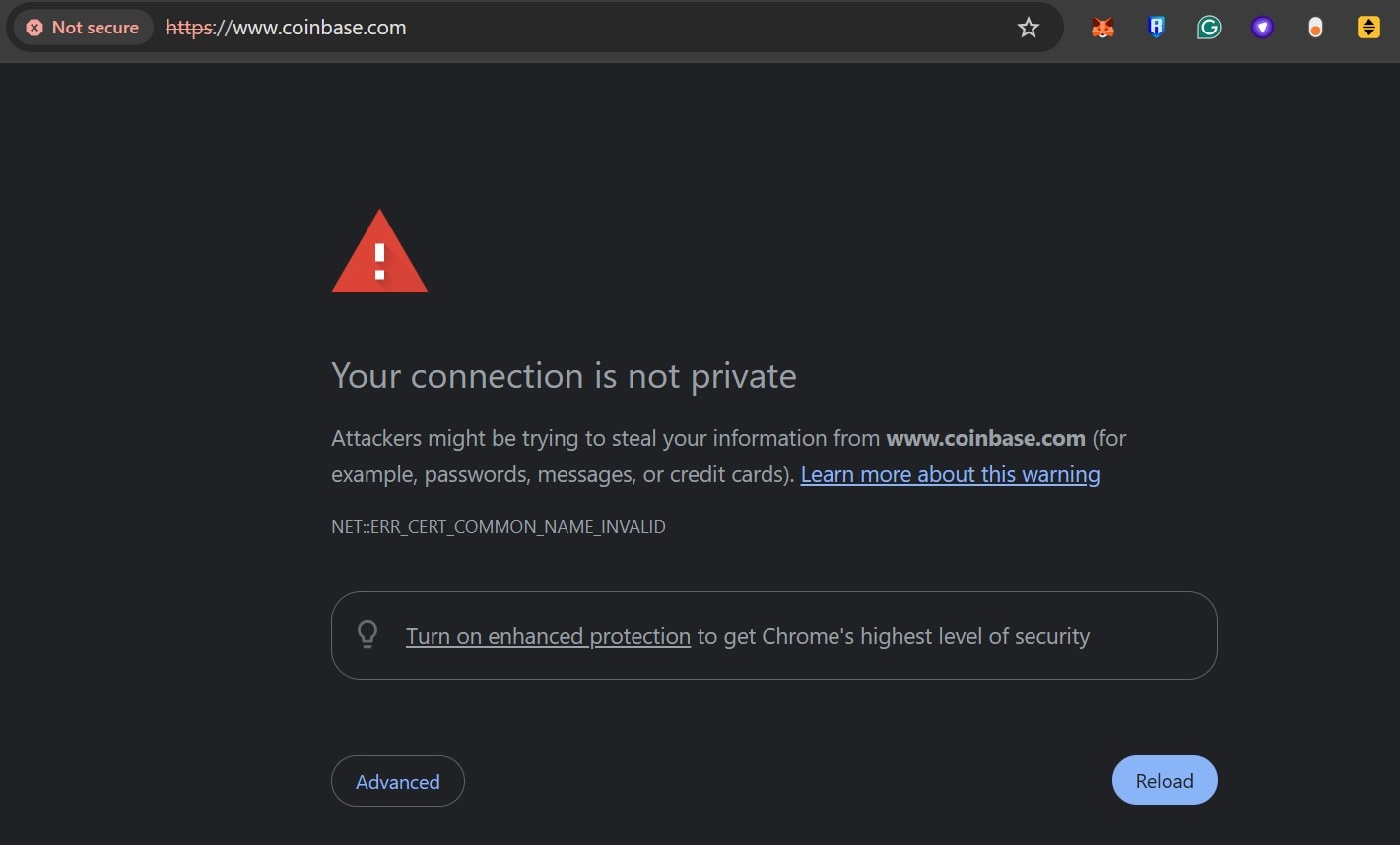
Crypto exchange Coinbase is now inaccessible in the Philippines. Source: Cointelegraph

Coinbase, Gemini join Binance in Philippines access block

While the Philippines has only recently blocked Coinbase and Gemini, the country has made enforcement moves against unlicensed crypto exchanges in the past.

In December 2023, the country started a 90-day countdown, giving Binance time to comply with local regulations before enforcing a ban on the crypto trading platform.

The Philippines Securities and Exchange Commission (SEC) said the period was meant to allow Filipinos to remove their funds from the exchange.

On March 25, 2024, the NTC ordered local ISPs to block Binance. Nearly a month later, the SEC ordered Apple and Google to block the exchange’s application from their stores.

After the ban was enforced, the Philippines SEC said it could not endorse ways for Filipinos to retrieve their funds.

More recently, the SEC identified 10 exchanges, including OKX, Bybit and KuCoin, operating without licenses.

Related: Grab deepens stablecoin push with StraitsX Web3 wallet and settlements

Regulated players roll out crypto products

While the country cracks down on unregulated platforms, compliant companies have been rolling out crypto-related infrastructure in the country.

On Nov. 19, regulated crypto exchange PDAX partnered with payroll provider Toku to let remote workers receive their salaries in stablecoins. This allows workers to convert earnings to pesos without wire fees or delays.

On Dec. 8, digital bank GoTyme rolled out crypto services in the Philippines following a partnership with US fintech firm Alpaca. With the rollout, 11 crypto assets can be bought and stored through the platform's banking application.

Magazine: Sei wallets in Xiaomi, Bhutan’s gold on Solana: Asia Express

Preguntas relacionadas

QWhy did the Philippines block access to Coinbase and Gemini?

AThe Philippines blocked access to Coinbase and Gemini because the National Telecommunications Commission, acting on an order from the central bank (BSP), directed ISPs to restrict access to these and other platforms flagged for operating without a local license.

QWhich government bodies were involved in the enforcement action against unlicensed crypto exchanges?

AThe enforcement action involved the Bangko Sentral ng Pilipinas (BSP), which flagged the unlicensed platforms, and the National Telecommunications Commission (NTC), which ordered internet service providers to block them. The Securities and Exchange Commission (SEC) was also involved in actions against other exchanges like Binance.

QWhat was the previous major enforcement action taken against an unlicensed crypto exchange in the Philippines before Coinbase and Gemini?

APrior to blocking Coinbase and Gemini, the Philippines enforced a ban on Binance. This process began with a 90-day countdown in December 2023 and culminated in the NTC ordering ISPs to block the platform in March 2024, followed by the SEC ordering its removal from app stores.

QWhat is the significance of this crackdown for the regulatory environment in the Philippines?

AThe crackdown signifies a major shift in the Philippines' regulatory stance, moving from informal tolerance to strict enforcement. It establishes local licensing as the decisive factor for crypto market access, prioritizing consumer protection and regulatory compliance.

QDespite the crackdown, what crypto-related services are being launched by compliant companies in the Philippines?

ACompliant companies are rolling out new services. Regulated exchange PDAX partnered with Toku to enable salaried payments in stablecoins, and digital bank GoTyme, in partnership with Alpaca, launched a service allowing users to buy and store 11 different crypto assets through its banking app.

Lecturas Relacionadas

Bitcoin's 'Rally Ends,' Officially Entering the Later Stage of a Bear Market?

Bitcoin prices declined 13% this week, reversing the recent rebound and signaling a likely transition into the later stages of a bear market. Key on-chain metrics deteriorated, with the short-term holder cost basis falling below the Realized Price—a pattern last seen in early 2022, characteristic of bear market maturity. The rally to ~$82k proved to be a bear market bounce, as evidenced by the 90-day realized profit/loss ratio failing to sustain above the bullish threshold of 2. Daily realized losses surged to $1.35B, including significant selling from long-term holders who accumulated near cycle tops, indicating ongoing supply redistribution. Price was rejected almost precisely at the aggregate US spot ETF cost basis of ~$83k, turning that level into resistance and leaving the average ETF investor underwater again. Spot market selling pressure intensified, with the 7-day volume delta turning significantly negative to its weakest level since February. While a major long liquidation event cleared over $400M in leverage, spot demand has not yet stepped in to absorb the resulting supply. Options markets continue pricing in higher future volatility (elevated volatility risk premium) and maintain a skew toward put options, reflecting persistent demand for downside protection, though not yet panic. Overall, market structure remains fragile. Sustained recovery likely requires a reclaim of the ETF cost basis, a shift back to positive spot demand, and a slowdown in realized loss-taking. Until then, the market risks further downside or extended consolidation within the broader bear trend.

Foresight NewsHace 39 min(s)

Bitcoin's 'Rally Ends,' Officially Entering the Later Stage of a Bear Market?

Foresight NewsHace 39 min(s)

How Risky is the "Death Spiral" of MSTR and STRC?

Summary: This article explores the perceived "death spiral" risk between MicroStrategy (MSTR), its Bitcoin holdings, and its perpetual preferred stock (STRC), drawing comparisons to the LUNA-UST collapse. While both systems feature price anchors, high yields for holders, and potential feedback loops, their core mechanisms differ fundamentally. The MSTR-STRC structure relies on continuous financing to sustain its high dividend payouts, primarily through stock ATM offerings. A negative feedback cycle could occur: falling MSTR stock price makes raising equity capital harder, increasing pressure to sell Bitcoin, which undermines STRC confidence and further depresses MSTR. However, unlike LUNA-UST's automated, direct linkage, the MSTR-STRC loop is weaker and has brakes: STRC dividends can be deferred or rates lowered, and STRC holders have a $100/share liquidation preference in bankruptcy, providing a price floor. The company's sustainability hinges on its ability to continue financing. Its current ~$900 million USD reserves cover only about 6.3 months of its ~$1.71 billion annual interest/dividend burden. The next six months are critical, aligning with both the potential bottom in Bitcoin's four-year cycle and the depletion timeline of its reserves. While a LUNA-style catastrophic collapse is deemed highly unlikely due to structural differences, the key question is whether MicroStrategy can navigate this period through healthy deleveraging to restart its capital engine.

Foresight NewsHace 57 min(s)

How Risky is the "Death Spiral" of MSTR and STRC?

Foresight NewsHace 57 min(s)

How Much Debt Does Strategy Really Have? Is There a Risk of Implosion?

MicroStrategy's Debt Risk: A Turning Point in the "Never Sell" Strategy As of June 3, 2026, MicroStrategy holds 843,706 bitcoins (valued at ~$53.1B) but faces significant financial obligations. Its capital structure includes $6.75B in convertible notes and $15.48B in perpetual preferred stock (led by the $8.5B STRC series), creating an annual payout burden of ~$1.71B. With software revenue at only ~$500M, interest and dividend obligations far exceed operating income. A critical shift occurred in late May 2026 when the company sold 32 bitcoins for ~$2.5M to cover dividends, breaking CEO Michael Saylor's long-standing "never sell" pledge. This symbolic move triggered a sharp decline in both Bitcoin's price and MSTR stock, reflecting market fears about cash flow sustainability. The core of the strain is the STRC perpetual preferred stock, designed as a "permanent loan" with no maturity date but requiring high monthly dividends (currently 11.5%). Its business model relies on a three-part cycle: issuing new STRC shares, using proceeds to buy more Bitcoin and fund a USD reserve, and using that reserve to pay dividends. This cycle depends on continuous investor demand for STRC and Bitcoin's price appreciation. Analysis shows Bitcoin needs to appreciate at least 2.3% annually to cover the $1.71B in yearly obligations at current holdings. With Bitcoin price down ~22% from March 2026 highs, this pressure has intensified. The company's $900M USD reserve can only cover about 7 months of payments if STRC issuance stalls. Key risks are not immediate bankruptcy or forced Bitcoin liquidation (as BTC is not collateral), but rather: 1) The erosion of MSTR's premium to its Bitcoin holdings (mNAV), which would cripple its ability to raise cheap capital; 2) A vicious cycle where stagnant Bitcoin prices reduce STRC demand, draining the USD reserve and forcing BTC sales, further depressing prices. The period from February 2027 to September 2028 is a crucial test, with over $5.9B in convertible notes facing put options or maturity. In essence, MicroStrategy has evolved from a simple Bitcoin holder into a complex financial entity acting like a "private Bitcoin bank," leveraging its BTC holdings to create layered financial products. Its survival depends on maintaining Bitcoin's price trend, its stock premium, and market appetite for its preferred shares. The recent token sale marks not a betrayal of its Bitcoin thesis, but an admission that the leveraged strategy must eventually be paid for.

marsbitHace 1 hora(s)

How Much Debt Does Strategy Really Have? Is There a Risk of Implosion?

marsbitHace 1 hora(s)

Trading

Spot
Futuros
活动图片

