Pharos Network Partners with Circle to Promote the Construction of an Open and Inclusive Global RealFi Settlement System

marsbitPublicado a 2026-03-27Actualizado a 2026-03-27

Resumen

Pharos Network, a financial-grade Layer1 blockchain, has announced the integration of USDC and Circle's Cross-Chain Transfer Protocol (CCTP) into its mainnet, The Pacific Ocean. This move introduces institutional-grade stablecoin settlement capabilities and enables seamless cross-chain liquidity across more than 20 supported blockchains. USDC, a fully reserved and transparent dollar-backed stablecoin, will serve as a core asset for real-world asset (RWA) tokenization, DeFi trading, lending, and global payments. By eliminating the need for third-party bridges or wrapped assets, CCTP enhances security and capital efficiency. The integration allows developers to build lending markets, structured products, and global payment networks on Pharos Network. It also gain access to compliant on-chain RWA markets, while users benefit from broader real-world financial opportunities. Additionally, Pharos Network has launched a $10 million ecosystem incubation program to support native application development. The foundation aims to build an open, transparent, and inclusive global RealFi settlement infrastructure, facilitating the flow of institutional-grade assets on-chain.

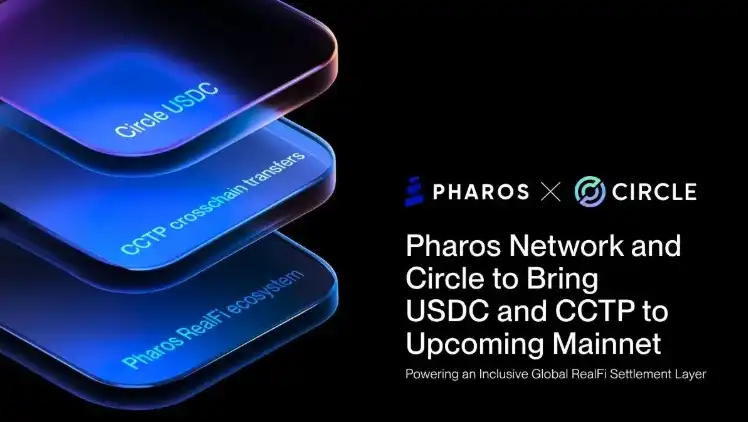
Pharos Network, a financial-grade Layer 1 blockchain, announced today that USDC and the Circle Cross-Chain Transfer Protocol (CCTP) will be deployed on its mainnet, The Pacific Ocean. This integration will introduce mainstream stablecoin settlement capabilities to the network and enable seamless cross-chain fund flows. This move marks a significant step forward in Pharos Network's mission to build an open and inclusive global RealFi settlement system.

The introduction of USDC brings an institutional-grade stablecoin to the Pharos Network ecosystem. As a transparent, 100% reserve-backed dollar stablecoin, USDC will serve as a core settlement and collateral asset in real-world asset tokenization (RWA), DeFi trading and lending, and global payment scenarios. Simultaneously, CCTP will establish native cross-chain connectivity between Pharos Network and over 20 supported blockchains, providing more than 400 secure transaction paths. By eliminating the reliance on third-party cross-chain bridges or wrapped assets, CCTP helps enhance asset integrity and capital efficiency.

With USDC integrated at the protocol layer for settlement, developers can build lending markets, structured financial products, and a 24/7 global payment network on Pharos Network. Institutional funds can access on-chain RWA markets through compliant infrastructure, while global users will gain access to real-world financial opportunities.

The integration of USDC and CCTP is expected to unlock diverse financial application scenarios within the Pharos Network ecosystem. In tokenized financial markets, USDC can serve as the primary settlement and collateral tool for assets such as government bonds, private credit, and commodities, while providing liquidity support for DeFi trading and lending. Beyond trading, merchants and payment service providers can leverage USDC for efficient settlement, benefiting from its transparent reserves and redemption mechanisms. Meanwhile, CCTP will support the seamless transfer of USDC between Pharos Network and other chains, enabling funds to flow freely across different ecosystems, thereby improving liquidity management efficiency and facilitating the distribution of RWA across chains.

Wish Wu, a member of the Pharos Network Foundation, stated: "RealFi requires both a trusted settlement system and global accessibility. The integration of USDC and CCTP will bring institutional-grade reliability to Pharos Network while making this reliability more accessible to global developers and users. Our vision has always been to build truly inclusive infrastructure to support the development of real-world financial markets."

With the deployment of USDC and CCTP completed, Pharos Network is now fully open to developers, financial institutions, and enterprises, providing compliant, stable, and high-performance infrastructure to support the development of real-world financial applications. To further drive ecosystem growth, Pharos Network has also launched a $10 million ecosystem incubation program to support developers in building native applications.

By introducing USDC and CCTP to enable secure cross-chain fund flows, Pharos Network is building the underlying infrastructure for RealFi, enabling institutional-grade assets to circulate on-chain while being accessible to global users, accelerating the transition of real-world finance towards openness, transparency, and inclusion.

About Pharos Network

Pharos Network is a Layer 1 blockchain designed for real-world financial applications, dedicated to enabling seamless interaction between on-chain systems and institutional-grade assets. The network features a modular architecture and supports deeply parallel execution in both EVM and WASM environments, with built-in compliance capabilities to support the next generation of global financial infrastructure. Pharos Network is developed by an engineering team from Ant Group and is backed by globally renowned investment institutions such as Hack VC and Faction VC.


Preguntas relacionadas

QWhat is the significance of USDC and Circle's Cross-Chain Transfer Protocol (CCTP) being deployed on Pharos Network?

AThe deployment of USDC and CCTP on Pharos Network introduces mainstream stablecoin settlement capabilities and enables seamless cross-chain fund flows. This integration is a major step in Pharos Network's mission to build an open and inclusive global RealFi settlement system.

QHow does the CCTP benefit the Pharos Network ecosystem in terms of connectivity?

ACCTP establishes native cross-chain connectivity between Pharos Network and over 20 supported blockchains, providing more than 400 secure transaction paths. It eliminates the need for third-party bridges or wrapped assets, enhancing asset integrity and capital efficiency.

QWhat role does USDC play within the Pharos Network's RealFi applications?

AUSDC serves as a core settlement and collateral asset in RealFi applications, including real-world asset (RWA) tokenization, DeFi trading and lending, and global payment scenarios. It provides liquidity and is backed by transparent, 100% reserve-backed dollars.

QWhat did the Pharos Network Foundation member, Wish Wu, say about the integration?

AWish Wu stated that the integration of USDC and CCTP brings institutional-grade reliability to Pharos Network and makes this reliability more accessible to global developers and users. The vision is to build truly inclusive infrastructure to support the development of real-world financial markets.

QWhat additional initiative has Pharos Network launched to support ecosystem growth?

APharos Network has launched a $10 million ecosystem incubation program to support developers in building native applications on its network, further promoting ecosystem growth alongside the new infrastructure.

Lecturas Relacionadas

Is the Sharp Decline Over? Let the Data Speak

**Has the Sharp Decline Ended? Let Data Speak** Bitcoin's recent significant drop has placed short sellers in a precarious position. Three concurrent pressures—sustained outflows from ETFs, miners offloading coins to exchanges, and short-term holders capitulating—pushed the price near $63k. The asset fell 13% this week and 21% this month, roughly halving from its all-time high. A critical data point is the extremely crowded short positioning, with a short-to-long ratio reaching 8:1, representing nearly $100 billion in short interest overhead. This creates conditions for a potential short squeeze if selling pressure merely pauses, similar to the event in November 2022 which triggered a 24% rally. The selling pressures are real: spot Bitcoin ETFs have seen a record $5.4 billion outflow over 20 days. Short-term holders moved 53k loss-held BTC to exchanges in a day, and miners sent 24k BTC to Binance, a six-month high. Capital is also rotating towards AI and tech stocks like SpaceX, with $400 billion invested in AI infrastructure recently. However, on-chain data shows accumulation by long-term holders, who added 200k BTC in a month, and institutions/miners have absorbed 1.24 million BTC since 2023. This indicates strong buying beneath the surface. Key levels to watch are the $67k-$70k zone (2021 high & 2024 breakout point). A swift recovery above it suggests a leverage washout; failure could test $60k-$55k. The direction also hinges on ETF flow reversal. Currently, the S&P 500 hits new highs driven by AI, while Bitcoin and DeFi (TVL down from $173b to $73.9b) lag. The most probable path is a grinding basing process between $60k-$58k with continued ETF outflows. A less likely but explosive scenario involves a sudden flow reversal, a surge above $70k triggering a short squeeze, and a rally back above $76k. The immediate trigger depends on when the relentless selling pauses. A final cautionary note questions Bitcoin's correlation: if the high-flying U.S. stock market corrects, will Bitcoin once again miss the rally but not the decline?

foresightnews_apiHace 9 min(s)

Is the Sharp Decline Over? Let the Data Speak

foresightnews_apiHace 9 min(s)

Single-Day Plunge of 30%, Arthur Hayes Suddenly Liquidates: Why Did ZEC Get Exploded by Security Issues?

On June 5th, Zcash founder Zooko Wilcox disclosed a critical soundness vulnerability in the project's latest Orchard privacy pool. This flaw, found in the elliptic curve multiplication constraints, could allow an attacker to create unlimited counterfeit ZEC within the shielded pool, with transactions appearing valid. The vulnerability was discovered in late May by security researcher Taylor Hornby, who utilized Anthropic's new Opus 4.8 AI model for a targeted audit. The Zcash ecosystem had already performed an emergency network upgrade to patch the issue. However, the detailed disclosure triggered severe market panic, causing ZEC's price to plummet over 30% in a single day. Notably, prominent investor Arthur Hayes announced he had sold his entire ZEC position following the news. The incident starkly challenges the "technological trust" narrative central to privacy coins. Despite years of top-tier cryptographic audits, the bug persisted until uncovered with advanced AI-assisted research. This highlights the growing gap between theoretical perfection and practical implementation in privacy technology. The event serves as a industry-wide warning: in an AI-driven security landscape, the assumption that "undiscovered equals safe" is obsolete. It underscores the urgent need for continuous, proactive security practices combining AI audits, formal verification, and rapid response mechanisms.

foresightnews_apiHace 1 hora(s)

Single-Day Plunge of 30%, Arthur Hayes Suddenly Liquidates: Why Did ZEC Get Exploded by Security Issues?

foresightnews_apiHace 1 hora(s)

Breaking the Curse of DeFi Cascading Liquidations, Vitalik Proposes a New Solution

**Vitalik Buterin Proposes New DeFi Design to Eliminate Forced Liquidations** Ethereum co-founder Vitalik Buterin has published a proposal for a new decentralized finance (DeFi) architecture aimed at removing the automatic liquidation mechanisms prevalent in current lending protocols. The core idea involves creating synthetic assets using options as building blocks, fundamentally avoiding the抵押借贷结构 that triggers forced sell-offs. The proposal responds to a recurring flaw in DeFi: during sharp market downturns, mass自动清算 of under-collateralized positions can exacerbate price declines, creating systemic selling pressure and market instability, as evidenced by recent crypto market volatility. Buterin's model would split an asset like 1 ETH into two option-like derivatives, P and N, pegged to a price index with a set strike price and expiration. At expiry, an oracle determines the settlement price to allocate the underlying ETH between P and N holders. This design eliminates the "cliff" of instant liquidation. Instead, a position's value would gradually drift from its target peg if not actively rebalanced by the user, transferring the rebalancing decision from the protocol to the user or automated tools. A key advantage is the reduced reliance on high-frequency, real-time oracle price feeds, which are vulnerable to manipulation and errors in current systems. The delayed settlement in the options model allows for more robust, fault-tolerant oracle designs. However, significant challenges remain for practical adoption. High transaction costs (slippage) from frequent rebalancing on automated market makers (AMMs) could erode user funds. The model may not be suitable for stablecoins requiring a strict 1:1 dollar peg, as it inherently allows for value drift. Success would depend on developing new liquidity provisioning models and deep markets for these synthetic assets. The proposal represents a fundamental rethinking of DeFi risk management, challenging the industry to explore alternatives to被动集中平仓 rather than merely optimizing existing liquidation processes. It remains a theoretical framework awaiting implementation and testing by development teams.

foresightnews_apiHace 1 hora(s)

Breaking the Curse of DeFi Cascading Liquidations, Vitalik Proposes a New Solution

foresightnews_apiHace 1 hora(s)

Bitcoin's Decline Marks the Transformation of Crypto

Title: The Decline of Bitcoin Marks the Transformation of Crypto While Bitcoin's price recently fell below $70,000, down approximately 45% from its peak, the broader crypto industry is not following it into decline. Instead, crypto is maturing and evolving beyond its dependence on Bitcoin's price movements. Two of Bitcoin's core functions are being usurped. First, AI has captured its role as the primary speculative asset. AI, with its tangible revenue, explosive demand, and massive capital inflows ($700-830 billion in 2024), is siphoning off the speculative "hot money" that once drove Bitcoin. It also contributes to a sustained high-interest-rate environment, further tightening liquidity for assets like Bitcoin. Second, dollar-pegged stablecoins like USDC and USDT have replaced Bitcoin as the crypto market's foundational currency and primary on/off-ramp. Most trading pairs and on-chain transactions are now settled in stablecoins, severing the historical link where all capital inflows had to pass through Bitcoin first. This decoupling allows projects to thrive based on their own fundamentals rather than Bitcoin's price. Examples include Hyperliquid, an on-chain derivatives exchange with annual revenues of $8-13 billion, and prediction market platform Polymarket, valued at $200 billion with $3.65 billion in annual fees. These projects are evaluated on traditional metrics like revenue and user growth. New opportunities are emerging, particularly around privacy. Privacy coins like Zcash (ZEC) are seeing surging demand, while infrastructure like NEAR enables private, cross-chain asset transfers without requiring users to hold a specific token—privacy becomes a universal service layer. In this new paradigm, stablecoins are the universal cash, various project tokens represent equity, and privacy-enabled cross-chain coordination layers (like NEAR) act as the critical infrastructure connecting a fragmented, multi-chain ecosystem. Bitcoin is now just one asset among many. The era where the entire crypto market moved in lockstep with Bitcoin is over. The industry's health should now be judged by project fundamentals—real revenue, active users, and tokenomics that capture value—and the development of the underlying infrastructure enabling a mature, dollar-denominated crypto economy.

foresightnews_apiHace 1 hora(s)

Bitcoin's Decline Marks the Transformation of Crypto

foresightnews_apiHace 1 hora(s)

Trading

Spot
Futuros

Artículos destacados

Cómo comprar LAYER

¡Bienvenido a HTX.com! Hemos hecho que comprar Solayer (LAYER) sea simple y conveniente. Sigue nuestra guía paso a paso para iniciar tu viaje de criptos.Paso 1: crea tu cuenta HTXUtiliza tu correo electrónico o número de teléfono para registrarte y obtener una cuenta gratuita en HTX. Experimenta un proceso de registro sin complicaciones y desbloquea todas las funciones.Obtener mi cuentaPaso 2: ve a Comprar cripto y elige tu método de pagoTarjeta de crédito/débito: usa tu Visa o Mastercard para comprar Solayer (LAYER) al instante.Saldo: utiliza fondos del saldo de tu cuenta HTX para tradear sin problemas.Terceros: hemos agregado métodos de pago populares como Google Pay y Apple Pay para mejorar la comodidad.P2P: tradear directamente con otros usuarios en HTX.Over-the-Counter (OTC): ofrecemos servicios personalizados y tipos de cambio competitivos para los traders.Paso 3: guarda tu Solayer (LAYER)Después de comprar tu Solayer (LAYER), guárdalo en tu cuenta HTX. Alternativamente, puedes enviarlo a otro lugar mediante transferencia blockchain o utilizarlo para tradear otras criptomonedas.Paso 4: tradear Solayer (LAYER)Tradear fácilmente con Solayer (LAYER) en HTX's mercado spot. Simplemente accede a tu cuenta, selecciona tu par de trading, ejecuta tus trades y monitorea en tiempo real. Ofrecemos una experiencia fácil de usar tanto para principiantes como para traders experimentados.

276 Vistas totalesPublicado en 2025.02.11Actualizado en 2026.06.02

Cómo comprar LAYER

Discusiones

Bienvenido a la comunidad de HTX. Aquí puedes mantenerte informado sobre los últimos desarrollos de la plataforma y acceder a análisis profesionales del mercado. A continuación se presentan las opiniones de los usuarios sobre el precio de LAYER (LAYER).

活动图片