Phantom taps Kalshi to offer regulated prediction markets in wallet

cointelegraphPublicado a 2025-12-12Actualizado a 2025-12-12

Resumen

Cryptocurrency wallet Phantom has partnered with regulated prediction market Kalshi to integrate event-based trading directly into its wallet interface. The new feature, Phantom Prediction Markets, will allow users to trade tokenized positions on real-world events in politics, economics, sports, and culture without leaving the app. This move aligns with a broader trend, as major crypto exchanges like Gemini and Coinbase are also entering the prediction market space. However, the industry faces regulatory challenges, exemplified by Connecticut's recent cease-and-desist orders against several platforms, including Kalshi, which is now legally challenging the state's actions.

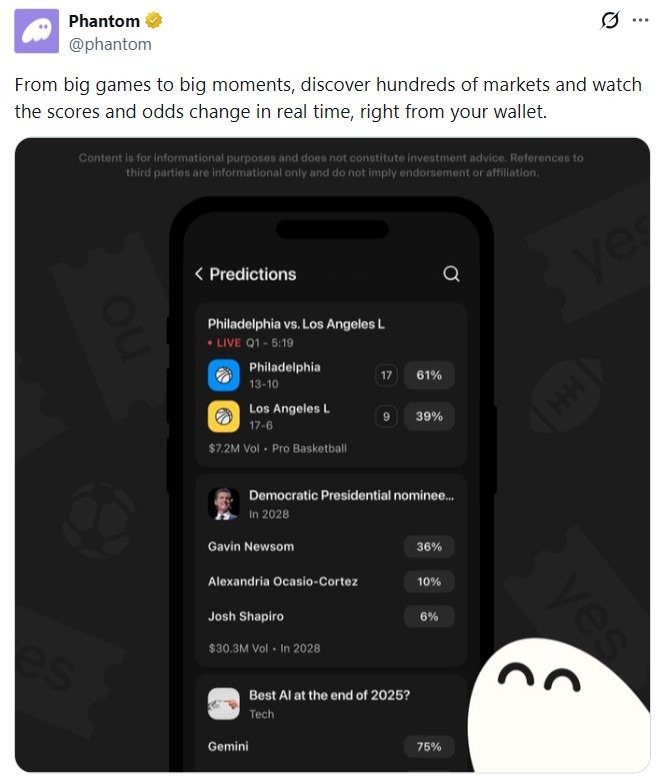
Crypto wallet application Phantom has partnered with regulated prediction market Kalshi to bring event-based trading directly inside its wallet interface, signaling a deeper convergence between onchain finance and real-world outcome betting.

The companies said Friday that the integration would allow Phantom users to discover trending events, track live odds and place bets without leaving their wallets.

A new feature called Phantom Prediction Markets would allow users to trade tokenized positions that reference Kalshi’s event markets across politics, economics, sports and culture.

“By integrating a layer of tokenized positions referencing Kalshi’s regulated event markets with Phantom, users can trade what they care about in real time,” said Phantom CEO Brandon Millman.
Source: Phantom

Crypto exchanges eye US prediction markets

Phantom’s move comes as major crypto trading platforms race to enter the US prediction markets business.

On Thursday, Gemini Titan, an affiliate of the crypto exchange Gemini, received a designated contract market license from the US Commodity Futures Trading Commission (CFTC). Gemini said it plans to enter the prediction markets space.

The exchange said that it would allow users to access event contract trading on its web platform. Following its announcement, Gemini shares went up by nearly 14% in after-hours trading.

On Nov. 19, tech researcher Jane Manchun Wong, known for discovering in-development features on Big Tech websites, claimed that crypto exchange Coinbase is working on a prediction market. Wong shared screenshots apparently showing the unreleased platform.

Citing anonymous sources, Bloomberg reported that Coinbase plans to announce the launch of its prediction markets and tokenized equities.

A Coinbase spokesperson previously told Cointelegraph that they company will hold a livestream on Wednesday to showcase new products. However, the spokesperson did not mention prediction markets or tokenized stocks.

Related: Polymarket trading figures are being double-counted: Paradigm

Prediction markets face regulatory pushback

While prediction markets have gained popularity in the US, the state of Connecticut has recently taken a stance against certain platforms.

On Dec. 4, the Connecticut Department of Consumer Protection (DCP) sent cease and desist orders to Robinhood, Kalshi and Crypto.com, alleging that they were conducting unlicensed online gambling. However, Kalshi immediately took action a day later.

The prediction market platform sued the DCP, arguing that its event contracts are lawful under federal law.

Connecticut federal court judge Vernon Oliver stated in an order that the DCP must refrain from taking enforcement action against Kalshi. This temporarily stops the DCP’s cease and desist order against Kalshi.

Magazine: Koreans ‘pump’ alts after Upbit hack, China BTC mining surge: Asia Express
Lecturas Relacionadas

Polymarket's "2028 Presidential Election" Volume King Is... LeBron James???

An article from Odaily Planet Daily, authored by Azuma, discusses a peculiar phenomenon observed on the prediction market platform Polymarket regarding the "2028 US Presidential Election" event. Despite having a real-time probability of less than 1%, unlikely candidates such as NBA star LeBron James (with $48.41 million in trading volume), celebrity Kim Kardashian ($33.84 million), and even ineligible figures like Elon Musk ($23.14 million) and New York City Mayor Zohran Mamdani ($18.39 million) account for approximately 70% of the total trading volume. In contrast, high-probability candidates like Vice President JD Vance ($10.58 million), California Governor Gavin Newsom ($15.71 million), and Secretary of State Marco Rubio ($9.32 million) have significantly lower trading activity. The article explains that this counterintuitive trend is not driven by irrational speculation but by rational strategies. Polymarket offers a 4% annualized holding reward for certain markets, including the 2028 election, to maintain long-term pricing accuracy. This yield exceeds the current 5-year US Treasury rate (3.98%), attracting large investors ("whales") to hold "NO" shares on low-probability candidates for risk-free returns. Additionally, some users utilize a platform feature that allows converting a set of "NO" shares into corresponding "YES" shares for better liquidity or pricing efficiency, rather than directly buying "YES" shares for their preferred candidates. Thus, the seemingly absurd trading activity is strategically motivated.

marsbitHace 52 min(s)

Polymarket's "2028 Presidential Election" Volume King Is... LeBron James???

marsbitHace 52 min(s)

Dialogue with ViaBTC CEO Yang Haipo: Is the Essence of Blockchain a Libertarian Experiment?

"ViaBTC CEO Yang Haipo: Blockchain as a Hardcore Libertarian Experiment" In a deep-dive interview, ViaBTC CEO Yang Haipo reframes the essence of blockchain, arguing it is not merely a new technology or infrastructure but a hardcore libertarian experiment. This experiment, born from the 2008 financial crisis and decades of cypherpunk ideology, tests a fundamental question: to what extent can freedom and self-organization exist without centralized trust? The discussion highlights the experiment's verified outcomes. On one hand, it has proven its core value of censorship resistance, providing critical financial lifelines for entities like WikiLeaks and individuals in hyperinflationary or sanctioned countries via tools like stablecoins. However, Yang points out a key paradox: the most successful product, USDT, is itself a centralized compromise, showing users prioritize a less-controlled pipeline over pure decentralization. On the other hand, the experiment has exposed the severe costs of this freedom—a "dark forest" without safeguards. Events like the collapses of LUNA, Celsius, and FTX, resulting in massive wealth destruction and prison sentences for founders, underscore the system's fragility and the inherent risks of an unregulated environment. Yang observes that despite decentralized protocols, human nature inevitably recreates centralized power structures, speculative frenzies, and narrative-driven cycles (from ICOs to Meme coins), where emotion and belonging often trump technological substance. Looking forward, he believes blockchain's future is significant but niche. Its real value lies in serving specific, real-world needs for financial sovereignty and bypassing traditional controls, not as a universal infrastructure replacing all centralized systems. For the average participant, Yang's crucial advice is to cultivate independent judgment. True freedom is not holding a crypto wallet, but possessing a mind resilient to groupthink and narrative hype in a high-risk, often irrational market.

marsbitHace 1 hora(s)

Dialogue with ViaBTC CEO Yang Haipo: Is the Essence of Blockchain a Libertarian Experiment?

marsbitHace 1 hora(s)

Trading

Spot
Futuros
活动图片