Peter Thiel Dumps Ethereum Treasury Play ETHZilla, Exits Entire Stake

bitcoinistPublicado a 2026-02-19Actualizado a 2026-02-19

Resumen

Peter Thiel and entities linked to Founders Fund have completely exited their position in ETHZilla, a publicly traded company that initially positioned itself as an Ethereum treasury play. A recent SEC filing shows the group held zero common shares as of Dec. 31, 2025, eliminating a stake that previously amounted to 5.6% of the class. This exit coincides with ETHZilla's strategic pivot away from holding ETH and toward tokenized real-world assets, such as aircraft engine leases. The timing raises questions about whether Thiel’s departure preceded the company’s shift in strategy. Commentators on social media have noted Thiel’s history of exiting positions ahead of market downturns. At the time of reporting, Ethereum was trading at $1,984.

Peter Thiel and entities tied to Founders Fund have fully exited ETHZilla, the publicly traded Ethereum treasury play that once marketed itself as a proxy bet on corporate ETH accumulation. A Schedule 13G/A filed Tuesday shows the reporting group finished 2025 with no remaining common shares, wiping out a position that had been closely watched across both crypto and small-cap equity circles.

Thiel Exists Ethereum Treasury Play

The amended filing, dated Feb. 17, 2026, is unusually blunt on the current footprint: “Aggregate amount... 0.00. Percent of class... 0.0%. Ownership of 5 percent or less of a class.” The positions are reported as of Dec. 31, 2025, meaning the exit was completed by year-end.

That zeroed-out line item is a sharp contrast to what Thiel-related vehicles disclosed just a quarter earlier. In a prior Schedule 13G/A reporting holdings as of Sept. 30, 2025, Thiel was listed with 928,389 shares beneficially owned, representing 5.6% of the class at that time, with additional blocks attributed to Founders Fund entities. The same filing noted the company’s 1-for-10 reverse stock split effective Oct. 20, 2025, with reported share counts adjusted accordingly.

ETHZilla’s story arc matters because it tried to translate the Bitcoin treasury template into an ETH-native wrapper at a moment when public-market vehicles were being pitched as liquid, leverable on-ramps to digital asset exposure. Thiel’s initial involvement, widely reported as a 7.5% stake disclosed in August 2025, helped legitimize that pitch, at least briefly.

More recently, ETHZilla has been signaling a pivot away from a pure ETH-treasury identity and toward tokenized real-world assets, including aviation. In an 8-K tied to a Feb. 12 press release, the company said its subsidiary launched “Eurus Aero Token I,” describing it as “a tokenized real-world asset instrument” that gives exposure to aircraft engines on lease “through tradable digital tokens representing contractual revenue rights.”

The sequencing leaves traders with an uncomfortable, unresolved question: did Founders Fund’s exit precede (and implicitly front-run) the strategy shift, or was it simply a portfolio cleanup after the initial “ETH treasury” narrative cooled?

On X, one commentator framed Thiel’s timing as part of a broader pattern, though several of the post’s claims go beyond what’s in the SEC filing. The account @treebook78 called Thiel a “master at sensing crises,” writing that he “dodged this current dip too,” and arguing he’s an “exit master” who gets out early when bubbles or stress build.

“Back in 2022, he posted diamond hands on SNS telling people to hold Bitcoin forever, but then he quietly sold everything and avoided the Luna crash and FTX collapse (as I recall),” @treebook78 wrote.

At press time, Ethereum traded at $1,984.
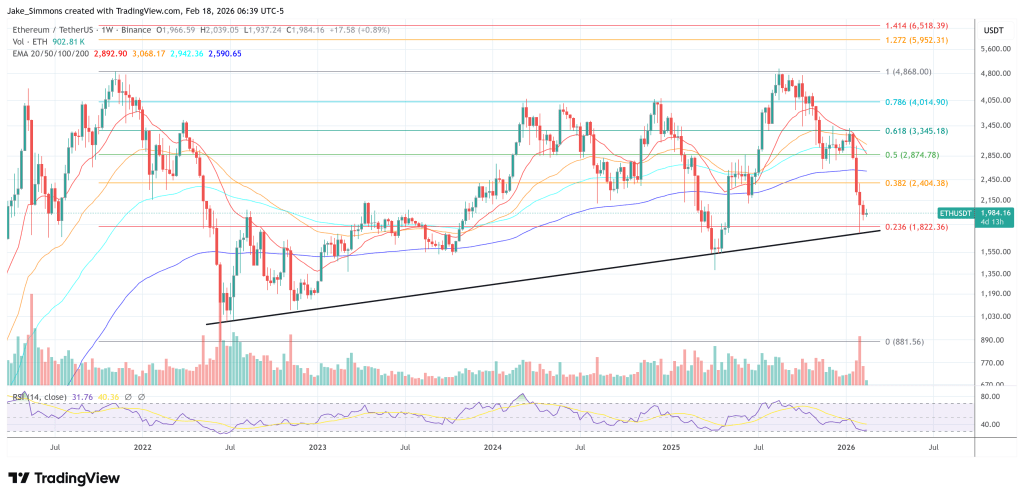
Ethereum remains below the 200-week EMA, 1-week chart | Source: ETHUSDT on TradingView.com

Preguntas relacionadas

QWhat action did Peter Thiel and Founders Fund take regarding their stake in ETHZilla by the end of 2025?

AThey fully exited their entire stake in ETHZilla, reducing their common share holdings to zero.

QWhat was the size of Peter Thiel's stake in ETHZilla as reported in the prior filing for September 30, 2025?

AThe prior filing reported that Peter Thiel beneficially owned 928,389 shares, representing 5.6% of the class.

QWhat new strategic direction has ETHZilla recently signaled it is pursuing?

AETHZilla is pivoting away from being a pure Ethereum treasury play and towards tokenized real-world assets, such as aviation, with the launch of its 'Eurus Aero Token I'.

QAccording to the article, what is one unresolved question that traders are left with regarding the fund's exit?

ATraders are questioning whether Founders Fund's exit preceded and front-ran the company's strategy shift, or if it was simply a portfolio cleanup after the initial 'ETH treasury' narrative cooled.

QHow does the commentator @treebook78 on X characterize Peter Thiel's investment timing?

AThe commentator characterizes Thiel as a 'master at sensing crises' and an 'exit master' who gets out early when bubbles or stress build, citing his past actions during the Luna crash and FTX collapse.

Lecturas Relacionadas

a16z: From Companies to DAOs, DUNA May Become the Next Generation Organizational Form

This article, "From Companies to DAOs: How DUNA Could Become the Next Organizational Form," traces the 500-year evolution of business collaboration. It begins with medieval structures like the *commenda* and Florentine *compagnia*, which exposed partners to personal risk. The modern corporation, exemplified by the Dutch East India Company (VOC), was a revolutionary leap, enabling large-scale, capital-intensive ventures by offering limited liability and reducing coordination costs. However, corporations introduced new challenges like principal-agent problems and bureaucratic overhead. The piece argues that software and internet-native protocols are now reducing these traditional overheads. Decentralized Autonomous Organizations (DAOs) emerged as a new model for coordination without centralized management. Yet, DAOs face a significant legal vacuum: they lack legal recognition, leaving members exposed to unlimited personal liability, and their tokens are vulnerable to being classified as securities under unclear regulations (e.g., the Howey Test). This has forced projects into suboptimal workarounds like offshore foundations. The article identifies the Decentralized Unincorporated Nonprofit Association (DUNA) as a potential solution. Recently legalized in states like Wyoming, the DUNA provides a legal wrapper for decentralized networks. It grants key protections—legal personality, limited liability, and perpetual existence—to a group without imposing a traditional hierarchical management structure. This allows token-holder communities to govern, hold assets, and contract as a single legal entity, aligning with their decentralized nature. While DUNA doesn't solve all governance challenges or magically resolve securities law questions, it represents a crucial step. It fills the legal recognition gap, offering a native legal form for internet-scale, decentralized collaboration and extending the separation of personal risk from organizational venture into a new domain.

marsbitHace 27 min(s)

a16z: From Companies to DAOs, DUNA May Become the Next Generation Organizational Form

marsbitHace 27 min(s)

2026 Mid-Year Report On-Chain RWA: Tokenized Stock Market Cap Doubles in a Year, But 90% of Rights Are Hollow Shells

The 2026 Mid-Year Report on On-Chain RWA highlights a significant growth in tokenized stock market capitalization, which nearly doubled from $951 million in March to $1.89 billion by July. However, the report reveals a fundamental contradiction in this "layer 2.5" ecosystem: products with the strongest legal foundation (like regulated U.S. infrastructure) lack liquidity and distribution, while freely tradable offshored wrapper products often lack substantive ownership rights. The increase is driven largely by a few products (SECZ, FGRS, STRCx) and platforms (Ondo, xStocks, Securitize collectively hold over 85% share). While distributed value across networks like Ethereum, Solana, and BNB Chain has grown, the market remains fragmented. Products referencing the same underlying asset (e.g., Apple stock) are distinct legal liabilities with different intermediaries and jurisdictional rules, offering varying degrees of legal claim. The report cautions that headline numbers are misleading, as they reflect changes in distributed token value—driven by issuance, conversions, and price movements—not pure investor inflows. True "canonical shares" with legal ownership, wide wallet distribution, institutional liquidity, and independent on-chain price discovery do not yet exist at scale. Tokenized treasuries show stronger product-market fit, and ETFs may be easier to scale than single stocks. The core takeaway is a trade-off: legal certainty versus liquidity and composability.

marsbitHace 1 hora(s)

2026 Mid-Year Report On-Chain RWA: Tokenized Stock Market Cap Doubles in a Year, But 90% of Rights Are Hollow Shells

marsbitHace 1 hora(s)

Coldcard Hardware Wallet Hacked: 594 Bitcoin Withdrawn in 25 Minutes

The Coldcard hardware wallet has been compromised, with hackers stealing approximately 594.5 Bitcoin (~$40 million) from 500 addresses in just 25 minutes. The root cause was a critical software bug, undetected for five years, which disabled the device's secure chip for generating true random numbers. This led to the creation of private keys based on predictable data like the processor's serial number, drastically reducing cryptographic security. The attackers exploited this offline by brute-forcing possible seed phrases, finding active addresses on the public ledger, and signing transactions. Initially, Coinkite (Coldcard's maker) claimed only older models were at risk but later admitted all devices running the compromised firmware were vulnerable. CEO Rodolphe Novak (NVK) apologized but ruled out financial compensation for affected users. To secure funds, owners must urgently update their firmware to specific safe versions, generate a completely new seed phrase on the updated device, and transfer all assets to new addresses created with that new seed. While a BIP-39 passphrase can help, it does not replace this migration process. Other Coinkite products like TAPSIGNER were not affected. This incident underscores that even specialized hardware requires rigorous, independent code audits, especially for cryptographic functions. It parallels past failures, like a 2006 OpenSSL bug in Debian, and raises questions about whether automated code analysis can ever fully replace human scrutiny in critical security areas.

cryptonews.ruHace 3 hora(s)

Coldcard Hardware Wallet Hacked: 594 Bitcoin Withdrawn in 25 Minutes

cryptonews.ruHace 3 hora(s)

Trading

Spot
活动图片