Peace Talks Hit an Impasse Again, U.S. Stocks Retreat from Highs, Can Bitcoin Hold the $80,000 Level?

marsbitPublicado a 2026-05-09Actualizado a 2026-05-09

Resumen

Peace Talks Stalemate Sinks Stocks, Tests Bitcoin's $80K Support Optimism over a potential U.S.-Iran peace deal, which briefly propelled the S&P 500 and Nasdaq to record highs, evaporated within 24 hours. Iran dismissed key U.S. proposals regarding uranium enrichment and Strait of Hormuz access, reversing market sentiment. U.S. stocks fell, led by semiconductors and small caps, while oil prices whipsawed violently. The core narrative is a binary market bet on war or peace, creating extreme volatility. The probability of a deal by mid-May dropped to 20%. Oil (Brent) briefly crashed 12% before recovering to around $100, but a shift in its market structure hinted at ample physical supply despite geopolitical risk. Bitcoin fell roughly 1.56%, finding support near $80,000. The pullback was considered structurally healthy, backed by strong institutional inflows into U.S. ETFs and rising long-term holder conviction. Ethereum gained on positive U.S. crypto regulation hopes. In equities, major indices declined with the Russell 2000 hit hardest. The "Magnificent Seven" tech stocks were a rare bright spot, but the semiconductor sector sold off sharply. Notably, high-beta momentum stocks suffered dramatically worse losses than the broader market. Upcoming U.S. non-farm payrolls data is the next key catalyst. Treasury yields rose with oil, the dollar was steady, and gold/silver gained on a mix of inflation and safe-haven demand. European markets also fell. The situation in the Strait...

The prospects for U.S.-Iran peace talks have once again fallen into uncertainty.

Following an exclusive report by Axios the previous day suggesting "both sides were close to reaching an agreement," the market was briefly immersed in optimism, with the S&P 500 hitting a record high and the Nasdaq setting a new record in sync. On Wednesday, the S&P 500 surged 1.46% to 7,365.12, and the Nasdaq skyrocketed 2.02% to 25,838.94, both touching all-time closing highs.

This positive sentiment failed to last 24 hours.

An Iranian Foreign Ministry spokesperson stated on Wednesday that Washington's proposed peace plan "is still under review," with two core demands—suspending uranium enrichment and reopening the Strait of Hormuz—remaining unresolved. Iran's red line on uranium reserves remained firm. The bullish confidence accumulated the previous day was rapidly drained by this news. Risk sentiment subsequently reversed. All three major U.S. stock indices closed lower, with the semiconductor sector leading the decline and small-cap stocks under particular pressure.

Core Narrative: Peace Agreement Still a Long Way Off

The market's interpretation of this war has become highly binary: either a deal is reached, or the fighting continues.

This week's diplomatic rhythm created significant volatility beats. On Monday, Trump announced a pause to the "Project Freedom" maritime escort mission, and Pakistani intermediaries released positive signals. On Tuesday, Saudi media even predicted a breakthrough on passage rights through the Strait of Hormuz "within hours," sending oil prices plummeting, with WTI crude briefly falling over 5% intraday and Brent dipping below $97.

However, Iran quickly tempered expectations. The Iranian Foreign Ministry explicitly stated that uranium enrichment is a red line, not a bargaining chip. Concurrently, the Islamic Revolutionary Guard Corps announced it would establish a new "control system" for the Strait of Hormuz, hinting that even if passage is opened in the future, it would be a selective opening under Iran's leadership, not an unconditional restoration.

Simultaneously, the U.S. Treasury Department announced additional sanctions on Iranian-related oil networks that same day, and U.S. forces reportedly used force against an Iranian oil tanker violating the blockade within the strait. This parallel pursuit of economic pressure and military deterrence shows the U.S. government has not loosened its grip.

Polymarket data shows the probability of a peace deal being reached before May 15 has fallen to 15%, and was around 20% at the time of writing.
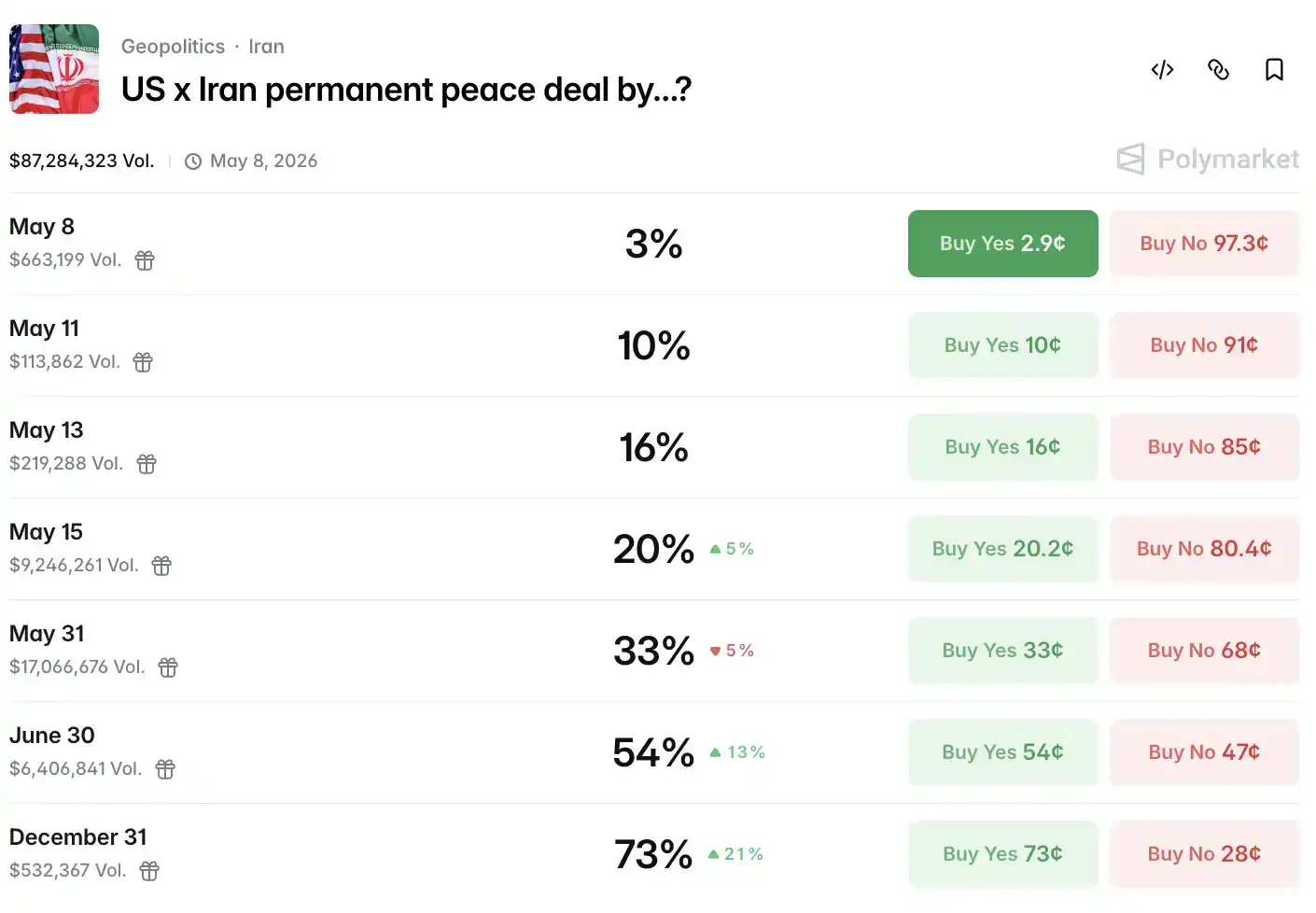
Consequently, oil prices traced a dramatic V-shape.

Intraday, Brent futures once fell to $96.73, a drop of over 12%. As the peace talk news gradually soured, bulls re-entered the market. Brent closed near $100, and WTI closed around $90.5, both barely holding key round-number levels.

Notably, Dated Brent (spot) has fallen below the Brent front-month futures contract, a reversal signal of the backwardation structure, hinting that physical crude oil supply is relatively ample at present, forming a structural divergence from the geopolitical risk priced into the futures market.

Outside the Strait, U.S. crude oil exports hit a record high last week, with global buyers accelerating their shift to U.S. supply sources to avoid Middle East transportation risks.

BNP Paribas' head of energy strategy, Aldo Spanjer, has simply abandoned trading the energy market: "The outcome is too binary, headlines are enough to trigger stop-losses, this has happened five times this week already, it's almost untradeable." TP ICAP energy analyst Scott Shelton called the current situation a "risk desert," with only hedging positions left in the market.

Can Bitcoin Hold the $80,000 Level?

Now, turning to the asset of most interest to crypto enthusiasts: Bitcoin.

Bitcoin continued to face pressure in this context, with spot Bitcoin falling about 1.56% on the day, finding support near the $80,000 level.

Unlike previous rounds of panic selling, this pullback structure is relatively healthy. On-chain data shows the proportion of long-term holder supply has risen to 78.3% of the circulating supply, exchange balances have fallen consecutively to a 7-year low, and whale addresses have net purchased about 270,000 BTC over the past 30 days. BlackRock's Bitcoin ETF holdings have grown to about $62 billion, indicating a stabilizing institutional holding structure.

Regarding Ethereum, sentiment this week overall benefited from rising expectations for U.S. crypto regulatory legislation to be enacted. ETH rose approximately 5.6% over five days, oscillating in the $2,360–$2,412 range, with its market cap maintaining around $2.33 trillion.

It's worth noting that April of this year was the strongest month for net inflows into U.S. spot Bitcoin ETFs since October 2025, with net inflows reaching $2.44 billion. The institutional pipeline continues to open, forming an internal echo with Bitcoin's relatively resilient performance amidst current macro turbulence.

From a narrative logic perspective, the impact of the Middle East situation on the crypto market is showing structural differentiation. Surging oil prices and rising inflation expectations lead to increased probability of Fed rate hikes, thus pressuring Bitcoin; but simultaneously, capital from some Middle Eastern regions is accelerating the transfer of assets into decentralized channels to evade potential sanction risks and liquidity constraints within the banking system. On the same day the U.S. Treasury added sanctions on Iranian-related oil networks, on-chain data showed slight abnormal movements in anonymous mixing transaction volumes. This is not a conclusion, but a signal worth continuous observation.

On the crypto legislation front, market expectations for the enactment of a U.S. regulatory framework are also supporting sentiment. Stablecoin and digital asset market structure bills are advancing in the U.S. Senate and House of Representatives. If passed within the year, they would provide compliance support for institutions to further expand allocations.

U.S. Stocks Fluctuate Near Highs, Semiconductors Catch Down

Thursday was the second directionless trading session of the week.

The S&P 500 closed down 0.38% at 7,337.11 points; the Dow fell 313.62 points (-0.63%) to 49,596.97 points; the Nasdaq's decline was relatively restrained, closing down just 0.13% at 25,806.20 points. The Russell 2000 small-cap index fell 1.63%, the largest decline among major indices for the day.

All sectors closed lower, with the energy sector suffering the heaviest losses and consumer staples showing relative resilience.

Divergence was evident within the tech sector. Tesla rose 3.28%, Nvidia rose 1.76%, Microsoft rose 1.68%, Meta rose 0.64%; Apple fell 0.03%, Alphabet fell 0.01%, Amazon fell 1.39%. The "Magnificent Seven" combined index rose a slight 0.69% overall, one of the few bright spots of the day.

Semiconductors were the hardest hit. The Philadelphia Semiconductor Index (SOX) closed down 2.72%, with AMD down 3.07% and TSMC's ADR down 1.28%. Stronger-than-expected earnings from Qualcomm and Fortinet, and Datadog's analyst day providing some support to the software sector—potentially marking a fourth consecutive weekly gain for the software index—could not conceal the systemic selling pressure in the chip sector.

Data from Goldman Sachs' trading desk provides a more telling dimension: their high-beta momentum basket fell a sharp 8% on the day, while the S&P 500 and Nasdaq 100 fell less than 0.5%. This spread is among the top ten extreme single-day values of the past five years, and this marks the fifth such occurrence so far in 2026.

Furthermore, the VIX fell 1.78% to 17.08, showing a rare divergence from the stock market decline. Typically, when stocks fall, the fear index rises; their concurrent downward movement suggests the market may already be waiting for tomorrow's (Friday) Non-Farm Payrolls data, unwilling to place directional bets in the short term.

Recent U.S. stock earnings reports are also highly representative. Arm Holdings reported its FY2026 Q4 earnings after the close on May 6th, with adjusted EPS of 60 cents and revenue of $1.49 billion, both slightly surpassing analyst expectations. Licensing revenue grew 29% year-over-year, royalty revenue grew 11%.

The report itself wasn't bad. But on the earnings call, management mentioned that the company's latest AGI CPU data center chips face supply bottlenecks, with an additional $1 billion in demand temporarily unable to convert into revenue. Raymond James analyst Simon Leopold wrote directly: "Supply constraints led management to temper revenue guidance increases."

The stock surged as much as 13% after hours, only to give back all gains and then some, falling over 10% after Thursday's open, becoming one of the heaviest decliners among tech giants for the day. This is the third time in the past year Arm has seen "better-than-expected earnings" followed by a "next-day plunge."

After Arm's performance, CoreWeave took the stage after hours. Its Q1 actual revenue beat expectations, its revenue backlog has ballooned to $99 billion, and Nvidia injected another $2 billion during the quarter. However, its Q2 revenue guidance fell short of market expectations, while its full-year 2026 capital expenditure guidance was raised to $31-35 billion, more than doubling the $14.9 billion in 2025. Its stock fell over 10% after hours.

CoreWeave's losses are real, its debt is real, but its orders are also real: a $99 billion revenue backlog, and Nvidia's continuous backing. But clearly, everyone is doubting whether this future money can outrun today's capital expenditures.

Fed Leans Hawkish, Friday's Non-Farm Payrolls Data

Finally, on the Federal Reserve front, slight hawkish shifts appeared in the short-term interest rate market that day, with the probability of an unexpected rate hike before year-end rising to about 20%. But the market largely viewed this as noise, as labor data remains strong. Weekly initial jobless claims only edged up to 200,000, showing no substantial cracks yet in the job market.

The 10-year U.S. Treasury yield rose about 4.8 basis points to 4.393%, moving higher in sync with the rebound in oil prices.

Offshore Chinese yuan briefly broke through 6.80 per dollar, hitting a four-year high, before retreating slightly, closing the New York session at 6.8078. The U.S. Dollar Index rose 0.08% to 98.10.

Regarding gold, spot gold touched above $4,700 per ounce intraday, a two-week high, closing up 0.22% at $4,701.61. The tug-of-war between inflation worries fueled by oil prices and safe-haven demand amid peace talk expectations found gold its place. Silver saw larger gains, with COMEX silver futures closing up 3.02% at $79.64 per ounce, and spot silver briefly breaking above $82 intraday.

In European markets, the pan-European STOXX 600 fell 1.02%, the UK's FTSE 100 fell 1.55%, France's CAC 40 fell 1.17%, and Germany's DAX fell 0.99%.

The variable of the Strait of Hormuz is not yet cleared. And the next market trigger is Friday's Non-Farm Payrolls data. This week's initial jobless claims slightly rose to 200,000 but remained below the market expectation of 206,000, indicating continued mild layoff pressure in the labor market. With the probability of a Fed rate hike this year rising to about 20%, this also means the jobs data will become the next coordinate for repricing.


Preguntas relacionadas

QWhat was the primary reason for the sudden reversal in market sentiment regarding the US-Iran peace talks?

AThe reversal was primarily triggered by statements from an Iranian Foreign Ministry spokesperson on Wednesday. The spokesperson indicated that the US-proposed peace plan was still 'under review' and that key demands—pausing uranium enrichment and reopening the Strait of Hormuz—remained unresolved. Crucially, Iran emphasized that its uranium enrichment was a 'red line' and not a negotiation chip.

QAccording to the article, what are two key factors that provide underlying support for Bitcoin's price near the $80,000 level?

ATwo key factors providing support are strong institutional demand and positive on-chain fundamentals. 1) Institutional demand: April saw the strongest net inflows ($24.4 billion) into US spot Bitcoin ETFs since October 2025, with BlackRock's ETF holdings reaching ~$62 billion. 2) On-chain fundamentals: The proportion of BTC held by long-term holders rose to 78.3% of the circulating supply, exchange balances hit a 7-year low, and whale addresses were net buyers of ~270,000 BTC over the past 30 days.

QDescribe the unusual divergence observed in the VIX (Volatility Index) on the day of the market decline.

AOn the day of the market decline, the VIX (often called the 'fear gauge') fell 1.78% to 17.08, moving in the same downward direction as the falling stock indices (S&P 500, Nasdaq). This is considered unusual because typically, when stocks fall, the VIX rises as market fear and expected volatility increase. The article suggests this divergence might indicate the market is in a holding pattern, waiting for the upcoming non-farm payrolls data before making a directional bet.

QWhy did Arm Holdings' stock price fall significantly despite reporting quarterly earnings that beat analyst expectations?

AArm Holdings' stock fell because, during its earnings call, management disclosed that its latest AGI CPU data center chip was facing supply constraints. This bottleneck meant that an additional $10 billion in demand could not be converted into immediate revenue. Analysts noted that these supply constraints caused management to refrain from raising revenue guidance, which outweighed the positive impact of the earnings beat.

QWhat contradictory signals does the article highlight in the crude oil market regarding the current physical supply versus futures market pricing?

AThe article highlights a structural divergence: the spot price of Brent crude oil has fallen below its front-month futures price. This reversal from the typical 'backwardation' structure (where spot prices are higher than futures) suggests that physical oil supply in the market is currently relatively abundant. This stands in contrast to the elevated prices seen in the futures market, which are still pricing in significant geopolitical risk premiums related to the Middle East tensions.

Lecturas Relacionadas

KOL's Perspective: Why Is SOL Set to Rise from This Point?

**Summary: Why SOL is Positioned for Growth at This Level** The article argues that SOL is poised for an upward move from its current price point, citing several key factors. Primarily, SOL has just broken out of a 4-month consolidation phase. This breakout signals a return of risk appetite to the broader crypto market, as SOL is seen as a key indicator of overall crypto health. The token's ownership has reportedly shifted from short-term traders and tourists to long-term accumulators, leading to low volume. Any meaningful increase in trading activity could thus trigger significant upward momentum. Fundamental strengths include strong institutional adoption, integration with DeFi and RWAs (Real-World Assets), and the potential benefits from the Clarity Act. Despite its high volatility—having dropped 70% from its all-time high but still up 12x from its bear market low—SOL is highlighted as one of the few tokens from the last cycle to reach new highs. It boasts a robust ecosystem of applications, users, and protocols. Future catalysts include the expected influx of AI developers following the Miami Accelerate conference, which focused on AI on Solana. Furthermore, Solana is positioned as the premier chain for memecoin activity, a trend expected to continue and drive network usage and fees. The article concludes that recent price action reflects a healthy transfer to long-term holders, setting the stage for growth.

marsbitHace 8 min(s)

KOL's Perspective: Why Is SOL Set to Rise from This Point?

marsbitHace 8 min(s)

Those Pre-Bitcoin PoW Protocols Have Recently Been Reimplemented

This article details a recent surge in replicating pre-Bitcoin Proof-of-Work (PoW) protocols, specifically focusing on Hal Finney's 2004 RPOW (Reusable Proofs of Work). Within five days in May 2026, multiple independent builders in the Bitcoin/cypherpunk community launched projects inspired by this early electronic cash proposal. The initiative began with Fred Krueger's `rpow2.com`, a centralized but auditable system that replaced RPOW's original IBM 4758 hardware with Ed25519 signatures. Initially a faithful replica, it later adopted Bitcoin-like features (21M supply cap, difficulty adjustment) and a controversial 5.24% founder allocation. This sparked rapid forks, including `rpow4.com` which incorporated full Bitcoin parameters, a prediction market (`rpowmarket.com`), and a DEX (`rpow2swap.com`). Concurrently, Mike In Space created a prototype of Wei Dai's 1998 b-money proposal (`b-money.replit.app`), pushing the historical exploration even further back. The article contrasts these centralized, server-dependent experiments with Bitcoin's core innovation of decentralized, trustless consensus. It also highlights a parallel development: the `HASH` project on Ethereum, which uses smart contract hooks to enable a purely fair-launch, browser-mineable PoW token with 0% allocations to team or VCs. The collective activity is framed as a meme-driven, educational exploration of cypherpunk history rather than a serious financial movement, with all projects heavily disclaiming any investment value.

marsbitHace 13 min(s)

Those Pre-Bitcoin PoW Protocols Have Recently Been Reimplemented

marsbitHace 13 min(s)

South Korean Exchanges 'Battle' Regulators, Challenging the Boundaries of Enforcement and Legislation

South Korea's cryptocurrency industry is engaged in a rare, direct confrontation with regulators. The Financial Intelligence Unit (FIU), the primary anti-money laundering (AML) watchdog, has recently imposed heavy penalties on major exchanges like Upbit and Bithumb for alleged violations involving unregistered overseas VASPs and AML procedures. However, exchanges are now actively challenging these actions in court and through industry associations. In a significant shift, the Seoul Administrative Court ruled in favor of Upbit's operator, Dunamu, overturning part of an FIU-ordered business suspension. The court found the FIU's penalty criteria and justification insufficiently clear. Similarly, the court suspended the enforcement of a six-month business suspension against Bithumb pending a final ruling, citing potential irreversible harm to the exchange. Beyond legal battles, the industry is contesting proposed legislative amendments. The Digital Asset eXchange Alliance (DAXA) strongly opposes a draft rule that would mandate Suspicious Transaction Reports (STRs) for all crypto transfers over 10 million KRW (~$6,800). DAXA argues this "poison pill" clause violates legal principles and would overwhelm the STR system, increasing reports from 63,000 to an estimated 5.45 million annually for major exchanges, thereby crippling effective AML monitoring. This conflict highlights a structural tension in South Korea's crypto governance: comprehensive digital asset laws are still developing, while regulators rely heavily on AML enforcement. The industry's move from passive compliance to active legal and legislative challenges signifies a new phase, pressing for clearer rules and more proportionate enforcement. While short-term disputes may intensify, this clash could ultimately lead to a more mature and sustainable regulatory framework for South Korea's vibrant crypto market.

marsbitHace 1 hora(s)

South Korean Exchanges 'Battle' Regulators, Challenging the Boundaries of Enforcement and Legislation

marsbitHace 1 hora(s)

After 50x Storage Surge, Justin Sun Always Looks to the Next Decade

Sun Yuchen, known for his controversial stunts like a $30 million lunch with Warren Buffett (canceled due to a kidney stone) and eating a $6.2 million duct-taped banana, is often overshadowed by a significant fact: his decade-long track record of spotting major investment trends. In 2016, he famously advised young people to invest in Bitcoin, Nvidia, Tesla, and Tencent instead of buying property. A hypothetical $20,000 investment in Nvidia and Tesla from that list would now be worth over 50 million RMB. His latest major call was on November 6, 2025, predicting a "50x storage opportunity" tied to the AI boom, which materialized with Sandisk's stock surging nearly 50-fold by 2026. Looking ahead, Sun now focuses on the next frontier: Physical AI. He identifies four key areas: 1. **Embodied AI/Robotics**: He sees this reaching its "iPhone moment," with companies like UBTech and Galaxy General leading in commercialization. 2. **Drones**: Viewed as the first commercially viable form of Physical AI, revolutionizing sectors from warfare (e.g., AeroVironment's Switchblade) to logistics. 3. **Spatial Computing**: Beyond VR, it's about AI understanding physical space, a foundational technology for robotics and autonomous systems, exemplified by Apple's Vision Pro. 4. **Space Exploration**: After a 2025 suborbital flight with Blue Origin, Sun advocates for space as the ultimate frontier, discussing blockchain's potential role in space asset management and data transactions. His investment philosophy involves betting on entire, inevitable trends rather than single companies. For robotics, he sees Tesla (the body/manufacturer) and Nvidia (the brain/AI platform) as complementary plays. In defense drones, he highlights companies making tanks obsolete (AeroVironment) and those augmenting fighter jets (Kratos). For space, he participated in Blue Origin's flight and anticipates SpaceX's potential IPO to redefine the sector's valuation. Sun Yuchen's vision frames the next two decades not as a revolution in information flow (like the internet), but in the fundamental operation of the physical world through AI-powered robots, autonomous systems, and spatial intelligence, ultimately extending human and AI activity into space. While many still focus on conventional assets, he continues to look toward the next technological horizon.

marsbitHace 2 hora(s)

After 50x Storage Surge, Justin Sun Always Looks to the Next Decade

marsbitHace 2 hora(s)

Trading

Spot
Futuros
活动图片