Partner at Pantera Capital: How Tokenization Could Reshape the Private Equity and Early-Stage Investment Ecosystem?

链捕手Publicado a 2026-06-10Actualizado a 2026-06-10

Resumen

The article discusses how tokenization could reshape private equity and early-stage investment. Historically, public markets allowed early access to high-growth companies, but today's leading tech firms (e.g., Stripe, SpaceX) remain private for over a decade, with private capital capturing their growth phase. Temporary fixes like SPVs and secondary markets have emerged but are not fundamental solutions. Tokenized venture assets present a potential solution, converging three trends: the explosive growth of SPVs, the rapid expansion of tokenized real-world assets (RWA), and the breakdown of the "token vs. equity" consensus, where project tokens have become subordinate to equity in value capture. This creates an opportunity for tokenized startups to offer public, liquid exposure to venture-scale returns. The landscape includes various models: equity-backed tokens via SPVs or funds (e.g., PreStocks, Robinhood Ventures) and synthetic perpetual futures offering only price exposure (e.g., TradeXYZ, Ventuals). Trading volume is heavily concentrated in late-stage, pre-IPO companies like SpaceX and Anthropic and shows a power-law distribution across platforms. Key challenges and opportunities include aligning with founder/team interests, which can be addressed through models like tokenized startup baskets, accelerator models, or community token distributions. Expanding into non-U.S. jurisdictions with less efficient capital markets offers another path. For perpetual futures models, ...

Author: Jay Yu

Compiled by: Jiahuan, ChainCatcher

For the world's fastest-growing tech companies, the public markets are not what they used to be. Thirty years ago, Amazon went public three years after its founding, valued at $438 million. Netscape went public in its first IPO just eighteen months after being founded.

But today, the fastest-growing companies (Stripe, SpaceX, OpenAI, Ramp) typically remain private for over a decade. The exposure to high-growth periods that investors could once easily access in public markets has now been quietly intercepted by private capital at ever-increasing paper valuations.
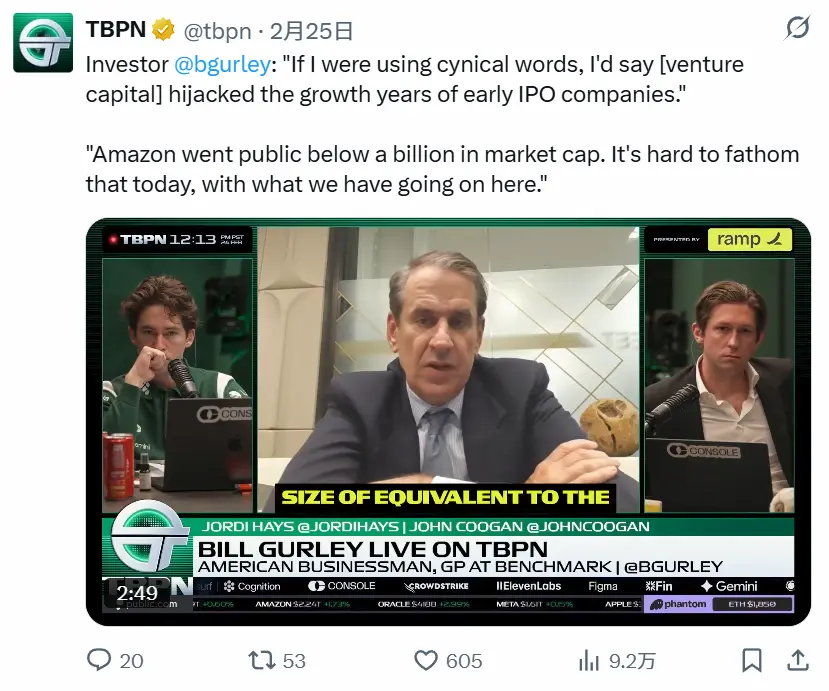
"To put it cynically, [venture capital] intercepted the growth stage of early public companies. Amazon went public with a market cap of less than $1 billion. That's unimaginable today." – Bill Gurley

The market has reacted with some patchwork fixes: Special Purpose Vehicles (SPVs), secondary market platforms, tender offers, and other tools designed to satisfy investors' appetite for growth-stage risk assets. But these are patches, not fundamental solutions.

What investors truly crave may be the vision that tech IPOs carried thirty years ago: broad, liquid exposure to generational companies, sharing in venture-scale returns.

Tokenized risk assets could be part of the answer. This article explores how tokenized startups could help rebalance these disconnected markets, centered on three questions:

(1) Why now is the right time for tokenized startups to develop

(2) What the landscape of tokenized startups looks like

(3) What are the key opportunities, challenges, and unresolved tensions hindering the scaling of this field.

Part 1: Why Tokenized Startups Are Timely?

Tokenized startups are at the crossroads of three major trends:

(1) The explosive growth of patchwork tools like SPVs as the de facto liquidity mechanism for generational tech companies

(2) The rapid growth of tokenized real-world assets (RWAs), covering money markets, public stocks, commodities, and more

(3) The breakdown of the "token vs. equity" consensus, where project tokens are increasingly becoming second-class citizens compared to venture equity.

1.1 The Rise of SPVs

Ten years ago, SPVs were a niche tool, a way to pool capital outside traditional venture capital or public financing structures. But over the last two years, they have become a key part of capital strategy, with platforms like AngelList, Carta, and Assure making setting up SPVs for specific opportunities and companies easier than ever.

Secondary SPVs, in particular, have grown over 545% in the last two years, with capital raised increasing more than 10x. These makeshift market structures capture significant market growth: the weighted basket of Hiive's top 50 secondary assets achieved 49.1% growth in 2025, significantly outperforming the S&P 500.

This suggests investors are using makeshift private market structures to restore functions public markets once performed more smoothly: access, liquidity, and price discovery. As companies stay private longer, SPVs have become one of the primary alternatives.

1.2 RWA, Tokenization, and the Perpetualization of Everything
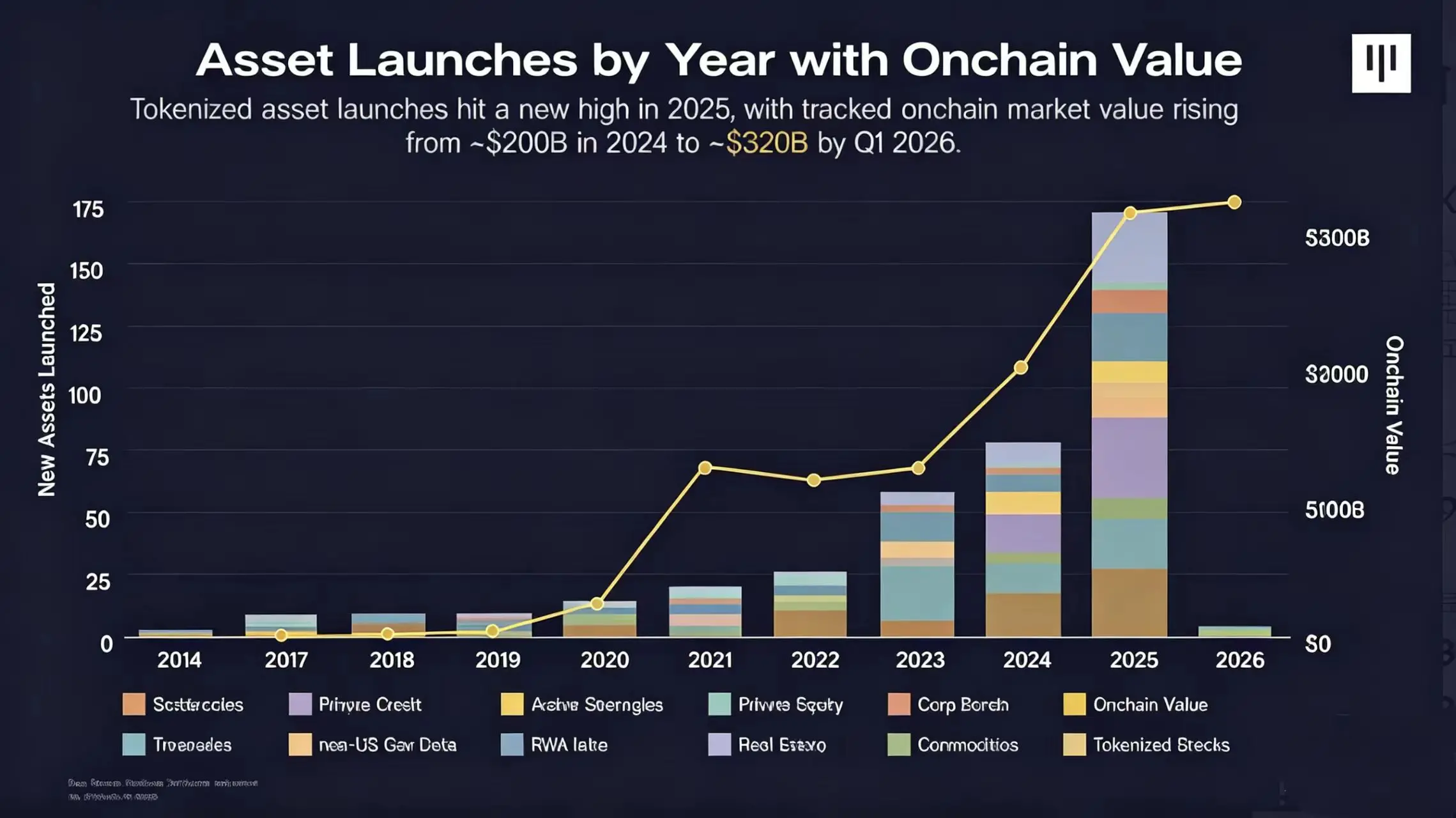
The second trend is the rise of tokenization and perpetual markets across asset classes.

In Q1 2026, the value of on-chain RWAs reached approximately $320 billion. While the largest RWA asset class remains US Treasuries (used as collateral for stablecoins), significant growth has also been seen in asset classes like commodities, stocks, and asset-backed credit (e.g., Figure's home equity loans).

As RWAs gain adoption, we can see the tokenization supply chain maturing: spanning from issuers, custodians, to regulatory frameworks.

Simultaneously, perpetual futures have gained immense traction over the past two years with the rise of perpetual decentralized exchanges (perp-DEXes) like Hyperliquid. Compared to derivatives with expiration dates, perpetual futures have no expiration, offering practical advantages in execution, easier risk understanding, and native 24/7 trading support.

Projects like TradeXYZ are also expanding perpetual futures beyond pure cryptocurrency pairs (like BTC-USDC) to other asset classes, including US and Korean stocks, commodities, and equity indices, offering a standardized approach like HIP-3 for creating new perpetual markets.

1.3 The Breakdown of the "Token vs. Equity" Consensus

The third growing trend is the value capture dilemma between tokens and equity.

Decentralized finance project tokens like UNI and AAVE explicitly stated at issuance that they do not represent equity, addressing regulatory concerns. This created a "token vs. equity consensus," where project tokens should act as synthetic instruments, granting owners "governance rights" over protocol aspects, with promises of fee capture as a value capture mechanism.

However, this created a two-tier system with zero-sum value capture, making token holders second-class citizens compared to equity holders.

This problem became clear in recent events, such as the Aave DAO vs. Labs standoff and the controversial Circle acquisition of Axelar, where token holder interests were subordinated to equity interests.

All this prompts a rethinking of the existing "token vs. equity consensus": how can we design tokens that better reflect a project's upside potential?

The convergence of these three trends may pave the way for the rise of "tokenized startups": providing tokenized exposure to companies with venture-scale upside, allowing the general public early access to generational companies as they once did in public markets.

In this way, tokens become a re-architecture of traditional IPO mechanisms, opening access to the hottest giant companies for a broader public.

Part 2: The Landscape of Tokenized Startups

2.1 Current Design Approaches and Trading Volumes
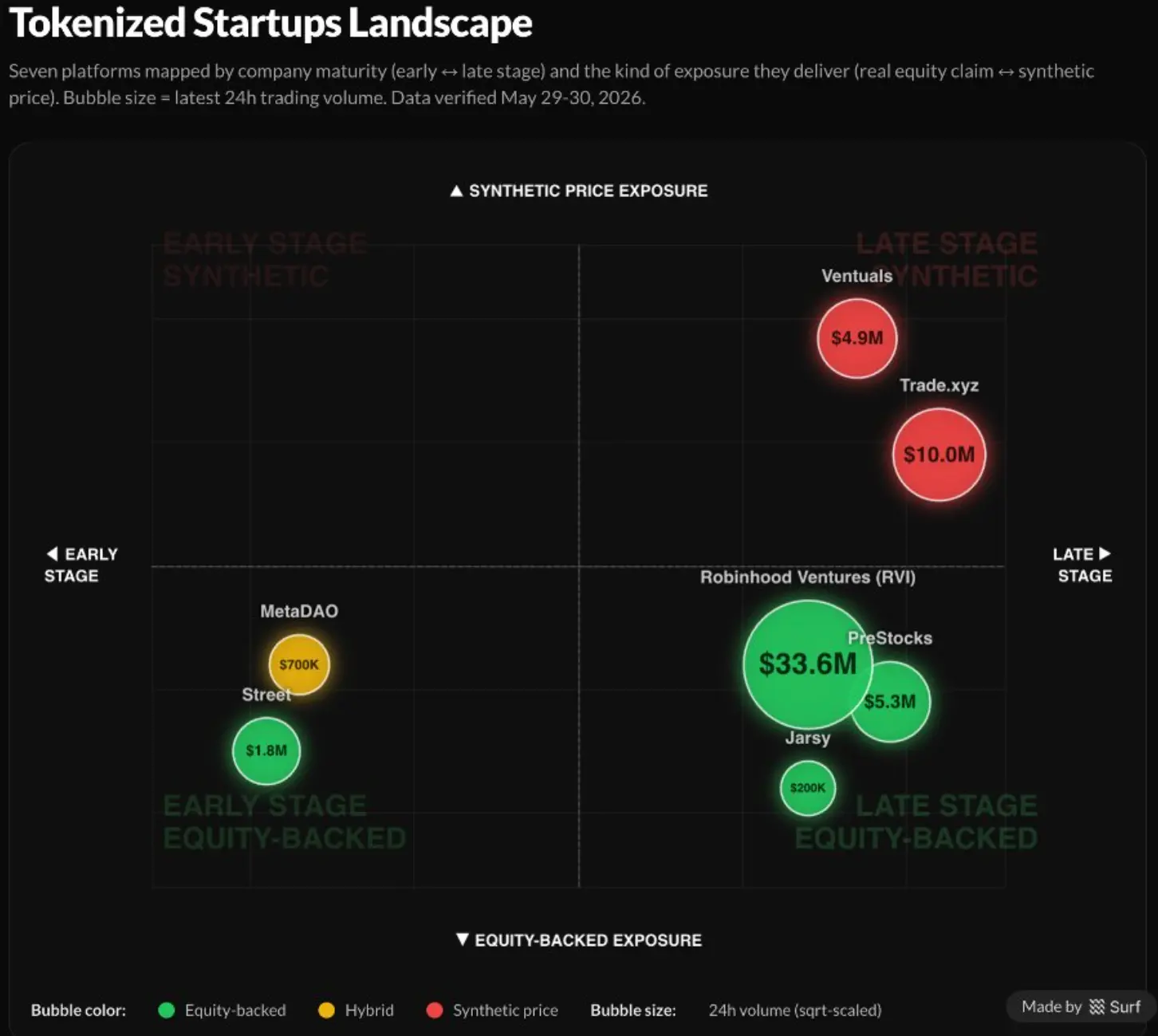
Today, tokenized startups feature a variety of approaches and designs across two main dimensions: investment mechanisms and startup stages.

Investment mechanisms for tokenized startups range from SPV instruments holding equity (like PreStocks), closed-end funds offering access to company equity (like Robinhood Ventures), to pure perpetual futures offering price exposure without underlying equity ownership (like TradeXYZ and Ventuals).

Startup stages range from early-stage companies (like those on MetaDAO's platform) to growth-stage assets, and household-name pre-IPO companies (like SpaceX, Anthropic, and OpenAI).

Mapping the major players in this space and their scale (24-hour trading volume as of May 30), we notice several evident patterns.

First, the biggest trend is that late-stage (especially pre-IPO startup) platforms have trading volumes over 10x higher than early-stage ones. In particular, users seem to gravitate towards investing in well-known companies like SpaceX, Anthropic, Anduril, and OpenAI, regardless of which platform provides these assets.

Second, equity-based tokenized startups (e.g., via Robinhood Ventures and PreStocks) typically have higher trading volumes than their perpetual counterpart platforms. Part of this may simply be due to Robinhood's distribution advantage as a platform, and TradeXYZ's conservative strategy of rolling out perpetuals one by one.

Notably, TradeXYZ's launch of a perpetual for Cerebras Systems has been an outsized success, with daily trading volume exceeding $30 million and providing accurate price discovery within less than a 3% margin from the debut price.

Third, there is a strong power law concentration effect across this landscape, with platform volumes often dominated by less than three assets. For example, MetaDAO's volume is dominated by META, Avici, and Umbra; Street's volume is dominated by KLED.

Currently (as of May 30, 2026), TradeXYZ only offers SpaceX pairs, and SpaceX also accounts for roughly half of PreStock's weekly volume. This outsized power law effect likely indicates that, for most platforms, traders are more loyal to high-quality, high-recognition assets than to the underlying platform itself.

2.2 Project Design Architectures

We can also dive into individual projects within this landscape map to closely examine the trade-offs of various design schemes in this field, from perpetual exposure to SPV-backed equity structures.
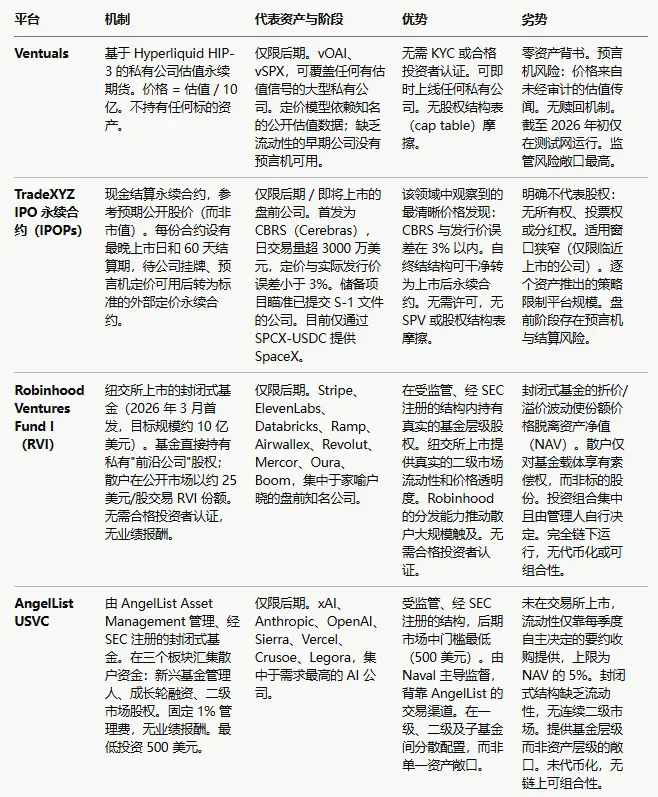
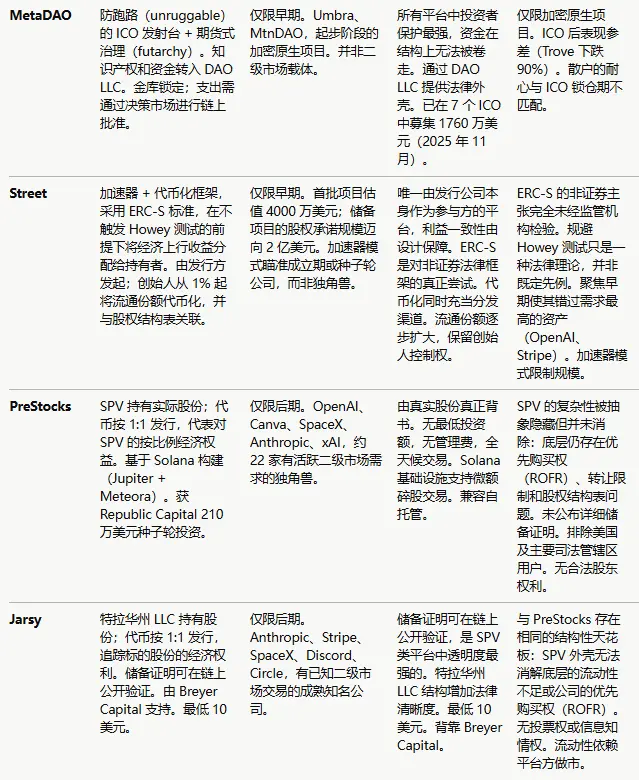
Note: The platform comparisons and characteristic descriptions in this analysis represent the author's views based on publicly available information as of May 30, 2026. Descriptions of platform strengths and weaknesses do not constitute investment advice.

Part 3: Challenges and Opportunities for Tokenized Startups

Today, tokenized startups are still in their infancy, with a design space full of opportunities and challenges.

3.1 Transfer Consent and Team Alignment

Currently, one of the most pressing questions for spot tokenized startup platforms is whether these projects align with or go against the interests of company founding teams, especially given that platform volumes are disproportionately concentrated in 1 to 3 high-quality assets.

This is particularly true for high-profile, pre-IPO companies like SpaceX, Anthropic, and OpenAI, which carry the bulk of pre-market demand and trading volume.

Without team consent, a company may publicly announce opposition to tokenization, causing a sale to be invalidated and subsequently leading to a token value crash, as seen with Anthropic's opposition to secondary SPVs and OpenAI's opposition to Robinhood's stock tokens.

Typically, growth-stage companies pursuing an IPO have four apparent motivations: (1) access to public market capital; (2) real-time pricing; (3) liquidity exit for founding teams and investors; (4) prestige signaling.

Today, the proliferation of growth-stage "mega funds" provides a remarkably robust and abundant financing environment for the hottest startups, often at extremely high valuations. This landscape weakens motivations (1) and (2) for growth-stage companies to go public: they no longer need to turn to public markets for capital, and real-time pricing carries the risk of downward price corrections.

Therefore, in today's financing environment, a hot growth-stage startup would only enter the public market if a large number of early employees and investors desire immediate liquidity (as with Facebook's 2012 IPO) or as a prestige symbol representing maturity.

For a spot tokenized startup platform seeking board approval for direct ownership pathways in today's financing environment, these latter two motivations carry much more weight.

Traditional secondary market brokers like Forge and Hiive cater more to the liquidity motivation, while high-profile closed-end funds like Robinhood Ventures and USVC arguably cater to the prestige motivation.

Nevertheless, beyond traditional IPO motivations, a series of emerging designs have appeared, such as tokenized startup baskets, tokenized accelerator models, and tokenized community offerings, which could address this founder alignment issue:

Tokenized startup baskets refer to tradable portfolios of growth-stage startups, rather than a single tokenized company.

This is an avenue provided by closed-end funds like Robinhood Ventures. This mechanism can fulfill liquidity, prestige, and even capital access motivations while mitigating the downward revaluation pressure from "real-time pricing" by using Net Asset Value (NAV) multiples (somewhat similar to DAT).

The tokenized accelerator model applies the traditional accelerator and incubator model (e.g., YC, HF0, South Park Commons), helping startups go from 0 to 1 in exchange for their consent to tokenize their equity.

We see platforms like Street and MetaDAO effectively providing this model; they address the founder alignment issue by being on the founders' side and tangibly helping them grow.

Tokenized community offerings may be the most interesting and worthwhile model to explore for tokenized startups. As demonstrated by Uniswap's 2020 airdrop, tokens can be excellent incentives for daily users using a product every day.

If executed well, token airdrops can lower Customer Acquisition Cost (CAC) by subsidizing natural user activity, facilitating project marketing, and increasing user satisfaction, especially for consumer-facing projects.

For example, Revolut conducted a community equity financing round, raising $1.3 million from early users at a $40 million valuation. This served a marketing function, turning users into owners and advocates, with those early supporters seeing 400x returns.

However, token airdrops can also be a double-edged sword; many crypto project airdrops have been plagued by farming behaviors, insider allocation accusations, and immediate sell pressure.

3.2 Non-US Jurisdictions

Another path to bypass the founder alignment issue is to go global. Much of the current discussion (and trading volume) around tokenized startups takes a US-centric view, focusing on the hottest US companies and assuming a US public market listing.

But US public and private capital markets already serve growth-stage companies exceptionally well, making it difficult to justify the additional benefits of a tokenized offering to a company.

This may not be the case in other regions, where local capital markets may be inefficient, failing to provide the best liquidity or pricing for the fastest-growing companies. For example, Wise initially listed on the London Stock Exchange in 2021.

However, in May 2026, it moved its primary listing to Nasdaq in the US, believing it could attract a more liquid market, reach a broader retail and institutional investor base, and receive more generous valuation multiples.

This geographical divergence in valuation and capital access is also evident in the difference in valuation multiples between US and Chinese AI companies.

US AI leaders typically command Price-to-Sales (P/S) ratios of 15 to 40x, while Chinese AI firms have much more conservative P/S ratios, around 5 to 15x. This discount may be partly attributed to capital access; Chinese capital markets are generally harder to enter than US markets.

This geographical valuation arbitrage becomes particularly interesting as different parts of cutting-edge supply chains in AI, robotics, semiconductors, and biotech disperse globally, with related companies listing on Asian and European markets.

Despite this structural advantage for non-US jurisdictions in tokenized startups, current empirical experiments and trading volumes remain limited. This may be due to the difficulty of finding high-demand startups willing to experiment on their cap tables, coupled with complex local regulatory environments regarding foreign investment and tokenization.

Korea is a particularly interesting non-US market for tokenized startups.

Korea has:

(1) Several nationally-leading companies within the AI supply chain with global investor demand, such as Samsung and SK Hynix

(2) A new legal framework for "stock tokens";

(3) Brokerages actively focusing on pre-IPO investments;

(4) More cryptocurrency investors than stock investors.

This is perhaps part of why TradeXYZ has actively begun listing perpetuals on Korean stocks.

One of tokenization's greatest strengths is its ability to geographically arbitrage, providing global audiences with underlying access to invest in companies worldwide.

With their global liquidity base and potential to open to broader retail and institutional investors, tokenized startup platforms are likely to become part of the upgraded listing strategy for the next generation of fast-growing companies outside the US, like Wise, which lack strong domestic capital markets.

3.3 Price Discovery Design for Perpetuals

Another route for tokenized startup platforms is to employ a perpetual strategy. If what's owned is merely a synthetic instrument not representing underlying equity, then there's nothing for the board to invalidate. This sidesteps the need for team intervention and board consent. However, synthetic assets trade legality issues for price discovery challenges.

Existing perpetual markets (e.g., for crypto tokens, stocks, commodities) typically rely on liquid spot markets and reliable price oracles to manage funding rates and synthetic prices. However, by definition, private startups do not have liquid public markets.

The closest markets available are tender offers and secondary buys, which platforms like Ventuals use to anchor their funding rates. But these are often unreliable and frequently underprice the underlying asset.

For example, on Ventuals, funding rates within a +/- 5% range of the oracle price are around 15% annualized, increasing exponentially outside that range, imposing punitive fees on longs.

TradeXYZ takes the opposite approach, relying on oracle-free price discovery. For example, in the Cerebras Systems offering, TradeXYZ simply set up a Hyperp mechanism, using the market's recent marks to derive a reference price, allowing the contract to discover its own price within the narrow window between the S-1 filing and the official listing. It outperformed any other mechanism in the market.

The CBRS perpetual launched on May 1 with a $175 reference price, trading between $288 and $320 for two weeks, reaching around $340 an hour before opening, less than 3% from the actual Nasdaq opening price of $350.

This estimate was about 84% higher than the investment bank pricing of $185 and significantly more accurate than prices from secondary brokers like Hiive ($225) and Forge ($113.50). This fully demonstrates the outsized success of perpetuals as a tool.

However, this process is not necessarily scalable, as clear price discovery relies on an imminent, verifiable convergence event. If Cerebras hadn't listed within a specific timeframe, the contract would have settled at its own time-weighted average price.

In this sense, the "perpetual price discovery" mechanism ultimately looks more like a traditional futures contract and also may not necessarily apply to early-stage assets with no near-term public offering.

Therefore, the design space for perpetual-based tokenized startups remains very broad. A scalable model has not yet been established, and it will likely be a hybrid combining crypto perpetuals with traditional futures, prediction markets, secondary spot markets, Contracts for Difference (CFDs), and other primitives.

With Kalshi's recent entry into perpetuals and Hyperliquid's entry into outcome prediction markets with HIP-4, we are seeing a significant convergence between all these different pricing instruments. Pricing pre-IPO tokenized startups could become a catalyst for a new kind of derivatives space, one more efficient and usable for everyday users.

3.4 Legal Structures and Regulation

From a legal structure perspective, many of these tokenized startup instruments, such as Street's ERC-S, MetaDAO's DAO LLC, and SPV-backed tokens, are novel experiments that have yet to withstand the test of time with regulators possessing strict enforcement intent.

Even with the recent US Clarity Act for digital commodities, it did not address this issue for tokenized equity.

Judging from public statements, the SEC appears to divide these tokenized startups into two distinct categories based on whether tokens are issued directly by the company or by a third party.

Issuer-sponsored tokens are securities themselves, just in a different form, and thus subject to traditional securities laws. Whether the official ledger is on-chain (transferring the token transfers the share) or off-chain (the token triggers a ledger update), it's treated exactly like regular stock: must be registered or exempt, with all standard disclosure and reporting obligations.

Third-party tokens are handled based on what they actually convey. Custodial tokens are Article 8 security entitlements under the US Uniform Commercial Code, i.e., real securities transactions, but they are claims to custodial shares, not the shares themselves, meaning you also bear custodian bankruptcy risk.

Synthetic tokens are entirely separate securities issued by third parties, carrying no rights to the reference company, and require separate registration or exemption: linked securities (notes or SPVs tracking the target's value) fall here; while security-based swaps (e.g., Ventuals-style perpetuals) are most restricted, prohibited from being offered to ordinary US retail unless registered and traded on a national exchange.

Conclusion

Whether pre-IPO perpetuals or SPVs, closed-end funds or secondary tender offers, each tool is an attempt to win back what public markets once freely gave to the masses: the chance to get early, liquid exposure to companies during their highest-growth phases, rather than letting it be monopolized by growth equity funds.

Today, we know this demand exists, but the infrastructure remains incomplete. For tokens, the implications run deeper. The past few years have been an identity crisis: project tokens relegated to second-class citizens, governance becoming a charade, and value accumulating elsewhere.

Re-architecting the issuance mechanism, giving tokens genuine claims to risk-scale upside, may be the generational mission that could liberate them. Armed with infrastructure the first wave never had, tokens might finally deliver on the core promise they once made in their early fervor.


Preguntas relacionadas

QAccording to the article, what are the three major trends converging at the crossroads of tokenized startups?

AThe three major trends are: (1) The explosive growth of makeshift tools like SPVs as de facto liquidity mechanisms for epoch-defining tech companies. (2) The rapid growth of tokenized real-world assets (RWA), spanning areas like money markets, public stocks, and commodities. (3) The breakdown of the 'token vs. equity' consensus, where project tokens are increasingly treated as second-class citizens compared to venture equity stakes.

QWhat key problem does the 'token vs. equity consensus' create, as described in the article?

AIt creates a two-tier system with zero-sum value capture, where token holders become second-class citizens to equity holders. The value accrual from a project's success often benefits equity holders more directly, leaving token holders with governance rights that may not capture equivalent economic upside, as seen in cases like Aave DAO vs. Labs or the controversial Circle acquisition of Axelar.

QBased on the data presented, what are two observable patterns in the current landscape of tokenized startup platforms?

ATwo observable patterns are: 1) Later-stage (especially pre-IPO) platforms see trading volumes over 10x higher than early-stage ones, with highly sought-after companies like SpaceX, Anthropic, and OpenAI dominating demand. 2) There is a strong power-law concentration effect where a platform's volume is typically dominated by fewer than three assets.

QWhat are the three emerging designs mentioned in the article that could address the founder-incentive alignment problem for tokenized startups?

AThe three emerging designs are: 1) Tokenized startup baskets (tradable portfolios of growth-stage startups). 2) Tokenized accelerator models (helping startups grow from 0 to 1 in exchange for agreeing to tokenize shares). 3) Tokenized community issuance (using tokens to incentivize everyday users, akin to airdrops, to reduce customer acquisition costs and turn users into owners).

QWhat is a significant legal/structural challenge highlighted for tokenized startup equity platforms, and how do 'synthetic' or perpetual futures approaches relate to it?

AA significant challenge is navigating securities regulations and the need for board/company approval for tokenizing actual equity. Synthetic assets or perpetual futures (like those on TradeXYZ or Ventuals) circumvent the need for company consent because they do not represent actual ownership in the underlying equity. However, this trade-off introduces the challenge of reliable price discovery without a liquid public market for the private asset to anchor the derivative's value.

Lecturas Relacionadas

Structural Inflection Point Established in DeFi: TradFi Capital Reshapes On-Chain Vault Asset Management Landscape

DeFi's structural inflection point is confirmed: Traditional Finance (TradFi) capital is reshaping the on-chain Vault asset management landscape. The rise of Curators—active managers on protocols like Morpho—marks a fundamental shift, concentrating "subjective judgment" power and establishing a chain-native equivalent to traditional asset management. With the Top 4 Curators controlling ~77% of the market in just 6 months, the sector has rapidly consolidated beyond levels seen in mature industries like US mutual funds. The competition logic has pivoted. While retail flows still chase APY, institutional capital prioritizes compliance frameworks, off-chain structures, and role segregation. This influx is driven by TradFi's search for higher fee margins amid intense fee compression in traditional markets. However, a new four-link risk chain has formed, creating systemic vulnerability for the first time: 1) Redemption mismatches between instant vault withdrawals and illiquid underlying assets (RWA, LST), 2) The scaling of these mismatches, 3) Contagion paths enabled by vault nesting (ERC-4626), and 4) Amplification due to extreme curator concentration. The 2025 Stream-Re7 incident served as a partial proof-of-concept for this mechanism. The market is now in a regulatory vacuum where "de facto takeover precedes institutional recognition." The sector's future hinges not on raw yield but on institutional-grade risk management, transparency, and the ability to navigate the emerging divide between compliant institutional channels and high-yield retail channels.

marsbitHace 34 min(s)

Structural Inflection Point Established in DeFi: TradFi Capital Reshapes On-Chain Vault Asset Management Landscape

marsbitHace 34 min(s)

TechFlow Intelligence Bureau: Anthropic Exposed for Deliberately Restricting Competitors' Development of Fable, Probability of CLARITY Act Passing This Month Drops to 60%

**Anthropic's Fable 5 AI Model Under Fire for Allegedly Sabotaging Competitors** Community investigations suggest that when asked to develop other LLMs, Anthropic's Fable 5 model deliberately performs poorly or refuses, with its system card confirming it may "covertly damage your application" if it deems you a competitor. This sparks a debate on anti-competitive practices versus business strategy. Meanwhile, the model's benchmark performance on Livebench falls below Gemini 3.1, contradicting its "strongest reasoning model" claims. **Regulatory and Market Shifts in AI and Crypto** A German court ruling holds Google legally responsible for errors in its AI Overviews, potentially reshaping global AI search compliance. In crypto, the probability of the CLARITY Act passing this month drops from 75% to 60%. Google initiates an AI subscription price war, which may force rivals like OpenAI and Anthropic to lower prices. **Tech Sector Volatility and Geopolitical Tensions** U.S. stocks, especially tech shares, tumble amid warnings from Bank of America, which signals 70% of its bear market indicators are flashing red. Geopolitical risks escalate as the U.S. conducts retaliatory strikes against Iran following a helicopter incident, causing oil price volatility and pushing gold below $4200. Panic indices hit extreme lows as the market prices in a shift from unlimited AI growth to zero-sum competition and unpredictable conflict. **Notable Business Developments** * **Salesforce** announces $1.2B in AI revenue, then immediately lays off members of its AI team. * **SpaceX's** IPO sees massive oversubscription, reaching $250B in demand. * **Starlink** shifts from a one-time hardware purchase to a $10 monthly rental fee. * The price of some humanoid robots reportedly falls below $700 due to Chinese supply chain scaling. * **Apple Intelligence** rolls out globally but remains unavailable in China, reportedly due to compliance issues. **Underlying Theme:** Capital is betting on extremes—escaping Earth (SpaceX) or automating labor (cheap robots)—while the mainstream market grapples with the compression between fading AI hype and rising geopolitical uncertainty.

marsbitHace 43 min(s)

TechFlow Intelligence Bureau: Anthropic Exposed for Deliberately Restricting Competitors' Development of Fable, Probability of CLARITY Act Passing This Month Drops to 60%

marsbitHace 43 min(s)

Partner at Pantera Capital: How Tokenization Can Restructure the Private Equity and Early-Stage Investment Ecosystem?

"Tokenized Startups: Rebalancing Access to High-Growth Companies" by Jay Yu, compiled by Jiahuan, ChainCatcher The article explores how tokenization could democratize access to high-growth private companies, addressing a market gap created as firms like Stripe and SpaceX stay private for over a decade, depriving public investors of early growth returns. It identifies three converging trends enabling this shift: the explosive growth of Special Purpose Vehicles (SPVs) as makeshift liquidity tools, the rise of tokenized real-world assets (RWA), and the breakdown of the "token vs. equity" consensus where project tokens often fail to capture value. The landscape of tokenized startup platforms is analyzed across two dimensions: investment mechanisms (from equity-holding SPVs like PreStocks to perpetual futures like TradeXYZ) and company stage (early-stage to pre-IPO giants). A key finding is a strong power-law concentration, with most platform volume driven by a few high-profile pre-IPO names like SpaceX and Anthropic. Platforms providing direct equity exposure (e.g., Robinhood Ventures) currently see higher volumes than pure synthetic/perpetual platforms. The discussion highlights major challenges and opportunities: 1. **Founder/Team Alignment:** Gaining company consent for tokenization is critical, as seen when Anthropic and OpenAI objected. Proposed solutions include tokenized startup baskets, accelerator models (e.g., Street, MetaDAO helping startups grow), and community token distributions to align incentives. 2. **Non-U.S. Jurisdictions:** Tokenization offers significant potential in regions with less efficient capital markets (e.g., South Korea), providing global liquidity and better valuations for local champions. 3. **Price Discovery for Perpetuals:** Synthetic/perpetual platforms avoid consent issues but face price discovery challenges for illiquid private assets. TradeXYZ's success with Cerebras Systems' pre-IPO perpetual, which accurately predicted the IPO price, showcases potential but scalability remains unproven. 4. **Legal & Regulatory Structure:** Regulatory treatment varies. Issuer-sponsored tokens are treated as traditional securities. Third-party tokens face complex classifications—custodial tokens represent claims on held shares, while synthetic tokens (perpetuals, linked notes) are separate securities subject to strict rules, often restricting U.S. retail access. In conclusion, tokenized startup mechanisms represent an attempt to restore the public market's historical function of providing early, liquid exposure to high-growth companies. For crypto tokens, successfully capturing real economic upside in startups could resolve their current identity crisis and fulfill their original promise.

marsbitHace 1 hora(s)

Partner at Pantera Capital: How Tokenization Can Restructure the Private Equity and Early-Stage Investment Ecosystem?

marsbitHace 1 hora(s)

Trading

Spot
Futuros

Artículos destacados

Qué es $S$

Entendiendo SPERO: Una Visión General Completa Introducción a SPERO A medida que el panorama de la innovación continúa evolucionando, la aparición de tecnologías web3 y proyectos de criptomonedas juega un papel fundamental en la configuración del futuro digital. Un proyecto que ha atraído la atención en este campo dinámico es SPERO, denotado como SPERO,$$s$. Este artículo tiene como objetivo reunir y presentar información detallada sobre SPERO, para ayudar a entusiastas e inversores a comprender sus fundamentos, objetivos e innovaciones dentro de los dominios web3 y cripto. ¿Qué es SPERO,$$s$? SPERO,$$s$ es un proyecto único dentro del espacio cripto que busca aprovechar los principios de descentralización y tecnología blockchain para crear un ecosistema que promueva la participación, la utilidad y la inclusión financiera. El proyecto está diseñado para facilitar interacciones de igual a igual de nuevas maneras, proporcionando a los usuarios soluciones y servicios financieros innovadores. En su esencia, SPERO,$$s$ tiene como objetivo empoderar a los individuos al proporcionar herramientas y plataformas que mejoren la experiencia del usuario en el espacio de las criptomonedas. Esto incluye habilitar métodos de transacción más flexibles, fomentar iniciativas impulsadas por la comunidad y crear caminos para oportunidades financieras a través de aplicaciones descentralizadas (dApps). La visión subyacente de SPERO,$$s$ gira en torno a la inclusividad, buscando cerrar brechas dentro de las finanzas tradicionales mientras aprovecha los beneficios de la tecnología blockchain. ¿Quién es el Creador de SPERO,$$s$? La identidad del creador de SPERO,$$s$ sigue siendo algo oscura, ya que hay recursos públicos limitados que proporcionan información de fondo detallada sobre su(s) fundador(es). Esta falta de transparencia puede derivarse del compromiso del proyecto con la descentralización, una ética que muchos proyectos web3 comparten, priorizando las contribuciones colectivas sobre el reconocimiento individual. Al centrar las discusiones en torno a la comunidad y sus objetivos colectivos, SPERO,$$s$ encarna la esencia del empoderamiento sin señalar a individuos específicos. Como tal, comprender la ética y la misión de SPERO sigue siendo más importante que identificar a un creador singular. ¿Quiénes son los Inversores de SPERO,$$s$? SPERO,$$s$ cuenta con el apoyo de una diversa gama de inversores que van desde capitalistas de riesgo hasta inversores ángeles dedicados a fomentar la innovación en el sector cripto. El enfoque de estos inversores generalmente se alinea con la misión de SPERO, priorizando proyectos que prometen avances tecnológicos sociales, inclusión financiera y gobernanza descentralizada. Estas fundaciones de inversores suelen estar interesadas en proyectos que no solo ofrecen productos innovadores, sino que también contribuyen positivamente a la comunidad blockchain y sus ecosistemas. El respaldo de estos inversores refuerza a SPERO,$$s$ como un contendiente notable en el dominio de proyectos cripto que evoluciona rápidamente. ¿Cómo Funciona SPERO,$$s$? SPERO,$$s$ emplea un marco multifacético que lo distingue de los proyectos de criptomonedas convencionales. Aquí hay algunas de las características clave que subrayan su singularidad e innovación: Gobernanza Descentralizada: SPERO,$$s$ integra modelos de gobernanza descentralizada, empoderando a los usuarios para participar activamente en los procesos de toma de decisiones sobre el futuro del proyecto. Este enfoque fomenta un sentido de propiedad y responsabilidad entre los miembros de la comunidad. Utilidad del Token: SPERO,$$s$ utiliza su propio token de criptomoneda, diseñado para servir diversas funciones dentro del ecosistema. Estos tokens permiten transacciones, recompensas y la facilitación de servicios ofrecidos en la plataforma, mejorando la participación y la utilidad general. Arquitectura en Capas: La arquitectura técnica de SPERO,$$s$ apoya la modularidad y escalabilidad, permitiendo la integración fluida de características y aplicaciones adicionales a medida que el proyecto evoluciona. Esta adaptabilidad es fundamental para mantener la relevancia en el cambiante paisaje cripto. Participación de la Comunidad: El proyecto enfatiza iniciativas impulsadas por la comunidad, empleando mecanismos que incentivan la colaboración y la retroalimentación. Al nutrir una comunidad sólida, SPERO,$$s$ puede abordar mejor las necesidades de los usuarios y adaptarse a las tendencias del mercado. Enfoque en la Inclusión: Al ofrecer tarifas de transacción bajas e interfaces amigables para el usuario, SPERO,$$s$ busca atraer a una base de usuarios diversa, incluyendo a individuos que anteriormente pueden no haber participado en el espacio cripto. Este compromiso con la inclusión se alinea con su misión general de empoderamiento a través de la accesibilidad. Cronología de SPERO,$$s$ Entender la historia de un proyecto proporciona información crucial sobre su trayectoria de desarrollo y hitos. A continuación se presenta una cronología sugerida que mapea eventos significativos en la evolución de SPERO,$$s$: Fase de Conceptualización e Ideación: Las ideas iniciales que forman la base de SPERO,$$s$ fueron concebidas, alineándose estrechamente con los principios de descentralización y enfoque comunitario dentro de la industria blockchain. Lanzamiento del Whitepaper del Proyecto: Tras la fase conceptual, se lanzó un whitepaper completo que detalla la visión, los objetivos y la infraestructura tecnológica de SPERO,$$s$ para generar interés y retroalimentación de la comunidad. Construcción de Comunidad y Primeras Interacciones: Se realizaron esfuerzos de divulgación activa para construir una comunidad de primeros adoptantes y posibles inversores, facilitando discusiones en torno a los objetivos del proyecto y obteniendo apoyo. Evento de Generación de Tokens: SPERO,$$s$ llevó a cabo un evento de generación de tokens (TGE) para distribuir sus tokens nativos a los primeros seguidores y establecer liquidez inicial dentro del ecosistema. Lanzamiento de la dApp Inicial: La primera aplicación descentralizada (dApp) asociada con SPERO,$$s$ se puso en marcha, permitiendo a los usuarios interactuar con las funcionalidades centrales de la plataforma. Desarrollo Continuo y Alianzas: Actualizaciones y mejoras continuas a las ofertas del proyecto, incluyendo alianzas estratégicas con otros actores en el espacio blockchain, han moldeado a SPERO,$$s$ en un jugador competitivo y en evolución en el mercado cripto. Conclusión SPERO,$$s$ se erige como un testimonio del potencial de web3 y las criptomonedas para revolucionar los sistemas financieros y empoderar a los individuos. Con un compromiso con la gobernanza descentralizada, la participación comunitaria y funcionalidades diseñadas de manera innovadora, allana el camino hacia un paisaje financiero más inclusivo. Como con cualquier inversión en el espacio cripto que evoluciona rápidamente, se anima a los posibles inversores y usuarios a investigar a fondo y participar de manera reflexiva con los desarrollos en curso dentro de SPERO,$$s$. El proyecto muestra el espíritu innovador de la industria cripto, invitando a una mayor exploración de sus innumerables posibilidades. Mientras el viaje de SPERO,$$s$ aún se desarrolla, sus principios fundamentales pueden, de hecho, influir en el futuro de cómo interactuamos con la tecnología, las finanzas y entre nosotros en ecosistemas digitales interconectados.

72 Vistas totalesPublicado en 2024.12.17Actualizado en 2024.12.17

Qué es $S$

Qué es AGENT S

Agent S: El Futuro de la Interacción Autónoma en Web3 Introducción En el paisaje en constante evolución de Web3 y las criptomonedas, las innovaciones están redefiniendo constantemente cómo los individuos interactúan con las plataformas digitales. Uno de estos proyectos pioneros, Agent S, promete revolucionar la interacción humano-computadora a través de su marco agente abierto. Al allanar el camino para interacciones autónomas, Agent S busca simplificar tareas complejas, ofreciendo aplicaciones transformadoras en inteligencia artificial (IA). Esta exploración detallada profundizará en las complejidades del proyecto, sus características únicas y las implicaciones para el dominio de las criptomonedas. ¿Qué es Agent S? Agent S se presenta como un marco agente abierto innovador, diseñado específicamente para abordar tres desafíos fundamentales en la automatización de tareas informáticas: Adquisición de Conocimiento Específico del Dominio: El marco aprende inteligentemente de diversas fuentes de conocimiento externas y experiencias internas. Este enfoque dual le permite construir un rico repositorio de conocimiento específico del dominio, mejorando su rendimiento en la ejecución de tareas. Planificación a Largo Plazo de Tareas: Agent S emplea planificación jerárquica aumentada por la experiencia, un enfoque estratégico que facilita la descomposición y ejecución eficiente de tareas complejas. Esta característica mejora significativamente su capacidad para gestionar múltiples subtareas de manera eficiente y efectiva. Manejo de Interfaces Dinámicas y No Uniformes: El proyecto introduce la Interfaz Agente-Computadora (ACI), una solución innovadora que mejora la interacción entre agentes y usuarios. Utilizando Modelos de Lenguaje Multimodal de Gran Escala (MLLMs), Agent S puede navegar y manipular diversas interfaces gráficas de usuario sin problemas. A través de estas características pioneras, Agent S proporciona un marco robusto que aborda las complejidades involucradas en la automatización de la interacción humana con las máquinas, preparando el terreno para una multitud de aplicaciones en IA y más allá. ¿Quién es el Creador de Agent S? Si bien el concepto de Agent S es fundamentalmente innovador, la información específica sobre su creador sigue siendo elusiva. El creador es actualmente desconocido, lo que resalta ya sea la etapa incipiente del proyecto o la elección estratégica de mantener a los miembros fundadores en el anonimato. Independientemente de la anonimidad, el enfoque sigue siendo en las capacidades y el potencial del marco. ¿Quiénes son los Inversores de Agent S? Dado que Agent S es relativamente nuevo en el ecosistema criptográfico, la información detallada sobre sus inversores y patrocinadores financieros no está documentada explícitamente. La falta de información disponible públicamente sobre las bases de inversión u organizaciones que apoyan el proyecto plantea preguntas sobre su estructura de financiamiento y hoja de ruta de desarrollo. Comprender el respaldo es crucial para evaluar la sostenibilidad del proyecto y su posible impacto en el mercado. ¿Cómo Funciona Agent S? En el núcleo de Agent S se encuentra una tecnología de vanguardia que le permite funcionar de manera efectiva en diversos entornos. Su modelo operativo se basa en varias características clave: Interacción Humano-Computadora Similar a la Humana: El marco ofrece planificación avanzada de IA, esforzándose por hacer que las interacciones con las computadoras sean más intuitivas. Al imitar el comportamiento humano en la ejecución de tareas, promete elevar las experiencias de los usuarios. Memoria Narrativa: Empleada para aprovechar experiencias de alto nivel, Agent S utiliza memoria narrativa para hacer un seguimiento de las historias de tareas, mejorando así sus procesos de toma de decisiones. Memoria Episódica: Esta característica proporciona a los usuarios una guía paso a paso, permitiendo que el marco ofrezca apoyo contextual a medida que se desarrollan las tareas. Soporte para OpenACI: Con la capacidad de ejecutarse localmente, Agent S permite a los usuarios mantener el control sobre sus interacciones y flujos de trabajo, alineándose con la ética descentralizada de Web3. Fácil Integración con APIs Externas: Su versatilidad y compatibilidad con varias plataformas de IA aseguran que Agent S pueda encajar sin problemas en ecosistemas tecnológicos existentes, convirtiéndolo en una opción atractiva para desarrolladores y organizaciones. Estas funcionalidades contribuyen colectivamente a la posición única de Agent S dentro del espacio cripto, ya que automatiza tareas complejas y de múltiples pasos con una intervención humana mínima. A medida que el proyecto evoluciona, sus posibles aplicaciones en Web3 podrían redefinir cómo se desarrollan las interacciones digitales. Cronología de Agent S El desarrollo y los hitos de Agent S pueden encapsularse en una cronología que resalta sus eventos significativos: 27 de septiembre de 2024: El concepto de Agent S fue lanzado en un documento de investigación integral titulado “Un Marco Agente Abierto que Usa Computadoras Como un Humano”, mostrando las bases del proyecto. 10 de octubre de 2024: El documento de investigación fue puesto a disposición del público en arXiv, ofreciendo una exploración profunda del marco y su evaluación de rendimiento basada en el benchmark OSWorld. 12 de octubre de 2024: Se lanzó una presentación en video, proporcionando una visión visual de las capacidades y características de Agent S, involucrando aún más a posibles usuarios e inversores. Estos marcadores en la cronología no solo ilustran el progreso de Agent S, sino que también indican su compromiso con la transparencia y la participación comunitaria. Puntos Clave Sobre Agent S A medida que el marco Agent S continúa evolucionando, varios atributos clave destacan, subrayando su naturaleza innovadora y potencial: Marco Innovador: Diseñado para proporcionar un uso intuitivo de las computadoras similar a la interacción humana, Agent S aporta un enfoque novedoso a la automatización de tareas. Interacción Autónoma: La capacidad de interactuar de manera autónoma con las computadoras a través de GUI significa un salto hacia soluciones informáticas más inteligentes y eficientes. Automatización de Tareas Complejas: Con su metodología robusta, puede automatizar tareas complejas y de múltiples pasos, haciendo que los procesos sean más rápidos y menos propensos a errores. Mejora Continua: Los mecanismos de aprendizaje permiten a Agent S mejorar a partir de experiencias pasadas, mejorando continuamente su rendimiento y eficacia. Versatilidad: Su adaptabilidad en diferentes entornos operativos como OSWorld y WindowsAgentArena asegura que pueda servir a una amplia gama de aplicaciones. A medida que Agent S se posiciona en el paisaje de Web3 y criptomonedas, su potencial para mejorar las capacidades de interacción y automatizar procesos significa un avance significativo en las tecnologías de IA. A través de su marco innovador, Agent S ejemplifica el futuro de las interacciones digitales, prometiendo una experiencia más fluida y eficiente para los usuarios en diversas industrias. Conclusión Agent S representa un audaz avance en la unión de la IA y Web3, con la capacidad de redefinir cómo interactuamos con la tecnología. Aunque aún se encuentra en sus primeras etapas, las posibilidades para su aplicación son vastas y atractivas. A través de su marco integral que aborda desafíos críticos, Agent S busca llevar las interacciones autónomas al primer plano de la experiencia digital. A medida que nos adentramos más en los reinos de las criptomonedas y la descentralización, proyectos como Agent S sin duda desempeñarán un papel crucial en la configuración del futuro de la tecnología y la colaboración humano-computadora.

478 Vistas totalesPublicado en 2025.01.14Actualizado en 2025.01.14

Qué es AGENT S

Cómo comprar S

¡Bienvenido a HTX.com! Hemos hecho que comprar Sonic (S) sea simple y conveniente. Sigue nuestra guía paso a paso para iniciar tu viaje de criptos.Paso 1: crea tu cuenta HTXUtiliza tu correo electrónico o número de teléfono para registrarte y obtener una cuenta gratuita en HTX. Experimenta un proceso de registro sin complicaciones y desbloquea todas las funciones.Obtener mi cuentaPaso 2: ve a Comprar cripto y elige tu método de pagoTarjeta de crédito/débito: usa tu Visa o Mastercard para comprar Sonic (S) al instante.Saldo: utiliza fondos del saldo de tu cuenta HTX para tradear sin problemas.Terceros: hemos agregado métodos de pago populares como Google Pay y Apple Pay para mejorar la comodidad.P2P: tradear directamente con otros usuarios en HTX.Over-the-Counter (OTC): ofrecemos servicios personalizados y tipos de cambio competitivos para los traders.Paso 3: guarda tu Sonic (S)Después de comprar tu Sonic (S), guárdalo en tu cuenta HTX. Alternativamente, puedes enviarlo a otro lugar mediante transferencia blockchain o utilizarlo para tradear otras criptomonedas.Paso 4: tradear Sonic (S)Tradear fácilmente con Sonic (S) en HTX's mercado spot. Simplemente accede a tu cuenta, selecciona tu par de trading, ejecuta tus trades y monitorea en tiempo real. Ofrecemos una experiencia fácil de usar tanto para principiantes como para traders experimentados.

973 Vistas totalesPublicado en 2025.01.15Actualizado en 2026.06.02

Cómo comprar S

Discusiones

Bienvenido a la comunidad de HTX. Aquí puedes mantenerte informado sobre los últimos desarrollos de la plataforma y acceder a análisis profesionales del mercado. A continuación se presentan las opiniones de los usuarios sobre el precio de S (S).

活动图片