Orbs Launches Institutional DeFi Trading Infrastructure

TheNewsCryptoPublicado a 2026-06-12Actualizado a 2026-06-12

Resumen

Orbs has launched "Orbs Institutional," a new infrastructure offering designed to provide institutional clients like trading desks, OTC firms, and custodians with direct access to its on-chain execution technology. This move expands the reach of its protocol, which has processed over $2.5 billion in spot volume since 2023. The core of the service is the Liquidity Hub, an aggregation protocol that sources liquidity from professional market makers and DEXes to improve execution quality and reduce MEV risks. Institutions gain access to trading tools like dTWAP and dLIMIT, while maintaining control of their assets through EIP-712 compatible custody solutions. Orbs Institutional offers integration via direct APIs for clients or white-label solutions for platforms. The company believes this direct, transparent, and self-custodied infrastructure will drive the next phase of institutional DeFi adoption as demand for sophisticated on-chain trading grows.

Today, Orbs, the decentralized Layer-3 blockchain infrastructure dedicated to sophisticated on-chain trading, unveiled Orbs Institutional, a new offering that gives trading desks, OTC companies, treasuries, custodians, and financial platforms direct access to its on-chain execution infrastructure.

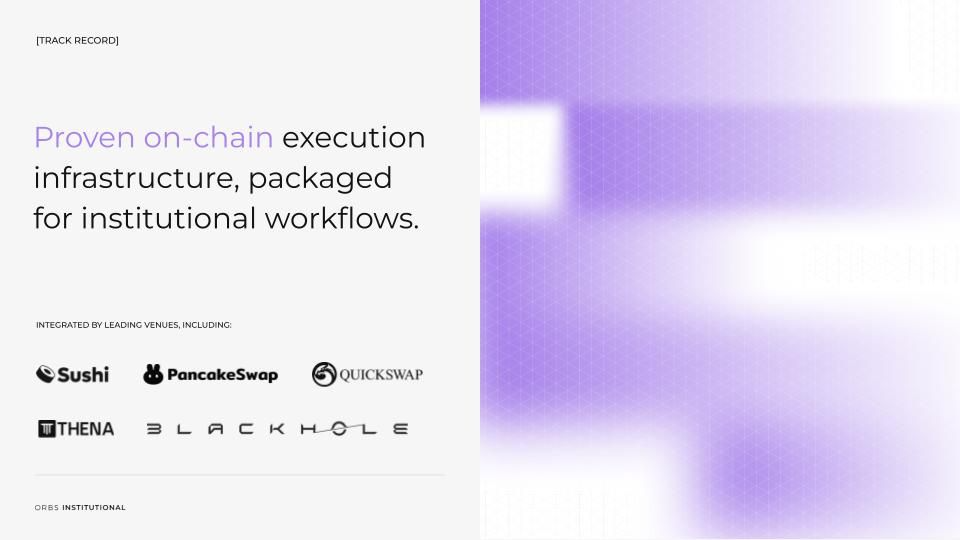
The rollout expands upon technology that, since 2023, has handled over $2.5 billion in spot trade volume across over 10 blockchain networks and over 30 decentralized exchange integrations. The infrastructure, which was previously accessible via well-known decentralized trading platforms like PancakeSwap, SushiSwap, QuickSwap, and THENA, is now being made directly available to institutional market players.

Businesses are increasingly investigating on-chain execution as a component of their trading operations as institutional acceptance of decentralized finance keeps expanding. However, while operating in decentralized markets, many institutions continue to encounter difficulties with regard to execution quality, custody requirements, and transparency.
“Institutions shouldn’t have to choose between the efficiency of decentralized markets and the standards they expect from professional trading infrastructure,” said Ran Hammer, Chief Business Officer at Orbs. “We’ve spent years building and refining execution technology that now powers some of the most active trading venues in DeFi. With Orbs Institutional, we’re making that infrastructure directly accessible to trading desks, treasuries, custodians and platforms looking to execute on-chain with greater transparency, competitive pricing and full control over their assets.”

Liquidity Hub, Orbs’ liquidity aggregation protocol, which sources liquidity from professional market makers and decentralized exchanges via a private RFQ layer intended to enhance execution quality while lowering exposure to MEV and front-running, is at the core of the offering. Additionally, Orbs’ execution tools, like as dTWAP, dLIMIT, and dSLTP, are made available to institutions.

Orders may be signed using current custody, treasury, or MPC infrastructure that meets the EIP-712 standard, and assets stay under client control throughout the execution lifecycle. Since 2017, the protocol has been operational in production with no known vulnerabilities thanks to audited smart contracts that don’t need admin keys.

There are two main integration routes that Orbs Institutional offers. While wallets, custodians, exchanges, MPC providers, and prime brokers may include Orbs’ execution capabilities into their current products via white-label or co-branded installations, institutional customers can connect directly using APIs to access the execution stack.

Orbs anticipates a rise in demand for transparent, self-custodied, and automated execution infrastructure as institutional involvement in digital asset markets continues to grow. According to the business, professional market players looking for direct access to on-chain liquidity and execution tools will spearhead the next stage of DeFi adoption.

A decentralized Layer 3 blockchain Orbs, was created for advanced on-chain trading. Orbs functions as an additional execution layer using a Proof-of-Stake consensus, allowing sophisticated logic and scripts that are not possible with traditional smart contracts. CeFi-level execution is brought to decentralized markets with Orbs-powered protocols such as dLIMIT, dTWAP, Liquidity Hub, and Perpetual Hub. Orbs continues to develop at the cutting edge of blockchain infrastructure with a worldwide staff spread across many locations. Visit www.orbs.com to find out more.


TagsAltcoinBlockchain

Preguntas relacionadas

QWhat is Orbs Institutional and what does it offer to the market?

AOrbs Institutional is a new offering from Orbs that provides trading desks, OTC companies, treasuries, custodians, and financial platforms with direct access to its on-chain execution infrastructure, aiming to bridge the gap between the efficiency of decentralized markets and professional trading standards.

QWhat technology is at the core of the Orbs Institutional offering?

AAt the core of the offering is Orbs' Liquidity Hub protocol, which aggregates liquidity from professional market makers and decentralized exchanges via a private RFQ layer to enhance execution quality and reduce exposure to MEV and front-running.

QWhat execution tools are made available to institutions through Orbs Institutional?

AOrbs Institutional makes execution tools such as dTWAP, dLIMIT, and dSLTP available to institutions for sophisticated on-chain trading.

QHow does Orbs Institutional address custody concerns for institutional clients?

AThroughout the execution lifecycle, client assets remain under their control. Orders can be signed using existing custody, treasury, or MPC infrastructure that complies with the EIP-712 standard, and the system uses audited smart contracts with no admin keys.

QWhat are the two main integration paths offered by Orbs Institutional?

AOrbs Institutional offers two main integration paths: 1) Institutional clients can connect directly via APIs to access the execution stack. 2) Wallets, custodians, exchanges, MPC providers, and prime brokers can integrate Orbs' execution capabilities into their existing products through white-label or co-branded installations.

Lecturas Relacionadas

Can Japan Buy Growth with AI? Will the Bond Market Believe It?

Japan's cabinet has introduced the 2026 Basic Policy on Economic and Fiscal Management and Reform, shifting its primary fiscal target. The new framework moves away from the traditional annual primary balance goal and instead prioritizes a stable reduction of the debt-to-GDP ratio. This change is tied to a strategy of increased "responsible proactive fiscal" spending, aiming to boost long-term growth through investments in strategic sectors like AI, semiconductors, energy, and robotics. The government estimates total public and private investment in 62 key technologies could exceed 370 trillion yen by 2040. The market reaction has been mixed and cautious. While equity markets may respond to policy signals, bond markets are focused on fiscal credibility. Concerns center on whether the weakening of the clear primary balance anchor could lead to looser fiscal discipline. If investors doubt that these strategic investments will generate sufficient productivity gains, tax revenue, and nominal growth to outpace rising interest costs, they may demand higher yields on Japanese Government Bonds (JGBs). Recent volatility in the yen and JGB yields, with the 10-year yield briefly reaching 2.9%, reflects this skepticism. The success of this new framework hinges on two factors: whether Japan can achieve a nominal growth rate consistently higher than its long-term interest rates, and whether future budgets demonstrate disciplined control over bond issuance. The government's narrative is that strategic investment is essential to break Japan's cycle of low growth, aging, and labor shortages. However, the bond market will continuously assess the credibility of this plan, pricing the risk that it may represent fiscal expansion rather than a viable growth strategy.

marsbitHace 21 min(s)

Can Japan Buy Growth with AI? Will the Bond Market Believe It?

marsbitHace 21 min(s)

Misjudged A-Shares: Resilience, Expectations, and Confidence

China's A-share market recently faced selling pressure, especially in tech sectors, initially triggered by a global tech sell-off that began in South Korea. However, the article argues this is a case of "mistaken injury" and highlights the market's underlying resilience. This resilience stems from three main pillars: **1) Tech Sector Fundamentals:** Unlike Korea's market dominated by a few memory chip stocks, China's tech sector is diversified across computing, communications, electronics, and semiconductors, supported by dual narratives of global AI supply chains and domestic substitution. Core areas like optical modules and fiber optics continue to show strong earnings growth. **2) "National Team" Support:** State-backed institutions and large corporations have made significant market purchases and announced buybacks, providing liquidity and signaling confidence. This is seen as a stabilizing policy signal, often associated with market bottoms. **3) Broader Market Pillars:** Other major sectors are showing endogenous recovery momentum. Consumer stocks benefit from stabilizing CPI and signs of sector recovery (e.g., liquor price hikes). Cyclical sectors like aluminum have high earnings, potential price increases due to tight supply, and low valuations. The financial sector offers stable dividends and low valuations. The conclusion is that the sell-off was driven by external contagion, not a collapse in fundamentals. With strong policy support and recovering momentum across key sectors, the A-share market possesses the toughness to regain stability.

marsbitHace 52 min(s)

Misjudged A-Shares: Resilience, Expectations, and Confidence

marsbitHace 52 min(s)

Trading

Spot
活动图片




