Orbs Launches Institutional DeFi Trading Infrastructure

TheNewsCryptoPublicado a 2026-06-12Actualizado a 2026-06-12

Resumen

Orbs has launched "Orbs Institutional," a new infrastructure offering designed to provide institutional clients like trading desks, OTC firms, and custodians with direct access to its on-chain execution technology. This move expands the reach of its protocol, which has processed over $2.5 billion in spot volume since 2023. The core of the service is the Liquidity Hub, an aggregation protocol that sources liquidity from professional market makers and DEXes to improve execution quality and reduce MEV risks. Institutions gain access to trading tools like dTWAP and dLIMIT, while maintaining control of their assets through EIP-712 compatible custody solutions. Orbs Institutional offers integration via direct APIs for clients or white-label solutions for platforms. The company believes this direct, transparent, and self-custodied infrastructure will drive the next phase of institutional DeFi adoption as demand for sophisticated on-chain trading grows.

Today, Orbs, the decentralized Layer-3 blockchain infrastructure dedicated to sophisticated on-chain trading, unveiled Orbs Institutional, a new offering that gives trading desks, OTC companies, treasuries, custodians, and financial platforms direct access to its on-chain execution infrastructure.

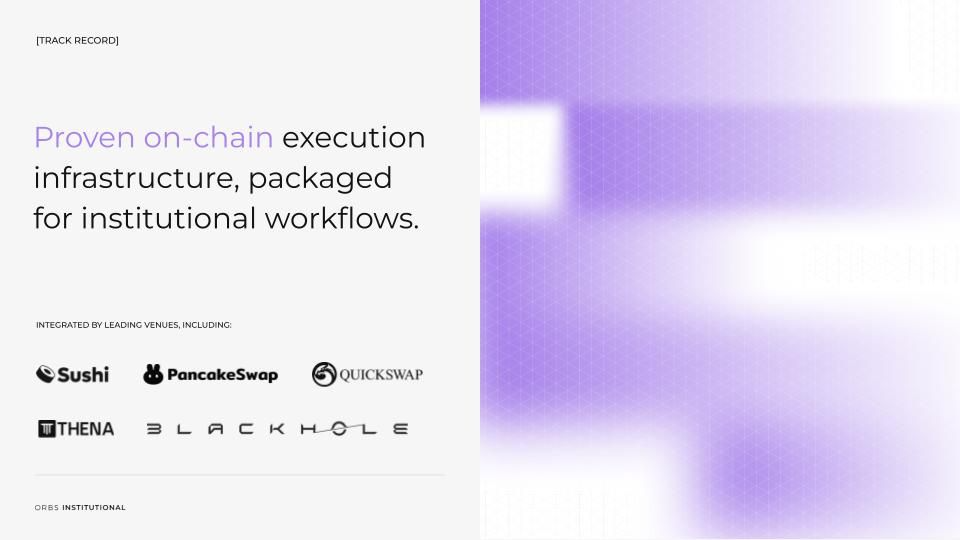
The rollout expands upon technology that, since 2023, has handled over $2.5 billion in spot trade volume across over 10 blockchain networks and over 30 decentralized exchange integrations. The infrastructure, which was previously accessible via well-known decentralized trading platforms like PancakeSwap, SushiSwap, QuickSwap, and THENA, is now being made directly available to institutional market players.

Businesses are increasingly investigating on-chain execution as a component of their trading operations as institutional acceptance of decentralized finance keeps expanding. However, while operating in decentralized markets, many institutions continue to encounter difficulties with regard to execution quality, custody requirements, and transparency.
“Institutions shouldn’t have to choose between the efficiency of decentralized markets and the standards they expect from professional trading infrastructure,” said Ran Hammer, Chief Business Officer at Orbs. “We’ve spent years building and refining execution technology that now powers some of the most active trading venues in DeFi. With Orbs Institutional, we’re making that infrastructure directly accessible to trading desks, treasuries, custodians and platforms looking to execute on-chain with greater transparency, competitive pricing and full control over their assets.”

Liquidity Hub, Orbs’ liquidity aggregation protocol, which sources liquidity from professional market makers and decentralized exchanges via a private RFQ layer intended to enhance execution quality while lowering exposure to MEV and front-running, is at the core of the offering. Additionally, Orbs’ execution tools, like as dTWAP, dLIMIT, and dSLTP, are made available to institutions.

Orders may be signed using current custody, treasury, or MPC infrastructure that meets the EIP-712 standard, and assets stay under client control throughout the execution lifecycle. Since 2017, the protocol has been operational in production with no known vulnerabilities thanks to audited smart contracts that don’t need admin keys.

There are two main integration routes that Orbs Institutional offers. While wallets, custodians, exchanges, MPC providers, and prime brokers may include Orbs’ execution capabilities into their current products via white-label or co-branded installations, institutional customers can connect directly using APIs to access the execution stack.

Orbs anticipates a rise in demand for transparent, self-custodied, and automated execution infrastructure as institutional involvement in digital asset markets continues to grow. According to the business, professional market players looking for direct access to on-chain liquidity and execution tools will spearhead the next stage of DeFi adoption.

A decentralized Layer 3 blockchain Orbs, was created for advanced on-chain trading. Orbs functions as an additional execution layer using a Proof-of-Stake consensus, allowing sophisticated logic and scripts that are not possible with traditional smart contracts. CeFi-level execution is brought to decentralized markets with Orbs-powered protocols such as dLIMIT, dTWAP, Liquidity Hub, and Perpetual Hub. Orbs continues to develop at the cutting edge of blockchain infrastructure with a worldwide staff spread across many locations. Visit www.orbs.com to find out more.


TagsAltcoinBlockchain

Preguntas relacionadas

QWhat is Orbs Institutional and what does it offer to the market?

AOrbs Institutional is a new offering from Orbs that provides trading desks, OTC companies, treasuries, custodians, and financial platforms with direct access to its on-chain execution infrastructure, aiming to bridge the gap between the efficiency of decentralized markets and professional trading standards.

QWhat technology is at the core of the Orbs Institutional offering?

AAt the core of the offering is Orbs' Liquidity Hub protocol, which aggregates liquidity from professional market makers and decentralized exchanges via a private RFQ layer to enhance execution quality and reduce exposure to MEV and front-running.

QWhat execution tools are made available to institutions through Orbs Institutional?

AOrbs Institutional makes execution tools such as dTWAP, dLIMIT, and dSLTP available to institutions for sophisticated on-chain trading.

QHow does Orbs Institutional address custody concerns for institutional clients?

AThroughout the execution lifecycle, client assets remain under their control. Orders can be signed using existing custody, treasury, or MPC infrastructure that complies with the EIP-712 standard, and the system uses audited smart contracts with no admin keys.

QWhat are the two main integration paths offered by Orbs Institutional?

AOrbs Institutional offers two main integration paths: 1) Institutional clients can connect directly via APIs to access the execution stack. 2) Wallets, custodians, exchanges, MPC providers, and prime brokers can integrate Orbs' execution capabilities into their existing products through white-label or co-branded installations.

Lecturas Relacionadas

Has Bitcoin Bottomed, or Is a 'Shakeout' Approaching? What's the Situation with XRP?

Cryptocurrency analytics platform Santiment shared key insights on Bitcoin and altcoin markets, highlighting significant signals from on-chain data. Analysis shows Bitcoin's 365-day MVRV ratio has fallen to -26%, indicating substantial losses for long-term holders, a level historically associated with market bottom formations and long-term buying opportunities. While short-term MVRV is near breakeven, suggesting no clear directional signal, the annual perspective points to a bottom before bullish cycles. On-chain data reveals divergent behavior: large wallets (10-10,000 BTC) have been accumulating, adding ~18,500 BTC in 10 days, while smaller retail investors continue buying dips. Analysts caution that high retail demand can sometimes create a risk of a final market shakeout or correction. The altcoin market shows a mixed picture. Ethereum's 365-day MVRV is around -33%, but recent monthly gains combined with overly optimistic social sentiment pose a short-term correction risk. XRP is in oversold territory with 30-day and 365-day MVRVs at -57.5% and -45.5% respectively, signaling potential for a strong mid-to-long term rebound. Social activity and optimism are rising for Solana, while investor sentiment remains calmer towards Cardano. Future direction for Bitcoin and altcoins depends not only on on-chain metrics but also on macroeconomic and regulatory developments. The Federal Reserve's interest rate decision and upcoming policy rulings are increasing market volatility expectations, while uncertainty around the U.S. Congressional clarity process continues to pressure pricing. *This is not investment advice.

cryptonews.ruHace 1 hora(s)

Has Bitcoin Bottomed, or Is a 'Shakeout' Approaching? What's the Situation with XRP?

cryptonews.ruHace 1 hora(s)

Bank of Korea Reveals Results of Tokenized Deposit Testing

The Bank of Korea has announced the results of its pilot test for tokenized deposits. Involving 28 central banks and international financial organizations, the project saw participation from major South Korean banks including KB Kookmin Bank, NH NongHyup Bank, Shinhan Bank, Woori Bank, and Hana Bank. Transactions, from payment orders to final settlement, were completed in real time, averaging just 80 seconds. The test involved 30 transactions across 17 different scenarios—such as corporate and interbank transfers—and was conducted in six currencies, including the Korean won, US dollar, and euro, with a total transaction value reaching approximately $995,000. The central bank reported that the platform operated stably throughout, despite being only partially connected to the existing banking infrastructure. Settlements using tokenized deposits were executed seamlessly, quickly, and transparently. An internal transfer of 20 million won (about $13,890) between NH NongHyup Bank and Shinhan Bank was also successfully processed via the Project Agora platform, which involved connecting to the Bank of Korea's CBDC test platform, Project Hangang. Additionally, KB Kookmin Bank and Japan's MUFG Bank tested cross-border payments using these deposit tokens—digital certificates issued by commercial banks within the pilot, not directly by the central bank. The Bank of Korea plans to continue testing payments with tokenized deposits. This follows last year's pledge by South Korean authorities to tighten regulations for won-based stablecoins, which will require approval from both the central bank and the Financial Services Commission.

cryptonews.ruHace 3 hora(s)

Bank of Korea Reveals Results of Tokenized Deposit Testing

cryptonews.ruHace 3 hora(s)

Trading

Spot
活动图片